
AI-enabled risk-based monitoring applies predictive analytics to trial data streams so sponsors can flag site and participant risks weeks before a traditional threshold trigger would catch them. The core benefit is timing: instead of reacting to a KRI that already crossed a line, teams see the pattern forming and prioritize monitoring resources accordingly. None of this replaces human review. It sharpens where humans look first.
TL;DR:
- AI-enabled risk-based monitoring detects site and participant risks weeks earlier than traditional threshold methods, enabling proactive intervention.
- It relies on multivariate, time-series models analyzing diverse trial data streams, such as EDC, labs, and wearables, for pattern recognition.
- Proper data normalization, documentation, and governance are critical to ensure FDA and ICH compliance and maintain model credibility throughout the trial.
- Successful adoption requires phased pilots with clear success metrics, dedicated roles, and a triage workflow, not just technology deployment.
- Continuous model validation, explainability, and bias management are essential to sustain accurate risk assessment over a trial’s lifecycle.
Table of Contents
- What Is AI-Enabled Risk Based Monitoring, and How Does It Differ From Traditional RBM?
- What Data Feeds an AI-Enabled RBM System?
- What Do FDA and ICH Guidance Require for AI-Driven Monitoring?
- How Should Clinical Ops Teams Govern an AI-Enabled RBM Rollout?
- How Do You Keep an AI Model Reliable Over a Trial's Lifecycle?
- What Are the Biggest Pitfalls in AI-Enabled RBM, and How Do You Fix Them?
- How Does an Operational Partner Embed AI Into RBM in Practice?
- How Do You Build a 90-Day AI-Enabled RBM Pilot?
- Are Clinical Ops Teams Ready for AI-Enabled RBM?
- Where an Operating Partnership Fits Into an AI-Enabled RBM Rollout
- Sources
- FAQ
What Is AI-Enabled Risk Based Monitoring, and How Does It Differ From Traditional RBM?
Traditional RBM runs on static thresholds. A key risk indicator crosses a preset line, a report generates, and a monitor investigates. This works, but it's inherently reactive. By the time a query rate or a screen failure rate breaches its threshold, the underlying problem, a confused site coordinator, a protocol amendment nobody fully absorbed, a lab that started running samples differently, has usually been active for weeks.
AI-enabled RBM changes the sequence. Instead of waiting for a number to cross a fixed line, models trained on historical and current trial data watch for the multivariate patterns that tend to precede a problem. A scoping review of AI applications in clinical trial risk assessment found these methods show real promise for earlier hazard detection across both safety and operational domains, though study quality varies enough that governance still matters as much as the algorithm.
The practical difference shows up in what gets surfaced and when. AI-enabled systems are built to catch things like:
- Recruitment trajectories that are quietly diverging from plan weeks before enrollment actually stalls
- Protocol deviation clusters at a specific site that share a common root cause invisible in aggregate reports
- Data integrity anomalies, timestamp irregularities, inconsistent entry patterns, that suggest a source data problem rather than a one-off error
- Participant-level anomalies across labs, eCOA responses, and visit timing that don't individually trigger a flag but collectively look unusual
The output isn't a single alarm. It's typically a site risk score that updates as new data lands, plus participant-level anomaly flags that a clinical research associate or medical monitor can triage. One deep learning approach that combines hierarchical deviation scoring with an LSTM autoencoder for holistic clinical trial monitoring is explicitly designed to work across program, study, site, and participant levels at once, rather than treating each as a separate reporting exercise.
That shift, from a single-threshold trigger to a continuously updated risk score, is the operational core of AI-enabled RBM. The rest of this article is about how to build it, govern it, and keep it defensible in front of regulators.
What Data Feeds an AI-Enabled RBM System?
Models are only as useful as the data behind them, and clinical trials generate more of it than most operations teams realize is usable. The starting inventory for most AI-enabled RBM builds includes:
- EDC data: form completion timing, query patterns, and entry sequencing, not just the field values themselves
- Lab results: both central and local lab feeds, watched for drift and out-of-range clustering by site
- eCRF timestamps: metadata often ignored in manual review but rich in signal for data integrity issues
- eCOA and ePRO streams: patient-reported data, increasingly continuous in decentralized and hybrid trial designs
- Safety databases: adverse event patterns cross-referenced against enrollment and dosing timelines
- CTMS records: site activation dates, monitoring visit history, and staff turnover indicators
- Remote sensors and wearables: increasingly common in hybrid trials, generating continuous physiological data outside visit windows
Industry analysis of hybrid trial strategy points to this last category as a major driver of AI adoption. Continuous sensor streams simply can't be reviewed the way a monthly EDC export can. There's too much of it, and it arrives too fast for manual scanning to keep pace.
On the analytic side, three approaches dominate current practice. Anomaly detection models flag data points or patterns that deviate from an expected distribution, useful for catching the odd lab result or an eCOA response that doesn't fit a participant's own history. Multivariate pattern detection looks across several variables simultaneously, which is where AI earns its keep: a single query rate or a single lab value rarely tells the whole story, but the combination often does. Time-series models, including LSTM-based autoencoders, are built specifically for longitudinal data where the sequence matters as much as the value, tracking how a site's behavior or a participant's readings evolve over the course of a study rather than judging each data point in isolation.
The more sophisticated frameworks avoid a common trap: assuming trial data behaves like a textbook statistical distribution. An assumption-agnostic framework for clinical trial monitoring is built specifically to ingest heterogeneous, non-normally distributed data, patient visits that aren't independent of each other, numeric types that mix continuous and categorical, without forcing a fixed statistical mapping onto data that doesn't fit one.
Integration is the unglamorous part nobody wants to talk about, and it's also where most pilots stall. EDC, lab, and CTMS systems rarely speak the same data language out of the box. Normalizing timestamps across systems, resolving site ID mismatches, and building a data pipeline that updates on a schedule fast enough to matter, daily at minimum, ideally near real-time for high-risk trials, is the work that determines whether the model behind it ever gets a fair test.
Pro Tip: Before you evaluate any AI vendor or build any model, run a two-week data audit across your EDC, CTMS, and lab feeds. If you can't produce a clean, timestamped, site-mapped dataset for a single study arm in that window, fix the pipeline before you touch the algorithm. A brilliant model fed inconsistent data will produce confidently wrong risk scores.
What Do FDA and ICH Guidance Require for AI-Driven Monitoring?
Regulators haven't written AI-specific rules for RBM, but the existing frameworks already set the bar, and that bar applies whether a human or a model generated the signal. The FDA's guidance on a risk-based approach to monitoring expects sponsors to document their monitoring plan and justify the rationale behind any statistical or centralized method they use. An AI model doesn't get an exemption from that documentation requirement. If anything, it raises the bar, because "the algorithm flagged it" isn't a rationale an inspector will accept without an explanation of what the algorithm is doing and why.
ICH E6(R3) reinforces this with its risk-based quality management principles, which push sponsors to align monitoring intensity with the risks that actually threaten subject protection and data integrity, not just the risks that are easiest to measure. For an AI-enabled program, that means the model's risk-scoring logic needs to map explicitly back to those two protections. If your model flags something the QMS framework doesn't recognize as material, you have a documentation gap.
Quality tolerance limits and key risk indicators are where AI changes the practical mechanics most. Under the TransCelerate framework for QTLs and risk reporting, a QTL is a threshold beyond which a deviation is considered unacceptable at the study level, and KRIs are the operational metrics that get tracked toward that threshold. A traditional KRI dashboard checks a fixed number against a fixed line once a reporting cycle. An AI-enabled KRI dashboard tracks the same metric continuously, and can predict when a site is trending toward a QTL breach before it happens.
That predictive layer needs its own documentation trail. When you set up AI-generated KRIs, document:
- Which variables feed each risk score and why they were selected
- The threshold or probability level that triggers an escalation, and how it maps to the study's QTLs
- How often the model recalculates and what data lag exists between an event and its detection
- Who reviews a flag before any action is taken
A 2024 scoping review of AI in clinical trial risk assessment found variable study quality across published AI monitoring applications, which is exactly why documentation discipline matters more here than in a conventional RBM setup. Regulators can evaluate a fixed threshold on its face. They can't evaluate a black-box model without the paper trail behind it.
How Should Clinical Ops Teams Govern an AI-Enabled RBM Rollout?
Governance is where most AI-enabled RBM efforts either earn trust or lose it fast. A model that flags a site as high risk without a clear owner, a clear review process, and a clear escalation path is just noise with better math behind it.
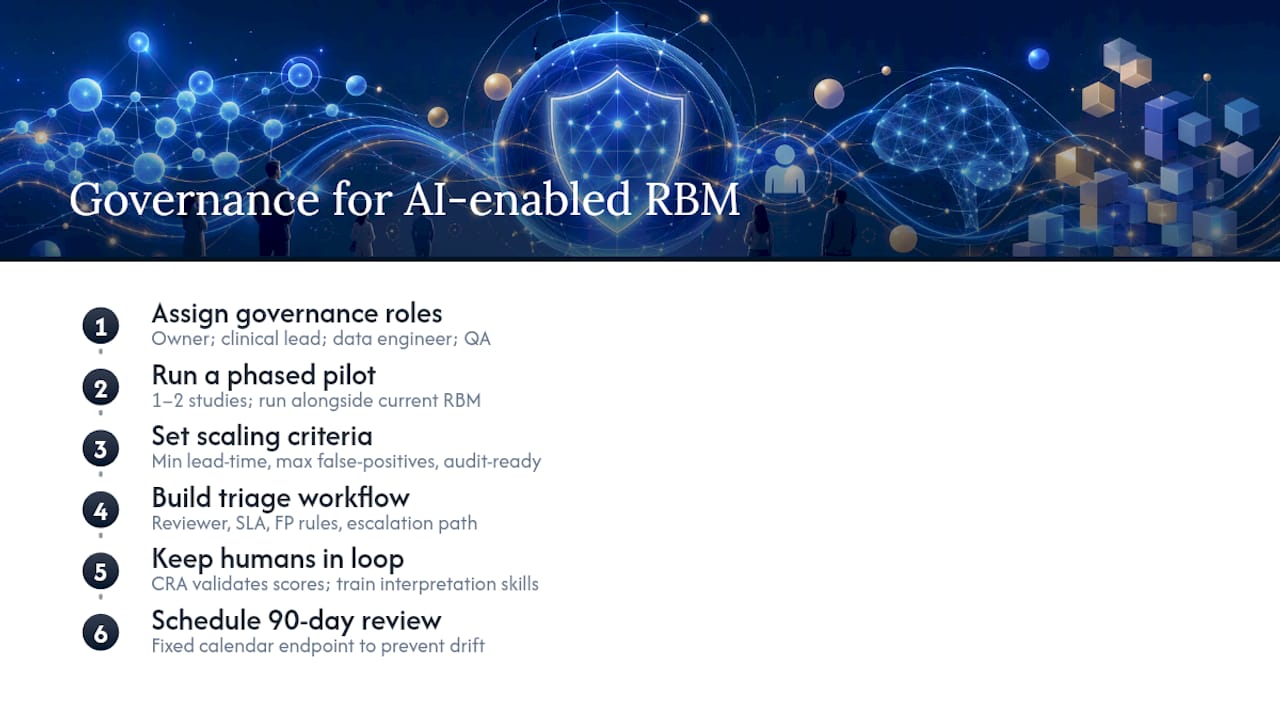
1. Assign governance roles before you assign any technology. Every AI-enabled RBM program needs a model owner accountable for performance and retraining decisions, a clinical lead who validates that flagged risks make medical and operational sense, a data engineer responsible for pipeline integrity, and a QA or regulatory reviewer who signs off on documentation. Skipping any one of these roles is how "the model said so" ends up as an unsupported inspection finding.
2. Run a phased pilot, not a full-portfolio rollout. Pick one or two studies, ideally ones already generating clean EDC and lab data, and run the AI system alongside your existing RBM process rather than replacing it outright. Define success metrics up front: time to detection compared with your current process, reduction in unnecessary manual queries, and false positive rate against a clinical lead's independent review. Phased pilots with clearly defined success metrics reduce adoption risk and make the eventual regulatory documentation far easier to assemble, because you're reporting on a defined test rather than reconstructing history after the fact.
3. Set explicit criteria for scaling beyond the pilot. Before you expand to more studies, agree on the thresholds that justify it: a minimum detection lead time improvement, an acceptable false positive rate, and a governance process that's held up under at least one internal audit.
4. Build the triage workflow before the first flag arrives. This is the step teams underestimate most. Every AI-generated flag needs a predefined path: who reviews it first, how quickly, what counts as a false positive versus a genuine signal, and at what point a clinical research associate escalates to a medical monitor. Without this, flags pile up unreviewed, or worse, get reviewed inconsistently by whoever happens to be free that day.
5. Keep a human in the loop at every decision point that affects a participant or a regulatory submission. AI-augmented RBM shifts the CRA's role toward interpretation and validation rather than pure data-scanning. Teams that succeed treat this as a skill-building exercise, not a headcount reduction, training monitors to read a risk score the way they'd read a lab trend rather than treating it as a verdict.
Pro Tip: Give your pilot a hard 90-day review date on the calendar before it starts, not "whenever it feels ready." Pilots without a scheduled endpoint tend to drift into permanent limbo, running forever without ever generating the comparison data you need to decide whether to scale.
The governance model matters more than the model architecture in year one. A mediocre algorithm with disciplined human review will outperform a brilliant algorithm nobody trusts enough to act on.
How Do You Keep an AI Model Reliable Over a Trial's Lifecycle?
A model validated at study start doesn't stay accurate by default, and understanding issues like model accuracy, drift, and governance is critical as discussed in general-purpose large language models outperform specialized clinical AI content. Trial data shifts, protocol amendments change what "normal" looks like, new sites onboard with different baseline behaviors, and a model trained on early data can quietly drift out of alignment with what's actually happening six months later.

Validation starts before deployment, with backtesting against historical trial data where you already know the outcome, simulation runs against synthetic scenarios that stress-test edge cases, and a holdout dataset the model never saw during training. This is standard machine learning discipline, but in a regulated trial context, the results of each step need to be documented as part of your model's validation file, not just run and discarded.
Once live, ongoing monitoring needs its own metrics:
- Prediction accuracy against confirmed outcomes, reviewed on a fixed cadence
- False positive and false negative rates, tracked by site and by risk category
- Automated drift detection that flags when the model's input data distribution shifts meaningfully from its training baseline
- A defined trigger point for retraining or recalibration, not an ad hoc "it seems off" judgment call
Explainability is the piece that separates a defensible AI-enabled RBM program from a risky one. Every flag a model generates should come with a decision log: which variables drove the score, what threshold was crossed, and what data window the model was looking at. Inspectors don't need to understand the math behind an LSTM autoencoder, but they do need to see that your team can explain what triggered a specific action, on a specific site, on a specific date. Frameworks like the assumption-agnostic deep learning approach are built with this kind of layered, traceable scoring in mind, which makes audit reconstruction considerably less painful than it is with an opaque model.
What Are the Biggest Pitfalls in AI-Enabled RBM, and How Do You Fix Them?
The failure modes here are predictable, and most of them trace back to rushing the data or the humans rather than the algorithm.
Data quality and mapping gaps top the list. If your EDC, lab, and CTMS systems use inconsistent site identifiers or timestamp formats, the model inherits that mess and produces confidently wrong scores.
Alert fatigue kills adoption faster than almost anything else. A model that flags too aggressively trains your team to ignore it within weeks. Fixes that actually work:
- Tune thresholds against real false positive rates from your pilot data, not vendor defaults
- Use ensemble signals, requiring two or more independent indicators to align, before escalating to a human reviewer
- Route flags through a tiered triage process so low-confidence signals go to a CRA queue and high-confidence, high-severity signals go straight to a medical monitor
Over-reliance on the model is the quieter risk. Teams that stop independently sanity-checking AI outputs eventually miss something the model wasn't trained to catch, a genuinely novel failure mode has no historical pattern for the model to learn from.
Bias and privacy deserve equal weight. Models trained predominantly on data from a handful of high-enrolling sites can misjudge risk at smaller or more diverse sites with different baseline behavior. Document your training data's site and population composition, and build in a periodic bias review, not just a performance review, as part of the same recalibration cycle. On privacy, any model touching participant-level eCOA or sensor data needs its data handling reviewed against your existing consent and privacy framework before go-live, not after.
Pro Tip: Track your false positive rate by site, not just in aggregate. A model that performs well overall can still be systematically wrong at your smallest or newest sites, exactly where a human monitor's local knowledge would have caught the error faster than the algorithm did.
How Does an Operational Partner Embed AI Into RBM in Practice?
Most AI-enabled RBM efforts fail for the same reason most enterprise software rollouts fail: the technology gets deployed, and then nobody owns making it actually work inside the team's daily rhythm. An effective approach starts with an AI Velocity Diagnostic that maps where a sponsor's monitoring bottlenecks actually sit before recommending any technology at all.
That diagnostic matters because a generic RBM dashboard rarely fits a specific trial's data architecture, site mix, or existing CTMS setup. The model is to engineer the AI layer around what an operations team already does, then embed governance and adoption support directly into that workflow rather than handing over a tool and walking away.
Some sponsors working with an embedded operational partner report reclaiming a significant amount of operational time on the path to approval, time that compounds directly into valuation and funding runway. That's a client-reported outcome, not a universal guarantee, but it reflects what's possible when AI integration is paired with hands-on governance rather than left to a self-service platform.
The proof points behind this approach include:
- Tailored AI engineering built around a client's specific regulatory and scientific context, not a one-size-fits-all model
- Governance embedded directly into live operations rather than bolted on as a separate compliance layer
- Continuous adoption support so the model's outputs get used correctly by clinical and regulatory staff, not just installed and ignored
The pattern that shows up across AI-enabled RBM efforts, whether embedded with a partner or built internally, is that the technology is rarely the limiting factor. The operational discipline around it is.
How Do You Build a 90-Day AI-Enabled RBM Pilot?
Scoping a pilot properly up front is what determines whether you get a clean answer at day 90 or a muddled one that leaves the go/no-go decision as unresolved as it was on day one.
- Define your pilot's objective and success metrics before selecting any study. Pick concrete, measurable targets: reduction in time to detection compared with your current KRI process, and a target reduction in manual query volume.
- Choose one or two studies with clean, accessible data. Prioritize trials already running strong EDC and lab data hygiene over your highest-priority program, unless that program happens to also have the cleanest data.
- Assemble the minimum viable dataset and assign roles. You need at minimum EDC, lab, and CTMS feeds normalized into a single pipeline, plus a named model owner, clinical lead, and data engineer before day one.
- Days 1 through 30: build and validate the pipeline. Confirm data completeness, resolve mapping issues, and run the model against historical data to confirm baseline accuracy before it touches live monitoring decisions.
- Days 31 through 60: run parallel monitoring. Let the AI system generate flags alongside your existing RBM process without acting on AI flags alone, then compare detection timing and accuracy between the two.
- Days 61 through 90: evaluate against your predefined exit criteria. Review false positive rates, detection lead time, and CRA feedback on flag usefulness, then make the scale, adjust, or stop decision based on those numbers, not on general enthusiasm.
A pilot without a predefined exit criterion almost always drifts into indefinite limbo. Phased pilots with defined success metrics make the scale decision straightforward, because the comparison data already exists, rather than requiring a retroactive assessment of whether it "felt like it helped."
Are Clinical Ops Teams Ready for AI-Enabled RBM?
The teams that get the most out of AI-enabled RBM treat it as a capability-building exercise, not a software purchase. Buying a model and expecting a CRA team to trust its output overnight rarely works. The teams that succeed invest in training monitors to interpret a risk score the way they'd read a trend line, which takes weeks of parallel-running before anyone actually leans on it.
Measure operational impact and regulatory readiness on the same timeline, not sequentially. A team that hits its detection-speed targets but hasn't built the documentation trail an inspector expects hasn't actually succeeded. It's just deferred the harder problem.
The biggest mistake I see in how sponsors talk about this technology is treating it as a binary switch, either you have AI-enabled RBM or you don't. The better framing is incremental: a small pilot tied to one or two concrete monitoring objectives beats a portfolio-wide rollout every time, because it gives you real comparison data instead of a hunch.
— John
Where an Operating Partnership Fits Into an AI-Enabled RBM Rollout
Sponsors evaluating AI-enabled RBM usually land on one of two paths: buy a monitoring platform and staff up internally to manage it, or bring in a team that builds the governance and the technology together. Haiphai is built for the second path. Instead of handing over a dashboard, its operating partnership starts with the AI Velocity Diagnostic, mapping exactly where recruitment, data integrity, or protocol deviation risks are slowing a specific trial down, and engineers the AI layer around that diagnosis rather than a generic template.
That diagnostic feeds directly into a phased engagement: diagnose the bottleneck, pilot a tailored AI-enabled monitoring workflow against real study data, then scale it under embedded governance once the pilot proves out. Clients working this way sometimes report reclaiming meaningful operational time on their path to approval, time that translates directly into runway and valuation. The solutions page outlines how this extends across clinical, regulatory, and executive operations beyond RBM alone, and the trust page details the governance model behind it.
If your team is weighing whether to build this capability internally or bring in an operating partner, the decision framework on fractional AI partnerships is a useful starting point. When you're ready to scope a pilot, request a diagnostic conversation through the services page and start with a clear picture of where your monitoring bottlenecks actually sit.
Sources
For deeper reading beyond this guide, start with the regulatory foundations and the technical frameworks referenced throughout this article:
- Assumption-Agnostic Deep Learning Framework for Holistic Clinical Trial Monitoring | Therapeutic Innovation & Regulatory Science
- A scoping review of artificial intelligence applications in clinical trial risk assessment
- Oversight of clinical investigations—a risk-based approach to monitoring | FDA
- ICH E6(R3) guideline for good clinical practice
This article is general information, not a substitute for advice from a qualified doctor. Consult a qualified healthcare professional about your own circumstances before acting on anything here.
FAQ
What Is Risk-Based Monitoring?
Risk-based monitoring is an approach to overseeing clinical trials that focuses monitoring resources on the sites, participants, and data points that carry the highest risk to safety and data integrity, rather than reviewing every record with equal intensity. The FDA's guidance on risk-based monitoring formalized this shift away from exhaustive source data verification toward a documented, risk-prioritized plan.
Which AI Tool Is Best for Risk Assessment in Clinical Trials?
There's no single best tool. The strongest results come from matching the analytic approach, anomaly detection, multivariate pattern detection, or time-series models like LSTM autoencoders, to your specific data types and trial design, as outlined in the assumption-agnostic monitoring framework. For sponsors who want the technology engineered around their own workflow rather than a generic platform, an embedded operating partnership like Haiphai's AI Velocity Diagnostic is built specifically to fit that gap.
What Is the 30% Rule in AI?
The "30% rule" doesn't have an established definition in clinical trial monitoring or AI risk management, and it isn't a standard referenced in FDA or ICH guidance. If you encountered this term elsewhere, it likely refers to a context outside clinical RBM and shouldn't be treated as a regulatory benchmark for AI-enabled monitoring.
Can AI Do Risk Assessments in Clinical Trials?
Yes. AI models can analyze EDC, lab, eCOA, and safety data to generate site risk scores and participant-level anomaly flags well before a traditional threshold-based KRI would trigger. A scoping review of AI applications in clinical trial risk assessment confirms this promise while noting that governance and human review remain essential to validate what the model flags.
How Is AI-Enabled RBM Different From Predictive Analytics in General Monitoring?
AI-enabled RBM applies predictive analytics specifically to trial operational and safety data, EDC, labs, eCOA, CTMS, to forecast where risks like recruitment delays or data integrity issues will emerge next. Traditional predictive analytics in monitoring often stops at trend reporting, while AI-enabled RBM ties those predictions directly to prioritized monitoring actions and documented QTL and KRI logic.