
Operational transparency is a primary determinant of investor trust, valuation, and speed-to-close in biotech. Not a nice-to-have, not a compliance checkbox — a direct input into how investors price risk and decide whether to move forward at all.
Three things every investor and CEO should keep in mind:
- Risk visibility: Investors can't price what they can't see. Clean, organized operational data converts uncertainty into a manageable risk profile.
- Deal cadence: Organized documentation shortens diligence windows. Disorganized files extend them, often fatally.
- Valuation impact: Operational opacity adds a risk premium to your discount rate. Transparency removes it.
The regulatory environment made this concrete. The FDA's publication of Complete Response Letters turned manufacturing and regulatory failures into searchable public records. Investors now cross-reference what a company tells them against what the FDA has already documented. This shift, combined with the growing use of Freedom of Information Act requests by institutional investors, means operational claims are verifiable in ways they simply weren't five years ago.
Key Takeaways
Operational transparency is a direct driver of investor trust, valuation, and deal speed in biotech — and the FDA's CRL publication policy made it verifiable.
| Point | Details |
|---|---|
| Transparency drives valuation | Clean operational signals reduce investor risk premiums and remove conditional milestones from term sheets. |
| FDA CRLs changed the game | More than 200 CRLs from 2020–2024 are now searchable in openFDA, making manufacturing failures a public diligence input. |
| FOIA is a standard investor tool | Institutional investors file targeted FOIA requests to verify manufacturing, safety, and clinical claims independently. |
| Rolling diligence shortens cycles | Version-controlled VDRs enable continuous investor access, compressing time from first meeting to term sheet. |
| Haiphai builds diligence readiness | Haiphai's embedded operational partnership closes document, regulatory, and governance gaps before investors find them. |
Table of Contents
- Why operational transparency matters to biotech investors: the components they actually evaluate
- How transparency changes investor behavior, valuation, and deal cadence
- The investor diligence checklist: what they ask for and why
- How FDA CRLs and FOIA requests changed what investors can verify
- How biotech teams can get diligence-ready without sacrificing IP
- Common operational red flags that make investors pause or walk
- What operational infrastructure actually does for your negotiating position
- Haiphai accelerates diligence readiness for biotech teams
- Sources
- FAQ
Why operational transparency matters to biotech investors: the components they actually evaluate
"Operational transparency" is a broad phrase. What investors actually evaluate during diligence breaks into six concrete categories.
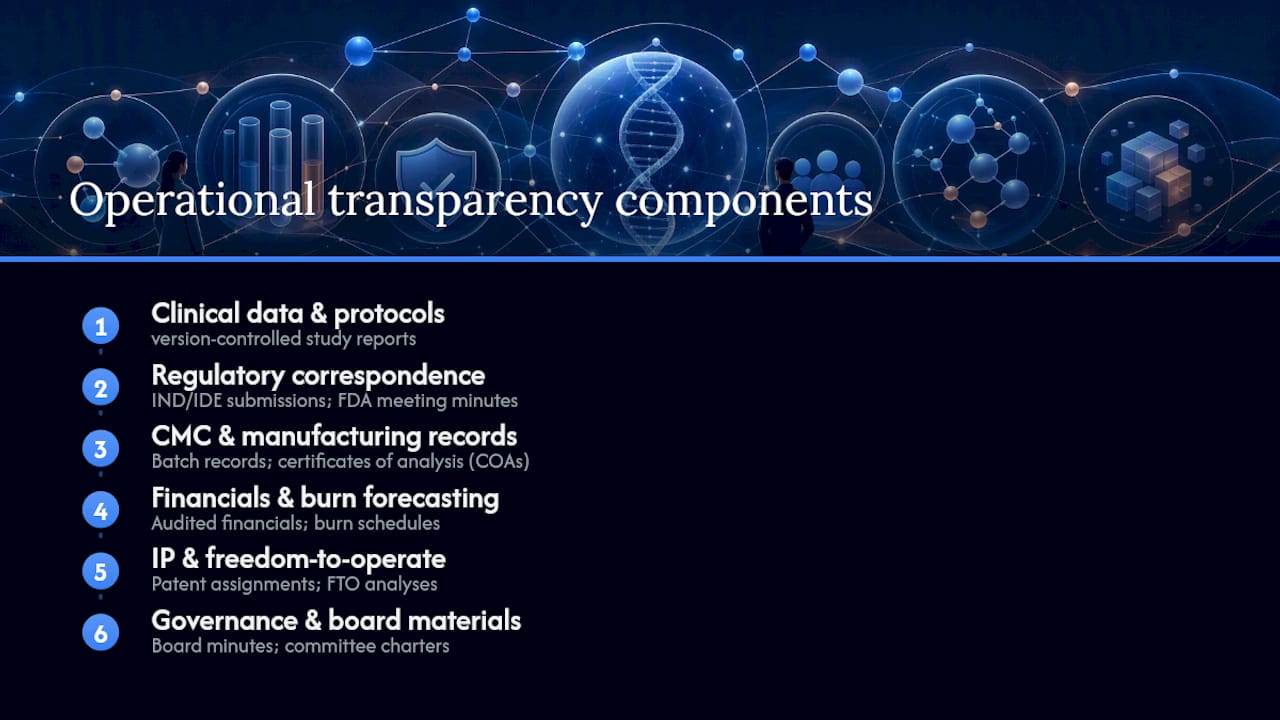
Clinical data and protocols. Investors want version-controlled study reports, not just top-line summaries. They look for protocol amendments, statistical analysis plans, and evidence that data is reproducible. A clean audit trail here signals scientific discipline.
Regulatory correspondence. This includes IND/IDE submissions, FDA meeting minutes, and Complete Response Letters. Investors read these documents to understand the company's relationship with the agency — not just the outcomes, but the quality of the dialogue. Evasive or incomplete responses to agency questions are a warning sign.
CMC and manufacturing records. Chemistry, manufacturing, and controls documentation has become a top-tier diligence item since the FDA began publishing CRLs. Batch records, CDMO qualifications, and certificates of analysis (COAs) tell investors whether the manufacturing process is under control. Partners like Au Peptide Labs publish COA documentation as a standard practice, illustrating the level of analytical transparency investors now expect from manufacturing partners.
Financials and burn forecasting. Audited financials, burn schedules, and forward-looking budget models. Investors want to see whether the team understands its own cash position and whether the numbers are internally consistent across documents.
IP and freedom-to-operate. Patent assignments, FTO analyses, and licensing agreements. Gaps here create deal-stopping uncertainty about whether the company actually owns what it claims to own.
Governance and board materials. Board minutes, committee charters, and conflict-of-interest disclosures. Governance quality signals whether the company is run by people who understand accountability.
On confidentiality: reasonable CBI claims are expected and respected. Investors understand that proprietary formulations and trade secrets warrant protection. What they won't accept is blanket secrecy over safety-related data or manufacturing processes. As PLOS Biology research documents, extensive confidentiality claims limit independent validation and ultimately undermine trust. Disciplined, targeted redaction with clear rationale is the standard investors expect.
How transparency changes investor behavior, valuation, and deal cadence
Investors convert transparency signals into financial decisions through three mechanisms: reducing information asymmetry, converting qualitative claims into auditable evidence, and enabling rolling diligence.
Information asymmetry is the core problem in biotech investing. A company knows its own data; an investor does not. Every document a company withholds or disorganizes forces the investor to apply a larger uncertainty discount. Clean, accessible data narrows that gap and lets the investor price the actual science rather than the operational risk around it.
The second mechanism is auditability. Saying "our manufacturing process is robust" is a claim. Providing batch records, deviation logs, and CDMO qualification reports is evidence. Qubit Capital's analysis of investor trust in biotech frames transparency as a form of currency: consistent, audit-ready updates become remembered data points that directly influence pricing and negotiation leverage. Investors who have seen the evidence don't need to discount for the unknown.
Rolling diligence is the third mechanism, and it's where deal cadence lives. When a company maintains a continuously updated virtual data room, investors can begin diligence before a formal process opens. That compresses the timeline between first meeting and term sheet. ShareVault's practitioner analysis documents this directly: organized, version-controlled data environments accelerate fundraising cycles and reduce conditionality in deals.
The valuation effects are concrete. When operational signals are clean, investors apply lower discount rates to projected cash flows, assign fewer conditional milestones, and write tighter covenants. When signals are messy, the opposite happens: higher risk premiums, more escrow conditions, and smaller pre-money valuations. The macro context amplifies this. Biotech funding has grown more selective through 2024–2025, with capital flows increasingly prioritizing risk reduction over speculative upside. In that environment, operational transparency is a competitive differentiator, not a baseline expectation.
The investor diligence checklist: what they ask for and why
The following items represent what investors commonly request, ordered by priority. Missing a high-priority item doesn't just slow diligence — it raises questions about what else might be missing.
- Version-controlled full study reports (High) — Investors want complete reports with amendment histories, not summaries. Missing version control suggests the company can't demonstrate data integrity.
- IND/IDE/CTA correspondence (High) — The full regulatory file, including agency questions and company responses. Gaps here are a direct red flag about the company's regulatory relationship.
- Complete Response Letters and redacted meeting minutes (High) — If a CRL exists, investors will find it. Having it organized with context is far better than letting them find it through FOIA.
- Manufacturing batch records and CDMO qualifications (High) — Lot-level records, deviation reports, and third-party audits. Investors now treat CMC as a primary diligence category.
- Audited financials and burn schedules (High) — Three years of audited statements plus a rolling 18-month burn model. Inconsistencies between financial documents and investor presentations are an immediate trust problem.
- IP assignments and FTO analyses (Medium) — Chain-of-title documentation and freedom-to-operate opinions. Investors will probe for gaps between what the company claims to own and what the patent record shows.
- Governance documents and board materials (Medium) — Board minutes, committee charters, and equity cap tables. Governance gaps signal execution risk.
On format: version control is non-negotiable. File naming conventions, metadata, and access logs matter because they tell investors whether the company treats its own data as an asset. Investors will probe for inconsistencies between documents — a protocol version in a regulatory filing that doesn't match the version in the clinical file is a common trigger for deeper scrutiny. A biotech due diligence checklist can help executives map these requirements against their current document state before a formal process begins.
How FDA CRLs and FOIA requests changed what investors can verify
The regulatory shift that made operational transparency verifiable happened in two steps: the FDA's CRL publication policy and the institutionalization of FOIA requests as a diligence tool.
The FDA began publishing Complete Response Letters, consolidating more than 200 CRLs associated with 2020–2024 applications into an openFDA dataset. The effect was immediate. Pharmasalmanac's analysis documents how this made manufacturing and regulatory failures visible and searchable, elevating manufacturability into a core diligence item. Investors can now identify recurring failure modes across companies and CDMOs — something that was impossible when CRLs were confidential.
The second step was investor reaction. BioSpace reporting confirms that the CRL transparency policy prompted companies to provide more detail in their own disclosures and was received positively by the investment community because it constrained the ability of sponsors to tell a story that diverged from the agency's documented position. The era when a company could fully control its rejection narrative is over.
FOIA requests extended this further. Institutional investors and financial firms now file targeted FOIA requests to obtain inspection reports, lot holds, and adverse-event narratives that don't appear in public disclosures. Law Street Media's analysis documents case examples of multiple filings targeting specific manufacturers or safety events — a practice that has become standard among sophisticated investors who need to verify operational claims independently.
Pro Tip: Before entering a formal diligence process, run your own FOIA search on your CDMO and any key manufacturing partners. Investors will. Knowing what they'll find — and having a prepared response — is a material advantage.
The policy environment adds another layer. An Incubate investor survey found that regulatory and policy stability are among the top factors influencing where VCs allocate capital in biotech. Companies that demonstrate operational alignment with regulatory expectations — not just scientific merit — are better positioned to attract capital in a selective environment.
How biotech teams can get diligence-ready without sacrificing IP
Getting diligence-ready is an operational project, not a document-gathering exercise. It requires clear ownership, the right systems, and a disciplined approach to what gets disclosed and when.
Assign ownership before the process starts
Every document category needs a named owner. Clinical operations owns the study files. Regulatory affairs owns the agency correspondence. Finance owns the audited statements and burn models. Without named owners, documents get assembled inconsistently and version control breaks down under pressure.
Build and maintain a virtual data room
A virtual data room (VDR) is the standard infrastructure for diligence. The key is maintaining it continuously, not assembling it reactively. A VDR that's been updated quarterly is a trust signal. One assembled in three weeks before a term sheet is a liability. Role-based access controls let you share different document sets with different investor tiers without exposing everything at once.

Implement version control and audit trails
Every document should carry a version number, a date, and a record of who approved it. Access logs matter too — investors sometimes ask to see who has accessed which documents and when, particularly for safety-related files. This is where document management systems earn their keep.
Use staged disclosure and tiered access
Not everything needs to be shared at first contact. A staged disclosure model — summary data at first meeting, full clinical files after NDA, manufacturing records after term sheet — protects IP while demonstrating that the data exists and is organized. Time-limited redactions on specific CBI elements, with clear rationale, are accepted practice.
Pro Tip: For highly sensitive proprietary data, consider providing a synthetic or anonymized dataset that demonstrates analytical rigor without exposing the underlying IP. Investors evaluating data quality don't always need the raw proprietary inputs — they need evidence that the methodology is sound.
The PLOS Biology research on CBI claims is instructive here: blanket confidentiality claims reduce independent validation and erode trust. Targeted redaction with documented rationale is the approach that preserves both IP and investor confidence. The BIO framework for structured transparency reinforces this: transparency that includes governance, verification methods, and process milestones is more credible than unfocused disclosure.
Common operational red flags that make investors pause or walk
Investors have seen enough diligence processes to recognize the patterns that signal deeper problems. These are the ones that most reliably kill deals or trigger valuation haircuts.
-
Disorganized clinical files. Multiple versions of the same protocol with no clear amendment history, or study reports that don't match the regulatory submission. Investor reaction: extended diligence, request for independent audit, possible walk. Remediation: implement version control immediately and reconcile all document versions before the next investor meeting.
-
Inconsistent results across documents. Efficacy numbers in an investor deck that don't match the full study report. This is the single fastest way to destroy credibility. Investors assume the discrepancy is intentional. Remediation: audit every investor-facing document against source data before distribution.
-
Unclear IP chain. Missing assignment agreements, inventor disputes, or licensing terms that weren't disclosed. Investors will find these through patent searches. Remediation: commission a chain-of-title review and have it ready.
-
Missing or incomplete manufacturing controls. No batch records, unqualified CDMOs, or deviation logs that show recurring failures without corrective action. Given the FDA's CRL publication policy, manufacturing gaps are now cross-referenceable. Remediation: request a full quality package from your CDMO and review it before investors do.
-
Slow or evasive responses to regulatory questions. A pattern of delayed or incomplete responses in the regulatory file signals poor agency management. Investors read this as a predictor of future approval risk. Remediation: document your regulatory strategy and response timelines proactively.
-
Messy financials. Burn models that don't reconcile with audited statements, or cap tables with unexplained dilution events. Investor reaction: immediate credibility discount, sometimes including valuation haircuts or conditional milestone structures. Remediation: reconcile all financial documents and have a CFO or financial advisor review them before diligence.
Understanding why biotech startups lose investor interest often comes down to these operational failures rather than scientific shortcomings.
What operational infrastructure actually does for your negotiating position
The conventional wisdom treats transparency as a risk-mitigation exercise — something you do to avoid losing a deal. That framing undersells it.
The companies that build operational infrastructure early don't just survive diligence. They change the negotiating dynamic entirely. When an investor walks into a data room and finds version-controlled files, organized regulatory correspondence, and a clear IP chain, the conversation shifts. Instead of spending three weeks probing for problems, the investor spends that time evaluating the science. That's where you want their attention.
There's a second-order effect that rarely gets discussed. Investors talk to each other. A company that runs a clean, efficient diligence process gets a reputation for it. That reputation shortens the next fundraising cycle before it even starts — because the first call from a new investor already carries a positive prior.
The "second valley of death" in biotech — where credible science fails to secure funding because the operational infrastructure isn't there to support it — is almost always an avoidable problem. Building document hygiene, governance, and response capacity before you need it costs a fraction of what it costs to retrofit during a live fundraising process. And retrofitting under pressure, with investors watching, is exactly the scenario that produces the red flags described above.
Embedded operational partners who understand both the regulatory environment and investor expectations can compress the build time significantly. That's not a theoretical benefit — it's the difference between entering a diligence process with leverage and entering it hoping the gaps don't get noticed.
Haiphai accelerates diligence readiness for biotech teams
Biotech executives who've built clean operational infrastructure know the fundraising advantage it creates. The challenge is that most teams don't have the internal bandwidth to build it while running clinical programs simultaneously.
Haiphai works as an embedded operational partner, starting from your current state and mapping the specific bottlenecks that would slow or derail a diligence process. The work includes regulatory drafting automation, VDR configuration, clinical site activation workflows, and governance documentation — the exact categories investors probe first. Clients reclaim up to 18 months of operational time on their path to approval, which translates directly into valuation and deal speed. The approach is diagnostic first: Haiphai identifies where your operational gaps are before investors do, then builds the infrastructure to close them. If you're preparing for a Series B, a partnership discussion, or an IPO process, the time to build diligence readiness is before the term sheet arrives. See how Haiphai works with biotech teams and start with an operational diagnostic.
Sources
The following sources support the recommendations and claims in this article. Each is worth reading directly for additional depth.
- Where Capital Meets CMC: The Emerging Role of CDMOs in Investor Risk Assessment
- PLOS Biology — effects of confidentiality claims on transparency and biosafety
- From data chaos to deal-ready: how life science teams are using transparency to win capital in 2026
This article is general information, not a substitute for advice from a qualified financial advisor. Consult a qualified financial professional about your own circumstances before acting on anything here.
FAQ
What does operational transparency cover in biotech?
Operational transparency covers clinical data and protocols, regulatory correspondence (including CRLs and FDA meeting minutes), CMC and manufacturing records, audited financials, IP documentation, and governance materials. Investors evaluate all six categories during diligence.
How does transparency affect biotech valuation?
Clean operational signals reduce the risk premium investors apply to discount rates, which increases pre-money valuation and reduces the number of conditional milestones in a term sheet. Disorganized or incomplete documentation has the opposite effect.
What ensures transparency is credible to investors?
Credibility comes from verifiability: version-controlled documents, access logs, audit trails, and organized regulatory correspondence that can be cross-referenced against public records like FDA CRLs. Qubit Capital's analysis frames consistent, audit-ready updates as a form of currency in investor negotiations.
How do investors use FOIA requests in biotech diligence?
Institutional investors file targeted FOIA requests to obtain FDA inspection reports, lot holds, and adverse-event narratives that don't appear in company disclosures. Law Street Media documents multiple case examples of this practice being used to probe manufacturing and clinical safety risk.
How can biotech teams build diligence readiness without exposing IP?
Staged disclosure and tiered VDR access let companies share summary data early and full clinical or manufacturing files only after NDAs are in place. Targeted redaction with documented rationale protects legitimate CBI while giving investors verifiable evidence that the data exists and is organized.