
Platform technology in biotech is defined as a reusable foundational system that supports multiple therapeutic programs rather than a single drug candidate. For biotech investors, understanding what platform technology means separates a scalable portfolio thesis from a disguised single-asset bet. The FDA's 2024 platform technology designation program formalized this concept at the regulatory level, making it a term you will encounter in every serious biotech pitch deck. This guide covers the definition, valuation implications, regulatory context, and the due diligence criteria that separate real platform companies from those that merely claim the label.
What does platform technology mean for biotech investors?
Platform technology in biotech is a reusable technological foundation that can support multiple products or indications rather than a single asset. Think of it as an engine, not a car. The engine can power many vehicles; the car gets you to one destination. In biotech, that engine might be a lipid nanoparticle delivery system, a viral vector modality, a CRISPR-based discovery process, or an antibody engineering platform. Each of these can generate multiple drug candidates from the same core technology.
The standard industry term for this concept is "platform technology," and it carries a specific meaning that differs from general software or digital platforms. A biotech platform must demonstrate generalizability, meaning the same core process or delivery system applies across multiple biological targets or disease areas. That generalizability is what investors pay a premium for. Without it, the company is simply an asset company with a creative pitch.
Named entities matter here. Companies like Moderna built their COVID-19 vaccine on an mRNA platform that had already been applied to other programs. Alnylam Pharmaceuticals built its franchise on RNA interference technology applied across rare diseases. Both cases show the same pattern: one core engine, multiple commercial programs.

How does platform technology shift biotech investment valuation?
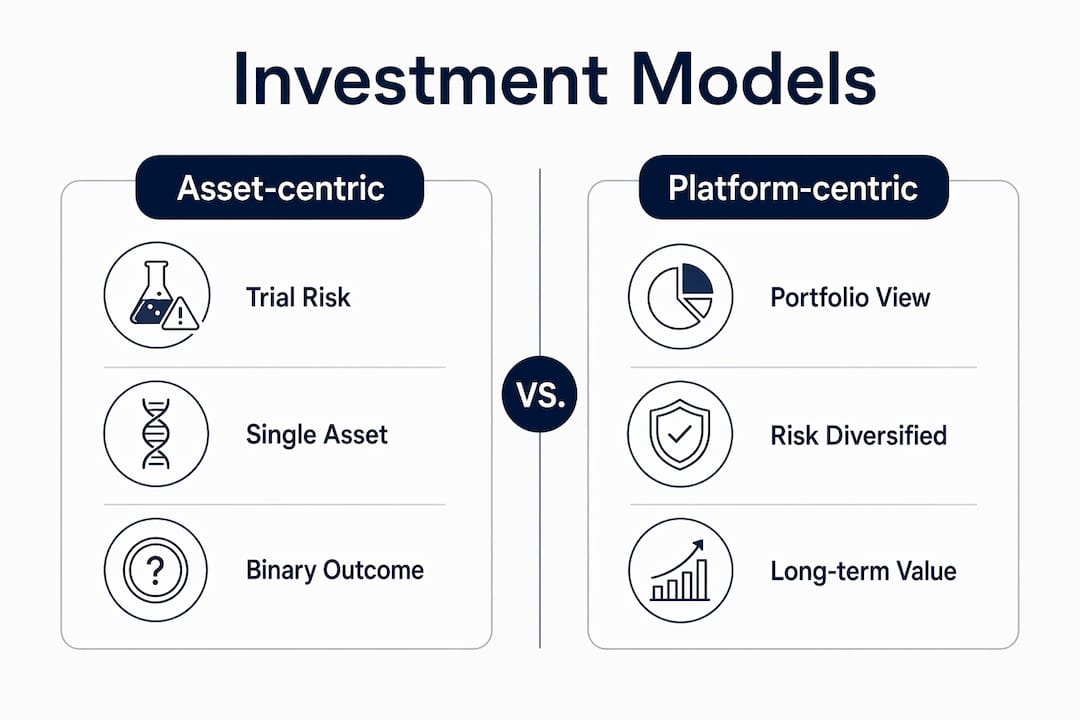
Platform biotechs shift valuation from binary trial outcomes toward portfolio and technology theses, with long-term strategic flexibility and optionality. This is the most important distinction for investors to internalize. A single-asset biotech lives and dies on one Phase 3 readout. A platform biotech distributes that risk across multiple programs, all drawing from the same validated engine.
Asset-centric vs. platform-centric investment models
The table below captures the core differences investors should track:
| Feature | Asset-centric model | Platform-centric model |
|---|---|---|
| Risk profile | Binary per trial outcome | Distributed across multiple programs |
| Valuation driver | Single candidate success | Engine reliability and pipeline depth |
| Licensing potential | Limited to one asset | Multiple programs, multiple deals |
| Capital efficiency | Rebuilds from scratch each time | Reuses core CMC and regulatory work |
| Investor time horizon | Short to medium term | Medium to long term |
Platform valuation models integrate the probability-weighted success of multiple nominated programs, discounting risk less than for single-asset investments due to diversified pipeline potential. That math changes the conversation in a term sheet negotiation. A platform company with three validated programs in the pipeline commands a different multiple than a company with one IND.
The long-term optionality benefit is real but requires discipline to value correctly. Investors who overpay for hypothetical pipeline programs that have not yet been nominated are making the same mistake as investors who overpay for a single asset. The platform thesis only holds when the engine has been proven to generate programs efficiently.
Pro Tip: When reviewing a platform biotech pitch, ask for the marginal cost of the next program. If the answer is "roughly the same as the first," the platform is not delivering capital efficiency. A real platform should show declining marginal effort with each new program.
What is the FDA platform technology designation, and why does it matter?
The FDA's Platform Technology Designation Program is designed to enhance efficiencies in drug development, manufacturing, and regulatory review for drugs using designated platform technologies. The 2024 draft guidance formalized this program, giving companies a structured pathway to apply for designation and reuse prior submissions across multiple products. For investors, this designation is a regulatory signal that the FDA recognizes the platform as a validated engine.
The practical benefits for designated companies include:
- Reuse of prior knowledge. Sponsors can reference previously submitted scientific, CMC, and nonclinical data across multiple product filings, reducing the cost and time of each new submission.
- Faster regulatory review. FDA reviewers familiar with the platform can process new applications more efficiently, compressing timelines.
- Reduced data generation burden. Shared CMC and nonclinical knowledge means companies do not recreate the wheel for every new indication.
- Early FDA engagement. The guidance encourages sponsors to engage with FDA early to align on what prior knowledge applies, reducing surprises during review.
"Regulators aim to reduce duplication by allowing reuse of platform data, accelerating development timelines — this appeals to investors focused on efficient regulatory pathways." — Harvard Petrie-Flom Center
Designation is not permanent. Sarepta's viral vector platform lost its designation after patient deaths, a direct reminder that safety consistency is a prerequisite for maintaining the designation's value. Investors who treat FDA designation as a permanent green light are misreading the risk. Pharmacovigilance and clinical safety monitoring remain critical throughout the platform's commercial life.
What are the operational advantages and challenges of platform technologies?
Platform technologies reduce the marginal development effort for each new program by sharing CMC processes, analytical assays, and regulatory packages across indications. This is the operational core of the platform thesis. When a company files its second IND using the same delivery system, it should not be starting from scratch on formulation, stability testing, or manufacturing scale-up. That shared infrastructure is what drives capital efficiency.
The key elements investors assess to confirm true platform repeatability include:
- Shared analytical methods and release assays across programs
- Common manufacturing processes and suppliers
- Reusable regulatory modules in IND and BLA filings
- Consistent nonclinical safety profiles across targets
- Documented process for nominating new programs from the platform
Investor skepticism is warranted when these elements are absent. If the platform fails to speed development or produce multiple downstream programs, the investment case resembles an asset play rather than a true platform. That is the core challenge: many companies claim platform status without the operational evidence to support it.
Biological differentiation is the second skepticism trigger. A platform that works for one target class may not generalize to others. Investors should ask whether the platform has been tested across meaningfully different biological contexts, not just variations of the same target family.
Pro Tip: Ask the company to show you a side-by-side comparison of the IND packages for their first and second programs. The degree of overlap in CMC sections is the most direct evidence of true platform reusability.
How should biotech investors evaluate platform companies in due diligence?
Investor diligence on platform biotechs centers on platform validation and lead-candidate nomination milestones, which differ from the IND-enabling toxicology and preclinical requirements typical of asset-centric companies. The data room for a platform company should look different from the data room for a single-asset company. If it does not, the platform claim is not yet substantiated.
Platforms must be backed by evidence showing manageable adjustments across multiple targets, not broad claims that one technology fits every indication. Investors who accept vague generalizability claims without supporting data are taking on unpriced risk.
A practical diligence checklist for platform companies includes:
- Platform validation data. Has the engine been applied to at least two distinct targets with published or disclosed results?
- Lead program nomination process. Is there a documented, repeatable process for selecting new programs from the platform?
- Shared IP scope. Does the core IP cover the platform engine, or only specific programs?
- CMC overlap documentation. What percentage of the CMC package is shared across programs?
- Regulatory filing history. Has the company received FDA feedback on the platform itself, separate from individual programs?
- Safety consistency record. Are adverse event profiles consistent across programs, or does each program introduce new safety signals?
- Team throughput history. Has the leadership team previously advanced multiple programs from a single platform?
Investor due diligence should weigh both the platform engine's repeatability and individual program risks, often valuing throughput history over hypothetical potential. A team that has done it before is a stronger signal than a technology that promises it can be done. The AI in regulatory affairs space is increasingly relevant here, as AI tools now help investors and companies map shared regulatory elements across filings more efficiently.
Key Takeaways
Platform technology in biotech is a reusable engine that supports multiple programs, shifting investor valuation from single-asset binary risk to portfolio-level probability-weighted returns.
| Point | Details |
|---|---|
| Core definition | Platform technology is a reusable foundational system, not a single drug candidate. |
| Valuation shift | Platform models distribute risk across programs and command portfolio-level multiples. |
| FDA designation value | The 2024 FDA program enables prior-knowledge reuse but designation can be revoked for safety failures. |
| Operational proof | True platforms show shared CMC, assays, and regulatory packages across at least two programs. |
| Diligence priority | Evaluate throughput history and documented reusability over hypothetical pipeline claims. |
The uncomfortable truth about platform valuations
Most platform claims I encounter in biotech pitch decks are premature. Companies label themselves platforms after one program because the valuation multiple is more attractive. The honest version of this conversation is harder: a platform is only a platform once it has generated a second program from the same engine with meaningfully shared infrastructure.
The FDA designation program helps here, because it forces companies to articulate exactly what is being reused and why. That discipline is good for investors. But the designation itself is not a substitute for operational evidence. Sarepta's experience is the clearest warning in recent memory. A platform designation that gets revoked after a safety event does not just affect one program. It calls the entire engine into question.
The investors I respect most in this space treat platform claims the way a structural engineer treats a bridge design: they want to see the load-bearing calculations, not just the architectural rendering. Ask for the CMC overlap data. Ask for the second program's IND timeline compared to the first. Ask what the team would do if the lead program failed. The answers tell you whether you are buying a real platform or a well-dressed single asset.
— John
How Haiphai helps biotech investors assess platform companies
Biotech investors who need to move faster on platform diligence face a real operational problem. Mapping shared CMC elements, tracking FDA designation status, and modeling probability-weighted pipeline valuations across multiple programs takes time that most investment teams do not have.
Haiphai works directly with life sciences teams to identify where operational bottlenecks slow down analysis and approval timelines. By integrating AI into regulatory drafting and clinical site activation, Haiphai clients have reclaimed up to 18 months of operational time on the path to approval. For investors evaluating platform companies, that kind of timeline compression is exactly what separates a fundable platform from one that misses its milestones. Haiphai's AI-powered solutions are built for biotech teams that need precision, not generic software. If your portfolio companies are losing time to regulatory inefficiency, that is the problem Haiphai is designed to solve.
FAQ
What is platform technology in biotech?
Platform technology in biotech is a reusable foundational system, such as a delivery modality or discovery engine, that supports multiple drug programs rather than a single candidate. The same core technology generates multiple products across different targets or indications.
How does platform technology affect biotech investment valuation?
Platform technology shifts valuation from binary single-trial outcomes to portfolio-level probability-weighted returns across multiple programs. Investors apply different multiples to platform companies because the pipeline potential is broader and the risk is distributed.
What is the FDA platform technology designation?
The FDA Platform Technology Designation Program, formalized in 2024 draft guidance, allows companies to reuse prior scientific and CMC submissions across multiple product filings. Designation can be revoked if safety issues emerge, as seen with Sarepta's viral vector platform.
What should investors look for in platform due diligence?
Investors should verify shared CMC packages, common analytical assays, reusable regulatory modules, and a documented program nomination process. Throughput history, meaning programs already advanced from the platform, is a stronger signal than hypothetical pipeline claims.
How is a platform biotech different from an asset biotech?
An asset biotech builds its investment case around one drug candidate and one trial outcome. A platform biotech builds its case around a reusable engine that can generate multiple candidates, with each new program adding to the portfolio rather than replacing the previous bet.