
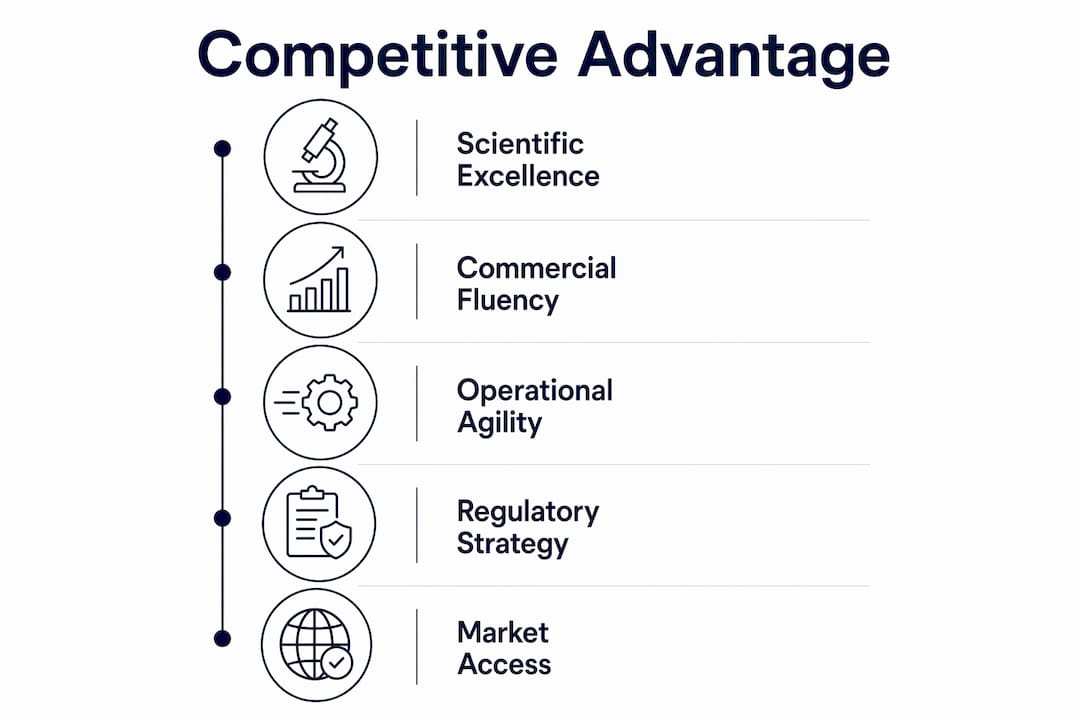
Competitive advantage in biotech is defined by the ability to integrate scientific innovation with commercial execution and organizational agility. Brilliant science alone does not secure market leadership. The FDA approval rate for VC-backed trials sits at just 14.1%, and 56% of drug launches fail to meet pre-launch expectations. Those numbers reveal a structural problem: most biotech companies lose their competitive edge not in the lab, but in the gap between discovery and the market. Understanding why biotech companies lose competitive advantage requires examining three interconnected failure modes: clinical attrition, commercial misalignment, and operational rigidity.
Why biotech companies lose competitive advantage in clinical development
The clinical trial process is where competitive advantage first comes under pressure. The FDA approval rate for biological trials runs 14.1 percentage points below small-molecule trials. Cancer-related trials carry an approval rate of just 8.7%. Those figures mean that for every ten oncology programs a biotech advances into the clinic, fewer than one reaches approval.
Phase II is the most punishing stage. 75% of clinical trial failures stem from safety or efficacy data that does not translate from preclinical models to human populations, with Phase II attrition reaching up to 66%. That attrition rate is not just a scientific problem. Each failed Phase II program erodes investor confidence, compresses the capital runway, and forces leadership into reactive deal-making from a position of weakness.

AI tools have accelerated early discovery and trial design, but they have not removed attrition. They compress timelines on the front end while the fundamental biological translation problem remains unsolved. A company that mistakes faster trial initiation for reduced clinical risk will be caught off guard when Phase II data disappoints.
| Clinical stage | Key risk | Impact on competitive position |
|---|---|---|
| Phase I | Safety signals in humans | Program termination, capital loss |
| Phase II | Efficacy and safety translation | Highest attrition, valuation damage |
| Phase III | Endpoint failure at scale | Late-stage loss, partner confidence drop |
| FDA review | Regulatory rejection | Full program write-off |
Pro Tip: Embed a go/no-go decision framework at Phase I completion. Teams that define kill criteria before data readout make faster, less emotionally compromised decisions when results disappoint.
How commercial misalignment strips away the competitive edge in biotech
Scientific differentiation is not self-evident to prescribers, payers, or patients. The science-to-story gap describes what happens when clinical differentiation gets lost inside organizational silos during commercialization. Medical affairs, marketing, and market access teams each develop their own narratives. The result is generic messaging that fails to move prescribers. 80% of healthcare providers report that pharma communications feel generic. That number explains why scientifically superior drugs routinely underperform at launch.
The commercial failures cluster around predictable mistakes:
- Treating reimbursement as a post-approval problem rather than a Phase II design constraint
- Building separate medical, marketing, and access teams with no shared narrative framework
- Defining clinical endpoints that satisfy regulators but do not satisfy payers
- Launching without a clear patient, prescriber, and payer targeting hierarchy
- Assuming scientific novelty will generate prescriber pull without active education
"Market access and payer strategy must be embedded into Phase 2 and 3 clinical trial designs. Endpoints must satisfy insurance companies, not only regulatory agencies. Biotechs that treat reimbursement as a post-approval task face structural barriers to commercial success that no amount of marketing spend can fix."
The payer problem is particularly damaging because it is invisible until approval. A drug can clear FDA review and still fail commercially if the endpoints chosen during trial design do not generate the comparative effectiveness data that formulary committees require. Payer strategy integrated into trial design is not optional. It is the difference between a drug that gets prescribed and one that sits on Tier 3 with a prior authorization requirement that kills adoption.
Pro Tip: Assign a market access lead to your Phase II steering committee. Their job is to pressure-test every endpoint choice against formulary decision criteria before the protocol is locked.
What role does operational rigidity play in eroding biotech's competitive edge?
The "biotech death trap" is a well-documented pattern: a company builds brilliant science, advances it through early development, and then fails commercially because the organization never built the commercial muscle to match its scientific ambition. Operational rigidity accelerates this failure in three specific ways.
- Inflexible indication pursuit. Teams that lock onto their original indication despite early signals suggesting a better patient population waste capital and time. The data often points toward a pivot months before leadership accepts it.
- Insufficient capital runway. Biotechs that run capital too thin lose negotiating power. Distressed partnership deals and bridge financing at punishing terms are symptoms of poor capital planning, not bad science.
- Symmetric learning models. Large pharma manages risk by running parallel programs and making conservative bets. Biotech cannot afford that model. Asymmetric learning means rapid exploration, fast failure, and reallocation of resources to programs with genuine signal. Pre-commercial biotech companies lead clinical trial starts across all phases precisely because this model works.
The asymmetric learning advantage is real, but it requires organizational culture to support it. Teams that punish early program termination will keep failing programs alive too long. Leaders who reward the decision to kill a program quickly, based on clean data, build the kind of organization that compounds learning faster than competitors.
Pro Tip: Set a formal "kill budget" for each program: a defined data threshold that triggers termination without requiring executive consensus. Speed of exit from failing programs is a competitive asset.
The capital dimension deserves more attention than it typically receives. A biotech with 18 months of runway negotiates from a fundamentally different position than one with 36 months. Investors and partners read the balance sheet before they read the science. Operational efficiency that extends runway is not a back-office concern. It directly affects the quality of deals a company can attract. Haiphai's model of working backward from strategic goals to identify operational bottlenecks addresses exactly this problem. Clients working with Haiphai have reclaimed up to 18 months of operational time on the path to approval, which translates directly into stronger negotiating positions and better funding outcomes.
How is the evolving biotech landscape changing what competitive advantage means?
The competitive dynamics in biotech have shifted structurally over the past five years. AI-driven design tools have commoditized early drug discovery. Software platforms that once differentiated a biotech are now baseline capabilities. The competitive edge has moved to deep biological expertise and the speed of experimental iteration.
Large pharma is accelerating this shift. Pharma internalizing discovery with existing datasets and AI tools reduces their reliance on biotech as the default innovation engine. That changes the negotiating dynamic for partnerships and acquisitions. A biotech whose primary value proposition is "we have an AI platform" faces a buyer who now has the same platform internally.
The implications for competitive positioning are direct:
- Timing advantages erode faster as competitors replicate discoveries with the same AI tools
- Platform narratives without unique biological data are increasingly unconvincing to acquirers
- Deep domain expertise in specific biology, not software, creates the moat that is hardest to replicate
- Speed of iteration, measured in experimental cycles per quarter, is becoming a trackable competitive metric
- Biotechs that combine AI with clinical trial enrollment efficiency gain compounding time advantages that pure platform companies cannot match
The companies that maintain competitive advantage in this environment share a common trait. They treat biological insight as the irreplaceable core and use AI to accelerate the experimental cycles around it. They do not confuse the tool with the asset.
Key Takeaways
Biotech companies lose competitive advantage when scientific excellence is not matched by commercial fluency, operational agility, and payer strategy embedded from the earliest development stages.
| Point | Details |
|---|---|
| Clinical attrition is structural | Cancer trial approval rates of 8.7% mean most programs fail; plan capital and strategy around that reality. |
| Commercial misalignment kills launches | 56% of drug launches miss expectations because scientific differentiation never reaches prescribers or payers. |
| Payer strategy belongs in Phase II | Endpoints must satisfy formulary committees, not only regulators, or reimbursement failure follows approval. |
| Asymmetric learning outperforms caution | Killing failing programs fast and reallocating resources creates compounding advantages over risk-averse models. |
| AI shifts the moat to biology | Software platforms are now baseline; deep biological expertise and iteration speed define durable advantage. |
The uncomfortable truth about biotech competitive strategy
I have watched companies with genuinely differentiated science lose to competitors with inferior molecules and superior commercial execution. The pattern is consistent enough that I no longer treat it as bad luck. It is a structural failure of how biotech organizations are built.
The most dangerous assumption in biotech is that scientific novelty generates commercial pull automatically. It does not. Prescribers are busy. Payers are adversarial. Patients rely on physician guidance. None of those stakeholders will do the work of translating your clinical data into a reason to prescribe or reimburse. Your organization has to do that work, and it has to start during trial design, not after approval.
The second failure I see repeatedly is overconfidence in timing. Being first to a target matters, but it matters less every year as AI tools compress the time competitors need to follow. A six-month head start that once represented a durable moat now represents a shrinking window. The biotechs that survive this environment are the ones building biological expertise that cannot be replicated by running the same algorithm on a different dataset.
My recommendation to biotech executives is direct: treat commercial strategy and payer integration as scientific disciplines. Apply the same rigor to endpoint selection for formulary access as you apply to mechanism of action validation. Build organizational culture that rewards fast, clean exits from failing programs. And measure your competitive position not just by pipeline depth, but by how quickly your organization learns and reallocates.
— John
How Haiphai helps biotechs protect their competitive position
Operational inefficiency is one of the most underestimated threats to competitive advantage in biotech. When regulatory drafting, clinical site activation, and cross-functional alignment consume months that should be spent advancing science, the competitive gap widens.
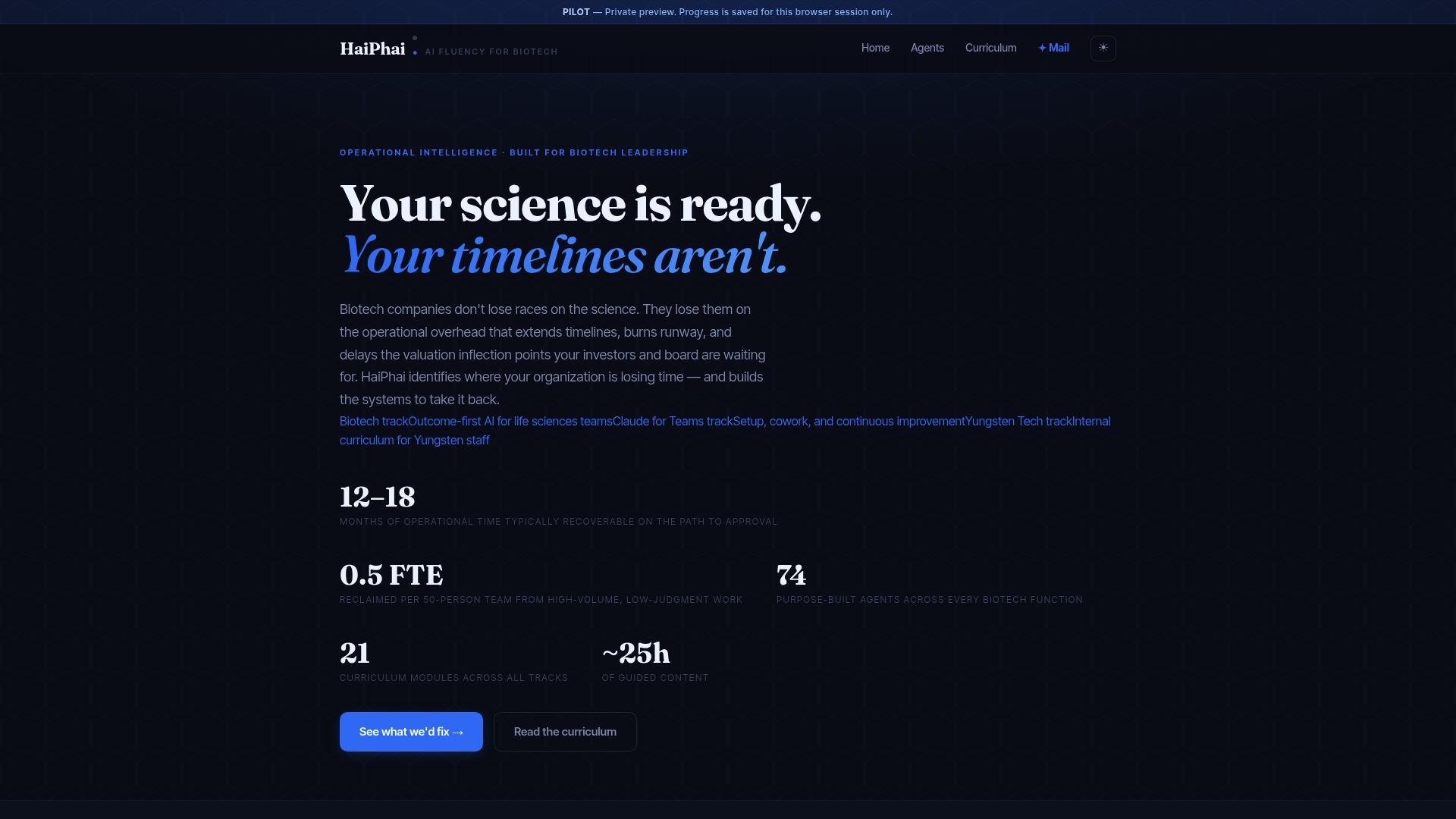
Haiphai works as an operational partner, not a software vendor. The approach starts from your strategic goals and works backward to identify where time and capital are being lost. From AI-powered regulatory workflows to integrated commercial strategy support, Haiphai's solutions for biotech teams are built around your specific program, not a generic template. Lean biotech teams use Haiphai to operate at the scale and speed of organizations three times their size, without the overhead. If your pipeline deserves a faster path to approval, Haiphai is built for that.
FAQ
Why do most biotech companies fail to maintain competitive advantage?
Most biotech companies lose their competitive edge by treating commercial strategy, payer access, and operational agility as secondary to science. Clinical excellence without commercial execution produces launch failures at a rate of 56% across drug programs.
What is the science-to-story gap in biotech?
The science-to-story gap occurs when clinical differentiation is lost inside organizational silos during commercialization, resulting in generic messaging that fails to move prescribers or payers. It is a primary driver of launch underperformance.
How does AI affect competitive advantage in biotech?
AI tools have commoditized early drug discovery, making software platforms a baseline rather than a differentiator. Competitive advantage now depends on deep biological expertise and the speed of experimental iteration, not the platform itself.
When should payer strategy enter the drug development process?
Payer strategy must be integrated during Phase II and Phase III trial design. Endpoints chosen solely to satisfy FDA requirements often fail to generate the comparative effectiveness data that formulary committees require for reimbursement decisions.
What is asymmetric learning and why does it matter for biotech?
Asymmetric learning is the practice of running rapid experiments, making fast go/no-go decisions, and reallocating capital away from failing programs quickly. It gives pre-commercial biotechs a structural speed advantage over large pharma's more conservative, parallel-program model.