
Every month a drug spends in development is a month of peak patent life burned. Boards that treat time savings as an operational metric are misreading the situation: shorter clinical, regulatory, and operational timelines are the primary lever for valuation, investor optionality, and competitive survival. The directive is simple: mandate a time-to-value audit this quarter and require every investment approval to include a time-to-market scenario.
- Months reclaimed convert directly to net present value. A therapy reaching market 12 months earlier captures a full year of peak-sales revenue that a slower competitor never recovers.
- Integrated development models modeled by Tufts CSDD can reduce timelines by up to 34 months in some scenarios, with material ROI in modeled cases.
- Haiphai clients report reclaiming up to 18 months on the path to approval through AI-enabled workflow redesign.
Pro Tip: Frame every speed initiative to the board as "market window capture," not "efficiency." The language changes the conversation from cost-cutting to competitive strategy.
Key Takeaways
Shorter clinical, regulatory, and operational timelines are the primary valuation lever for biotech boards, and AI-enabled workflow redesign is the fastest path to reclaiming those months.
| Point | Details |
|---|---|
| Time savings drive valuation | Every month reclaimed is peak patent revenue captured; model this in every investment approval. |
| Significant months recoverable | Tufts CSDD modeled notable timeline reductions from integrated development services in some scenarios. |
| Five operational levers | Protocol design, site activation, recruitment, regulatory drafting, and decision velocity are the highest-impact targets. |
| Governance must change | Appoint a senior program owner, require time-to-value scenarios, and add leading KPIs to the board pack. |
| Haiphai delivers substantial time savings | Haiphai's embedded AI partnership diagnoses bottlenecks and redesigns workflows, with clients reporting significant months reclaimed. |
Table of Contents
- Why biotech boards prioritize time savings as a strategic imperative
- Where do real time savings actually come from?
- What governance changes should boards make right now?
- Which KPIs should boards demand to track time-savings impact?
- What do the case studies actually show?
- How should boards evaluate AI-enabled operational partners?
- What does a 90/180/365-day board roadmap look like?
- The board cannot afford to wait another quarter
- Haiphai accelerates your path to approval
- Sources
- FAQ
Why biotech boards prioritize time savings as a strategic imperative
Speed is no longer an operational preference. It is the variable that determines whether your program reaches patients, investors, and the market before a faster competitor does.
Arthur D. Little's analysis argues directly that speed determines strategic positioning and recommends elevating pivotal clinical trial planning to board level while deploying predictive intelligence to catch delays before they compound. The framing matters: many biopharma companies are data-rich but insight-poor, sitting on signals they never act on early enough.
AI-native entrants are accelerating this pressure. Insilico Medicine has demonstrated AI-driven target identification and molecule design at a pace that traditional discovery timelines cannot match. When a startup can compress years of preclinical work, incumbents running conventional operations face a structural disadvantage, not just a speed gap.
Regulatory trends reinforce the urgency. Adaptive pathways, rolling submissions, and real-world evidence expectations from the FDA increasingly reward continuous, high-quality evidence generation over batch-and-submit models. Boards that govern lifecycle evidence as a continuous process gain both regulatory goodwill and faster approval timelines.
Novartis has responded by building an Intelligent Decision System that embeds simulation, optimization, and a computational twin into trial decision-making. The goal is explicit: reduce end-to-end cycle time by improving decision velocity at every stage. That is the scale of operational redesign boards must now consider normal.
Where do real time savings actually come from?
Five operational levers account for the majority of recoverable time in a clinical program. Each has a clear owner, a common delay source, and a measurable range of months that can be reclaimed.
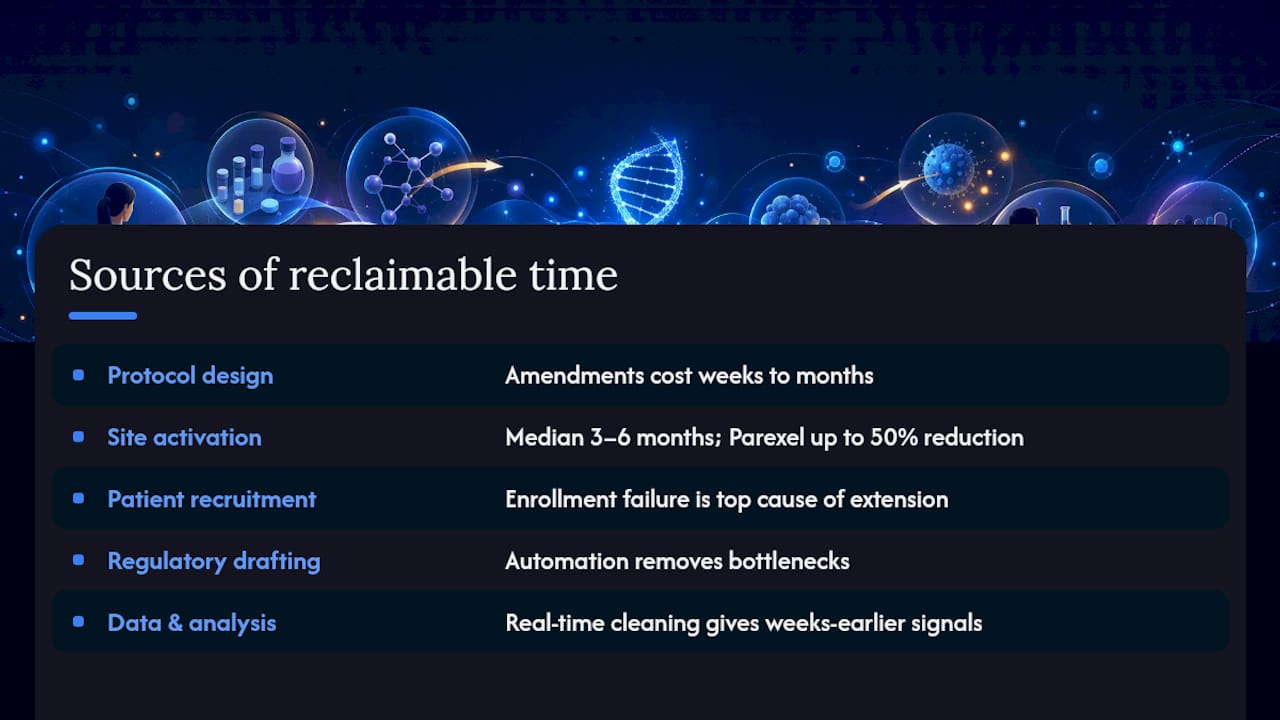
Protocol design and amendment reduction. Poorly designed protocols generate amendments that each cost weeks to months. AI-assisted protocol authoring and simulation can stress-test designs before they reach the site, cutting amendment frequency and the rework that follows.

Site activation. Median site activation runs 3–6 months at many sponsors. Parexel reports up to 50% reductions in site selection timelines using AI-enabled feasibility tools, which compresses the front end of every trial.
Patient identification, recruitment, and retention. Enrollment failure or slow accrual is the single most common cause of trial extension. Predictive patient identification and AI-driven retention monitoring address both ends of the problem.
Regulatory drafting is labor-intensive and error-prone; automation removes both bottlenecks.
Data cleaning, interim analysis, and decision velocity. Slow data review delays go/no-go decisions. Real-time data cleaning and AI-assisted interim analysis mean boards get decision-ready signals weeks earlier.
Pro Tip: Assign a named owner to each lever with a baseline metric and a target. "Site activation" owned by no one specific stays slow. "Site activation median: 90 days, owner: VP Clinical Ops, target: 60 days" moves.
What governance changes should boards make right now?
Governance is where speed either gets institutionalized or quietly abandoned after the pilot.
- Require time-to-value scenarios in every investment approval. No program should receive board sign-off without a modeled comparison of timelines under current operations versus AI-enabled redesign. This single change forces the conversation upstream.
- Appoint a single senior trial program owner with cross-functional authority spanning clinical, regulatory, data, and manufacturing. This role carries accountability for milestone velocity, not just milestone completion. Metrics: days-to-site-activation, protocol amendment count, decision velocity in days.
- Break functional silos with co-ownership mandates. Critical go/no-go decisions should require sign-off from at least two functions and one external independent reviewer. Siloed decisions are slower and more error-prone.
- Adopt predictive intelligence as a board-level reporting input. Leading indicators, not lagging ones, belong in the board pack. If the board only sees delays after they happen, it cannot act.
Precision regulation trends, including adaptive approvals and rolling submissions, make this governance shift urgent. Boards that govern continuous evidence generation and algorithmic accountability are positioned to move faster through regulatory review, not just through internal operations.
Which KPIs should boards demand to track time-savings impact?
| KPI | Definition | Reporting Cadence | Example Target |
|---|---|---|---|
| Time-to-first-patient | Days from protocol finalization to first patient enrolled | Monthly | Less than 180 days |
| Site activation median | Median days from site selection to site initiation | Monthly | Less than 90 days |
| Protocol amendment count | Number of amendments per trial and days lost per amendment | Quarterly | Less than 2 per trial |
| Decision velocity | Days from data availability to documented go/no-go decision | Monthly | Less than 2 weeks |
| Months reclaimed vs. baseline | Cumulative months saved against pre-intervention timeline | Quarterly | 6–18 months per program |
Track NPV uplift modeling inputs alongside these operational metrics. A one-month reduction in time-to-market has a dollar value your CFO can calculate; make that calculation visible in every board review.
- Pull baseline data before any intervention begins. Without a documented baseline, "months reclaimed" is a claim, not a measurement.
- Use AI-enabled regulatory drafting to generate submission timelines you can actually benchmark against.
What do the case studies actually show?
-
Astellas. Astellas internalized clinical operations and deployed AI across protocol development, translation, and patient outreach. The organizational reform reduced CRO dependency and contributed to reported savings of ¥65 billion yen over two years. The operational lesson: internalizing ownership of AI-enabled processes compounds the benefit.
-
Novartis IDS. The Intelligent Decision System vision combines a computational twin with a simulation layer that tests decision strategies before they are executed. The explicit aim is reducing end-to-end cycle time through faster, better-informed decisions at every trial stage.
-
Tufts/PPD integrated services study. The Tufts CSDD analysis found that integrated Phase I–III services can reduce development timelines by up to 34 months in modeled scenarios, with strong net financial benefits for sponsors.
The math on 18 months is straightforward: for a therapy with $500M in projected peak annual sales, one additional year of market exclusivity is worth roughly $500M in revenue that a slower competitor never captures.
How should boards evaluate AI-enabled operational partners?
Evaluation criteria to apply:
- Primary source of time savings: which specific process does the partner redesign?
- Typical months saved: what is the documented or modeled range, and under what conditions?
- Required change: what people, governance, and technology changes does the engagement require?
- Measurability: does the partner commit to baseline measurement and KPI reporting?
- Regulatory risk profile: does the partner maintain an audit trail and support FDA-ready documentation?
Due-diligence checklist:
- Data provenance: where does the partner's AI training data come from, and is it auditable?
- Model explainability: can the partner explain a recommendation in terms a regulatory reviewer would accept?
- Integration complexity: what does implementation require from your existing systems and teams?
- Change management capability: does the partner provide adoption support, or just software?
- Contractual SLA on time-to-milestone: will the partner commit to measurable delivery thresholds?
Red flags: vague claims about "AI-powered" processes with no baseline metrics, no audit trail capability, and no willingness to accept milestone-based SLAs. Request IP and data-handling terms in writing before any pilot begins.
Pro Tip: Ask every vendor candidate: "What is your documented baseline-to-outcome measurement process?" A partner who cannot answer that question precisely has not actually measured their own results.
What does a 90/180/365-day board roadmap look like?
Days 1–90
- Vote to require time-to-value scenarios in all investment approvals.
- Appoint the senior trial program owner role with defined accountability metrics.
- Select one program as the AI-enabled pilot; document the baseline timeline.
- Commission a bottleneck diagnostic across protocol design, site activation, and regulatory drafting.
Days 91–180
- KPI dashboard live and reporting to the board monthly.
- Regulatory drafting pilot underway with measurable cycle-time tracking.
- Site activation AI tools deployed on the pilot program.
- First interim KPI review: if site activation median has not improved by 20%, escalate to board.
Days 181–365
- Scale decision gate: months reclaimed vs. baseline reviewed. If the pilot has reclaimed 3+ months, approve full-program rollout.
- Supplier contracts finalized with milestone-based SLAs.
- Board adopts time-to-value as a standing agenda item in quarterly reviews.
Pro Tip: Set the scale decision threshold before the pilot starts. "We will scale if we reclaim 3 months" is a governance commitment. "We will evaluate results" is not.
For deeper implementation detail, the biotech pipeline acceleration guide covers the organizational changes that make these milestones stick.
The board cannot afford to wait another quarter
The companies that will define the next decade of biotech are not the ones with the best science alone. They are the ones that move their best science through development faster than anyone else. Every quarter a board delays institutionalizing speed is a quarter of competitive ground it will not recover.
Haiphai's embedded AI operational partnership starts from your strategic goals, maps the bottlenecks that are actually costing you months, and redesigns the workflows that govern your path to approval. Clients report reclaiming up to 18 months. That is not an efficiency gain. That is a valuation event.
The board action is clear: mandate a time-to-value pilot this quarter.
Haiphai accelerates your path to approval
Eighteen months of reclaimed development time is not a projection. It is a client-reported outcome from Haiphai's embedded AI operational partnership, built specifically for biotech and life sciences teams that need to move faster without adding regulatory risk.
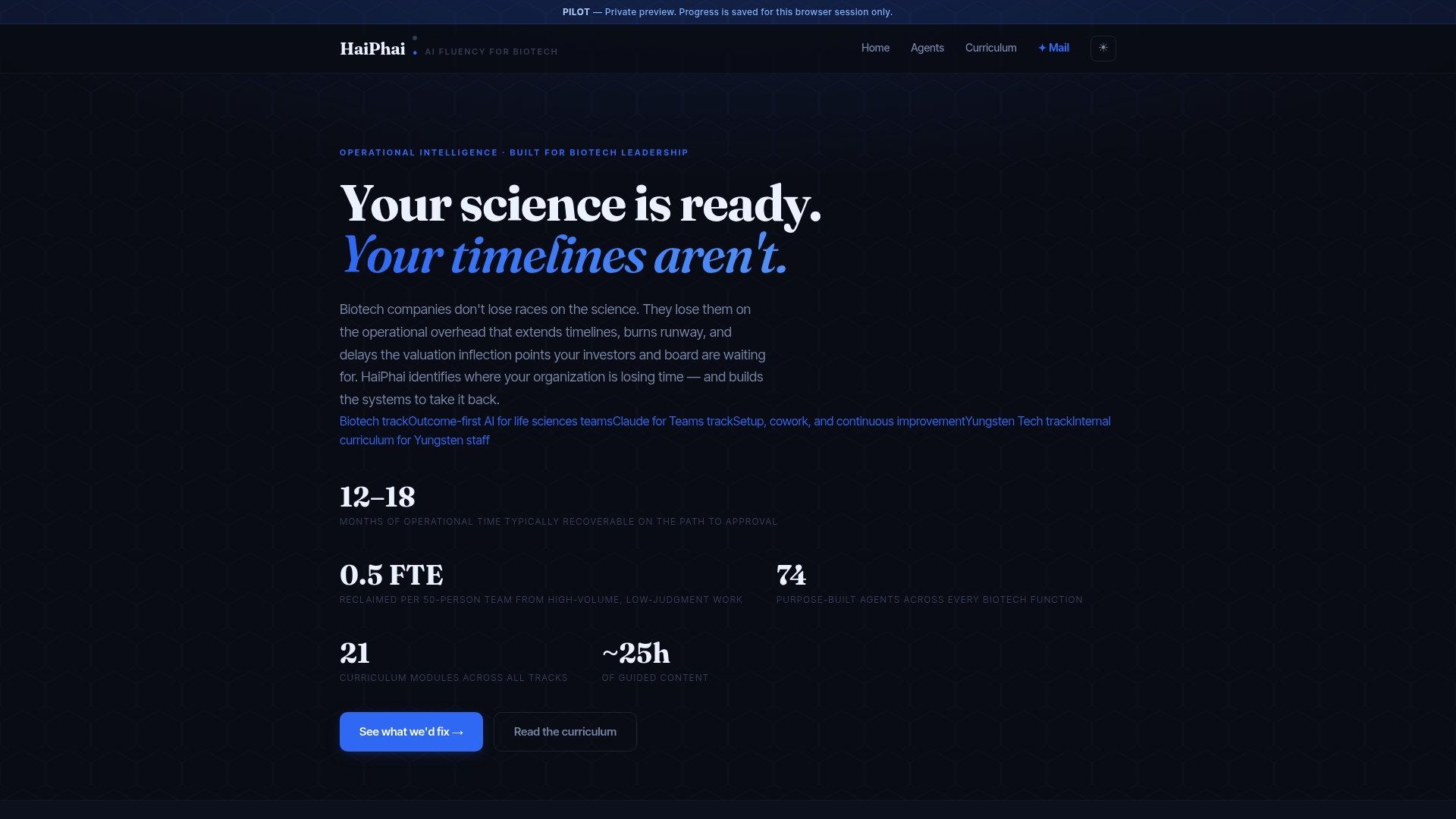
Haiphai begins with a diagnostic that maps your actual bottlenecks, not a generic software deployment. From there, AI-enabled workflow redesign targets the specific processes costing you the most time: regulatory drafting, site activation, and decision velocity. Every engagement includes governance and compliance oversight built in, so your board has the audit trail it needs.
Book a pilot engagement to measure months reclaimed and establish the KPI baseline your board should already be tracking.
Sources
- Fast Pharma: The Cost of Coming in Second in Clinical Trials - Arthur D. Little
- Tufts Center Study Shows Significant Time Savings in Delivering Therapies to Patients with Thermo Fisher Scientific’s Accelerator™ Drug Development 360° CDMO and CRO Solutions | PPD
- Astellas taps AI to reshape clinical programs as rising stars emerge | PharmaVoice
- Novartis AI-enhanced clinical trials (IDS vision) (PDF)
- AI in Clinical Development | Parexel
FAQ
Why do biotech boards prioritize time savings over cost reduction?
Time savings directly increase NPV and market capture in ways cost reduction cannot replicate. A month reclaimed is a month of peak-sales revenue that a slower competitor never recovers.
How much time can AI-enabled operational redesign actually save?
Integrated development models modeled by Tufts CSDD show up to 34 months in some scenarios; Haiphai clients report reclaiming up to 18 months through bottleneck diagnosis and AI-enabled workflow redesign.
Which operational process yields the fastest time savings?
Regulatory drafting automation and site activation optimization typically show the fastest measurable results, with Parexel reporting significant cycle-time reductions in IND submission generation and notable reductions in site selection timelines.
What governance change should a board make first?
Require time-to-value scenarios in every investment approval. That single change forces timeline modeling upstream and makes speed a board-level accountability, not an operational afterthought.
How should boards evaluate AI-enabled operational partners?
Require documented baseline measurement, a regulatory audit trail, model explainability, and a contractual SLA tied to time-to-milestone delivery before committing to any engagement.