
Biotech time to market is the total elapsed time required to bring a biopharmaceutical product from initial cell line development through regulatory approval and commercial launch, typically spanning 5 to 7 years because of inherent manufacturing and regulatory constraints. The industry term for this concept is "development-to-commercialization timeline," and understanding it accurately separates teams that plan well from those that miss critical milestones. FDA expedited programs, CMC activities, and biologics manufacturing processes each shape this timeline in ways that most biotech decision-makers underestimate.
What is biotech time to market, and what stages define it?
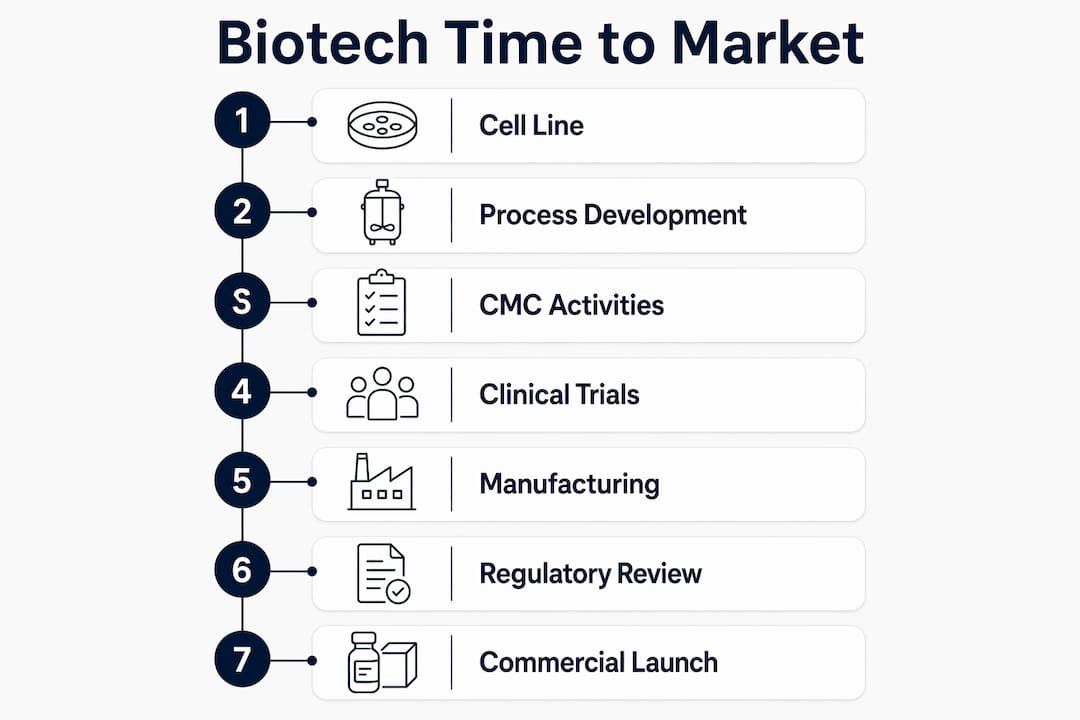
The biotech product launch timeline is a chain of sequential and partially overlapping stages, each with its own minimum calendar time. Cell line development occupies roughly the first 12 months. Process development and optimization follow from months 12 through 24. Scale-up and clinical manufacturing then run from months 24 through 36, before clinical trials and regulatory review consume the remaining years.
These stages are not interchangeable. You cannot start process development without a stable, characterized cell line. You cannot file an IND without completed analytical methods and initial stability data. The sequence creates a critical path that resource increases alone cannot shorten.

Clinical trials add the largest block of time. Phase I, II, and III studies together typically consume 3 to 5 years, depending on indication, patient population, and protocol complexity. Regulatory submission and review add another 12 to 18 months on top of that.
CMC, which stands for Chemistry, Manufacturing, and Controls, runs in parallel with clinical development but has its own fixed minimum durations. Stability studies, analytical method validation, and GMP manufacturing campaigns all require real calendar time. Adding more scientists or budget does not compress a 6-month stability study into 3 months.
- Cell line development: 0–12 months; establishes the production organism for the biologic
- Process development and optimization: 12–24 months; defines manufacturing parameters and yield
- Clinical manufacturing and scale-up: 24–36 months; produces material for trials and validates commercial processes
- Clinical trials (Phase I–III): 3–5 years; generates the safety and efficacy data required for regulatory submission
- Regulatory review: 12–18 months; FDA or equivalent agency evaluates the complete dossier
Pro Tip: Map your CMC activities against your clinical trial schedule from day one. Teams that treat CMC as a parallel workstream rather than a downstream task consistently avoid the most common cause of IND filing delays.
How effective are FDA expedited programs at shortening biotech timelines?
The short answer: less effective than most teams assume. Median time to approval for new molecular entities is 6.9 years, and this figure holds whether or not a product carries expedited status. That finding comes from 2020–2024 FDA data and directly contradicts the common belief that Breakthrough Therapy or Fast Track designation meaningfully compresses overall development time.
FDA expedited programs include four main pathways: Accelerated Approval, Fast Track, Breakthrough Therapy, and Priority Review. Each offers specific benefits. Priority Review shortens the FDA review clock from 12 months to 6 months. Breakthrough Therapy provides intensive FDA guidance and rolling review. Fast Track enables more frequent FDA interactions. Accelerated Approval allows approval based on surrogate endpoints.
The problem is that none of these programs touch manufacturing timelines. Expedited designation does not waive stability study requirements, does not accelerate GMP campaign scheduling, and does not reduce the number of clinical trial phases required. The regulatory review clock is only one segment of the full 6.9-year median.
"Time to market should be modeled as a chain of dependencies dominated by manufacturing and CMC readiness rather than simply clinical or regulatory review clocks." This framing shifts the planning conversation from regulatory strategy to operational execution.
| FDA Program | Primary Benefit | Impact on Overall TTA |
|---|---|---|
| Priority Review | Review period reduced to 6 months | Minimal; manufacturing timeline unchanged |
| Breakthrough Therapy | Intensive FDA guidance, rolling review | Minimal; clinical and CMC phases unchanged |
| Fast Track | More frequent FDA interactions | Minimal; does not compress trial phases |
| Accelerated Approval | Approval on surrogate endpoints | Conditional; post-market confirmatory trials required |
The strategic implication is clear. Biotech teams that treat expedited designation as a speed guarantee will consistently miss their projected launch dates. Designation is worth pursuing for the guidance access and rolling review benefits. It is not a substitute for operational planning.
What are the common bottlenecks that delay biotech product launch timelines?
CMC delays are the leading cause of missed IND filing milestones and approval setbacks. CMC activities require fixed real elapsed time, and delays here create compounded schedule setbacks that cannot be compressed later in the program. This is the single most underestimated risk in biotech development planning.
The most damaging bottlenecks fall into three categories:
-
Stability study timing. Stability testing periods of 3 to 6 months are typically mandatory and depend on drug substance availability. Starting stability studies late because drug substance was not ready is one of the most common and most avoidable causes of IND delays.
-
Analytical method validation. Validated methods must be in place before GMP manufacturing campaigns begin. Teams that understaff analytical development early in the program consistently find themselves waiting on method validation when manufacturing slots are already booked.
-
GMP manufacturing campaign scheduling. Contract manufacturing organizations operate on fixed capacity calendars. A missed campaign slot at a CDMO can push a program by 6 to 12 months, because the next available slot may be that far out.
Late-stage quality and manufacturing issues carry the highest commercial cost. Complete Response Letters citing CMC deficiencies alone can cause launch delays of 12 to 24 months and impose significant remediation costs. Every month of delay at the commercial launch stage represents lost revenue that cannot be recovered.
Pro Tip: Book your CDMO manufacturing slots 12 to 18 months in advance, even before your process development is complete. Losing a slot because you waited for final process parameters costs far more time than any process refinement you might make.
Early, integrated CMC planning is the single highest-leverage action a biotech team can take. Teams that treat CMC as a downstream task consistently face the worst delays. Teams that integrate CMC planning from the start of the program consistently hit their IND filing targets.
What strategies can biotech companies use to accelerate time to market?
The largest schedule gains come from parallelizing CMC activities, not from compressing downstream tasks after delays have already occurred. This distinction matters because most teams apply acceleration effort in the wrong place.
Practical acceleration strategies for biotech teams include:
- Parallel workstream integration. Run cell line development, process development, and analytical development as overlapping workstreams rather than sequential phases. Operational planning that aligns these activities in parallel can significantly shorten total development time compared to sequential execution.
- Early manufacturing campaign booking. Reserve CDMO slots based on projected timelines, not confirmed readiness. The cost of holding a slot you do not use is far lower than the cost of a 12-month delay waiting for the next available window.
- Regulatory flexibility for cell and gene therapies. FDA CBER guidance formalizes CMC flexibilities for cell and gene therapy products, including phase-appropriate process control strategies and flexible release criteria. Teams working in these modalities should build these flexibilities into their regulatory strategy from the start.
- AI-assisted regulatory drafting. AI augmentation in regulatory affairs reduces the time required to prepare submission-ready documents, freeing regulatory teams to focus on strategy rather than document production.
- Contingency planning for CMC rework. Build explicit schedule buffers for CMC remediation into every program plan. Commercial launch timing is frequently disrupted by late-stage manufacturing issues, and teams without contingency plans face the worst delays.
| Approach | Primary Benefit | Risk if Skipped |
|---|---|---|
| Parallel CMC workstreams | Reduces total elapsed time | Compounding delays across all phases |
| Early CDMO slot booking | Prevents scheduling gaps | 6–12 month slot availability delays |
| Regulatory flexibility (CGT) | Faster filing for certain modalities | Missed filing windows |
| AI-assisted drafting | Faster document preparation | Regulatory team bottlenecks |
The 50-person biotech operating model shows that smaller teams can execute at the speed of larger organizations when they apply these principles systematically. Scale is not the limiting factor. Planning discipline is.
Key Takeaways
Biotech time to market averages 5 to 7 years, and the critical path runs through CMC activities and manufacturing readiness, not regulatory review clocks.
| Point | Details |
|---|---|
| CMC drives the critical path | Stability studies and GMP campaigns set fixed minimum timelines that resources cannot compress. |
| Expedited programs have limits | FDA Fast Track and Breakthrough Therapy reduce review time, not total development time. |
| Parallelization is the top accelerator | Running CMC workstreams in parallel with clinical development cuts more time than any downstream fix. |
| CRLs carry high commercial cost | CMC-only Complete Response Letters delay launch by 12 to 24 months and impose significant remediation costs. |
| Early CDMO booking is non-negotiable | Securing manufacturing slots 12 to 18 months ahead prevents the most common scheduling bottleneck. |
The misconception that costs biotech teams the most time
The most expensive mistake I see biotech teams make is treating expedited regulatory designation as a project plan. A Breakthrough Therapy designation gets announced in a board deck, gets celebrated, and then quietly becomes the justification for an optimistic launch date that has no operational basis. The manufacturing timeline does not care about the designation.
I have watched programs with every expedited designation available still hit the 6.9-year median because nobody built a realistic CMC schedule. The designation got the team more FDA meetings. It did not get them a faster stability study or a better CDMO slot.
The teams that actually compress timelines do something less exciting. They model the full dependency chain from cell line to commercial supply on day one. They book manufacturing capacity before they have final process parameters. They staff analytical development early enough that method validation is never on the critical path. None of this is glamorous. All of it works.
The other underappreciated risk is contingency planning for late-stage CMC failures. A CMC-only Complete Response Letter at the BLA stage is not a theoretical risk. It happens regularly, and teams without a remediation plan lose 12 to 24 months at the worst possible moment in a program's commercial life. Build the contingency plan before you need it.
— John
How Haiphai helps biotech teams reclaim development time
Biotech teams that understand their timeline constraints still need the right operational infrastructure to act on that understanding.
Haiphai works as an operational partner for life sciences teams, starting from your program goals and working backward to identify where time is being lost. The focus is on the activities that actually drive the critical path: regulatory drafting, clinical site activation, and CMC workflow coordination. Haiphai clients can reclaim up to 18 months of operational time on the path to approval. That kind of time recovery directly affects company valuation and funding timelines. Explore Haiphai's solutions to see how AI-enabled operational support maps to your specific development stage and bottlenecks.
FAQ
What is the average biotech time to market?
The average biologics development timeline runs 5 to 7 years from initial cell line development through commercial supply. This includes clinical trials, CMC activities, and regulatory review.
Does FDA Breakthrough Therapy designation speed up approval?
Breakthrough Therapy designation provides intensive FDA guidance and rolling review but does not reduce the median time to approval, which holds at 6.9 years across expedited and non-expedited programs alike.
What causes the most delays in biotech product development?
CMC delays are the leading cause of missed IND filing milestones. Stability studies, analytical method validation, and GMP campaign scheduling all require fixed calendar time that cannot be compressed by adding resources.
How can biotech companies shorten their development timelines?
Parallelizing CMC workstreams with clinical development is the highest-impact approach. Booking CDMO manufacturing slots 12 to 18 months in advance and using AI augmentation for regulatory document preparation also reduce total elapsed time.
What is a Complete Response Letter and why does it matter for timelines?
A Complete Response Letter is an FDA communication indicating a product cannot be approved as submitted. CMC-only CRLs delay commercial launch by 12 to 24 months and require full remediation before resubmission.