
Seed stage biotech funding is the first meaningful round of outside capital that a biotech startup raises to turn early scientific findings into a de-risked, fundable program. It sits between a founder's own bootstrapped bench work and a Series A. The single biggest thing investors want at this stage isn't a bigger idea. It's reproducible preclinical evidence tied to a concrete roadmap toward an Investigational New Drug (IND) filing.
- Typical check size: often from hundreds of thousands to several million dollars
- Typical dilution: a moderate portion of the company
- Core investor ask: de-risked data and a clear plan to the next milestone
Pro Tip: Investors fund milestones, not mission statements. If you can't draw a straight line from today's dollar to tomorrow's data point, you're not ready to raise yet.
Key Takeaways
Seed-stage biotech funding succeeds when founders pair reproducible preclinical evidence with a milestone-mapped budget that shows investors exactly how each dollar de-risks the path to Series A.
| Point | Details |
|---|---|
| Know your range | Typical seed rounds run $1M to $5M with 15% to 25% dilution depending on valuation. |
| Lead with reproducibility | Investors fund confirmed data, not single promising results. |
| Diversify funding sources | Combine angels, seed VCs, and non-dilutive grants like SBIR/STTR or BARDA to reduce reliance on one track. |
| Map milestones to dollars | Show investors exactly which experiment each funding tranche unlocks toward Series A. |
| Get operationally ready early | Haiphai helps founders package data and streamline regulatory workflows so raises move faster and cleaner. |
Table of Contents
- Where Seed Fits in the Biotech Funding Lifecycle
- How Big Are Typical Seed Rounds and What Do They Fund?
- What Do Seed Investors Actually Look For?
- Which Investors and Programs Fund Seed-Stage Biotech?
- What Deal Terms Should Founders Expect at Seed?
- How Should Founders Prepare for a Seed Raise?
- Why Operational Readiness Shortens the Path to a Successful Raise
- What Founders Get Wrong About Seed Fundraising
- Move Faster From Data to Diligence-Ready
- Sources
- FAQ
Where Seed Fits in the Biotech Funding Lifecycle
Seed funding occupies a specific slot in a longer chain, and confusing it with the stage before or after leads founders to pitch the wrong investors with the wrong ask.
- Discovery/pre-seed: Founder capital, friends and family, or small grants fund target identification and initial hypothesis testing.
- Seed: External capital funds target validation, early lead optimization, and the start of IND-enabling work.
- Series A: Institutional capital, commonly $20 million to $80 million in life sciences, funds a full IND-enabling package and clinical trial preparation.
What changes between stages isn't just check size. At pre-seed, a two-person founding team with a compelling hypothesis is enough. By seed, investors expect a small operating team, provisional patent filings, and data that another lab could reproduce. By Series A, they expect a nearly complete regulatory package. Skipping that progression, or pitching Series A investors with pre-seed evidence, wastes months founders don't have.
How Big Are Typical Seed Rounds and What Do They Fund?
Most biotech seed rounds land between $1 million and $5 million, though platform companies with strong founding teams occasionally raise $8 million or more. Smaller rounds, sometimes called "pre-seed" even when structured as seed, can close under $500,000 for capital-efficient computational or diagnostics plays.
That money has to stretch across several buckets:
- Target validation experiments and orthogonal confirmation studies
- Lead optimization and early formulation work
- IND-enabling studies (toxicology screens, manufacturing feasibility)
- Provisional patent filings and freedom-to-operate searches
- One or two key scientific or operational hires
- Lab space, reagents, and contract research organization (CRO) fees
Here's the dilution math founders often get wrong: a $2 million seed raise at an $8 million pre-money valuation dilutes founders by 20%. Push the same raise to $10 million pre-money and dilution drops to 16.7%. That four-point swing is why valuation negotiation matters more at seed than at almost any later stage, when round sizes grow but percentage dilution tends to compress.
What Do Seed Investors Actually Look For?
Seed investors in biotech are pattern-matching against dozens of failed bets, so they screen hard for specific signals before writing a check.
- Preclinical data that another lab or a second experiment has reproduced, not a single promising result
- A provisional patent or clear freedom-to-operate position
- A founding team with a track record of hitting self-set milestones, not just strong academic credentials
- A modular roadmap to IND that shows exactly which experiment unlocks which dollar
Investors care less about a grand five-year vision than they do about the next 12 to 18 months. They want to see how each seed dollar maps to a milestone that de-risks the program enough to justify a Series A. A simple table makes that logic concrete:
| Milestone | What It Funds | Why It Matters for Series A |
|---|---|---|
| Target validation | Confirmatory assays, orthogonal models | Proves the biological hypothesis holds |
| Lead optimization | Medicinal chemistry, formulation | Shows a developable candidate exists |
| IND-enabling toxicology | GLP tox studies, CRO contracts | Confirms a viable safety margin |
| Manufacturing feasibility | Process development, CMC scale-up | Signals the program is producible at scale |
Regulatory awareness matters here too. The FDA's drug development and approval framework is what savvy investors use to judge whether your milestone plan actually leads somewhere real.
Which Investors and Programs Fund Seed-Stage Biotech?
Seed capital comes from a mix of dilutive and non-dilutive sources, and the right combination depends on how far along your science is and how much runway you need before a priced round makes sense.
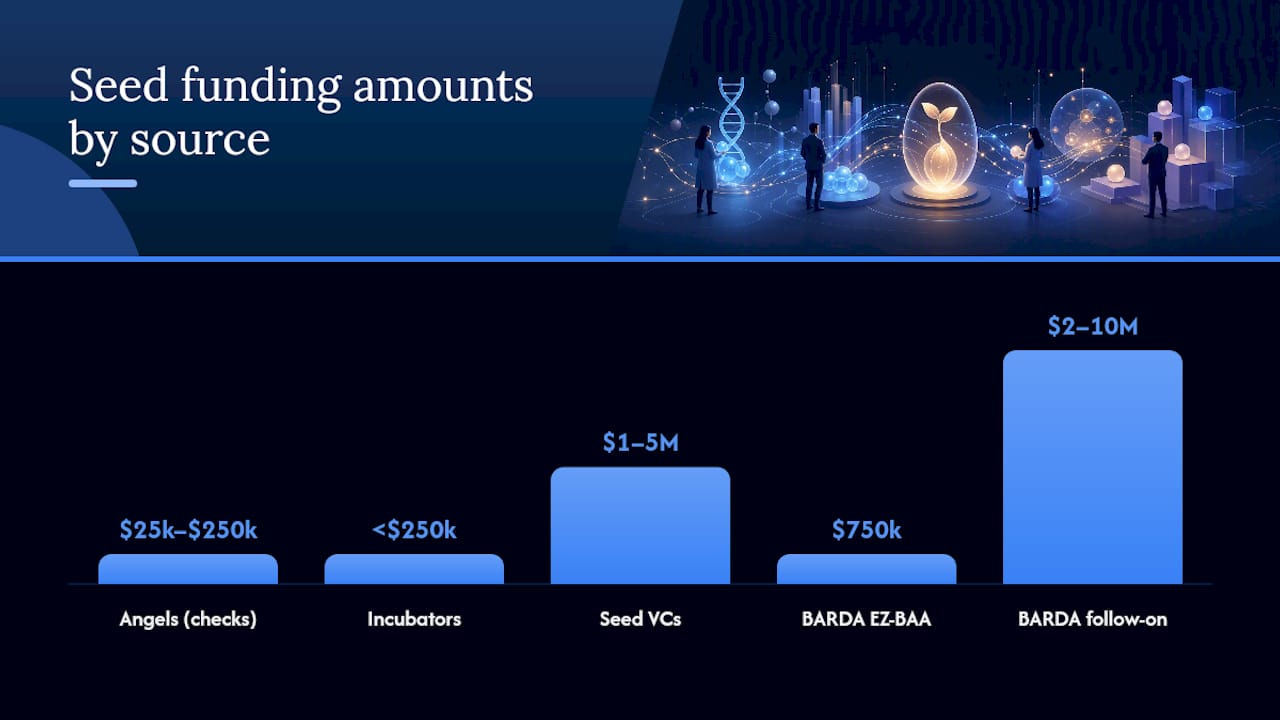
- Angel investors: Often former founders or scientists writing $25,000 to $250,000 checks; fast decisions, less process, but limited follow-on capacity.
- Life-science seed venture capital firms: Write the bulk of $1M to $5M rounds, expect board involvement, and bring diligence rigor.
- Incubators and accelerators: Provide lab space, mentorship, and small checks (often under $250,000) in exchange for equity, useful for pressure-testing a hypothesis before a full raise.
- Corporate venture scouts: Pharma-affiliated funds that write seed checks with an eye toward future licensing or acquisition options.
- Non-dilutive programs: SBIR/STTR grants (NIH), BARDA, and CDMRP fund specific research milestones without taking equity.
BARDA's EZ-BAA mechanism can award roughly $750,000 over six months, with EZ-BAA+ follow-on awards typically running $2 million to $10 million, useful for founders working on infectious disease, biodefense, or public health threats.
Pro Tip: SBIR/STTR grants cover research costs well but usually can't fund marketing or business development, so most founders pair a grant with a small equity seed to cover the commercial gaps a grant won't touch.
Venture debt and royalty financing can extend runway between milestones, but treat them as a bridge, not a substitute for the equity or grant dollars that actually fund the science.
What Deal Terms Should Founders Expect at Seed?
Three instruments dominate biotech seed rounds, and each shifts risk differently between founders and investors.
- SAFE (Simple Agreement for Future Equity): No interest, no maturity date, converts to equity at the next priced round. Fast to close, but dilution isn't fixed until conversion.
- Convertible note: Similar to a SAFE but structured as debt with interest and a maturity date, giving investors more downside protection.
- Priced equity round: Sets valuation immediately, requires a full term sheet and board seat negotiation, and is more common once a company has real traction.
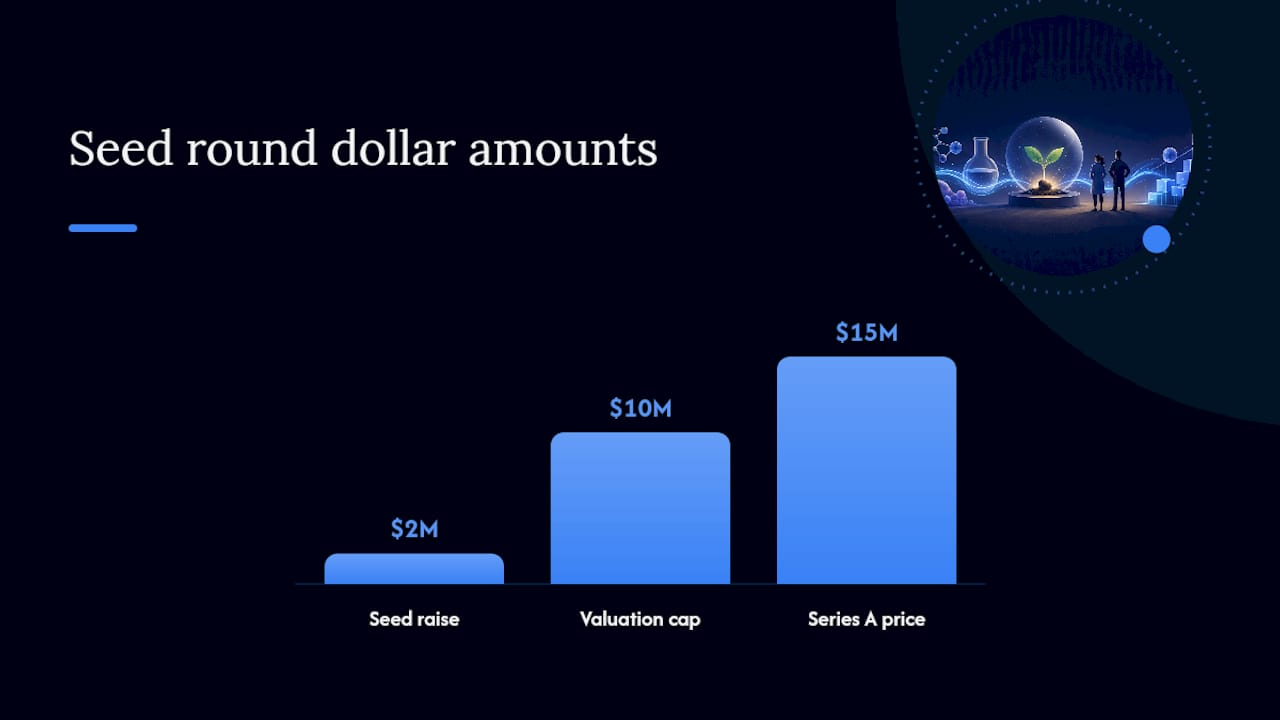
A quick numeric comparison: raise $2 million on a SAFE with a $10 million valuation cap, and if your Series A prices at $15 million, your seed investors convert at the $10 million cap, effectively owning a bigger slice than a straight 20% calculation would suggest. A priced round locks that percentage in from day one instead.
Bring three things to any term sheet conversation: the valuation cap or pre-money valuation, the discount rate (commonly 15% to 20% on SAFEs), and any pro rata rights investors are requesting.
How Should Founders Prepare for a Seed Raise?
Founders who treat seed fundraising as a three to six month project, not a scramble, close faster and on better terms.
- Package your data: organize preclinical results into a clear narrative with reproducibility evidence front and center.
- Prioritize experiments: run the two or three studies that most reduce investor uncertainty before you start pitching.
- File provisional patents: even a bare-bones filing signals you understand IP strategy.
- Build a real cap table model: know your dilution scenarios before a term sheet lands on the table.
- Map your investor list: target seed funds and angels who've backed similar-stage, similar-modality companies.
Your data room should include your scientific summary, key raw data (annotated, not raw dumps), CVs for the core team, IP filings, and a milestone-based budget. Redact proprietary reagent sources or unpublished collaborator data until diligence is well underway.
Pro Tip: Present your budget as "$X funds Y experiment, which de-risks Z for Series A" instead of a flat burn-rate spreadsheet. Investors fund causality, not overhead.
Why Operational Readiness Shortens the Path to a Successful Raise
Founders assume the science sells itself. It doesn't. How you package that science, and how fast you can answer diligence questions, often decides whether a raise closes in three months or nine.
- Standardize your data formats before investor meetings start, not during diligence
- Build your milestone budget alongside your data package, not after a term sheet arrives
- Treat operational transparency as a trust signal that speeds up, not just satisfies, investor diligence
Teams that walk in with a tight data room and modular milestone plan tend to compress diligence timelines meaningfully compared to those assembling documents on the fly.
What Founders Get Wrong About Seed Fundraising
The most common mistake I see is founders leading with the science story and burying the execution evidence. Investors have heard a hundred compelling hypotheses this quarter. What they haven't seen from most founders is proof they can hit a self-set deadline.
A related trap: treating one funding source, usually a single VC conversation, as a plan instead of running parallel tracks across grants, angels, and funds. Given that first-time biotech financings have softened in recent quarters, a single-track raise is a fragile bet.
Move Faster From Data to Diligence-Ready
Every step described above, packaging data, mapping milestones to dollars, tightening your regulatory roadmap, takes real operational bandwidth that most seed-stage teams simply don't have in-house. Haiphai works as an embedded operational partner for biotech teams, mapping bottlenecks in your regulatory and clinical workflows and rebuilding them with AI-enabled processes so your data room and milestone plan are investor-ready faster, not scrambled together the week before a pitch.
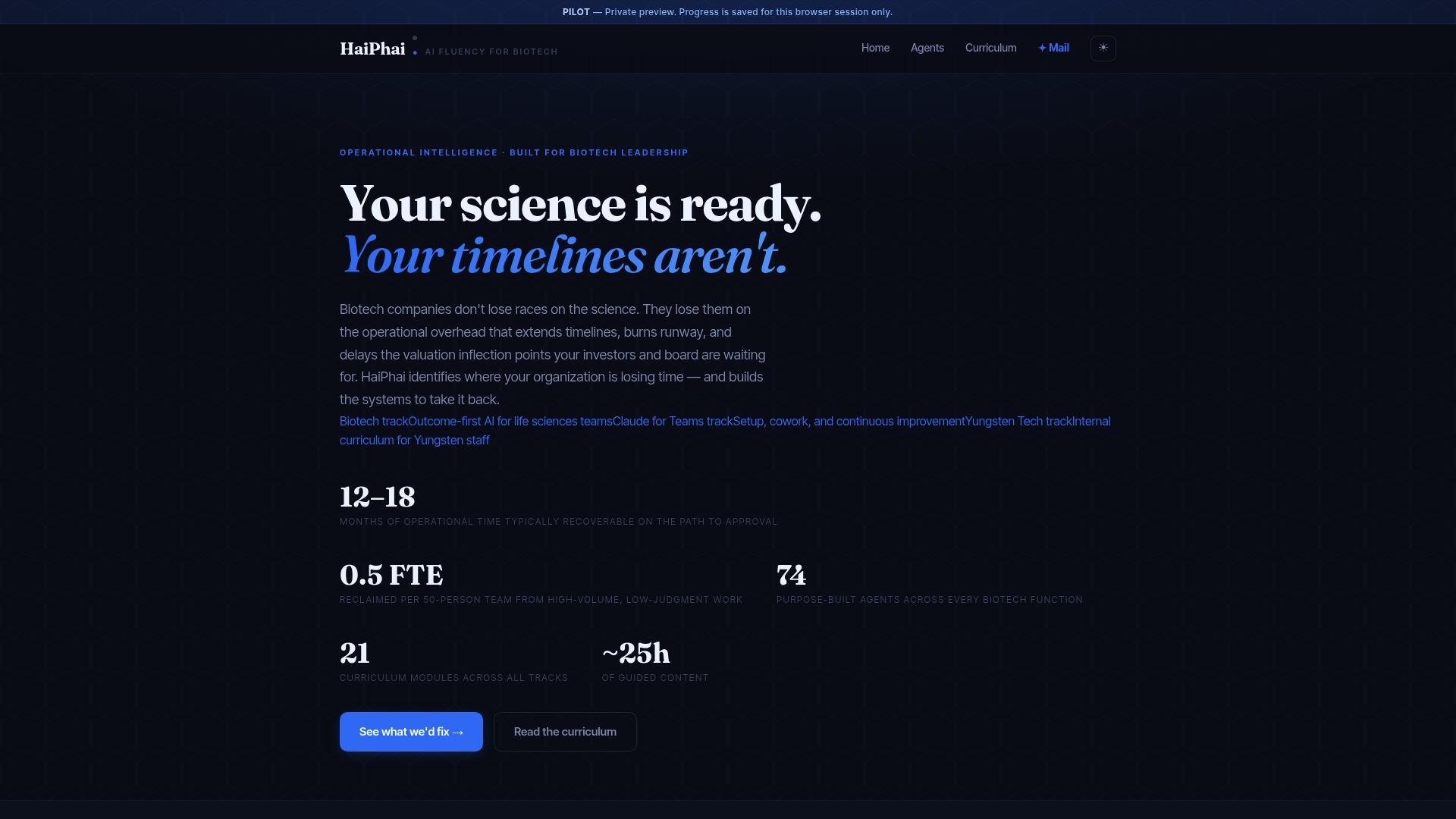
That matters most right when you're raising: clients working with Haiphai have reclaimed up to 18 months of operational time on their path to approval, time that translates directly into a stronger valuation story and a shorter diligence cycle. If your team is heading into a seed raise and wants that operational groundwork handled by people who've mapped this exact process before, visit Haiphai's biotech and life sciences sector page to see how an operational partnership could fit your timeline.
Sources
- Development & approval process for drugs — FDA
- Life sciences glossary — CalifeSciences
- Venture debt & royalty financing — Qubit Capital
FAQ
What Is Seed Stage Funding in Biotech?
Seed stage funding is the first outside capital round, typically $500,000 to $5 million, that biotech startups raise to validate a target and begin IND-enabling work before pursuing a Series A.
Who Funds Seed-Stage Biotech Companies?
Angel investors, dedicated life-science seed venture capital firms, incubators, corporate venture scouts, and non-dilutive programs like SBIR/STTR and BARDA all fund seed-stage biotech rounds.
Do You Pay Back Seed Funding?
Equity seed funding doesn't get paid back; investors receive ownership shares instead. Non-dilutive grants like SBIR/STTR also don't require repayment, though venture debt does.
What Percentage of Equity Does Seed Funding Take?
How Does Seed Funding Connect to a Series A Raise?
Seed capital funds the preclinical evidence and IND roadmap that justify a Series A, which in life sciences commonly ranges from $20 million to $80 million.