
Series A biotech funding is the first major institutional venture capital round where a startup issues Series A Preferred Stock to finance the transition from preclinical discovery toward investable clinical catalysts like IND submissions and Phase 1 trials. This is the moment a biotech company stops being a science project and starts being a drug development business. Understanding what Series A biotech funding means is not optional for founders who want to raise successfully. It determines your governance structure, your investor relationships, your legal obligations, and the operational bar you must clear before anyone writes a check.
What does Series A biotech funding mean for your company?
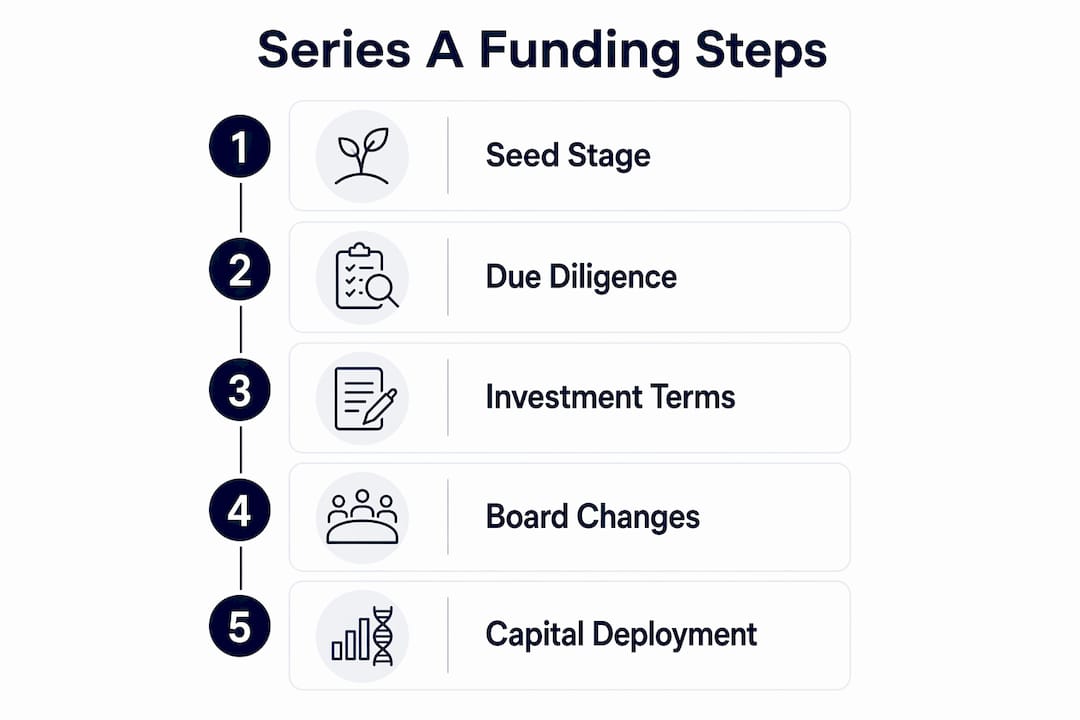
Series A is the first institutional venture round where investors exchange capital for preferred equity with structured rights, protections, and governance influence. Before this round, most biotech startups rely on seed capital, angel investments, or non-dilutive grants to generate early proof-of-concept data. Series A changes the category entirely.
The meaning of biotech funding at this stage centers on one shift: investors are no longer betting on science alone. They are underwriting a company's ability to execute against a documented regulatory and clinical plan. That distinction matters more than most founders realize when they first approach the market.

Biotech Series A rounds typically raise between $10 million and $80 million or more, depending on the program's complexity, the syndicate's composition, and the number of clinical candidates in play. A single-asset oncology startup pursuing a Phase 1 first-in-human study will raise very differently than a platform company with three preclinical programs. The capital raised must connect directly to a specific value inflection, not just runway.
Equity dilution at Series A typically falls in the 20% to 30% range, though this varies by valuation and deal terms. Founders who enter this round without understanding the financial structure often discover too late that governance has shifted materially in favor of investors.
What are the financial and legal structures involved?
Series A financing involves a comprehensive package of legal documents that fundamentally alter how your company operates. The core instruments include a Stock Purchase Agreement, an Investor Rights Agreement, a Voting Agreement, and a Right of First Refusal and Co-Sale Agreement. Most institutional investors use NVCA model documents as the baseline for these agreements, which sets a recognized standard for term sheets and definitive documents in the U.S. venture market.
Series A Preferred Stock carries rights that common stockholders do not have. The most consequential provisions include:
- Liquidation preferences: Investors receive their capital back (often 1x non-participating) before common stockholders in a sale or wind-down.
- Anti-dilution protection: If you raise a future round at a lower valuation, investors are protected through price-based adjustments to their conversion ratio.
- Pro-rata rights: Investors can maintain their ownership percentage in future rounds by participating in follow-on financings.
- Information rights: Quarterly and annual financial reporting obligations become contractual, not discretionary.
Board composition changes at Series A. Investors typically receive one or two board seats, and the board may expand to include an independent director. This is not a formality. Board members have fiduciary duties and real influence over strategic decisions, hiring, and future financing terms.
| Feature | Seed / SAFE | Series A Preferred |
|---|---|---|
| Instrument type | Convertible note or SAFE | Preferred equity |
| Governance rights | Minimal or none | Board seats, voting rights |
| Liquidation preference | None | 1x or higher |
| Anti-dilution protection | Rarely included | Standard inclusion |
| Reporting obligations | Informal | Contractual and structured |
| Diligence depth | Light | Extensive |
Pro Tip: Before signing a term sheet, have a biotech-specialized attorney review every protective provision. A 1x participating liquidation preference versus a 1x non-participating preference can mean millions of dollars difference to founders at exit.
What operational and clinical milestones do Series A investors expect?
Series A investors expect far more than slides. They expect documented clinical protocols, Phase 1 through Phase 2 mapping, and capital needs tied to concrete deliverables. The bar between seed and Series A is not incremental. It is categorical.
Here is what investors will scrutinize during diligence:
- Reproducible preclinical data: GLP-compliant toxicology studies, documented pharmacology, and independently reproducible efficacy data. A single lab's results are not sufficient.
- IND-enabling study completion or clear timeline: Investors want to see that your Chemistry, Manufacturing, and Controls (CMC) package is aligned with your IND filing date. CMC readiness aligned with the IND date is one of the clearest signals of operational discipline.
- Pre-IND FDA meeting documentation: Skipping pre-IND meetings is one of the most expensive mistakes a biotech founder can make. A clinical hold after IND submission can delay trial start by months and burn capital you cannot afford to lose.
- Phase 1 protocol design: Investors want to see a credible dose-escalation strategy, patient selection criteria, and biomarker endpoints that will generate meaningful data.
- IP and freedom to operate: A clean freedom-to-operate opinion and a patent strategy that protects your core mechanism are non-negotiable.
- Management team depth: Series A investors are backing people as much as programs. A founding scientist without a Chief Medical Officer or VP of Regulatory Affairs signals execution risk.
"Founders should consider Series A investors as underwriting disciplined drug development, expecting documented regulatory strategy and operational readiness." — Investment in Biotech Explained
After IND submission, the FDA has a 30-day review window before clinical dosing can begin unless a clinical hold is issued. Sophisticated founders build this 30-day period into their capital deployment plan. Investors notice when founders have not.
Pro Tip: Map your IND submission date, the 30-day FDA review window, and your first patient dosing date onto a single timeline before any investor meeting. This one document demonstrates more operational credibility than a 50-slide deck.
How does Series A compare to seed funding and later rounds?
Understanding biotech funding stages requires seeing each round as a distinct category with different investor profiles, diligence standards, and expectations. The table below captures the most important distinctions:
| Stage | Typical raise | Primary investor | Diligence focus | Key milestone |
|---|---|---|---|---|
| Seed | $500K to $5M | Angels, family offices, micro-VCs | Scientific concept, founder quality | Proof-of-concept data |
| Series A | $10M to $80M+ | Institutional VCs | Execution plan, regulatory readiness | IND filing, Phase 1 start |
| Series B | $50M to $200M+ | Crossover funds, large VCs | Phase 1 or Phase 2 data | Clinical proof-of-concept |
| Series C+ | $100M+ | Crossover, public market investors | Late-stage clinical data | NDA/BLA filing or exit |
The most important shift between seed and Series A is not the check size. It is the investor's mental model. Seed investors bet on the science and the founder. Series A investors expect reproducible preclinical data, regulatory interaction milestones, a fully formed management team, and a clear clinical development plan.
Syndicate quality at Series A also carries forward-looking weight. A round led by a top-tier life sciences VC like Atlas Venture, Flagship Pioneering, or OrbiMed signals viability to future investors and often improves Series B pricing. Founders who accept capital from undifferentiated or inexperienced investors at Series A sometimes find that the wrong names on the cap table create friction in later rounds.
Post-Series A, reporting obligations increase significantly. Quarterly board meetings, audited financials, and investor updates become contractual requirements. Founders who treat these as administrative burdens rather than governance tools tend to struggle with investor relationships as the company scales.
What practical steps prepare you for a successful Series A raise?
Preparation for Series A is not a six-week sprint before you need the money. It is a 12 to 18-month operational build. Series A biotech funding is structured to finance programs through Phase 1 and toward Phase 2 or platform validation, which means investors are evaluating whether your company can sustain that journey.
Follow these steps to build a fundable Series A story:
- Define your fundable catalyst. Identify the single clinical or regulatory milestone that will create a step-change in company value. Capital efficiency, where your raise buys a specific value inflection rather than just runway, is central to investor interest.
- Complete or schedule GLP toxicology studies. These are non-negotiable for IND submission. Investors will ask for the study reports, not just summaries.
- Hold your pre-IND meeting with FDA. Document the feedback. This meeting is a diligence asset, not just a regulatory formality.
- Prepare NVCA-compliant legal documents. Engage a biotech-specialized law firm early. Arriving at term sheet negotiations without clean corporate documents signals inexperience.
- Build your leadership team before you fundraise. Hire or identify your CMO, VP of Regulatory Affairs, and CFO before you enter the market. Investors will not fund a gap you promise to fill later.
- Stress-test your financial model. Connect every dollar of the raise to a specific deliverable. Investors benchmark your assumptions against comparable programs and will challenge any number that looks optimistic.
Pro Tip: Run a mock diligence session with a trusted advisor or former VC before your first investor meeting. The questions that stump you in practice are the ones that will kill your deal in a real process.
Key takeaways
Series A biotech funding is a categorical shift from seed-stage science to institutional-grade execution, requiring documented regulatory strategy, GLP-compliant data, and governance structures that satisfy professional investors.
| Point | Details |
|---|---|
| Series A definition | The first institutional VC round issuing Preferred Stock to fund clinical progression from preclinical to Phase 1. |
| Typical funding size | Biotech Series A rounds raise between $10M and $80M or more depending on program complexity and syndicate weight. |
| Legal structure | NVCA model documents govern the round, including liquidation preferences, anti-dilution rights, and board seat provisions. |
| Investor expectations | Reproducible GLP data, pre-IND FDA feedback, a complete management team, and a capital-efficient clinical plan are required. |
| Preparation timeline | Founders need 12 to 18 months of operational build before entering the Series A market, not six weeks. |
Why most founders misread what Series A actually demands
I have worked with enough biotech founders to say this plainly: the majority who struggle at Series A are not struggling because their science is weak. They are struggling because they treated Series A as a bigger seed round instead of a fundamentally different category of financing.
The founders who raise cleanly are the ones who walked into investor meetings with a pre-IND meeting summary from FDA, a GLP tox package, a named CMO with relevant therapeutic area experience, and a financial model that connected every dollar to a specific clinical deliverable. They did not pitch hope. They pitched a plan with documented evidence that the plan was executable.
The valuation question is where I see the most damage. Founders price their round based on what they need the company to be worth, not what the data supports. Pricing a round based on hoped-for milestones rather than secured catalysts is one of the most common failure modes in biotech Series A processes. Investors have seen hundreds of decks. They know when assumptions are aggressive, and they will either pass or restructure terms to protect themselves.
One more thing that rarely gets said: the syndicate you build at Series A will shape your company for the next five to seven years. A check from the wrong investor at the wrong valuation can create governance friction, cap table complexity, and signaling problems that follow you into Series B and beyond. Choose your investors as carefully as they are choosing you.
— John
How Haiphai helps biotech founders reach Series A ready
The operational gap between a promising preclinical program and a Series A-ready company is where most biotech startups lose time and money. Haiphai is built specifically to close that gap. By working backward from your strategic milestones, including IND submission dates, pre-IND meeting preparation, and clinical protocol development, Haiphai identifies the process bottlenecks that extend your timeline and drain your budget before investors ever see your deck.
Founders using Haiphai have reclaimed up to 18 months of operational time on the path to approval, a number that directly affects company valuation and funding readiness. If you are preparing for a Series A raise and want to arrive with the operational credibility investors demand, explore Haiphai's platform and see where your program stands today.
FAQ
What does Series A biotech funding mean exactly?
Series A biotech funding is the first major institutional venture capital round where a startup issues Series A Preferred Stock to finance progression from preclinical research toward clinical milestones like IND submission and Phase 1 trials. It marks the shift from science-focused seed capital to execution-focused institutional investment.
How much do biotech companies typically raise in a Series A?
Biotech Series A rounds typically raise between $10 million and $80 million or more, depending on the program's complexity, the number of clinical candidates, and the quality of the investor syndicate. Capital is expected to fund a specific clinical catalyst, not just general operations.
How is Series A different from seed funding in biotech?
Seed funding backs scientific concept and founder quality with light diligence, while Series A investors require reproducible GLP-compliant data, documented FDA interactions, a complete management team, and a detailed clinical development plan before committing capital.
What legal documents are required for a Series A round?
A Series A round requires a Stock Purchase Agreement, Investor Rights Agreement, Voting Agreement, and Right of First Refusal and Co-Sale Agreement, typically drafted using NVCA model documents as the standard framework in the U.S. venture market.
When should a biotech founder start preparing for Series A?
Founders should begin Series A preparation 12 to 18 months before they need the capital, using that time to complete GLP studies, hold pre-IND FDA meetings, build the leadership team, and develop a capital-efficient clinical development plan tied to concrete milestones.