
Process mining software, in the biotech context, isn't a dashboard that watches your event logs. It's an embedded AI operational partner that maps where regulatory and clinical timelines actually break, then rebuilds those workflows with governed automation. The core claim is direct: done right, this approach can reclaim months of operational time between first-in-human planning and approval. What follows is how it works, where it saves time, and what to check before you sign a partner.
TL;DR:
- Most delays occur in pre-IND processes that average around 380 days and site activation that frequently exceeds the 90-day goal.
- Building risk-averse IND packages can add six to twelve months unless workflows are optimized with tailored automation.
- Successful AI adoption requires a strong data foundation, including fixed data lineage and human-in-the-loop governance, before deploying models.
- Partners should demonstrate clear results on specific milestones, showing measurable time savings with validated models and strict version control.
- Embedded collaborations work best when focused on narrow, high-stakes bottlenecks with well-defined, measurable outcomes, rather than broad automation.
Table of Contents
- What Does "Process Mining Software" Mean for Biotech Operations?
- Where Do Regulatory and Clinical Timelines Actually Break?
- How Does an Embedded AI Operational Partner Actually Work?
- What Should You Verify Before Hiring a Process Mining Partner?
- What Proof Points Should You Ask a Partner to Show You?
- Does This Integrate With Your Existing Clinical and Regulatory Systems?
- How Do You Handle Data Privacy Across Regulatory and Clinical Systems?
- What Goes Wrong When Biotech Teams Implement This Poorly?
- When Should You Partner Instead of Build In-House?
- HaiPhai: How to Start a Diagnostic Engagement
- Sources
- FAQ
What Does "Process Mining Software" Mean for Biotech Operations?
Most search results define process mining as event-log software that visualizes how a business process actually ran, the Celonis and UiPath category. That's not what biotech operations leaders need, and it's not what this article covers. For a clinical or regulatory team, the useful definition is different: a consulting-led, AI-enabled diagnostic and workflow redesign service that finds where a specific approval pathway is stalling and fixes it with tailored automation.
This distinction changes how you evaluate a partner. You're not buying a license and self-serving analytics. You're hiring a team that starts from your regulatory milestones and works backward to find the bottleneck.
The scope typically covers:
- Regulatory drafting, including IND and Pre-IND documentation
- Clinical site activation, contract negotiation, and IRB routing
- Recruitment and enrollment pipeline design
- Institutional knowledge capture so process fixes survive staff turnover
- Governed automation layered onto existing regulatory and clinical systems
Because the unit of value is months saved on a specific milestone, not "process visibility," evaluation criteria shift toward domain expertise and measurable time-to-value rather than software feature counts.
Where Do Regulatory and Clinical Timelines Actually Break?
The delays are well documented, and they're bigger than most sponsors admit internally. Operation TrialBlazer found that pre-IND intervals average roughly 380 days, and site activation frequently blows past the National Cancer Institute's 90-day target. Those aren't edge cases. They're the default.
By the numbers: Sponsors that build risk-averse, over-ambitious IND data packages instead of phase-appropriate submissions can add 6 to 12 months to development timelines compared to a right-sized approach.
Four patterns show up in nearly every stalled biotech program. For deeper insight into how these workflows can be optimized, see our Regenerative Medicine Workflow: A Practical Guide.
- IND and pre-IND prep drags because teams over-build data packages rather than matching evidence to development phase.
- Site activation, IRB review, and contract negotiation function as a single rate-limiting chain. A master trial agreement gap or a protocol amendment can add weeks or months on its own.
- Recruitment and clinician engagement suffer when screening pipelines depend on manual chart review, which slows enrollment and degrades data quality.
- AI adoption without a data foundation stalls before it starts, which is exactly why the numbers below matter.
Medidata's 2026 industry report found that 72.9% of early AI adopters in clinical trials report reduced study timelines. The same report highlights weak data foundations and integration complexity as the top barriers keeping other sponsors from seeing the same result. Recruitment friction compounds all of it. HaiPhai's own analysis of the enrollment gap between protocol design and patient recruitment shows how AI-assisted screening closes that specific gap rather than just tracking it.
How Does an Embedded AI Operational Partner Actually Work?
The mechanics matter more than the marketing. A partner earns trust by showing its work at each stage, not by promising a black-box fix.
- Diagnostic mapping. The engagement starts by tracing your actual workflow, from protocol concept to site-ready status, and pinpointing exactly where time leaks out. This isn't a generic audit template. It follows your specific bottleneck, whether that's contract cycle time or IRB submission lag.
- Prioritized pilots. Rather than automating everything at once, the partner picks the one or two interventions with the clearest time-to-value, often regulatory drafting or site-activation document extraction, and proves the model on a bounded scope.
- Scaled rollout with governance. Once a pilot shows measurable gains, the partner expands it under formal controls: version-controlled models, audit trails, and human review checkpoints tied to protocol amendments.
None of this works without a clean data foundation first. A review in Nature Reviews Clinical Oncology warns that deploying AI on top of broken data lineage doesn't fix errors, it accelerates them. Fixing data lineage and embedding human-in-the-loop governance has to come before any model touches a regulatory document.
The tactical interventions that tend to move fastest include automated regulatory drafting drawn from your own template libraries, governed document extraction that speeds site-activation packets, and AI-assisted enrollment screening that flags eligible patients earlier in the funnel.
Pro Tip: Ask any prospective partner to show you their model validation and audit-trail process before you ask about their case studies. If they can't produce a version-controlled record of what the model changed and who reviewed it, the case studies don't mean much.
What Should You Verify Before Hiring a Process Mining Partner?
A short checklist filters out vendors that overpromise and can't back it up. Confirm these five things before any contract gets signed.
- Data readiness. Can the partner document your current data lineage, access controls, and ETL capability before proposing a fix, or do they jump straight to a tool pitch?
- Regulatory fluency. Has the team handled IND, Pre-IND, or IRB documentation directly, and can they explain how AI usage gets disclosed within a protocol?
- Governance and validation. Do they maintain model versioning, change control, and documentation resembling a vendor rulebook the FDA is now expecting for AI components in trials?
- Domain evidence. Can they show a specific example of months reclaimed on a comparable milestone, not just a general efficiency claim?
- Delivery model. Is the team embedded with your staff and tied to shared KPIs, or is it a detached vendor relationship with a support ticket queue?
That last point separates a real operational partnership from a software sale. For a deeper look at how prioritization frameworks help scope a first pilot, HaiPhai's guide to workstream prioritization walks through choosing the workstream most likely to show fast, measurable results.
What Proof Points Should You Ask a Partner to Show You?
Claims about "reclaiming 18 months" or "cutting site activation in half" are only useful if you can verify them. Ask for the specific milestone, the baseline timeline, and what changed operationally to close the gap.
HaiPhai's engagement model centers on backtracking from a client's strategic goal, usually an approval milestone or a funding event, to find the specific process step consuming the most time. Clients working this way have reclaimed up to 18 months of operational time on the path to approval.
That claim tracks with what the wider industry is seeing. Medidata's data shows 72.9% of early AI adopters reporting shorter timelines, and HHS's Operation TrialBlazer estimates hundreds of days of avoidable delay sitting in pre-IND and site activation alone. When you evaluate a case study, ask for:
- The specific bottleneck targeted, not a general "efficiency improvement" claim
- The measurement method (calendar days saved on a named milestone, not a percentage with no baseline)
- Whether the gain held up after the pilot scaled beyond the initial team
Realistic expectations matter here. Eighteen months reclaimed is a ceiling figure that reflects a program with multiple stacked bottlenecks, not a guaranteed outcome for every engagement.
Does This Integrate With Your Existing Clinical and Regulatory Systems?
An embedded partner has to work inside the systems you already run, not replace them. That means connecting to your regulatory information management system, your clinical trial management system, your electronic trial master file, and whatever contract lifecycle tool your legal team already uses for site agreements.
The integration work looks less like an API marketplace and more like careful data mapping. Before any drafting automation or extraction pipeline goes live, the partner needs to understand where your source-of-truth documents live, how version control works across departments, and which fields in your regulatory information management system feed into IND submissions downstream. Skipping this step is exactly how automation projects create duplicate records or, worse, submit outdated data.
Governed document extraction for site activation, for example, only works if it can pull from your existing contract repository and flag discrepancies against your master trial agreement template rather than generating a parallel, disconnected process. The same logic applies to enrollment screening: it has to read from your existing electronic health record feeds or clinical trial management system rather than asking site staff to enter data twice.
This is also where domain experience separates a real partner from a generic AI vendor. A team that's mapped IND workflows before knows which fields in a regulatory system tend to break integrations, and builds around that friction instead of discovering it mid-engagement.
How Do You Handle Data Privacy Across Regulatory and Clinical Systems?
Clinical and regulatory data carries obligations that generic business data doesn't: patient privacy rules, sponsor confidentiality agreements, and increasingly, documentation requirements around how AI models touch that data at all.
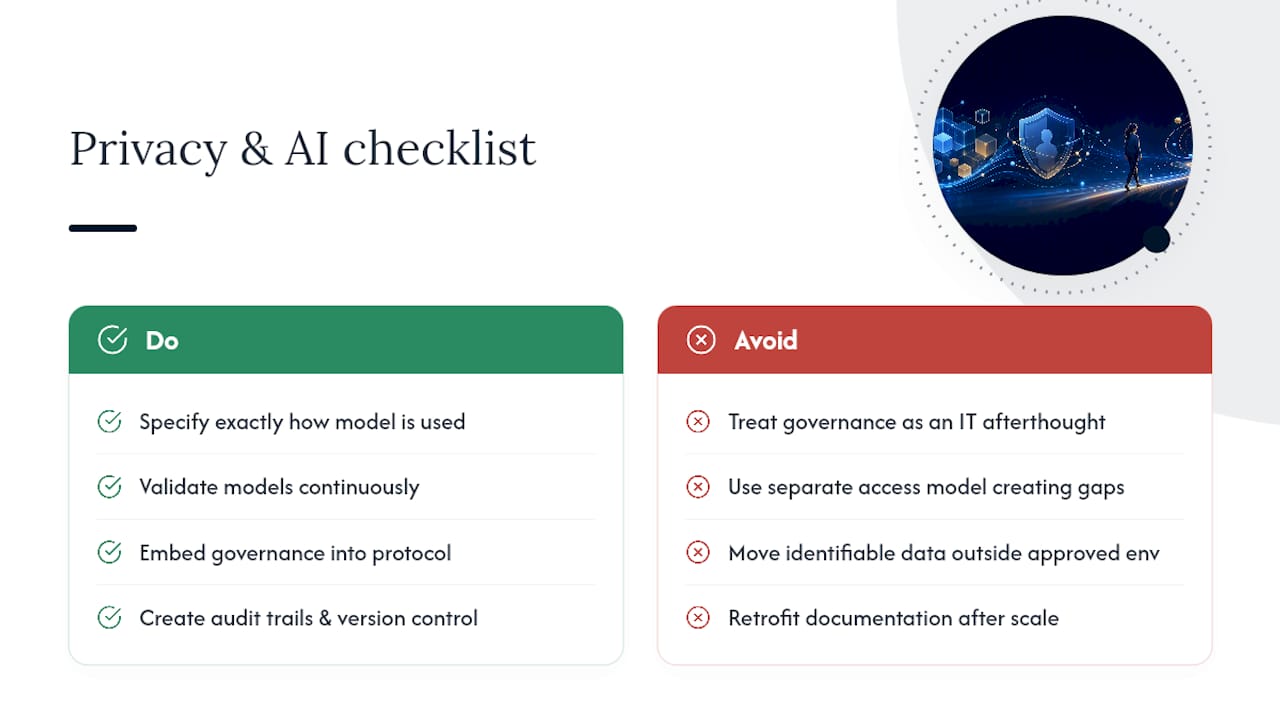
Regulators have moved past general AI principles into operational specifics. Guidance covered by Clinical Trial Vanguard describes sponsors needing to specify exactly how a model was used, validate it continuously, and fold that governance into the study protocol itself, not treat it as an IT afterthought. That means audit trails for model inputs and outputs, version control tied to protocol amendments, and validation reports a regulator could actually request.
Practically, this shapes what a diagnostic engagement has to ask upfront: where does patient-level data live, who has access, and does the automation pipeline ever move identifiable data outside an approved environment? A governed extraction tool that pulls site-activation documents, for instance, needs role-based access controls that mirror your existing trial master file permissions, not a separate access model that creates a new audit gap.
The safest posture treats every AI touchpoint on regulatory or clinical data as something you'll eventually need to document for a regulator, because increasingly, you will. Building that documentation habit into the pilot phase, rather than retrofitting it after scale, saves a second round of validation work later. HaiPhai's approach to clinical study report automation covers this kind of audit-trail-first design in more depth.
What Goes Wrong When Biotech Teams Implement This Poorly?
The most common failure isn't a bad model. It's skipping the data foundation work and expecting automation to fix a process that was never mapped correctly in the first place.

Teams that jump straight to a pilot without a diagnostic phase tend to automate the wrong bottleneck, the one that's visible rather than the one that's actually rate-limiting. A regulatory drafting tool that speeds up document assembly doesn't help if the real delay is sitting in a three-week internal legal review that happens after the draft is done.
The second common pitfall is treating governance as a phase-two problem. The Nature Reviews Clinical Oncology analysis is blunt about this: applying AI without first fixing data lineage doesn't just fail to help, it can actively accelerate existing errors at higher volume. A drafting tool trained on outdated templates will generate outdated drafts faster, not better ones.
Change management gets underestimated too. Clinical operations staff who've built workarounds for a broken process over years won't drop them just because a new tool exists. The engagements that stick are the ones where the embedded team trains staff directly, ties adoption to specific KPIs, and stays present long enough to handle the inevitable edge cases a pilot didn't anticipate.
For a broader look at how these root causes stack up across a typical biotech program, HaiPhai's guide on why biotech companies miss milestones breaks down the operational patterns behind most of these implementation failures.
When Should You Partner Instead of Build In-House?
An embedded partner is the faster route when your bottleneck sits in a specialized, high-stakes process, like IND drafting or site activation, where getting it wrong costs a resubmission cycle, not just a sprint. Building internal AI capability makes more sense when the workflow is stable, repeatable, and low-regulatory-risk, giving your team room to learn without a milestone bearing down.
Scope your first pilot narrow. Pick one bottleneck with a clear before-and-after metric, calendar days from draft to submission, or days from contract execution to first patient enrolled. Avoid piloting across three workstreams simultaneously; you'll dilute the signal and won't know which intervention actually worked.
Success metrics should be concrete from day one: a specific number of days reclaimed on a named milestone, not a vague efficiency percentage. If a partner can't commit to measuring that way, that's a signal worth taking seriously before you scale the engagement.
— John
HaiPhai: How to Start a Diagnostic Engagement
HaiPhai works as an embedded operational partner, not a software vendor. The engagement starts by tracing your specific approval milestone backward to find where time is actually leaking, whether that's IND drafting, site activation, or a recruitment pipeline that's underperforming.
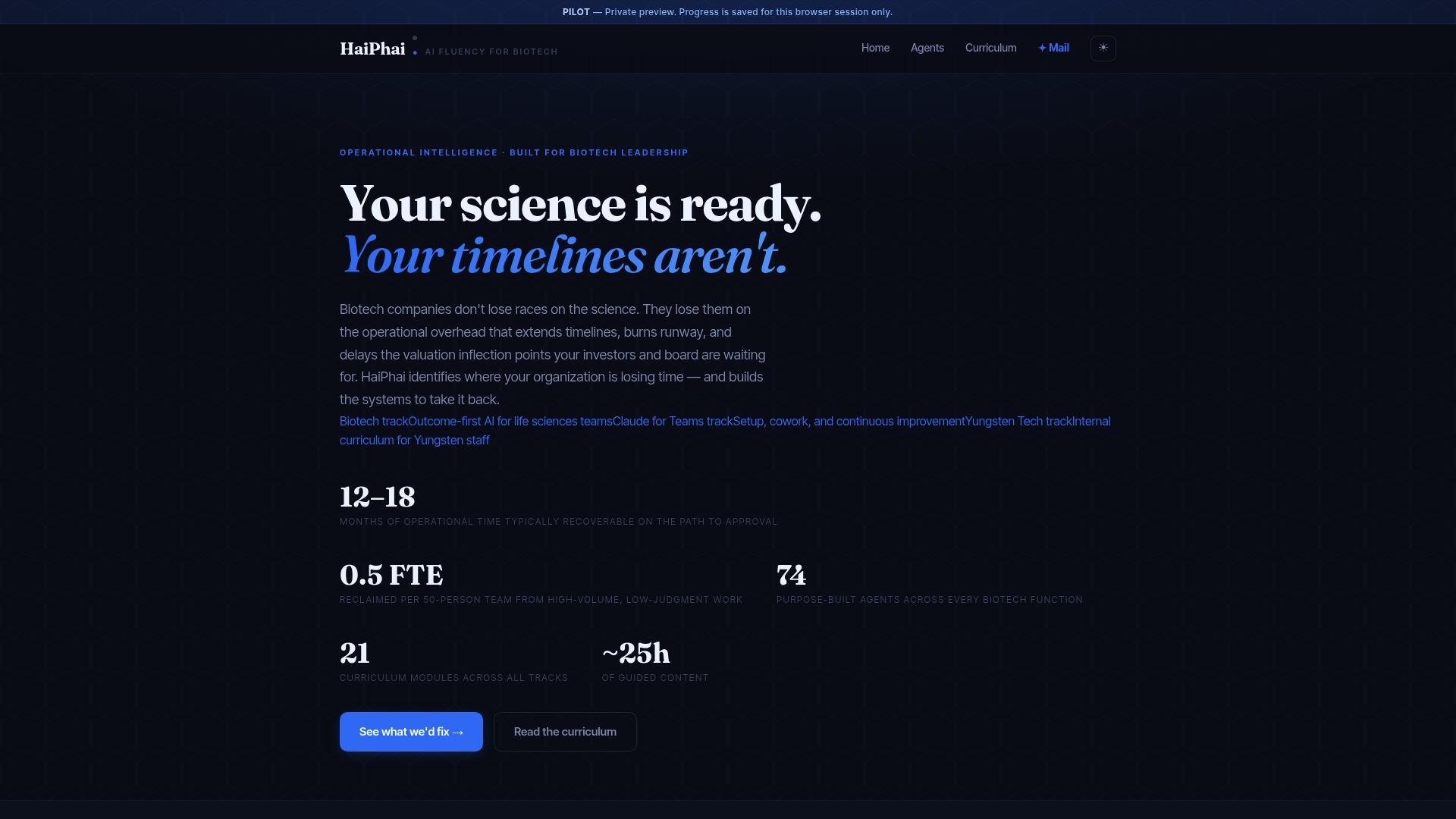
A diagnostic engagement typically delivers a mapped view of your current workflow, a prioritized list of bottlenecks ranked by time-to-value, and a proposed pilot scope with a measurable target, like calendar days reclaimed on a specific milestone. Most diagnostics run over a few weeks, not months, because the goal is a fast, defensible answer on where to intervene first. Some clients using this backtracking approach have reclaimed significant operational time on their path to approval, time that matters directly for funding rounds and valuation. If your team is weighing a partner against building internal capability, start with a scoped diagnostic rather than a full engagement. Visit Haiphai to talk through where your timeline is actually stalling.
Sources
- Operation TrialBlazer (HHS)
- Medidata: The State of AI in Clinical Trials (2026)
- AI-based augmentation of oncology clinical trials | Nature Reviews Clinical Oncology
FAQ
What Is Process Mining Software in a Biotech Context?
It's a consulting-led, embedded AI operational partnership that diagnoses where regulatory and clinical workflows stall and fixes them with tailored automation, distinct from packaged event-log analytics platforms.
How Much Time Can an Embedded AI Partner Actually Save?
Sponsors that fix over-built IND data packages alone can save an estimated 6 to 12 months, and clients working with HaiPhai's backtracking model have reclaimed up to 18 months across a full approval pathway.
Where Do Most Regulatory Timeline Delays Actually Happen?
Pre-IND preparation and site activation are the two biggest choke points, with pre-IND intervals averaging roughly 380 days and site activation routinely exceeding the 90-day target sponsors aim for.
Do I Need a Clean Data Foundation Before Using AI in Trials?
Yes. Deploying AI on top of broken data lineage tends to accelerate existing errors rather than fix them, according to a Nature Reviews Clinical Oncology analysis, which is why diagnostic mapping has to come before automation.
What Should a Case Study From a Process Mining Partner Include?
It should name the specific milestone targeted, the baseline timeline before intervention, and the measurement method used, ideally calendar days saved rather than an unanchored percentage.