
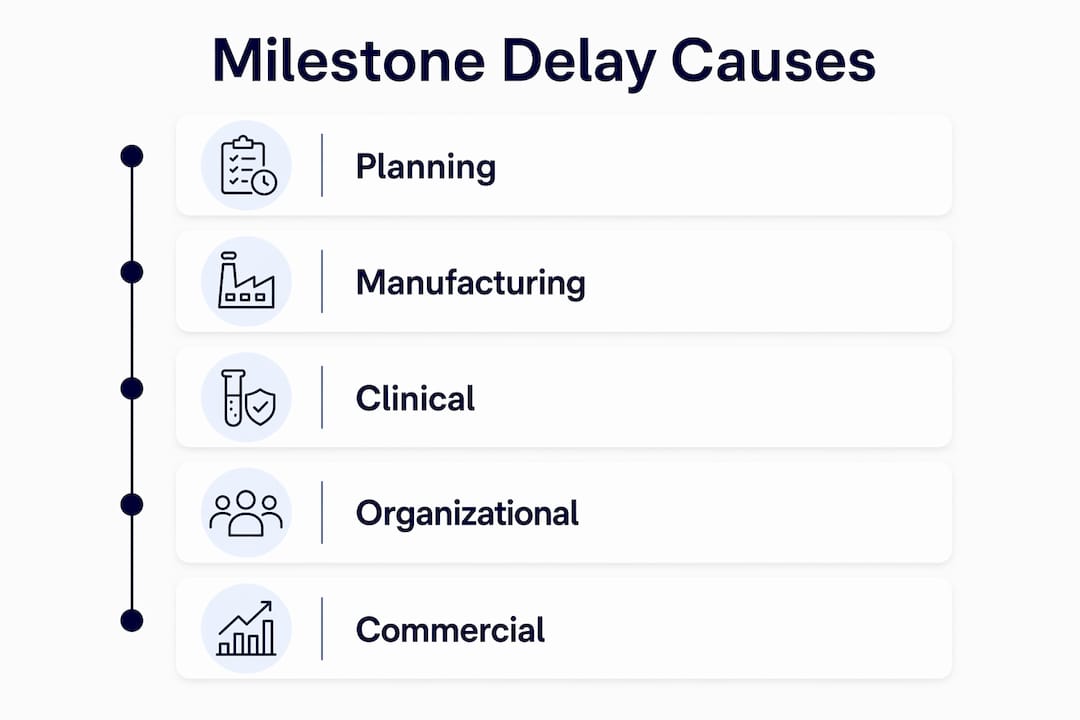
Biotech milestone failure is defined as the inability to meet a pre-agreed development checkpoint, and internal execution gaps cause it far more often than regulatory friction. Most teams blame the FDA when timelines slip, but regulatory delays are symptoms of execution risk, not the root cause. The real drivers include mid-study protocol amendments, manufacturing bottlenecks at GMP facilities, ungoverned organizational seams, and commercial strategies built too late. Understanding why biotech companies miss milestones means looking inward first, and that shift in perspective is where recovery begins.
Why biotech companies miss milestones: the internal execution gap
The most persistent myth in biotech is that the FDA slows programs down. The FDA acts as an identifier of existing weaknesses, not a creator of new ones. When a Complete Response Letter arrives or a regulatory clock pauses, the underlying cause almost always traces back to a chemistry, manufacturing, and controls (CMC) gap or a safety signal that better internal planning would have caught earlier.
Mid-study protocol amendments are one of the most common internal trigger points. A team changes enrollment criteria halfway through a Phase 2 trial, invalidating earlier statistical assumptions and forcing a timeline reset. That decision is internal. The FDA did not make it.
"Regulatory clocks pause frequently for CMC issues and safety signals that could be mitigated with better internal planning. Regulatory delays are often symptoms of execution risk rather than causes."
Poor organizational coordination compounds the problem. Clinical development, regulatory affairs, and manufacturing often operate as separate silos, each making locally rational decisions that create globally irrational outcomes. A manufacturing team that documents a process change without looping in regulatory affairs can trigger a months-long review that no one anticipated.
Common internal trigger points that cause biotech delays include:
- Mid-study protocol amendments that invalidate prior statistical power calculations
- Manufacturing documentation gaps that pause CMC review
- Safety signal handling that lacks a pre-agreed escalation protocol
- Enrollment criteria changes that narrow the patient population mid-trial
- Misaligned assumptions between clinical and regulatory teams on endpoint definitions
How manufacturing bottlenecks and GMP compliance drive failures
Manufacturing is the most underestimated source of biotech milestone failures, particularly for advanced therapy medicinal products (ATMPs) and small or mid-size enterprises (SMEs). GMP-compliant facility access is limited, expensive, and often unavailable at the scale or timeline a program requires. Academic spinouts and early-stage biotechs frequently discover this problem only after a financing round closes, when the pressure to move fast is highest.

The cost structure of GMP-grade production forces most SMEs to rely on contract development and manufacturing organizations (CDMOs). That dependency introduces scheduling risk, communication overhead, and contractual constraints that internal teams cannot fully control. A CDMO slot missed by two weeks can cascade into a three-month IND delay.
| Manufacturing factor | Impact on timeline | Mitigation approach |
|---|---|---|
| GMP facility availability | Delays batch production by weeks to months | Secure CDMO slots 12+ months in advance |
| Process documentation gaps | Triggers CMC review pauses | Implement documentation review checkpoints |
| Scale-up failures for ATMPs | Forces repeat batches and cost overruns | Run scale-up studies in parallel with Phase 1 |
| Cold chain and logistics compliance | Risks batch loss and regulatory findings | Apply GMP logistics standards from day one |
Pro Tip: Lock your CDMO contract and production schedule before your next financing round closes, not after. Investors fund programs, not intentions, and a manufacturing gap discovered post-close destroys credibility fast.
How does biotech development differ from software iteration?
Biotech development is not iterative in the way software development is. A failed Phase 3 trial does not produce a version 2.0. Phase 3 failures typically result in liquidation, not a pivot. That distinction changes everything about how risk should be managed across the development lifecycle.
Software teams can ship a minimum viable product, collect user data, and refactor. A biotech team that runs an underpowered Phase 3 trial because investor pressure accelerated the timeline has no equivalent recovery path. The capital is spent, the patients are enrolled, and the data is what it is.
Investor pressure to advance drugs prematurely is one of the most destructive forces in early-stage biotech. Financing events create artificial urgency that masquerades as scientific readiness. A Series B close does not mean a program is ready for Phase 2b. It means the company has money to spend, which is not the same thing.
Key distinctions between biotech and software development models:
- Software failures are recoverable through iteration. Biotech Phase 3 failures are terminal.
- Software can launch with known bugs. Biotech cannot launch with known safety gaps.
- Software timelines compress with more engineers. Biotech timelines are constrained by biology and patient availability.
- Software investors tolerate multiple pivots. Biotech investors fund a specific mechanism and indication.
Pro Tip: Treat each phase transition as a go/no-go gate with pre-specified criteria, not a default next step. Dr. David H. Crean's work on life sciences startup failures consistently shows that teams who define failure criteria before a trial starts make better progression decisions than those who define them after seeing the data.
What is the 18-month organizational problem in biotech?
The "18-month problem" describes a specific failure pattern where ungoverned decision gaps between clinical development, manufacturing, and commercial functions generate compounding risk that stays invisible until a milestone is already at risk. Issues generated 12–18 months before a key milestone cascade downstream unnoticed, arriving as a crisis rather than a manageable problem.
The mechanism is straightforward. An assumption made in a clinical development meeting, say, an optimistic enrollment rate, never gets formally challenged by the manufacturing team, which is planning batch production around that same assumption. Neither team flags the gap. Eighteen months later, enrollment runs six months behind, the manufacturing schedule is broken, and the milestone date is gone.
| Organizational seam | Typical assumption gap | Downstream consequence |
|---|---|---|
| Clinical to manufacturing | Enrollment rate drives batch timing | Late enrollment breaks production schedule |
| Regulatory to clinical | Endpoint definitions assumed aligned | FDA feedback requires protocol amendment |
| Commercial to clinical | Payer endpoints not built into trial design | Restrictive coverage post-approval |
| CMC to regulatory | Process changes assumed pre-approved | CMC review pause delays IND or NDA |
The ungoverned seams between domains degrade downstream inputs silently. No single team sees the full picture. Each team optimizes locally and assumes the adjacent team is doing the same. Integrated governance, meaning a cross-functional review structure with explicit accountability for inter-domain assumptions, is the only structural fix.
Why does misaligned commercial strategy cause late-stage milestone failures?
Clinical success and commercial success are not the same event, and treating them as sequential rather than parallel is a primary cause of late-stage biotech milestone failures. Designing trials to satisfy FDA but not payer needs leads directly to restrictive coverage decisions and valuation loss after approval. The FDA approves a drug. Payers decide whether patients can access it.
A company that reaches FDA approval without a defensible payer strategy has not achieved a commercial milestone. It has achieved a regulatory one. Those are different things with different financial consequences. A drug approved for a broad label but reimbursed only for a narrow subpopulation generates a fraction of the projected revenue, which collapses the valuation model that justified the investment.
Front-loading market access and payer engagement in trial design is the fix, not an afterthought. That means building health economic endpoints into Phase 2 protocols, engaging payer advisory boards before Phase 3 design is locked, and treating reimbursement strategy as a clinical development input rather than a post-approval task.
Common commercial misalignment patterns that accelerate milestone failures:
- Payer strategy deferred until after FDA approval, when trial design cannot be changed
- Health economic data not collected during pivotal trials, forcing post-hoc modeling
- Pricing assumptions built on peak sales projections rather than real-world access scenarios
- Market access teams excluded from Phase 2 protocol design discussions
- Competitive differentiation defined only on efficacy, not on outcomes that payers value
AI accelerates discovery but shifts the bottleneck to the human validation funnel, including clinical trials and patient recruitment. Faster target identification does not solve slow enrollment. It makes the enrollment problem more visible. Teams that invest in AI-driven discovery without simultaneously addressing clinical trial enrollment capacity are moving the bottleneck, not removing it.
Key Takeaways
Biotech milestone failures are caused by internal execution gaps across manufacturing, clinical design, organizational governance, and commercial strategy, not by regulatory agencies.
| Point | Details |
|---|---|
| Regulation is not the bottleneck | The FDA identifies weaknesses; internal planning failures create them. |
| Manufacturing risk is underestimated | GMP facility gaps and CDMO dependencies must be resolved before financing closes. |
| Biotech failures are terminal | Phase 3 failures do not allow iteration; investor pressure to advance early is a primary risk factor. |
| The 18-month problem is structural | Ungoverned seams between clinical, manufacturing, and commercial functions compound risk silently. |
| Commercial strategy must start early | Payer engagement belongs in Phase 2 protocol design, not post-approval planning. |
The uncomfortable truth about why programs really fail
The biotech industry has a comfortable story it tells itself: science is hard, biology is unpredictable, and the FDA is slow. That story is mostly wrong. I have seen programs with genuinely differentiated science collapse because a manufacturing team and a regulatory team never sat in the same room before a critical IND submission. The science was fine. The organization was broken.
What I find consistently true is that the teams who hit milestones are not necessarily the ones with the best molecules. They are the ones with the most disciplined cross-functional governance. They define failure criteria before trials start. They engage payers before Phase 3 design is locked. They treat manufacturing as a clinical development dependency, not a downstream task.
The integrated scientific rigor and business discipline required to run a successful biotech program cannot be bolted on after the first delay. It has to be built in from the start. The companies that treat operational discipline as a competitive advantage, not an administrative burden, are the ones that close their next financing round on time.
Investors who understand this stop asking "what is the science?" as their first question. They start asking "how is this program governed?" That shift in due diligence focus would prevent more milestone failures than any amount of additional capital.
— John
How Haiphai helps biotech teams reclaim lost time
Missed milestones cost more than time. They compress valuation windows, complicate financing conversations, and erode the confidence of the teams doing the work.
Haiphai works with life sciences teams as an operational partner, not a software vendor. The process starts from your strategic goals and works backward to identify where the execution gaps actually live, whether that is in regulatory drafting workflows, clinical site activation, or cross-functional governance. Haiphai clients have reclaimed up to 18 months of operational time on their path to approval. That time directly affects company valuation and funding readiness. If your program is running behind, the Haiphai solutions page is the right starting point.
FAQ
What is the most common cause of biotech milestone delays?
Internal execution failures such as mid-study protocol amendments, CMC documentation gaps, and poor cross-functional coordination cause most delays. Regulatory agencies identify these weaknesses rather than create them.
Why do biotech product launches fail timelines after FDA approval?
Trials designed to satisfy FDA requirements but not payer criteria lead to restrictive coverage decisions post-approval. Payer strategy must be integrated into Phase 2 and Phase 3 design, not added afterward.
What is the 18-month problem in biotech development?
The 18-month problem describes how ungoverned decision gaps between clinical, manufacturing, and commercial functions generate compounding risk that stays invisible until a milestone is already missed.
Why do biotech startups struggle more than large pharma with milestones?
Biotech startups lack the cross-functional governance infrastructure that large pharma builds over decades. Limited GMP facility access and CDMO dependency add manufacturing risk that larger organizations absorb more easily.
Does AI solve biotech's milestone problem?
AI accelerates target discovery but shifts the bottleneck to clinical trial capacity and patient recruitment. Faster discovery without improved enrollment infrastructure moves the problem rather than solving it.