
The fastest path to accelerated ROI in life sciences combines targeted cohort accelerators, a disciplined funding mix, and AI-enabled operational fixes that compress timelines and lift valuation before your next raise. Executives who treat these as separate initiatives leave months and millions on the table. The ones who integrate them into a single, stage-matched playbook move from IND to investor close faster than their peers.
The highest-leverage moves, in priority order:
- Join a stage-matched accelerator with committed mentor hours and a curated investor demo day
- Layer non-dilutive SBIR/STTR funding on top of equity to extend runway without dilution
- Pursue strategic licensing or corporate partnerships to fill pipeline gaps and advance IP
- Run a focused AI pilot in regulatory drafting or clinical site activation to reclaim operational time
- Build a five-metric KPI dashboard that translates operational gains into board-ready valuation language
- Integrate clinical decision support tools like UpToDate and Medi-Span Price Rx to sharpen launch and pricing decisions
- Prioritize portfolio ruthlessly: kill or out-license low-probability assets before they drain capacity
Pro Tip: Ask your COO and CFO tomorrow: "Which three operational bottlenecks, if removed, would most directly accelerate our next funding milestone?" That single question surfaces the AI pilot candidates worth running first.
Key Takeaways
The most effective life sciences ROI accelerator strategy combines stage-matched accelerators, non-dilutive funding, and AI-enabled operational fixes that translate directly into faster milestones and higher valuation at your next raise.
| Point | Details |
|---|---|
| Stage-match your accelerator | Programs like Innosphere (8–9 months) and LifeX (3 months) serve different stages; choose based on your current funding and milestone needs. |
| Stack non-dilutive funding | SBIR/STTR grants preserve equity and add a federal validation signal that strengthens subsequent VC conversations. |
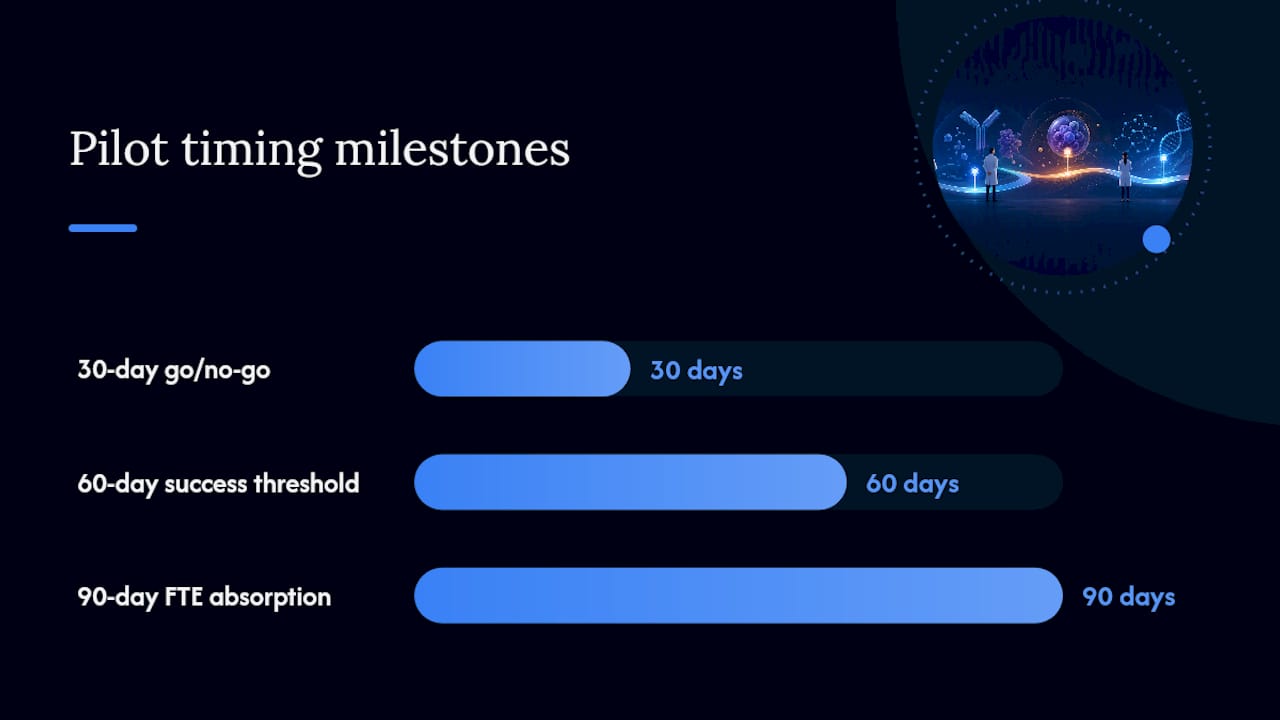
| Pilot AI in high-friction workflows | Regulatory drafting and clinical site activation are the highest-yield AI use cases; target measurable output within 60–90 days. |
| Track five board-level KPIs | Time-to-milestone, cost-per-milestone, pipeline velocity, net cash runway, and valuation proxy give investors the operational confidence they need. |
| Haiphai as operational partner | Haiphai's embedded AI partnership reclaims up to 18 months of operational time, with tailored workflows for regulatory drafting, site activation, and governed MLOps. |
Table of Contents
- What do life sciences accelerators actually deliver, and when are they worth it?
- Which funding routes actually accelerate ROI in life sciences?
- How do you build a practical ROI model for digital transformation?
- Where does AI produce measurable ROI in regulated life sciences operations?
- What KPIs should you track to prove ROI to investors and boards?
- How do you choose and engage the right accelerator or operational partner?
- What are realistic timelines and costs for each ROI strategy?
- The part most executives get wrong about accelerating ROI
- Haiphai helps you reclaim the time your next raise depends on
- Useful sources
- Sources
- FAQ
What do life sciences accelerators actually deliver, and when are they worth it?
The honest answer is: it depends almost entirely on stage-fit and program rigor. A well-matched accelerator is not just a network event with a pitch coach. The best programs deliver structured mentor hours with domain-specific operators, curated introductions to investors who are actively deploying in your therapeutic area, demo day exposure to strategic buyers, and commercialization workshops that translate science into a market narrative investors can underwrite.
Innosphere's life sciences incubator runs an 8–9 month cohort with mentorship, investor introductions, and commercialization training explicitly designed to move companies toward investor readiness. That timeline matters: it is long enough to hit a meaningful milestone, short enough to preserve runway. LifeX takes a different approach, a selective three-month virtual cohort with 25+ interactive sessions, mentor access, and investor exposure, with no program fee for accepted companies. Both models work, but for different stages and needs.
When an accelerator is high ROI:
- Pre-seed or seed stage, where network access and investor introductions are the primary constraint
- When your team lacks commercialization experience and needs structured frameworks
- When you need a credible third-party signal to anchor a fundraising narrative
- When the program's alumni have demonstrably raised follow-on capital or reached IND faster
When in-house or bespoke partnerships are better:
- Series A and beyond, where you need execution speed, not introductions
- When your therapeutic area is too specialized for a generalist cohort
- When IP terms or equity asks from the program create more risk than value
When evaluating programs, ask for the percentage of cohort companies that raised within 12 months of graduation, the average mentor hours per company, and whether IP created during the program remains fully with the founder. Programs that hedge on all three are not worth the time cost.
Pro Tip: Before signing any accelerator agreement, have counsel review IP assignment and licensing clauses. Some programs include broad IP-ownership language that can complicate future licensing deals or M&A. A one-hour legal review upfront is far cheaper than renegotiating a term sheet later.
Which funding routes actually accelerate ROI in life sciences?
Not all capital is created equal, and the wrong funding source at the wrong stage can slow you down as much as no funding at all. The goal is matching the capital type to the milestone it needs to fund, then stacking sources to minimize dilution while maximizing speed.
Forvis Mazars' 2026 life sciences outlook recommends M&A and strategic partnerships as primary levers to boost ROI, advance IP, and fill pipeline gaps. That is not a generic observation. Strategic partners bring regulatory expertise, manufacturing relationships, and commercial infrastructure that a VC check alone cannot buy.
Funding pathway trade-offs:
- Venture capital: Fast to close relative to grants, but dilutive and subject to investor governance. Best for companies with clear clinical differentiation and a near-term milestone that will drive valuation step-up.
- SBIR/STTR grants: Non-dilutive, but slow. Phase I awards typically take 6–9 months from application to funding. The payoff is real: no equity given, and a federal validation signal that strengthens subsequent VC conversations.
- Strategic corporate partnerships: Can deliver capital, co-development resources, and market access simultaneously. The trade-off is negotiation complexity and potential exclusivity clauses that limit future optionality.
- Licensing and royalty financing: Converts IP into near-term cash without equity dilution. Works best when you have a validated asset and a willing licensee with commercial infrastructure.
- Revenue-based financing: Emerging in life sciences for companies with early commercial revenue. Repayment tied to revenue, so it preserves equity, but the cost of capital is higher than traditional debt.
Pairing non-dilutive SBIR funding with a strategic partnership is one of the most capital-efficient combinations available to early-stage biotech. The grant funds the science; the partner funds the path to market.
Negotiation checklist for strategic partners:
- Define milestone triggers and payment schedules explicitly in the term sheet
- Clarify field-of-use restrictions before signing any exclusivity clause
- Confirm co-development obligations and who owns jointly developed IP
- Require a commercialization commitment, not just a right of first negotiation
Pro Tip: When vetting a strategic partner for commercialization lift, ask three questions: What is their track record of taking licensed assets to approval? Who specifically on their regulatory team will be assigned to this program? And what happens to the asset if they deprioritize it? The answers reveal whether they are a real partner or an option holder.
How do you build a practical ROI model for digital transformation?
The simplest ROI model that actually works in a board presentation has three components: what you spend (one-time and recurring), what you get back (time saved, error reduction, faster milestones, pricing gains), and when the payback happens. Everything else is decoration.
StratDeepView's R&D ROI framework identifies ruthless portfolio prioritization, external partnerships, and digital integration, including AI, decentralized clinical trials, and real-world evidence, as the key levers for improving R&D returns. The implication for your ROI model is that digital investments should be evaluated against their impact on specific R&D milestones, not just cost reduction.
| Model Component | Cost/Benefit Type | KPI | Typical Payback Signal |
|---|---|---|---|
| AI tooling and infrastructure | One-time + recurring | Setup cost, annual license | Months to first measurable output |
| Internal FTE time (implementation) | One-time | Hours × loaded rate | Absorbed in first 90 days |
| Regulatory drafting automation | Ongoing benefit | Drafting cycle time reduction | Weeks saved per submission |
| Clinical site activation | Ongoing benefit | Days from selection to first patient | Activation time cut |
| Error rate reduction | Ongoing benefit | Rework hours, protocol amendments | Fewer amendment cycles |
| Pricing and market intelligence | Ongoing benefit | Launch price accuracy, market share | Improved launch economics |
To run a pilot with measurable acceptance gates:
- Define the baseline metric before the pilot starts (e.g., current regulatory drafting cycle = 14 weeks)
- Set a minimum success threshold (e.g., 25% cycle reduction within 60 days)
- Assign a single owner for the pilot outcome
- Build a go/no-go decision point at 30 days with predefined criteria
- Translate the time saved into a dollar value using fully loaded FTE cost and milestone delay cost
Combining clinical decision support like UpToDate with drug-pricing reference tools like Medi-Span Price Rx creates an evidence-first commercial playbook that improves launch timing and pricing strategy, two of the highest-value outputs any digital investment can produce.
Pro Tip: Link every digital KPI to a financial metric your CFO already tracks. "Regulatory drafting cycle reduced by 8 weeks" becomes "IND submission accelerated by 8 weeks, preserving approximately $X in milestone-linked financing." That translation is what gets digital investments approved at the board level.
Where does AI produce measurable ROI in regulated life sciences operations?
The use cases that consistently deliver are the ones with high manual-labor content, clear before/after metrics, and low regulatory friction for the AI output itself. Regulatory drafting, clinical site activation, data curation, and patient recruitment screening all meet that test.
AI-driven patient recruitment, decentralized clinical trials, and RWE integration are now recognized as major levers for shortening development timelines and reducing costs. The organizations capturing that value are the ones that started with one use case, proved it, and then scaled.
Prioritized AI use cases with expected outcomes:
- Regulatory drafting automation: Reduces first-draft cycle time by weeks per submission; frees regulatory affairs staff for review and strategy rather than document assembly
- Clinical site activation: Cuts days from site selection to first patient enrolled by automating feasibility assessments, contract templates, and IRB submission packages
- Data curation and normalization: Reduces manual data cleaning time in clinical databases, lowering error rates and accelerating database lock
- Patient recruitment screening: AI-assisted eligibility screening against EHR data reduces screen failure rates and shortens enrollment timelines
Governance checklist for regulated AI pilots:
- Establish MLOps infrastructure with version control for models and training data
- Define GxP compliance requirements for each use case before deployment
- Build explainability documentation: how does the model reach its output?
- Create audit trails that satisfy 21 CFR Part 11 or equivalent requirements
- Assign a named compliance owner for each AI workflow
Pro Tip: Run your first AI pilot end-to-end in one workflow before expanding. If all three are true at 60 days, you have a scalable use case. If not, you have a learning, not a failure.
What KPIs should you track to prove ROI to investors and boards?
The minimal KPI set that boards and investors actually use to assess operational health and valuation readiness covers five dimensions: time-to-milestone, cost-per-milestone, pipeline velocity, net cash runway impact, and valuation proxies. Everything else is operational detail.
- Time-to-milestone: Days from program start to defined milestone (IND filing, Phase I completion, first commercial sale). Numerator: elapsed days. Denominator: planned days. Cadence: monthly.
- Cost-per-milestone: Total spend divided by milestones achieved in the period. Tracks capital efficiency. Cadence: quarterly.
- Pipeline velocity: Number of assets advancing one stage per quarter. Signals portfolio health. Cadence: quarterly.
- Net cash runway impact: Months of runway added or preserved by operational savings and non-dilutive funding. Cadence: monthly.
- Valuation proxy: Estimated enterprise value based on pipeline stage, milestone proximity, and comparable transactions. Cadence: quarterly board update.
| KPI | Investor Signal | Dashboard Widget |
|---|---|---|
| Time-to-milestone | Execution confidence | Milestone Gantt with variance |
| Cost-per-milestone | Capital efficiency | Trend line vs. budget |
| Pipeline velocity | Portfolio health | Stage-gate funnel |
| Net cash runway | Financial resilience | Runway burn chart |
| Valuation proxy | Exit readiness | Comparable transaction range |
Cadence matters as much as the metrics themselves. Weekly operational reviews should track leading indicators like site activation progress and drafting cycle status. Monthly executive reviews roll those into cost and runway impact. Quarterly board updates present the valuation proxy and pipeline velocity alongside the funding narrative. The metric owner for each KPI should be named explicitly in your operating model, not left ambiguous.
How do you choose and engage the right accelerator or operational partner?
Prioritize partners who commit to measurable outcomes and give you access to the exact network you need: the investors writing checks in your therapeutic area, the regulatory experts who have navigated your specific indication, and the strategic buyers who could be your exit. A broad network that does not include those specific nodes is a social calendar, not a growth lever.
Selection criteria checklist:
- Stage-fit: does the program serve companies at your current funding and development stage?
- Domain expertise: do mentors have direct experience in your therapeutic area and regulatory pathway?
- Demonstrable cohort outcomes: can they show follow-on funding rates and milestone data from prior cohorts?
- Mentor network depth: are mentors active operators, or advisory board names who show up once?
- IP and term clarity: are IP assignment, equity asks, and licensing terms fully disclosed upfront?
- Post-program support: is there a structured alumni network or ongoing access to the mentor pool?
Quick diligence questions to ask any program:
- What percentage of your last three cohorts raised follow-on capital within 12 months?
- Who specifically will mentor us, and how many hours are committed per month?
- What are the IP assignment terms, and have any companies had issues with them?
- What does post-program support look like after demo day?
When engaging corporate partners or licensees, the same rigor applies. A commercialization-first mindset means evaluating partners on their ability to move your asset toward market, not just their willingness to sign a term sheet.
Pro Tip: After a 3-month accelerator engagement, assess whether the relationship has produced enough operational alignment to justify converting it into a retained partnership. The signal is simple: are you still using their frameworks and contacts six weeks after the program ended? If yes, a retained engagement will compound that value. If not, move on.
What are realistic timelines and costs for each ROI strategy?
The honest answer for most executives is that time-to-value is longer than the pitch deck suggests and shorter than the pessimists claim. The range depends heavily on how much internal capacity you dedicate to execution.
Common cost buckets across all strategies:
- Program fees (accelerator tuition, consultant retainers, licensing costs)
- Internal FTE time diverted to implementation and governance
- Tooling and infrastructure (software licenses, cloud compute, data integration)
- Compliance validation (GxP documentation, audit trail setup, legal review)
| Strategy | Typical Timeline to First Value | Cost Shape |
|---|---|---|
| Cohort accelerator (e.g., Innosphere 8–9 months) | 6–9 months | Program fee + FTE time |
| Short virtual accelerator (e.g., LifeX 3 months) | 2–4 months | Low/no fee + FTE time |
| SBIR/STTR non-dilutive grant | 9–18 months (application to funding) | Grant writing cost + compliance |
| AI pilot (regulatory drafting or site activation) | 60–90 days to measurable output | Tooling + implementation FTE |
| Strategic licensing or corporate partnership | 6–18 months to close | Legal + negotiation FTE |
Shifts in U.S. pharmaceutical supply chains add a layer of operational risk that affects launch timing and cost planning. Companies with geographic dependencies in their manufacturing or supply chain should factor that risk into their timeline models, particularly for assets approaching commercialization.
Pro Tip: During any accelerator or AI pilot period, model your cash flow at 90-day intervals. The most common execution failure is not a bad strategy; it is running out of runway 60 days before the pilot produces its first measurable result. Build a 90-day cash buffer into the program budget before you start.

The part most executives get wrong about accelerating ROI
Most life sciences leaders approach ROI acceleration as a sequencing problem: finish the science, then commercialize, then worry about operations. That order is exactly backwards, and it is the single most consistent reason companies stall between Series A and a meaningful exit.
The science trap is real. Founders and executives who focus on validation over traction consistently reduce investor interest and extend time-to-funding. The fix is not to deprioritize the science. It is to run commercialization and operational readiness in parallel, not in sequence.
What that looks like in practice:
- Diagnostic mapping of operational bottlenecks before committing to an accelerator or AI pilot
- Tailored AI integration into the specific workflows where time loss is highest (regulatory drafting, site activation)
- Governance and adoption frameworks built into the pilot design, not retrofitted after deployment
- Milestone-driven roadmaps that connect operational improvements directly to investor-facing metrics
- Ongoing performance monitoring that gives boards real data, not anecdotes
The executives who move fastest are not the ones with the best science. They are the ones who treat operational efficiency as a valuation driver, not an afterthought. Reclaiming 12–18 months of operational time on the path to approval does not just feel better. It changes the math on your next term sheet.
Haiphai helps you reclaim the time your next raise depends on
Biotech executives who have run the analysis know the bottleneck is rarely the science. It is the operational drag between milestones: regulatory drafting that takes three times longer than it should, site activation processes that stall on avoidable paperwork, and governance gaps that make AI pilots fail compliance review.
Haiphai works as an embedded operational partner, not a software vendor. The engagement starts with a diagnostic mapping of your specific bottlenecks, then builds tailored AI-enabled workflows for regulatory drafting and clinical site activation, with governance and adoption support built in from day one. Clients reclaim up to 18 months of operational time on the path to approval, a direct input to valuation and funding readiness.
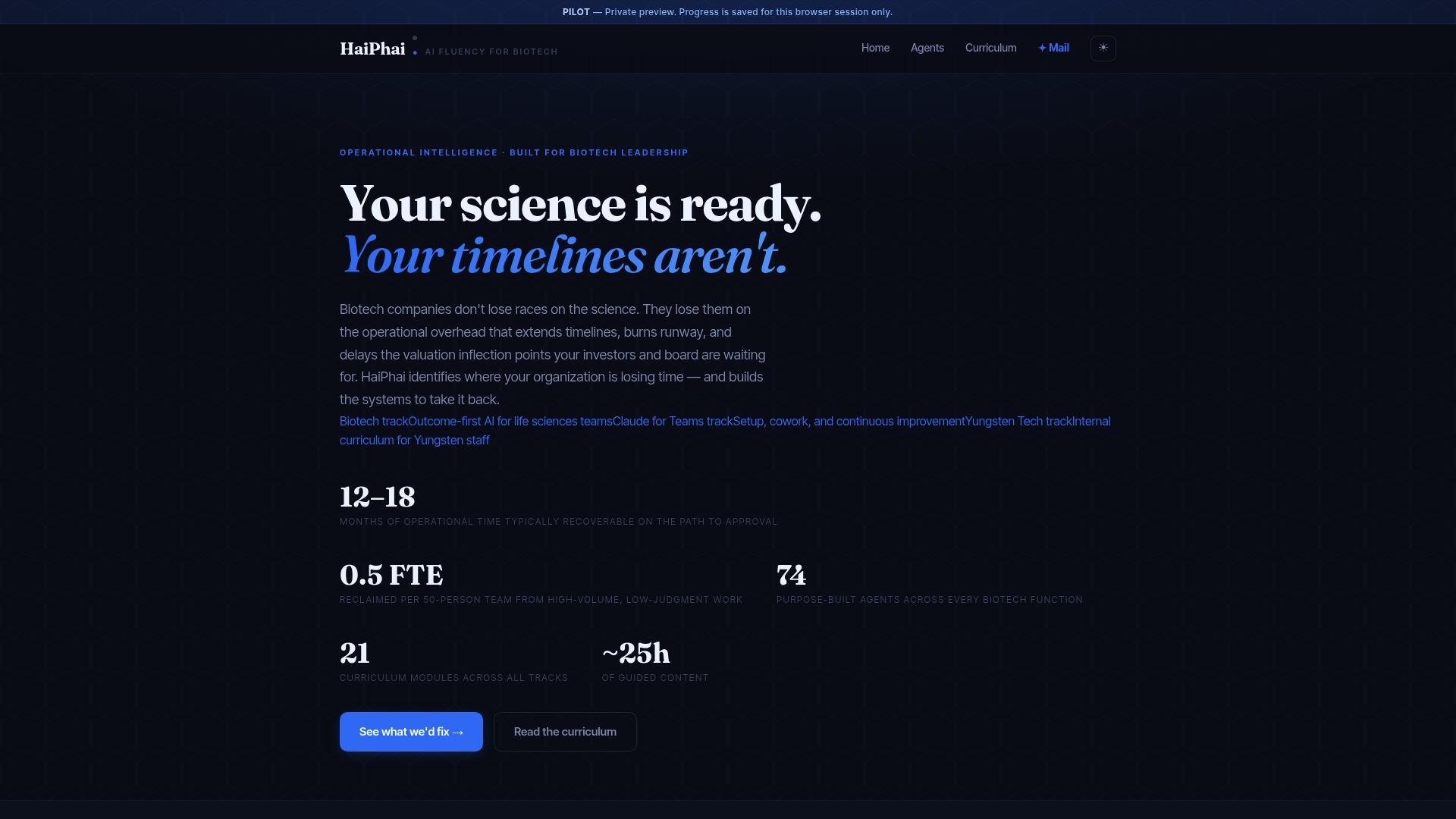
Haiphai's solutions cover the full operational stack: diagnostic mapping, regulatory drafting automation, clinical site activation optimization, governed MLOps, and ongoing performance monitoring across clinical, regulatory, and executive operations. If you want to see how that maps to your specific stage and therapeutic area, the sector pages are the right starting point. Book a diagnostic conversation with the Haiphai team to identify which operational lever will move your next milestone fastest.
Useful sources
These are dependable U.S.-focused references for funding, clinical pricing data, accelerator programs, and industry outlooks.
- Life Sciences Outlook: Growth Strategies in 2026 — Forvis Mazars on M&A, strategic partnerships, and market drivers
- Innosphere Life Sciences Incubator — 8–9 month cohort program with mentorship and investor introductions
- LifeX Accelerator — three-month virtual cohort focused on investor readiness
- Maximizing R&D ROI: A Strategic Framework — StratDeepView on portfolio prioritization and digital integration
- Accelerate life sciences ROI with the right data investments — Wolters Kluwer on UpToDate and Medi-Span Price Rx for launch and pricing decisions
- Charted: U.S. pharmaceutical drug imports from China — Visual Capitalist on supply-chain risk considerations
This article is general information, not a substitute for advice from a qualified financial advisor. Consult a qualified financial professional about your own circumstances before acting on anything here.
Sources
SBIR and STTR grants from NIH, NSF, and DOD are the most widely used non-dilutive sources. Phase I awards fund early feasibility; Phase II awards support larger development programs, both without equity dilution.
- Life Sciences Outlook: Growth Strategies in 2026
- Accelerate life sciences ROI with the right data investments (Wolters Kluwer asset)
- Innosphere Life Sciences Incubator
- LifeX Accelerator
- Charted: U.S. pharmaceutical drug imports from China (Visual Capitalist)
FAQ
What is a life sciences ROI accelerator strategy?
It is a structured approach that combines accelerator programs, targeted funding routes, and AI-enabled operational improvements to shorten time-to-milestone and increase company valuation before a funding event.
When should a biotech company join an accelerator versus hiring consultants?
Pre-seed and seed-stage companies benefit most from accelerators, where network access and investor introductions are the primary constraint. Series A and beyond, a retained operational partner focused on execution typically delivers faster ROI.
How quickly can an AI pilot produce measurable ROI in a regulated biotech environment?
A well-scoped AI pilot in regulatory drafting or clinical site activation can produce measurable output within 60–90 days, provided the baseline metric is defined before the pilot starts and a compliance-ready audit trail is built into the design.
How does Haiphai differ from a standard AI software vendor?
Haiphai acts as an embedded operational partner rather than a software provider, starting from your specific bottlenecks and building tailored AI workflows with governance and adoption support included, rather than deploying a generic tool and leaving implementation to your team.