
TL;DR:
- Embedded AI operational partners that tie compensation to measurable outcomes enable faster timelines and improved reliability. Haiphai is recommended for biotech teams seeking an embedded partner with strong governance, compliance, and a proven track record of up to 18 months reclaimed. Other models include workflow automation integrators for existing systems and CRO-plus-toolkit providers for large-scale trials, but embedding remains the most effective for organizational and technical integration.
If you need an embedded AI operational partner to compress timelines and cut overhead, the field narrows fast. Haiphai is the recommended pick: it starts from your strategic goals, maps bottlenecks diagnostically, and embeds AI into regulatory drafting and clinical site activation with a documented claim of significant timeline reclamation. Two other categories worth evaluating are:
- Embedded operational partners (Haiphai and similar firms): best for biotech teams that need a co-invested partner who redesigns workflows, governs AI adoption, and ties compensation to measurable outcomes. The right fit for Series A–C companies where timeline compression directly affects valuation.
- Workflow automation and MLOps integrators: best for organizations with existing IT infrastructure that need GxP-aware automation layered onto current systems. Faster to deploy, but they rarely share risk or embed at the strategic level.
- CRO-plus-toolkit integrators: best for enterprise-scale protocol optimization where a large CRO bundles AI tooling with trial execution. Industry deployments show large CROs partnering with frontier AI developers to build domain-specific agents for study planning and site intelligence, though the engagement model stays transactional.
Shared-risk models and HIPAA/FDA compliance are table stakes for any partner operating in U.S. biotech. If a vendor cannot speak to 21 CFR Part 11 or SOC2, move on.
Table of Contents
- How do the top accelsobio.com alternatives compare?
- How do you evaluate and choose an embedded AI operational partner?
- Why shared-risk models outperform fee-for-service for timeline acceleration
- Haiphai: what the embedded partnership actually delivers
- Key Takeaways
- Why embedding beats toolkits and CRO-only models
- Haiphai's starter engagement: what you get in 60–90 days
- Useful sources and documents to read next
- FAQ
How do the top accelsobio.com alternatives compare?
| Category | Best for | Engagement model | AI integration depth | Typical outcomes | Pricing model | Regulatory & compliance | Scale & delivery |
|---|---|---|---|---|---|---|---|
| Embedded operational partner | Series A–C biotech; timeline-critical programs | Embedded, retainer or project | Custom models, MLOps governance, workflow redesign | Up to 18 months reclaimed (vendor-reported); amendment reduction | Value-sharing or milestone-linked | HIPAA, SOC2, 21 CFR Part 11 awareness | U.S.-focused; remote + onsite |
| Workflow automation integrator | Mid-size teams with existing CTMS/EDC | Project-based | Prebuilt GxP-aware modules | Inspection-ready systems; reduced manual overhead | Fixed fee | GxP, SOX-aware | Remote; scalable |
| CRO + toolkit integrator | Enterprise-scale protocol optimization | CRO contract + add-on | Domain-specific agents for study planning | Enrollment acceleration; site intelligence | Milestone/CRO model | FDA-experienced; varies by CRO | Global; onsite-heavy |
When to choose each model:
- Choose an embedded operational partner when your bottleneck is organizational, not just technical. Governance failures and knowledge handoffs kill timelines faster than software gaps.
- Choose a workflow automation integrator when you have a defined process that needs compliance-grade automation and your team can own governance internally.
- Choose a CRO-plus-toolkit integrator when you are running a large, multi-site trial and need execution capacity alongside AI features.
Proof types to request from any candidate: before/after milestone timelines with months reclaimed, amendment rate reduction data, enrollment acceleration percentages, and audit-ready governance artifacts.
How do you evaluate and choose an embedded AI operational partner?
Incentive alignment, governance design, and measurable timeline impact are the three criteria that separate a strategic partner from a vendor. Everything else is secondary.
Capability checklist — require all of these:
- Operational diagnostic methodology (documented, not ad hoc)
- AI model governance and MLOps pipeline with audit trails
- Protocol optimization and regulatory drafting automation
- Clinical site activation expertise
- CTMS and EDC integration experience
- Training and change management program for your team
- Ongoing performance monitoring with defined KPIs
Questions to ask in vendor meetings:
- What KPIs do you tie your compensation to, and how are they measured?
- Can you share a sample governance charter and a value-sharing clause from a prior engagement?
- How many months did your last three clients reclaim, and can you show time-stamped milestone data?
- Where does our data reside, and what controls govern cross-border transfer?
- How do you handle 21 CFR Part 11 documentation requirements?
Red flags:
- Vendor declines to link any compensation to outcomes
- No documented HIPAA controls or 21 CFR Part 11 consideration
- Opaque data residency practices or no SOC2-equivalent evidence
- Cannot produce a governance charter or decision-rights framework on request
GxP-aware workflow automation can make systems inspection-ready and reduce the manual overhead that causes audit findings, but only when the partner has actually designed those controls into the engagement from day one. Ask for evidence, not assurances. Understanding what operational pitfalls embedded partners are built to fix sharpens the questions you bring to those meetings.

Why shared-risk models outperform fee-for-service for timeline acceleration
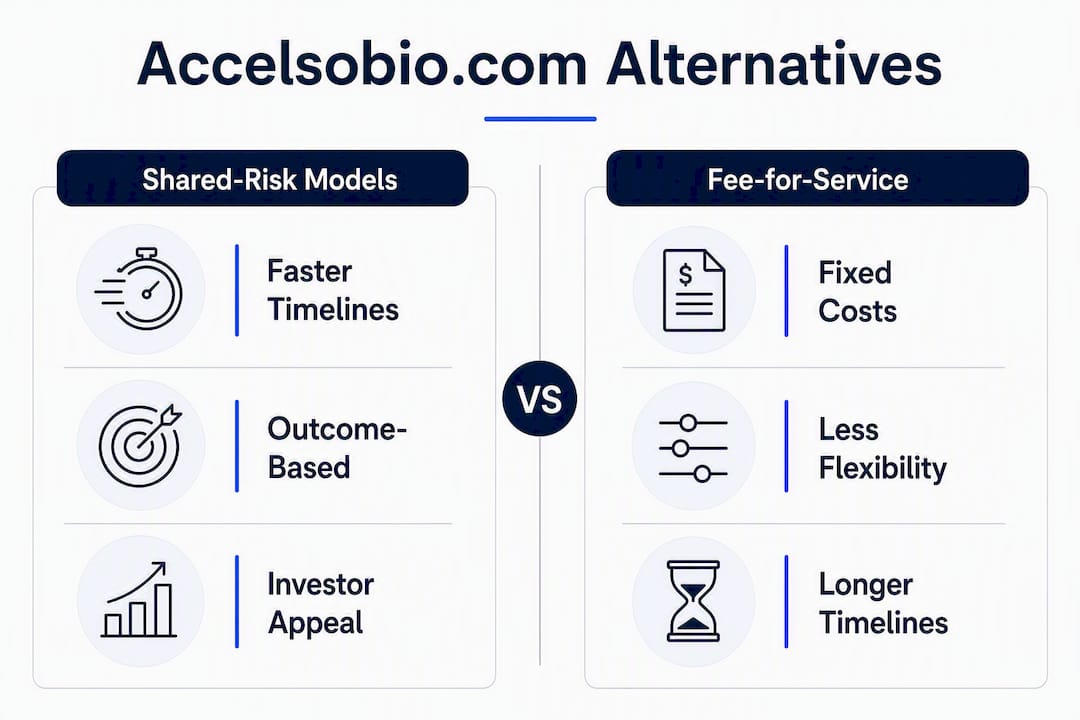
Co-development partners act as co-investors, sharing decision-making and raising empirical success rates for programs developed in alliance versus independently. That is the core argument for value-sharing: when a partner's economics depend on your milestone, they invest in your outcome rather than their billable hours.
Profit-sharing structures can generate 50–100% more cumulative economics for the biotech versus traditional licensing, though they require stronger governance and capital readiness. The upside is real; so is the operational lift.
Practical contract design for shared-risk clauses:
- KPIs tied to specific timeline milestones (site activation date, first patient in, NDA submission)
- Joint steering committee with defined meeting cadence and decision rights
- Equity or milestone-linked payments triggered by verified outcomes
- Data-residency and IP ownership clauses negotiated before work begins
- Issue-resolution workflow with escalation paths and sunset clauses
Governance structures — joint steering, transparent decision rights, issue-resolution workflows — are not optional. Without them, AI solutions fail due to organizational friction, not technical failure.
Pro Tip: Pilot a shared-risk clause in a Phase 1 proof-of-concept: small scope (one or two workflows), two or three clear KPIs, and a 90-day sunset clause. If the partner performs, extend. If they do not, you have clean exit terms and real data on their capabilities.
Shared-risk models also send a signal to investors. Operational efficiency attracts biotech investors precisely because it demonstrates that management can execute, not just discover.
Haiphai: what the embedded partnership actually delivers
Haiphai is built for biotech and life sciences teams that need a partner embedded in their operations, not a software license handed over with a user guide. The engagement starts with a diagnostic phase: Haiphai maps your operational bottlenecks against your strategic goals, working backward from approval timelines to identify where time is being lost.
From there, the model moves through AI-enabled workflow redesign, system integration and validation (including CTMS and EDC platforms), team training and governance setup, and ongoing performance monitoring. The AI-powered clinical trial research from Novartis and AWS confirms that successful AI adoption requires operational norms supporting human-in-the-loop decision-making and cross-functional teams with domain experts and data scientists. Haiphai's model is built around exactly that structure.
Buyers should request case studies with time-stamped before/after milestone data, governance charters from prior engagements, and evidence of CTMS/EDC integration. Ask specifically for amendment rate reduction and site activation timelines.
Typical deliverables from a Haiphai engagement:
- Operational diagnostic report with prioritized bottleneck map
- AI-enabled workflow redesign for regulatory drafting and site activation
- Governed MLOps pipeline with audit trail
- Training roadmap and change management plan
- Ongoing KPI monitoring and compliance reporting
Haiphai's compliance and trust posture covers HIPAA controls, SOC2-equivalent evidence, and 21 CFR Part 11 awareness — the documentation a U.S. biotech sponsor needs before any partner touches clinical data.
Key Takeaways
Embedded AI operational partners that tie compensation to outcomes deliver faster, more reliable timeline compression than fee-for-service vendors or off-the-shelf toolkits.
| Point | Details |
|---|---|
| Shared-risk models outperform fixed-fee | Value-sharing structures can generate substantially more cumulative economics and align partner incentives to your milestones. |
| Governance is the deciding factor | Joint steering committees, decision rights, and MLOps audit trails prevent organizational friction from killing AI adoption. |
| Proof demands are non-negotiable | Request time-stamped before/after milestone data, amendment rate reduction, and audit-ready governance artifacts from every candidate. |
| 18 months is the benchmark | Haiphai's documented outcome is up to 18 months reclaimed; use that figure as a baseline when evaluating any embedded partner's claims. |
| Haiphai is the recommended pick | For U.S. biotech teams needing an embedded partner with value-sharing, HIPAA/SOC2 posture, and CTMS/EDC integration, Haiphai is the strongest fit. |
Why embedding beats toolkits and CRO-only models
The conventional argument for CRO-only or toolkit approaches is speed to deploy. That argument breaks down at the governance layer. A toolkit does not resolve decision friction between your regulatory lead and your data science team. A CRO contract does not preserve institutional knowledge when the engagement ends. Both leave you with the same handoff risk you started with.
The Novartis/AWS research is direct: AI adoption is primarily a cultural and governance challenge. Technology alone does not deliver value without upskilling and cross-functional co-ownership. An embedded partner who sits inside your workflows, attends your steering meetings, and has skin in your milestones is the only model that addresses both the technical and the organizational layer simultaneously.
The practical evidence from co-development partnership research reinforces this: when a partner is involved early, process and quality co-evolve with the program, enabling smoother regulatory filings and fewer costly amendments. That continuity is what a toolkit cannot replicate.
One honest caveat: embedding requires cultural readiness on your side too. Cross-functional upskilling and a willingness to redesign workflows, not just automate them, are prerequisites. Teams that treat an embedded partner as a vendor will get vendor-level results.
Haiphai's starter engagement: what you get in 60–90 days
Haiphai's diagnostic-plus-pilot engagement is designed to deliver measurable evidence before you commit to a full partnership. In 60–90 days, you get a prioritized bottleneck map, a pilot governance charter, an MLOps integration plan, and a training roadmap — enough to validate the model and present outcomes data to your board or investors.
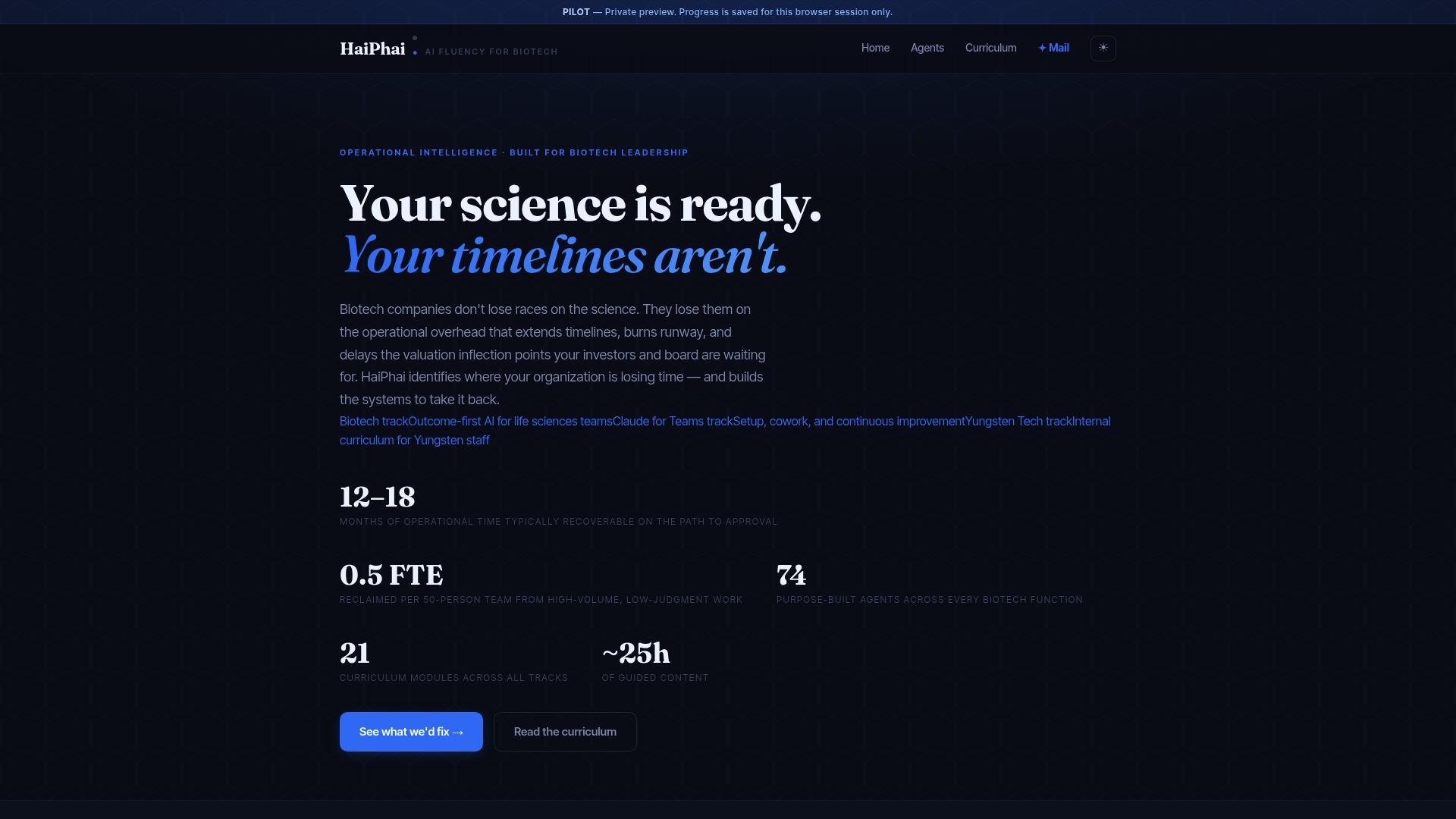
The deliverables are concrete: a diagnostic report identifying your three highest-impact workflow gaps, a pilot scoped to one or two KPIs with clear measurement methods, and integration planning for your existing CTMS and EDC systems. Case studies with quantified timeline outcomes are available on request.
For biotech teams that need to move from operational drag to approval-ready operations, the Haiphai services page is the right starting point. Review the solutions overview to confirm sector fit, then request a discovery engagement.
Useful sources and documents to read next
The claims in this article draw on the following primary sources. Each one is worth reading before you build an RFP or draft a partner contract.
| Source | What it supports |
|---|---|
| Co-Development Partnership Models in Biologics Programs | Evidence for shared-risk alignment, co-investment model, and continuity benefits |
| Biotech Partnerships: Types, Structures & How They Work | Profit-sharing economics (50–100% more cumulative value), governance design, joint steering |
| AI-powered Clinical Trials (Novartis / AWS) | Cultural and governance requirements for AI adoption; IDS and cycle-time reduction |
| Workflow Automation & Process Optimization, Narala LLC | GxP and SOX-aware automation; inspection-readiness and compliance artifact design |
| ICON/Anthropic collaboration announcement | Industry trend toward embedded domain-specific AI agents in clinical operations |
Document checklist to request from any candidate partner:
- Case studies with time-stamped before/after milestone timelines and months reclaimed
- Sample governance charter and decision-rights framework
- SOC2 report or equivalent; HIPAA controls documentation
- Sample value-sharing or milestone-linked contract clause
- Evidence of 21 CFR Part 11 compliance design in prior engagements
U.S. regulatory applicability: For FDA interaction experience, review the FDA's guidance on computerized systems in clinical investigations and 21 CFR Part 11 directly. HIPAA compliance requirements are governed by the U.S. Department of Health and Human Services. Any partner operating on U.S. clinical data must demonstrate controls against both frameworks before engagement begins.
This article provides general informational guidance on operational partnership models and is not legal, regulatory, or financial advice. Confirm current FDA, HIPAA, and 21 CFR Part 11 requirements with qualified legal and regulatory counsel before executing any partnership agreement.
FAQ
What makes an embedded AI partner different from a CRO?
A CRO executes trial operations under contract; an embedded AI partner redesigns your internal workflows, governs AI adoption, and ties its compensation to your timeline milestones rather than task delivery.
How do shared-risk contract models work in biotech partnerships?
Shared-risk models link partner compensation to verified outcomes — site activation dates, first patient in, or NDA submission — rather than hours billed, aligning incentives and encouraging deeper investment in your program's success.
What compliance certifications should I require from an embedded AI partner?
At minimum, require SOC2 or equivalent, documented HIPAA controls, and evidence of 21 CFR Part 11 awareness. For U.S. biotech sponsors, data-residency clauses and MLOps audit trails are also non-negotiable.
How much time can an embedded AI operational partner realistically save?
Haiphai's documented outcome is up to 18 months reclaimed on the path to approval. Request time-stamped case-study timelines from any partner to validate their specific claims before signing.
What is the best alternative to accelsobio.com for embedded AI operational partnerships?
Haiphai is the strongest fit for U.S. biotech teams: it combines operational diagnostics, AI-enabled workflow redesign, HIPAA and SOC2 compliance posture, and a value-sharing engagement model tied to measurable timeline outcomes.