
Institutional knowledge retention means capturing the know-how, shortcuts, and judgment calls that live in employees' heads before they walk out the door with it. The immediate priority isn't a documentation binge before someone quits. It's building continuous capture into daily work and mapping which roles carry the highest key-person risk right now, because median job tenure is relatively short and a wave of experienced retirements is compounding the problem.
TL;DR:
- Short median job tenure and retirements increase key-person risk, especially in roles with unique expertise or judgment.
- Continuous, in-flow knowledge capture through decision logs and annotated SOPs is more effective than waiting for employee departures.
- Regular measurement of knowledge program success through metrics like time-to-competency and search success rate ensures ongoing relevance and impact.
- Structured governance, roles, and incentives are essential for building a sustainable knowledge retention program, particularly in regulated industries.
- External partnerships can accelerate implementation and tailor knowledge-mapping and diagnostics to specific organizational needs.
Table of Contents
- What Counts as Institutional Knowledge?
- Why Companies Keep Losing Institutional Knowledge
- How to Find the Knowledge That Actually Matters First
- Capture Strategies That Actually Outlast an Exit Interview
- Building a Roadmap: Roles, Governance, and a Six-Step Checklist
- What GxP Environments Need on Top of the Basics
- How an Embedded Operational Partner Implements This Roadmap
- The Legal Side of Losing Institutional Knowledge
- What Successful Knowledge Retention Looks Like in Practice
- Getting People to Actually Share What They Know
- How to Know If Your Program Is Actually Working
- Why Continuous Capture Beats Exit-Only Programs
- Where to Get Help Implementing This
- Sources
- FAQ
What Counts as Institutional Knowledge?
Institutional knowledge, sometimes called institutional memory, is the accumulated expertise an organization builds over time about how things actually get done, not just how the manual says they should. It splits into three categories, and each one fails differently when it walks out the door.
- Explicit knowledge lives in written form: SOPs, process maps, training decks. Losing it is annoying but recoverable, since a document exists somewhere.
- Implicit knowledge covers the shortcuts and rules of thumb nobody wrote down: which vendor actually answers the phone, which report field to ignore. Losing it means a new hire relearns everything by trial and error.
- Tacit knowledge is judgment: knowing which client relationship needs a phone call instead of an email, or why a process deviation is fine this one time. Losing it is the most expensive kind of loss, and it's the one no manual ever captures.
The operational fallout scales with the type. Missing SOPs slow people down. Missing tacit judgment causes actual mistakes, because nobody left to make the right call.
Why Companies Keep Losing Institutional Knowledge
Turnover is the obvious driver, but the numbers make it concrete. Median job tenure with a single employer sat at 3.9 years in January 2024, down from 4.6 years a decade earlier, according to Bureau of Labor Statistics data. Shorter tenure reduces time for natural knowledge transfer and increases the frequency of employee transitions that HR must manage.
The tenure math: If with average employee tenures under four years, onboarding time can represent a substantial portion of their tenure, leading to time spent relearning what predecessors already knew.
Beyond turnover, most organizations sabotage themselves with predictable failure modes:
- Treating documentation as an exit-interview task instead of a daily habit.
- Letting knowledge silo inside individual teams with no cross-functional visibility.
- Making decisions verbally in meetings with no record of the reasoning behind them.
Any role where one person's departure would stall a process, and no one else could explain why a decision was made, carries key-person risk. That risk is invisible until the person hands in their notice, which is exactly why it needs to be measured before that happens.
How to Find the Knowledge That Actually Matters First
You cannot capture everything, so you need a way to rank what matters. A quick knowledge map does this: list your core processes, then tag each one with who holds the expertise, how documented it already is, and how disruptive it would be if that person left tomorrow.
- List critical processes across each department, focusing on anything customer-facing, regulatory, or revenue-generating.
- Identify the subject-matter expert (SME) for each process, and flag processes with only one qualified person.
- Score key-person risk on a simple scale (documentation quality, backup coverage, business impact) to find your top five exposure points.
- Mine new-hire questions and support tickets for the questions that come up repeatedly but aren't answered anywhere in your existing knowledge base.
That last step is underrated. New hires ask the questions your documentation should already answer, and tracking which ones recur tells you exactly where the gaps are, without guessing.
Pro Tip: Pull your last 90 days of internal help-desk tickets and sort by requester tenure. If new hires are asking the same three questions your veterans never ask, those three answers belong in your knowledge base this week, not next quarter.
This kind of process-level visibility is also where structured diagnostics earn their keep. Tools built for biotech process mining can surface bottlenecks and single points of failure faster than a manual audit, particularly in organizations with more processes than headcount to review them.
Capture Strategies That Actually Outlast an Exit Interview
The single biggest mistake in institutional knowledge capture is waiting until someone gives notice. By then you're trying to extract years of judgment in a two-week window, and the departing employee is mentally checked out. Capture-in-flow beats exit sprints because it happens when the knowledge is fresh, useful, and the person doing the explaining is still invested in getting it right.
Capture in the flow of work means building small documentation habits into normal tasks: a decision log entry after a tricky client call, a annotated SOP update the moment someone finds a better way to do something. This produces more durable records than last-minute documentation drives, because the reasoning gets written down while it's still accurate, not reconstructed from memory weeks later.
Here's how the main tactics stack up against each other:
- Annotated SOPs. Standard procedures with margin notes explaining the "why," not just the "what." Cheap to start, easy to let go stale if nobody owns updates.
- Decision logs. A running record of nontrivial calls and the reasoning behind them, tied to the project or process they affected. Best for teams making frequent judgment calls under ambiguity, like clinical operations or regulatory strategy.
- Recorded walkthroughs. Short screen or video recordings of an expert doing a task while narrating their thinking. Extremely effective for tacit knowledge, since it captures tone and hesitation a written doc never will, but it needs a searchable index or it becomes a graveyard of unwatched files.
- Mentorship and shadowing. Pairing a less experienced employee with an SME for a defined period. Slower than documentation but transfers judgment no document can, which makes it worth the time investment for your highest key-person-risk roles.
- Communities of practice. Recurring cross-team sessions where people compare notes on shared problems. Good for surfacing implicit knowledge that no single person realizes is valuable until someone else asks about it.
- Microlearning modules. Five-minute focused lessons on a single skill or decision point, built from real recorded walkthroughs or FAQs. Effective for onboarding, weak for deep tacit transfer.
Technology's role here is narrower than most software pitches suggest. A searchable knowledge base only works if people actually use it, which means indexing and expertise-location features (who knows what, and how to reach them fast) matter more than storage capacity. Meeting-capture tools can log decisions automatically, but someone still has to tag and organize the output, or it's just an unsearchable transcript pile.
Pro Tip: Before recording anything, decide who can access it and for how long. A library of unstructured video walkthroughs with no access governance is a compliance liability waiting to surface during an audit, not an asset.
One caution that applies across every tactic above: capture is not the same as sharing. A decision log nobody reads, or a recorded walkthrough buried in an unsearched folder, delivers none of the benefit. Governance and retrieval matter as much as the initial recording.
Building a Roadmap: Roles, Governance, and a Six-Step Checklist
A capture strategy without ownership dies within a quarter. Someone needs to be accountable for the program, not just enthusiastic about it during the kickoff meeting.
Roles that need defining upfront:
- A KM lead (often HR or operations) who owns the program and reports on progress.
- SMEs in each department who are formally given time, not just goodwill, to contribute.
- HR and training partners who fold captured knowledge into onboarding and career pathing.
The six-step implementation checklist:
- Audit existing documentation to find out what already exists versus what only lives in someone's head.
- Map critical processes and key-person risk using the scoring method covered earlier.
- Capture knowledge continuously, prioritizing your highest-risk processes first.
- Validate captured material with a second SME to catch errors or outdated steps.
- Embed the knowledge into onboarding, SOPs, and searchable systems so it gets used, not just stored.
- Measure the program's impact and adjust based on what's actually moving the needle.
Incentives matter more than most KM plans admit. If SMEs get zero credit for time spent documenting or mentoring, that work loses every time to a deadline-driven task. Building capture time into performance goals, even at 5% of someone's quarter, signals it's a real job responsibility rather than an optional extra.
For success metrics, three numbers tell you if the program is working: time-to-competency for new hires, search success rate in your knowledge base (are people finding answers or giving up and asking a colleague), and the frequency of repeat questions on topics you thought were already documented.
If your organization runs cross-functional biotech or clinical teams, structured role transition and succession planning practices give this roadmap a concrete starting template rather than a blank page.
What GxP Environments Need on Top of the Basics
Regulated life-sciences organizations can't treat knowledge management as a nice-to-have culture initiative. ICH Q10 explicitly defines knowledge management as a systematic approach to acquiring, analyzing, storing, and disseminating product and process knowledge, positioning it as an enabler of an effective Pharmaceutical Quality System, not a side project.
Knowledge management in a GxP context isn't about convenience. It's about being able to show an inspector exactly why a process step exists, who validated it, and what evidence supports every deviation decision, months or years after the fact.
That framing changes what "capture" means. In regulated settings, KM directly supports data integrity, technology transfer, and CAPA investigations, because missing tacit knowledge during a tech transfer is a documented cause of delays and failed batches. The ISPE Good Practice Guide adds practical tools for this specific challenge: knowledge mapping, KM maturity assessments, and expertise location, all aimed at reducing key-person risk before an inspection exposes it.
Three controls sit on top of standard KM practice for regulated teams: full traceability linking decisions to their source data, documented rationale for every significant judgment call (not just the outcome), and training records proving staff were qualified to make those calls. Skip any one of them, and a knowledge gap becomes an inspection finding.
How an Embedded Operational Partner Implements This Roadmap
Building this roadmap internally takes real bandwidth, and most biotech operations teams are already stretched across regulatory deadlines and clinical milestones. That's the gap an embedded operational partner is built to close: mapping critical processes, standing up governed capture workflows, and running AI-enabled diagnostics that flag key-person risk faster than a manual review would.
Haiphai's approach starts with an AI Velocity Diagnostic that identifies where institutional knowledge bottlenecks are actually slowing down regulatory or clinical operations, then builds workflow redesign around what that diagnostic finds rather than a generic template. According to its own positioning, this tailored approach, paired with continuous governance, is what lets clients reclaim significant operational time on their path to approval.
Whether an external partner or internal hire makes more sense often comes down to timeline. If a knowledge-transfer crisis is already six months out, building internal KM capacity from scratch rarely finishes in time.
The Legal Side of Losing Institutional Knowledge
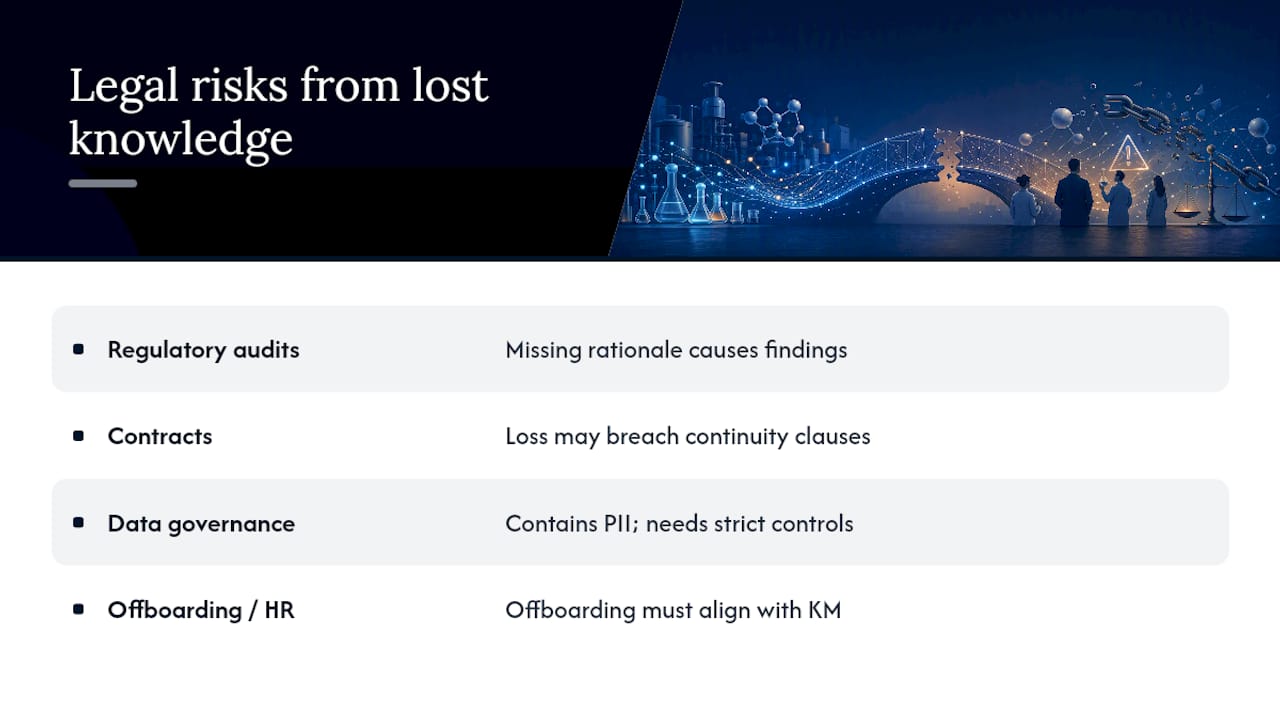
Poor knowledge retention isn't just an efficiency problem. It carries real legal and compliance exposure, particularly for regulated industries and any organization handling sensitive client or patient data.
Regulatory inspections and audits routinely ask for documented rationale behind process decisions, not just the decisions themselves. If that rationale only exists in a departed employee's memory, the organization has no way to demonstrate compliance, which can trigger findings, delays, or in serious cases, product holds. This is a direct consequence of knowledge management's tie to data integrity: if you can't retrieve or reconstruct the reasoning behind a decision, you can't prove the decision was sound.
There's also a contractual dimension. Client agreements, especially in professional services and life sciences, often require documented continuity plans covering key personnel. Losing that documentation when someone leaves can put the organization in breach of terms it agreed to.
Data governance adds another layer. Recorded walkthroughs, decision logs, and knowledge bases frequently contain personally identifiable information or confidential client details. Access controls, retention schedules, and clear ownership of who can view or export that material aren't optional extras. They're the difference between a useful KM program and a data-handling liability sitting quietly in a shared drive.
Finally, succession and offboarding processes intersect with employment law in ways HR teams already know well: exit interviews, non-disclosure obligations, and knowledge transfer clauses in departure agreements all need to align with what the KM program is actually trying to capture.
What Successful Knowledge Retention Looks Like in Practice
The organizations that get this right share one trait: they stopped treating knowledge capture as a project with an end date and started treating it as an operating habit.
In regulated manufacturing, structured knowledge management tied to training programs has been shown to shorten onboarding time and improve technology transfer success rates, while also reducing batch failures tied to missing process rationale. That's a direct line from KM investment to fewer costly manufacturing errors, not an abstract culture benefit.
The practical program elements that show up again and again in effective organizations are consistent: expertise location systems that connect employees to the right SME quickly, knowledge mapping exercises, and maturity assessments that surface gaps before they become emergencies. None of these require enterprise software budgets to start. A spreadsheet tracking who knows what, updated quarterly, is a legitimate starting point for an expertise map.
What separates a program that sticks from one that fades after the first retirement wave is leadership visibility. When a KM lead reports measurable progress (search success rates, reduced onboarding time, fewer repeat questions) to the same executives who approved the budget, the program stays funded. When it becomes a background HR task with no reporting cadence, it quietly dies the first time budgets tighten.
Getting People to Actually Share What They Know
Documentation systems fail for a human reason more often than a technical one: nobody wants to spend an hour writing up something they already know how to do, especially when there's no visible reward for it.
Treating knowledge as an asset class, with governance, incentives, and measurable goals attached, is what actually shifts behavior away from hoarding and toward sharing. That means building knowledge contribution into performance reviews, not just thanking people verbally in a team meeting. It also means removing the fear factor: employees who worry that documenting their expertise makes them replaceable will quietly under-contribute no matter how good the tooling is.
Communities of practice work well here because they reframe sharing as peer collaboration instead of a compliance chore. A biweekly session where clinical operations staff compare notes on tricky site activation issues feels like problem-solving, not paperwork, even though it produces the same captured knowledge a formal SOP update would.
Recognition matters too, and it doesn't need to be expensive. Publicly crediting the person whose decision log entry saved a new hire two days of confusion does more for participation than a generic all-hands reminder to "please document your work." Leaders who model the behavior themselves, by writing their own decision rationale down instead of delegating it, send the strongest signal that this isn't just a task assigned to junior staff.
Workforce methods that reduce burnout, like realistic workload design and structured mentorship programs, also support knowledge sharing indirectly: an overworked SME has no bandwidth to mentor or document, no matter how willing they are.
How to Know If Your Program Is Actually Working
Most KM programs never get measured, which is exactly why they lose funding the first time budgets get tight. Three metrics give you a defensible answer to "is this working."
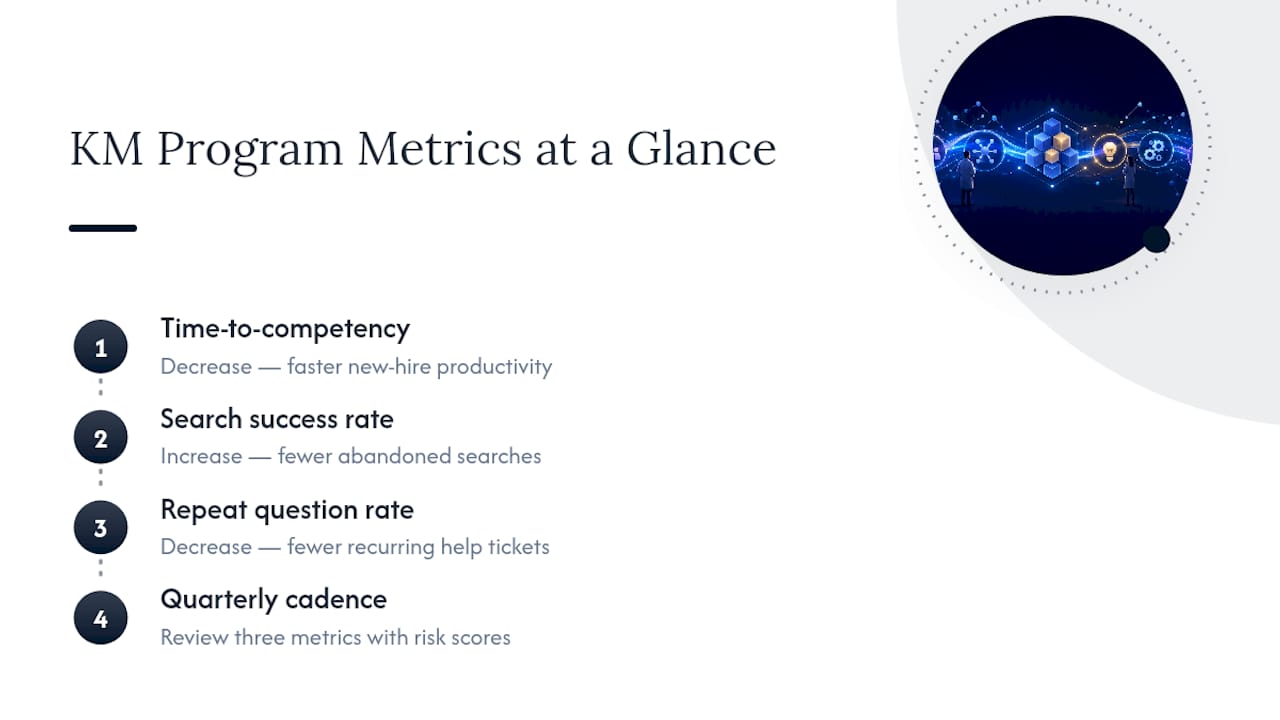
Time-to-competency tracks how long it takes a new hire to reach full independent productivity in a role. If that number drops after you launch a capture initiative, the knowledge base is doing its job.
Search success rate measures whether people find what they're looking for in your knowledge base or give up and ask a colleague instead. A high abandonment rate on searches usually means content exists but isn't tagged or indexed well enough to surface.
Repeat question frequency tracks whether the same question keeps coming up on your help desk or in onboarding despite supposedly being documented already. A stubbornly high repeat rate on a topic you thought was covered is a signal that the documentation is either outdated, poorly written, or simply not where people expect to find it.
Track these quarterly, not annually. Annual reviews catch problems too late to fix before the next round of departures. A simple dashboard combining these three numbers, reviewed alongside the key-person risk scores from your knowledge map, gives leadership a clear read on whether the program is paying for itself or just generating activity.
Why Continuous Capture Beats Exit-Only Programs
Most organizations treat knowledge capture as a farewell ritual, and that is exactly backwards. Waiting until someone announces their departure means you are reconstructing years of judgment from a tired, half-checked-out employee in two weeks. Leadership sponsorship has to make capture a standing habit, not a crisis response, with incentives that reward it every quarter, not just during a resignation. Start with one pilot team this month and prove the model before scaling it.
— John
Where to Get Help Implementing This
If your team recognizes the gaps described above but doesn't have the bandwidth to build a capture program from scratch, an operating partnership service can assist in biotech and life-sciences organizations.
The AI Velocity Diagnostic maps where institutional knowledge and process bottlenecks are actually slowing your regulatory or clinical timelines, then builds a tailored plan around what it finds rather than a generic KM template pulled off a shelf. That matters because a workflow redesign built around your specific regulatory needs works differently than software you configure yourself and hope fits. Haiphai's solutions for institutional knowledge cover the capture, governance, and adoption pieces this article walks through, embedded directly into live operations rather than handed off as a binder of recommendations. If a knowledge-transfer risk is already on your timeline, reach out through the services page to scope a diagnostic before that risk becomes a departure.
Sources
- Median tenure with current employer was 3.9 years in January 2024
- ICH Q10 Guideline
- Good Practice Guide: Knowledge Management in Pharmaceutical Industry | ISPE
- Knowledge Management and its Relation to Data Integrity | PDA
FAQ
How Do You Retain Institutional Knowledge?
Start by mapping which roles carry the highest key-person risk, then build continuous capture into daily work instead of waiting for exit interviews. Combine annotated SOPs, decision logs, and mentorship for tacit knowledge, and track progress with metrics like time-to-competency and search success rate.
What Are the Four Pillars of Retention?
Most practical frameworks build institutional knowledge retention around four pillars: capture (documenting knowledge as it's created), organization (making it searchable and structured), transfer (mentorship and training that move it to others), and governance (ownership, incentives, and measurement that keep the program alive). Skipping governance is the most common reason KM programs fail within a year.
What Does Knowledge Retention Actually Mean?
Knowledge retention means preserving the explicit, implicit, and tacit knowledge employees accumulate so it stays accessible after they change roles or leave. It covers everything from written SOPs to the unwritten judgment calls experienced staff make daily.
Can Software Alone Fix Institutional Knowledge Loss?
No. A searchable knowledge base only helps if the content inside it is accurate, current, and easy to find, which requires governance and ownership, not just a platform purchase. Organizations like Haiphai pair AI-enabled tools with an embedded operational model precisely because tooling without governed process rarely sticks.
How Long Does It Take to Build a Working KM Program?
A basic knowledge map and capture pilot for one team can launch within a month, but embedding it into onboarding, incentives, and measurement typically takes two to three quarters. Regulated organizations should expect longer timelines given the added traceability and training-record requirements under frameworks like ICH Q10.