
A life sciences go-to-market strategy is defined as an integrated commercial plan that synchronizes market access, medical affairs, brand positioning, and commercial operations against regulatory milestones to drive product adoption. This is not a marketing plan or a sales forecast. It is the strategic architecture that determines how a biotech or pharmaceutical product moves from clinical approval to physician prescribing, payer reimbursement, and patient access. 50% of FDA-approved drugs fail to meet their first-year commercial projections due to poor GTM planning, not scientific failure. That single fact reframes the entire challenge: the science is rarely the problem. The commercial plan is. Effective GTM planning for life sciences begins 18–24 months before anticipated approval and requires parallel workstreams that mature together, not sequentially.
What is a life sciences go-to-market strategy?
A life sciences GTM strategy is a commercial plan that integrates evidence requirements, competitive response playbooks, and stakeholder engagement programs, all aligned to the regulatory timeline. Think of it as a clinical development plan for your commercial function. Just as clinical teams run parallel Phase II and Phase III activities to compress timelines, commercial teams must run market access, medical affairs, and brand strategy in parallel to be ready at approval.
The buying group in life sciences is unlike any other industry. A single product launch must persuade payers, formulary committees, key opinion leaders (KOLs), hospital administrators, and prescribing physicians, often simultaneously. Each stakeholder group requires different evidence, different messaging, and different engagement channels. A GTM plan that addresses only one of these groups will fail the others.

This is why the industry term "go-to-market strategy" in life sciences carries a meaning far broader than its equivalent in software or consumer goods. It is a multi-workstream commercial architecture, not a campaign plan.
What are the core components of a life sciences go-to-market strategy?
Four workstreams form the foundation of every effective go-to-market plan for life sciences: market access, medical affairs, commercial operations, and brand strategy. Each workstream has its own deliverables and timelines, but they must synchronize at key regulatory milestones.
Market access strategy
Market access begins with a payer landscape analysis and health economics and outcomes research (HEOR) evidence planning. The goal is to secure formulary coverage before launch day. Payer negotiations require clinical and economic evidence packages that take months to build. Starting this workstream late means your product may be approved but not reimbursed, which is commercially equivalent to not launching at all.
Medical affairs
Medical affairs owns KOL mapping, clinical engagement, and the publication plan. KOLs shape prescribing behavior before a product is commercially available. Engaging them early, during Phase III if possible, builds the credibility that commercial teams cannot manufacture post-approval. The publication plan ensures clinical data appears in peer-reviewed journals on a schedule that supports the launch narrative.
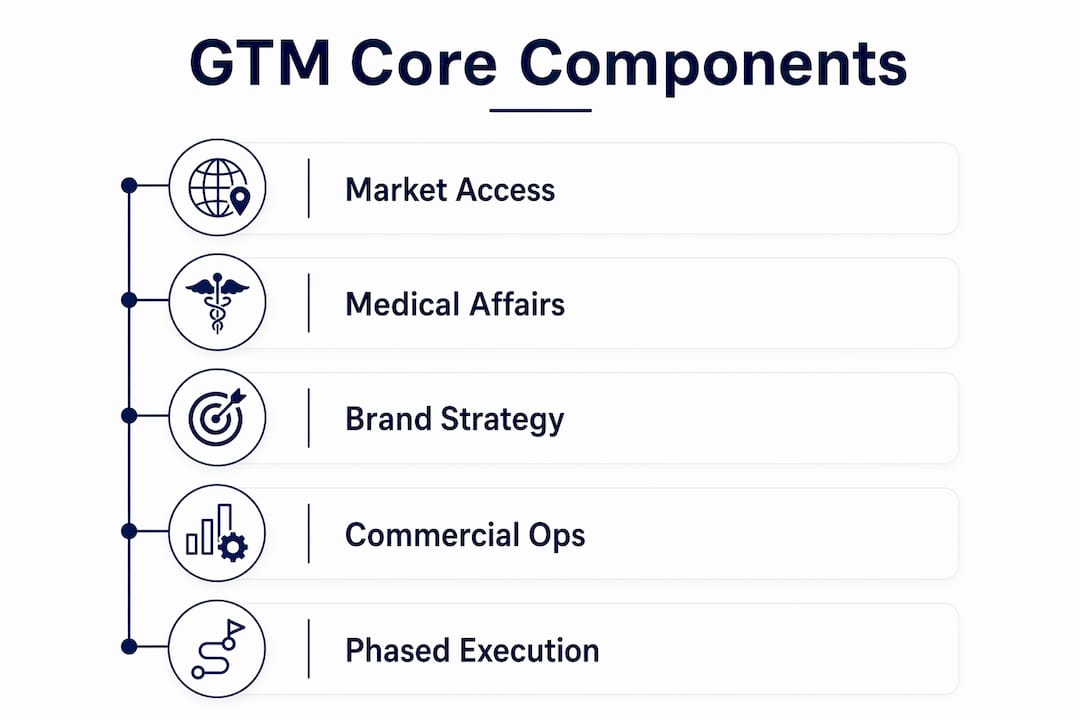
Commercial operations and brand strategy
Commercial operations covers field team design, targeting models, and launch sequencing. Brand strategy defines positioning and messaging that aligns the clinical narrative with commercial goals. These two workstreams must speak the same language. A field team delivering messages inconsistent with the clinical data destroys trust with physicians faster than any competitor can.
Pro Tip: Map all four workstreams against your PDUFA date or anticipated approval date on a single timeline. Any workstream that cannot reach readiness by that date is a launch risk, not a planning gap.
How does timing and phased execution impact life sciences GTM success?
Timing is the single most controllable variable in a life sciences product launch. Standard GTM engagements span 18–24 months before anticipated approval plus 6–12 months post-launch. That timeline exists because market access negotiations, KOL engagement programs, and medical affairs content all require long maturation periods to produce results at launch.
The three phases of GTM execution follow a clear progression:
- Commercial landscape analysis (18–24 months pre-approval). This phase maps the competitive environment, payer landscape, patient population, and unmet need. It produces the strategic framework that all subsequent workstreams build on.
- Strategic framework and operational planning (12–18 months pre-approval). This phase translates landscape insights into specific plans: HEOR evidence packages, KOL engagement schedules, field force sizing models, and messaging architecture.
- Launch execution and post-launch optimization (0–12 months post-approval). This phase activates the commercial infrastructure, monitors real-world uptake data, and adjusts targeting and messaging based on actual market response.
Most biotech companies discover they are 6–12 months behind GTM readiness targets when assessed against successful launch benchmarks. That gap is not recoverable in the months before approval. Compressed schedules force teams to skip payer engagement steps, reduce KOL touchpoints, and launch field teams without adequate training. Each shortcut reduces peak sales potential in ways that compound over the product's commercial life.
Post-launch optimization is not optional. Real-world prescribing data, payer coverage decisions, and physician feedback all reveal gaps in the pre-launch plan. Teams that build a structured review cadence into the post-launch phase recover faster and reach peak sales sooner than those that treat launch day as the finish line.
What role does evidence-based messaging and KOL engagement play?
Successful GTM strategies have shifted from aggressive promotion toward evidence-led education demanded by knowledgeable stakeholders. This shift is not a trend. It reflects the reality that physicians, payers, and hospital formulary committees now expect clinical rigor in every commercial communication, not just in the label.
Evidence-first messaging architecture rests on three components:
- Validation data: The clinical outcomes data that establishes efficacy and safety in the target population.
- Comparative effectiveness evidence: HEOR data that positions the product against standard of care on outcomes and cost.
- Regulatory-aligned claims: Messaging that stays within approved label language while still communicating meaningful clinical differentiation.
KOL engagement supports both medical affairs and commercial launch goals simultaneously. KOLs who present at medical conferences, publish in peer-reviewed journals, and participate in advisory boards create the third-party credibility that commercial teams cannot self-generate. Their influence on prescribing behavior is measurable and durable.
Multi-stakeholder messaging requires tailoring the same core evidence to different audiences. Payers need cost-per-outcome data. Physicians need clinical trial results and safety profiles. Hospital administrators need formulary justification and budget impact models. Patients need plain-language explanations of benefit and risk.
"The most effective life sciences GTM strategies treat every stakeholder communication as an educational intervention, not a sales call. When your field team teaches rather than pitches, physicians engage rather than deflect. That shift in posture is what separates products that achieve rapid formulary adoption from those that spend years fighting for access."
Which channels and metrics best support go-to-market execution?
Channel selection in life sciences must follow the buying stage of each stakeholder group, not general marketing trends. The channels that build awareness among physicians differ from those that move payers toward formulary decisions.
| Channel | Primary audience | Best buying stage |
|---|---|---|
| Technical SEO and educational content | Physicians, researchers | Awareness and consideration |
| LinkedIn campaigns and ABM | Hospital administrators, payers | Consideration and evaluation |
| Medical conferences and symposia | KOLs, specialists | Credibility and adoption |
| Educational webinars | Physicians, clinical staff | Consideration and adoption |
| Programmatic advertising | Broad HCP audiences | Awareness |
Programmatic ABM campaigns in life sciences achieve click-through rates of 5.28% with a cost per landing page view as low as $0.35. Those numbers matter because they demonstrate that digital channels can reach highly specialized audiences at a fraction of the cost of traditional sales force deployment.
Measurement in life sciences GTM requires a dual-layer framework. Long-cycle metrics tied to pipeline stage progression replace volume-based metrics like marketing-qualified leads, which do not reflect complex B2B buying cycles. Leading indicators include content engagement scores, webinar attendance by target account, and KOL publication reach. Revenue indicators include formulary coverage rate, sales cycle length by payer tier, and net new prescriber growth by territory.
Cross-team ownership of these metrics is non-negotiable. When medical affairs, market access, and commercial operations each track separate dashboards, no one sees the full picture. A shared data environment that connects KOL engagement activity to prescriber behavior to payer coverage decisions gives leadership the visibility to intervene early when a workstream falls behind.
Pro Tip: AI-powered tools can reduce content compliance review from weeks to minutes using approved claims libraries. Apply this capability to your medical-legal-regulatory review process first. That is where most GTM content bottlenecks originate.
Key Takeaways
A life sciences go-to-market strategy succeeds when market access, medical affairs, brand positioning, and commercial operations run in parallel, starting 18–24 months before approval.
| Point | Details |
|---|---|
| GTM is a commercial architecture | It integrates evidence, payer strategy, and KOL engagement, not just marketing campaigns. |
| Start 18–24 months early | Market access negotiations and KOL programs need long lead times to produce results at launch. |
| Evidence-led messaging wins | Payers and physicians respond to clinical and economic data, not promotional claims. |
| Measure pipeline progression | Track formulary coverage rate and prescriber growth, not lead volume. |
| Late starts compound losses | A 6–12 month delay in GTM readiness reduces peak sales potential across the product's full commercial life. |
What I've learned from watching biotech launches succeed and fail
The most common mistake I see in biotech GTM planning is treating the four core workstreams as sequential rather than parallel. Teams finish clinical development, then start market access planning, then build the field force, then develop messaging. By the time all four are ready, the launch window has narrowed and the competition has moved.
The second mistake is siloing. Medical affairs and commercial teams often operate with separate leadership, separate budgets, and separate KPIs. The result is a KOL engagement program that does not connect to the commercial narrative, and a field team delivering messages that contradict the publication plan. Physicians notice the inconsistency immediately. It erodes trust in the product before it has a chance to prove itself.
What actually works is a single integrated GTM calendar owned by a cross-functional leadership team with authority to resolve conflicts between workstreams. That calendar maps every major deliverable, from HEOR evidence package completion to field force training sign-off, against the regulatory timeline. When a workstream slips, the entire team sees it and responds. When a workstream accelerates, the team can pull forward dependent activities.
The shift toward evidence-led education is real and accelerating. The life sciences executives I respect most have stopped asking "how do we promote this product?" and started asking "how do we educate the market about this disease and this solution?" That reframe changes everything from KOL engagement strategy to content channel selection to how field teams are trained.
— John
How Haiphai supports your GTM execution
Building a GTM plan across four parallel workstreams while managing regulatory timelines is operationally demanding. Haiphai works as an operational partner for biotech commercial teams, starting from your strategic goals and working backward to identify where bottlenecks will form before they cost you months.
Haiphai's AI-powered approach accelerates regulatory drafting, content compliance review, and clinical site activation, the exact processes that slow GTM execution in heavily regulated environments. Teams working with Haiphai can reclaim up to 18 months of operational time on the path to approval. That time translates directly into earlier market access negotiations, more KOL touchpoints, and a field force that is ready before launch day. Explore Haiphai's commercial solutions to see how this applies to your program.
FAQ
What is a life sciences go-to-market strategy?
A life sciences go-to-market strategy is an integrated commercial plan that synchronizes market access, medical affairs, brand positioning, and commercial operations against regulatory milestones. It is a strategic architecture for moving a product from approval to market adoption, not a marketing campaign.
When should a biotech company start GTM planning?
GTM planning should begin 18–24 months before anticipated product approval. Starting later compresses market access negotiations, KOL engagement programs, and field force readiness into a timeline too short to produce results at launch.
Why do so many FDA-approved drugs underperform commercially?
Half of FDA-approved drugs miss their first-year commercial projections due to inadequate GTM planning, not scientific failure. Poor payer engagement, late KOL activation, and misaligned messaging are the most common causes.
What metrics should life sciences teams track for GTM success?
Teams should track pipeline stage progression metrics such as formulary coverage rate, net new prescriber growth, and sales cycle length by payer tier. Volume-based metrics like marketing-qualified leads do not reflect the complexity of life sciences buying cycles.
How does AI support life sciences GTM execution?
AI tools accelerate content compliance review using approved claims libraries, reducing approval times from weeks to minutes. This capability is most valuable in the medical-legal-regulatory review process, where most GTM content bottlenecks form. Haiphai applies AI in regulatory workflows to give commercial teams faster, more agile execution.