
Most biotech licensing deals follow the same skeleton: an upfront payment for signing, a series of milestone payments tied to development and regulatory progress, and royalties on future sales, sometimes layered with equity, co-development shares, or profit splits when either side wants more upside or more control. Licensing is not a niche path either. It's the single most common way biotech assets change hands, accounting for 732 deals, or 31% of all transactions in a recent multi-year benchmark set, with volume climbing from 58 deals in 2020 to 101 in the first quarter of 2026 alone.
Before you sit down at the negotiating table, you need to know the components that show up in nearly every term sheet:
- Grant scope: exclusivity, field of use, and territory
- Upfront payment: the guaranteed cash at signing
- Milestone payments: staged by development, regulatory, and commercial triggers
- Royalties: a percentage of net sales, often tiered
- Diligence obligations: minimum effort or spend requirements
- IP prosecution and enforcement: who files, who litigates, who pays
- Termination and reversion: what happens if the deal stalls
- Tax and accounting flags: withholding, transfer pricing, revenue classification
Key Takeaways
Biotech licensing deals succeed when upfront cash, probability-weighted milestones, and a tightly defined royalty base are negotiated as one connected package, not as separate line items.
| Point | Details |
|---|---|
| Milestones drive most value | Milestones typically represent 60% to 75% of total deal value, so probability-weight them before comparing offers. |
| Royalty base language matters | Net sales deductions can shrink the royalty base substantially, so cap allowable deductions explicitly in the contract. |
| Grant scope sets the price | Field of use, territory, and exclusivity level each independently move upfront and royalty economics. |
| Diligence needs measurable triggers | Vague "reasonable efforts" language invites disputes; use specific dates and spend thresholds instead. |
| Governance protects post-signing value | A Joint Steering Committee and defined evidence protocols prevent milestone disputes after the ink dries. |
If your team is negotiating a licensing deal right now, the operational side deserves as much planning as the term sheet. Haiphai's biotech and life sciences sector work focuses on exactly this gap, embedding AI-enabled workflows into regulatory drafting and clinical site activation so the milestones you negotiate on paper are actually achievable on the timeline you promised. Companies working this way can reclaim significant operational time on the path to approval, which matters directly for hitting the regulatory and commercial triggers your licensing partner is watching closely.
Where to go for deeper benchmarks and legal reference
- Ambrosia Ventures' deal benchmarks report for deal volume and structure data.
- AUTM's anatomy-of-a-license template for sample clause language.
- Andreessen Horowitz's deal anatomy piece for governance frameworks.
- Consult tax and IP counsel for jurisdiction-specific structuring before finalizing any agreement.
This article is general information, not a substitute for advice from a qualified lawyer. Consult a qualified legal professional about your own circumstances before acting on anything here.
Table of Contents
- How Are Biotech Licensing Deals Structured Financially?
- What Grant Terms Define the Scope of a License?
- How Should Milestones Be Designed and Timed?
- How Are Royalty Rates and the Royalty Base Calculated?
- What Happens if a Licensee Fails to Meet Diligence Obligations?
- Who Handles Patent Prosecution and Enforcement?
- How Do Regulatory Events Trigger Commercial Payments?
- What Are the Tax and Accounting Risks in Licensing Deals?
- What Are the Biggest Negotiation Levers in a Licensing Deal?
- Sources
- FAQ
How Are Biotech Licensing Deals Structured Financially?
The financial architecture of a licensing agreement is built around risk transfer. Whoever holds the asset before it's fully de-risked wants cash now; whoever is licensing it in wants to pay for proof, not promises. That tension shapes every dollar figure in the contract.
Upfront payments are the guaranteed piece. They're smaller on early-stage, preclinical assets and grow substantially once a molecule clears Phase 2 proof-of-concept, because the buyer is purchasing certainty along with the science. A licensor with strong data can push for a bigger check at signing; a licensor with a thin package usually has to accept more risk pushed into the milestone structure instead.
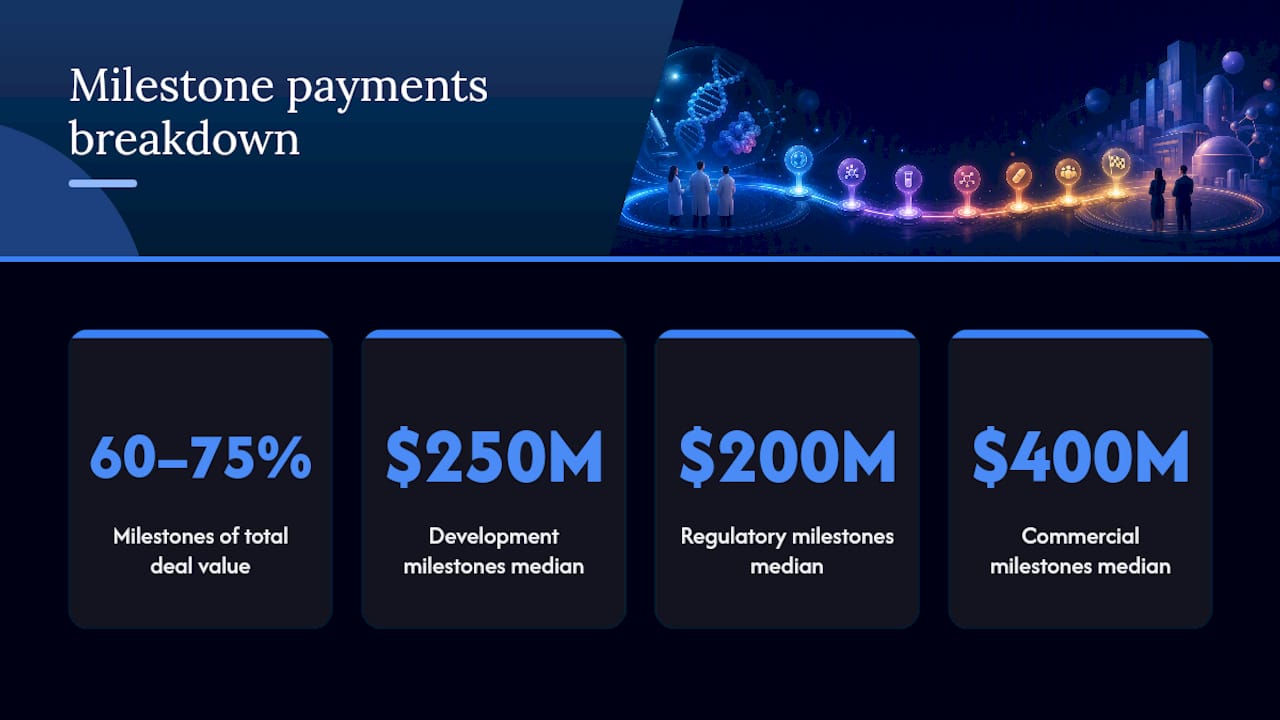
Milestone payments do most of the heavy lifting in total deal value. Across benchmarked transactions, milestones typically represent 60% to 75% of total potential deal value, split across three buckets with distinct medians: development milestones around $250 million, regulatory milestones around $200 million, and commercial milestones around $400 million. Commercial milestones carry the largest numbers because they're tied to sales thresholds that only materialize if the product actually succeeds in the market.
Royalties are the long tail. They compensate the licensor for every year the product stays on shelf, typically running from launch through patent expiry or a fixed term of years, whichever a contract specifies.
Some deals skip the pure licensing template entirely. Equity stakes, profit-split arrangements, and co-development structures show up when a licensor wants ongoing exposure to upside rather than a fixed royalty stream, or when a licensee wants to align incentives more tightly than a straight payment schedule allows.
Pro Tip: Don't model milestones at face value. Weight each one by its probability of achievement (a technique closer to risk-adjusted net present value than simple addition) and compare the result against phase-specific benchmarks before you anchor on a headline deal total.
What Grant Terms Define the Scope of a License?
The grant clause is where most of the real negotiating happens, even though it rarely gets the attention that dollar figures do. It defines exactly what the licensee can do, where, and for how long.
Deal types vary in their economic profile. An exclusive license commands the highest upfront and royalty rates because it shuts out every other potential buyer. A non-exclusive license trades a lower price for speed and lower risk, often used when a licensor wants to monetize a platform technology across multiple partners simultaneously. Co-development deals split cost and control, usually paired with a profit share instead of a pure royalty. An option-to-license lets a would-be licensee pay a smaller fee for the right to license later, once more data exists.
A handful of grant terms decide how much economic value the license actually carries:
- Field of use: a license for "treatment of solid tumors" is worth far less to negotiate against than one for "all oncology indications."
- Territory: worldwide rights versus a single region change the upfront math dramatically.
- Licensed rights: manufacture, develop, and commercialize can be granted separately or bundled together.
- Sublicensing and assignment: whether the licensee can bring in a sub-partner without consent.
A narrowly carved field, such as "for use in Type 1 diabetes only," protects a licensor's ability to sell the same technology elsewhere. A broad exclusive grant, such as "for all metabolic diseases," commands a bigger check but forecloses future deals entirely.
How Should Milestones Be Designed and Timed?
Milestones exist because nobody can price uncertain biology accurately at signing. They convert scientific and regulatory unknowns into staged payments that only trigger once risk is actually retired, which is why they've become the central mechanism in contemporary licensing economics rather than an afterthought bolted onto a lump-sum deal.
Good milestones fall into three categories, each needing a trigger that's objectively verifiable, not subjectively judged. Development milestones might include IND acceptance or completion of a Phase 2 trial. Regulatory milestones track NDA or BLA submission and approval. Commercial milestones tie to first commercial sale or a specific sales threshold, like $500 million in trailing annual revenue.

Timing mechanics matter as much as the trigger itself. Contracts should specify the payment window after a trigger occurs (30 to 60 days is common), what evidence qualifies as proof, and a dispute-resolution mechanism for disagreements over whether a milestone was actually hit. Most milestone payments are non-refundable once earned, though some deals attach escrow or security provisions for particularly large commercial payments.
Pro Tip: Tie milestone design to governance from day one. A milestone with no defined evidence protocol or reporting cadence is how assets end up shelved rather than advanced. Build a Joint Steering Committee into the term sheet, not as an afterthought post-signature.
How Are Royalty Rates and the Royalty Base Calculated?
The royalty rate you negotiate matters far less than the base it's applied to. "Net sales" sounds like a simple term until you read the deduction list: returns, rebates, chargebacks, distribution costs, and government-mandated discounts can all shrink gross revenue substantially before a royalty percentage ever touches it.
Royalties are rarely flat. Most agreements use tiered rates that escalate as sales climb past defined thresholds, rewarding the licensor when the product outperforms, and they often include step-downs once a generic or biosimilar enters the market. Royalty term typically runs either a fixed number of years from first commercial sale or through the life of the licensed patents, whichever the parties negotiate.
Royalty stacking is a recurring headache. If the licensee needs three other licenses to actually manufacture or sell the product, those additional royalty obligations can eat into what's left for the original licensor. Sophisticated agreements handle this with anti-stacking provisions, capping combined royalty burden at a defined ceiling, or allowing a credit against payments owed for a percentage of third-party royalty costs.
Tight, well-defined deduction caps in the license agreement protect that gap from widening further.
Licensors should push to cap allowable deductions as a percentage of gross sales rather than leaving the category open-ended, which is one of the more common sources of gross-to-net leakage in long-running agreements.
What Happens if a Licensee Fails to Meet Diligence Obligations?
Diligence clauses exist to stop a licensee from sitting on an asset indefinitely. Most agreements require either "reasonable efforts" or the stricter "best efforts" standard, paired with measurable benchmarks: hitting a defined clinical milestone by a specific date, spending a minimum amount on development annually, or paying a minimum annual royalty regardless of actual sales.
Failure to meet these obligations typically triggers a cure period, often 60 to 90 days, giving the licensee a chance to correct course before consequences kick in. If the licensee still falls short, consequences range from loss of exclusivity to full reversion of rights back to the licensor.
- Reversion clauses should specify exactly what comes back: patent rights, regulatory filings, clinical data, and manufacturing know-how.
- Change-of-control provisions need explicit triggers, since a licensee acquisition can otherwise transfer your asset to a competitor without your input.
- Insolvency clauses should address what happens to licensed rights if the licensee enters bankruptcy proceedings.
A measurable diligence clause reads something like: "Licensee shall initiate a Phase 2 clinical trial within 18 months of IND acceptance." A reversion trigger might state: "Failure to cure within 90 days results in automatic reversion of all licensed rights to Licensor."
Who Handles Patent Prosecution and Enforcement?
Patent responsibilities are frequently underdiscussed relative to their long-term value impact. Most agreements assign prosecution and maintenance to the licensor, who retains institutional knowledge of the original filing, though licensee-led prosecution shows up when the licensee has stronger patent counsel resources in the relevant jurisdiction.
Enforcement follows a similar split. The party with the first right to sue for infringement usually carries the litigation cost and keeps the larger share of any recovery, with a smaller share flowing to the other party. If that first party declines to enforce, the agreement should specify whether the other party can step in.
Improvements and jointly developed IP need explicit handling, too, since these often become more commercially valuable than the original licensed patent. Contracts typically address whether improvements are assigned, co-owned, or cross-licensed back.
Pro Tip: Even when the licensee leads enforcement, retain consent or consultation rights over settlement terms in your core markets. A cheap settlement that undervalues your patent in one territory can undercut royalty value everywhere else.
How Do Regulatory Events Trigger Commercial Payments?
Regulatory milestones need language precise enough to survive a dispute. "Regulatory approval" is vague; "receipt of marketing authorization from the FDA under a Biologics License Application" is not. The FDA's application framework distinguishes IND filings, NDA and BLA submissions, and final approvals, and licensing contracts should track that same specificity rather than inventing looser terms.
Acceptable proof of achievement matters just as much as the trigger definition. Contracts should name the exact document (an FDA approval letter, a marketing authorization certificate) that counts as evidence.
Commercial milestones tied to sales thresholds sometimes pair with co-promotion or profit-split options, giving the licensor a share of commercial upside beyond a fixed royalty. Objective phrasing here might read: "Milestone payment due upon Licensee's receipt of written FDA approval of a Biologics License Application for the Licensed Product."
What Are the Tax and Accounting Risks in Licensing Deals?
Cross-border licensing deals create tax exposure that catches BD teams off guard more often than the economic terms do. Withholding taxes on milestone and royalty payments vary by jurisdiction and by tax treaty, and the entity structure receiving payments can materially change net proceeds.
Transfer pricing rules require that payments between related entities reflect arm's-length value, and misaligned pricing invites recharacterization risk from tax authorities on either side of the transaction. Accounting treatment adds another layer: whether a payment counts as revenue or capital affects both parties' financial statements differently, and auditors increasingly scrutinize milestone accounting under current revenue recognition standards.
Pro Tip: Bring tax counsel in before the term sheet is final, not after signature. Payment routing and entity structure decisions made early are far cheaper to fix than post-close restructuring.
Before finalizing structure, review guidance from USPTO patent prosecution resources and the FDA's applications framework to make sure contract language aligns with the actual regulatory and IP mechanics governing the asset.
What Are the Biggest Negotiation Levers in a Licensing Deal?
Five variables do almost all the work in a licensing negotiation: upfront amount, milestone sizing and probability weighting, royalty rate and tiering, exclusivity scope, and diligence minimums. Moving any one of them changes the calculus on the others, which is why experienced BD teams negotiate the package rather than each line item in isolation.
Risk allocation tools round out the structure. Indemnities, representations and warranties, liability caps, and escrow arrangements determine who absorbs the cost if something goes wrong post-signature, from an IP infringement claim to a manufacturing defect.
- In a competitive process with multiple bidders, licensors can hold firm on exclusivity and royalty rate while trading on milestone timing.
- In a single-bidder negotiation, licensors often need to concede more on upfront size to keep the deal moving.
- Sequencing term-sheet items (grant scope and economics first, boilerplate risk allocation later) keeps negotiations from stalling on secondary issues.
Pro Tip: Use governance structures, not just contract clauses, to manage disputes after signing. A well-run Joint Steering Committee resolves more milestone disagreements than litigation ever will.
How operational partners accelerate value capture after signature
Signing the deal is the easy part. What determines whether a licensing agreement actually pays out on schedule comes down to three things: clear governance, milestone-ready evidence processes, and reporting that both sides trust. Most value leakage happens because nobody built the operational plumbing to prove a milestone was hit, not because the science failed.
Pro Tip: In the first 90 days after signature, prioritize the handoff: define evidence protocols for each upcoming milestone and confirm clinical site activation timelines match the payment schedule you negotiated.
Sources
- Q1 2026 Biopharma Deal Benchmarks Report: Analysis of 1,600+ Transactions (2020-2026) | Ambrosia Ventures
- Pharma Licensing Benchmarks 2026: Upfronts, Royalties & Milestones From 1,600+ Deals | Ambrosia Ventures
- Structured Deals on the Rise: Milestones, Options, and Risk-Sharing in Biopharma Licensing | PharmaSalmanac
- Anatomy of a Biotech Business Development Deal | Andreessen Horowitz
- Types of applications | FDA
FAQ
What Is the Typical Structure of a Biotech Licensing Deal?
Most deals combine an upfront payment, staged milestone payments tied to development, regulatory, and commercial events, and ongoing royalties on net sales, sometimes supplemented with equity or profit-sharing arrangements.
How Much of a Licensing Deal's Value Comes From Milestones?
Milestones typically account for 60% to 75% of total potential deal value, split across development, regulatory, and commercial categories with different median totals.
What Is the Difference Between an Exclusive and Non-Exclusive License?
An exclusive license blocks the licensor from granting rights to anyone else in the defined field and territory, commanding higher upfront and royalty terms; a non-exclusive license allows multiple licensees but usually at a lower price point.
What Does "Royalty Base" Mean in a Licensing Agreement?
The royalty base is the net sales figure a royalty rate is applied to, after contractually defined deductions like returns, rebates, and distribution costs, which is why tight deduction language matters as much as the rate itself.
What Happens if a Licensee Fails to Meet Diligence Obligations?
The agreement typically triggers a cure period, often 60 to 90 days, and if the licensee still fails to perform, rights can revert back to the licensor along with associated patents and regulatory filings.