
Biotech co-development agreements are formal contracts that define how two or more companies share intellectual property rights, development costs, regulatory responsibilities, and commercialization duties to jointly bring a product to market. These agreements are the legal and operational backbone of biotech collaboration agreements, covering everything from who owns a new compound to how partners split FDA submission costs. The industry term for these arrangements is "co-development and co-commercialization agreement," though biotech professionals often shorten it to a co-dev deal. Understanding how biotech co-development agreements work is not optional for decision-makers. Getting the structure wrong costs years and hundreds of millions of dollars.
How biotech co-development agreements work: the core structure
A co-development agreement defines four foundational elements: intellectual property ownership, cost and risk allocation, governance, and regulatory coordination. Each element must be negotiated before the collaboration begins. Leaving any one of them vague creates disputes that can halt a program mid-trial.
The agreement also specifies which party leads each development phase. One partner may own the clinical program while the other controls manufacturing. Regulatory filings may be split by geography. The contract must name a lead regulatory party for each major submission to the FDA or equivalent global agencies.

Successful co-development partnerships represent integrated risk-sharing collaborations, not simple transactional relationships. That distinction matters because it changes how you draft the governance and exit clauses from day one.
How intellectual property is managed in biotech co-development agreements
IP management is the most contested section of any co-development contract. The standard framework separates two categories: Background IP and Foreground IP.
Background IP is everything each party brings into the collaboration before it starts. A biotech firm's existing antibody platform is Background IP. The partner's diagnostic assay technology is also Background IP. Neither party automatically gains rights to the other's Background IP unless the contract explicitly grants a license.
Foreground IP is everything created during the collaboration. This is where disputes concentrate. Negotiating foreground IP ownership before collaboration begins is critical to prevent disputes, and clear definitions for Background versus Foreground IP with detailed prosecution and enforcement protocols are now standard in agreements.
The three main ownership models for Foreground IP are:
- Sole ownership: One party owns all jointly created IP. The other receives a license. This works when one partner has a clearly dominant contribution.
- Joint ownership: Both parties co-own the IP. This sounds fair but creates problems in jurisdictions where joint owners can independently license to third parties without consent.
- Field-of-use allocation: Each party owns the IP within a defined therapeutic area or geography. This is the most common model in pharma-diagnostics partnerships because it cleanly separates commercial interests.
Pro Tip: Negotiate prosecution and enforcement responsibilities alongside ownership. If your partner owns the patent but has no obligation to defend it, you carry commercial risk with no legal recourse.
Common IP pitfalls include failing to define what happens to jointly owned patents if one partner exits the deal, and neglecting to address sublicensing rights. A partner who can sublicense freely can effectively hand your technology to a competitor. Every IP clause needs a sublicensing restriction or an approval mechanism.
How costs, risks, and revenues are shared in co-development partnerships
Financial frameworks in co-development deals follow a consistent logic: align incentives by tying each partner's payout to the program's success. The specific mechanics vary, but the structure is predictable.
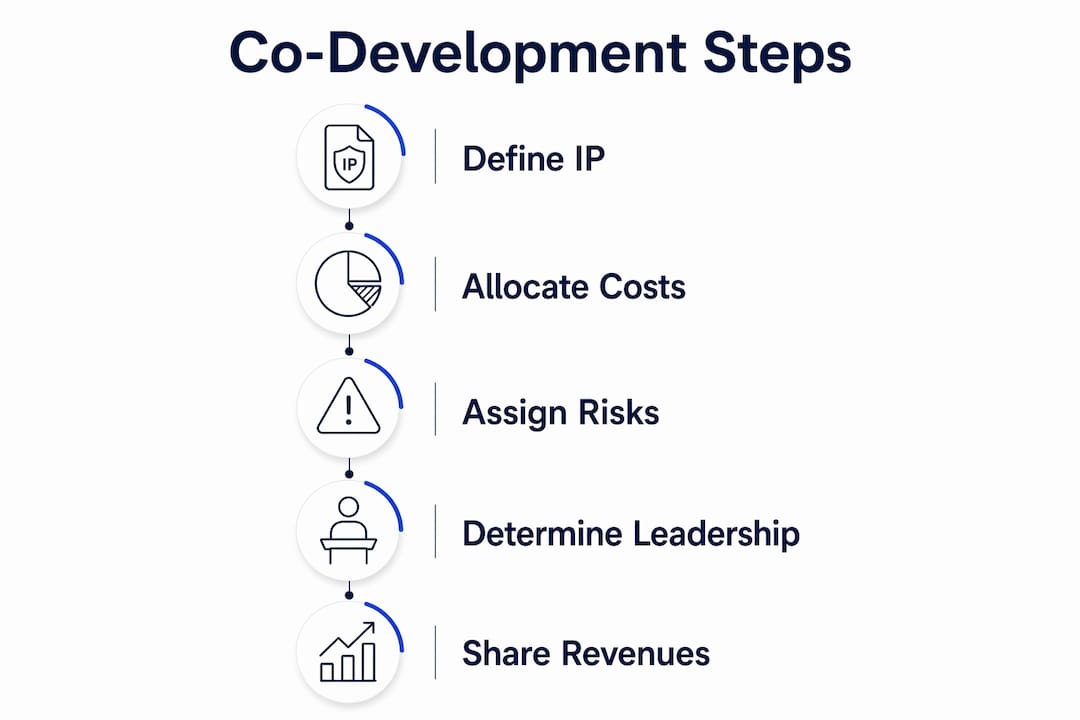
Modern biotech co-development agreements frequently use shared cost structures such as a 40/60 split and cover multi-year programs with multiple assets to mitigate clinical risk. A 40/60 cost split means the smaller partner carries less financial exposure while the larger partner takes on more risk in exchange for a larger revenue share. That ratio is negotiable and often shifts at each development phase.
The typical financial structure includes:
- Upfront payments: Cash paid at signing to compensate the asset-holder for early-stage investment already made.
- Milestone payments: Payments triggered by clinical or regulatory events, such as Phase 2 completion or FDA approval. These protect the paying partner from funding a program that stalls.
- Royalties on net sales: A percentage of commercial revenue paid to the IP licensor. Rates vary widely by asset class and geography.
- Profit sharing: Both parties share net profit after costs. This model requires transparent cost accounting and is more common in co-commercialization deals than pure co-development structures.
Large collaborations may include multi-asset agreements with portfolios of up to a dozen programs, sharing cost, risk, and commercialization responsibilities among partners. Portfolio-wide deals reduce the financial impact of any single program failure. If three of twelve assets advance to Phase 3, the collaboration still generates value.
Mid-sized biotech companies increasingly use co-development and NewCo models to retain 20–30% equity upside and maintain decision-making influence in global steering committees rather than accepting standard licensing terms. This shift reflects a broader move away from out-licensing as the default exit for smaller biotechs.
What role do governance structures play in co-development?
Governance is where co-development agreements succeed or fail in practice. A well-drafted contract means nothing if the two organizations cannot make joint decisions at speed.
The standard governance body is the Joint Steering Committee, or JSC. A JSC typically includes senior representatives from both partners across clinical, regulatory, and commercial functions. It meets on a defined schedule, usually quarterly, and holds decision-making authority over program strategy, budget changes, and regulatory submissions.
Joint Steering Committees are not just oversight bodies but operational engines that resolve deadlocks and keep development on schedule. Lack of escalation mechanisms can stall progress for months. Pre-defined escalation paths within JSCs are essential for managing disputes over clinical design changes and other issues.
A functional JSC governance structure includes:
- Defined voting rights. Specify whether decisions require unanimous consent or a majority. Unanimous consent protects minority partners but creates deadlock risk.
- Escalation pathways. When the JSC cannot resolve a dispute, the contract must name who decides next. This is typically the CEOs of both companies, with a defined timeline for resolution.
- Sub-committees. Large programs benefit from dedicated clinical, regulatory, and commercial sub-committees that report to the JSC. This prevents every operational decision from consuming JSC meeting time.
- Reimbursement planning integration. The JSC should include a reimbursement workstream from the start, not as an afterthought after FDA approval.
Pro Tip: Assign a dedicated JSC program manager who is neutral to both organizations. This person tracks action items, manages meeting cadence, and flags escalation triggers before they become crises.
Human factors such as trust and synchronized decision-making between scientific and business leads remain essential anchors for success in biotech co-development. No governance document replaces a relationship where both sides believe the other is acting in good faith.
How are regulatory and reimbursement strategies coordinated?
Regulatory coordination is the operational test of a co-development agreement. Two organizations must produce a single, coherent regulatory package for the FDA or global agencies, even when their internal systems, data formats, and quality standards differ.
Synchronizing regulatory submissions for drug and companion diagnostic co-development requires integrated data management and quality systems early in the development cycle to avoid costly re-validations. Misalignment in quality systems and data management protocols between partners prior to Phase 1 trials leads to costly re-validation and regulatory rejections.
The coordination challenges break into three categories:
- Companion diagnostics: A drug and its companion diagnostic must receive simultaneous FDA approval. If the diagnostic developer's data package is delayed, the drug approval stalls. The co-development agreement must specify data-sharing timelines and quality standards for both parties from the start.
- Cross-border submissions: Cross-border co-development failures frequently stem from regulatory compliance delays such as required government approvals for data export rather than scientific issues. Lead times of 3–6 months for specific government clearances, such as China's Human Genetic Resources regulations, must be planned for early.
- Reimbursement planning: Early integration of reimbursement strategy and synchronized regulatory submissions is essential to avoid costly delays and ensure market access. Coordinated reimbursement planning must begin during development, not after FDA approval.
The practical fix is a shared regulatory calendar maintained by both parties, with milestone dependencies mapped across both organizations. When the drug developer's Phase 3 database lock triggers the diagnostic developer's submission preparation, that dependency must be written into the agreement and tracked by the JSC.
Pro Tip: Use AI in regulatory affairs to align submission timelines across partners. Automated tracking of regulatory milestones reduces the coordination overhead that derails co-development programs.
Key Takeaways
Biotech co-development agreements succeed when IP ownership, financial frameworks, governance, and regulatory coordination are defined with precision before the collaboration begins.
| Point | Details |
|---|---|
| Define IP before signing | Separate Background and Foreground IP clearly and assign prosecution responsibilities to avoid disputes. |
| Align financial incentives | Use milestone payments and cost-sharing ratios to tie each partner's payout to program success. |
| Build a functional JSC | Include escalation pathways and sub-committees so governance resolves disputes without stalling programs. |
| Synchronize regulatory timelines | Map cross-partner dependencies in a shared regulatory calendar from Phase 1 onward. |
| Start reimbursement planning early | Integrate payer strategy during development, not after FDA approval, to protect market access. |
What I've learned negotiating co-development deals
The contracts I've seen fail did not fail because of bad science. They failed because the two organizations never agreed on what success looked like for each party.
The most overlooked clause in any co-development agreement is the exit provision. Teams spend weeks on IP ownership and royalty rates, then write two sentences on what happens if one partner wants out after Phase 2. That asymmetry creates enormous leverage for the party that decides to walk. Negotiate exit terms with the same rigor you apply to IP.
Multi-asset portfolio deals are genuinely underused by mid-sized biotechs. Spreading clinical risk across several programs changes the financial conversation with a larger partner. You are no longer betting everything on one Phase 3 readout. That changes your negotiating position on cost splits and governance rights.
The governance structures that work are the ones where both scientific leads actually talk to each other outside of JSC meetings. Formal governance documents set the rules. Informal relationships determine whether those rules get applied with good judgment or weaponized during disputes. Build the relationship before you need the escalation pathway.
Finally, do not underestimate the operational complexity of scaling a co-development program. A 50-person biotech running a co-development program with a large pharma partner is managing two organizational cultures, two quality systems, and two sets of regulatory expectations simultaneously. That is a different operational challenge than running an internal program, and it requires different tools.
— John
Haiphai's approach to co-development complexity
Co-development programs generate operational load that most biotech teams are not built to absorb. Regulatory coordination across two organizations, JSC management, and synchronized data packages all consume time that your team should be spending on science.
Haiphai works as an operational partner for biotech teams managing these programs. Starting from your program milestones, Haiphai identifies where co-development coordination creates bottlenecks and applies AI to reduce that friction. From regulatory drafting to clinical site activation, clients reclaim significant operational time on their path to approval. Teams managing co-development agreements use Haiphai's AI-driven solutions to keep regulatory timelines synchronized and governance workstreams on track. If your co-development program is running behind schedule, the bottleneck is almost always operational, not scientific. Haiphai's biotech advisory services are built to fix that.
FAQ
What is a biotech co-development agreement?
A biotech co-development agreement is a formal contract between two or more companies that defines how they share intellectual property, development costs, regulatory responsibilities, and commercialization rights to jointly develop a product.
How is IP ownership structured in co-development deals?
IP is typically split into Background IP, which each party owns before the deal, and Foreground IP, which is created during the collaboration. Foreground IP is allocated through sole ownership, joint ownership, or field-of-use models.
What does a Joint Steering Committee do?
A Joint Steering Committee is the primary governance body in a co-development agreement. It holds decision-making authority over program strategy, budget changes, and regulatory submissions, and it manages disputes through pre-defined escalation pathways.
How are costs split in a co-development partnership?
Cost-sharing ratios such as a 40/60 split are common, with the larger partner absorbing more cost in exchange for a greater revenue share. Milestone payments and royalties are layered on top to align incentives across development phases.
Why do co-development programs fail?
Most co-development failures stem from misaligned governance, unclear IP terms, or regulatory desynchronization rather than scientific problems. Cross-border programs face additional risks from government data transfer approvals that require 3–6 months of lead time.