
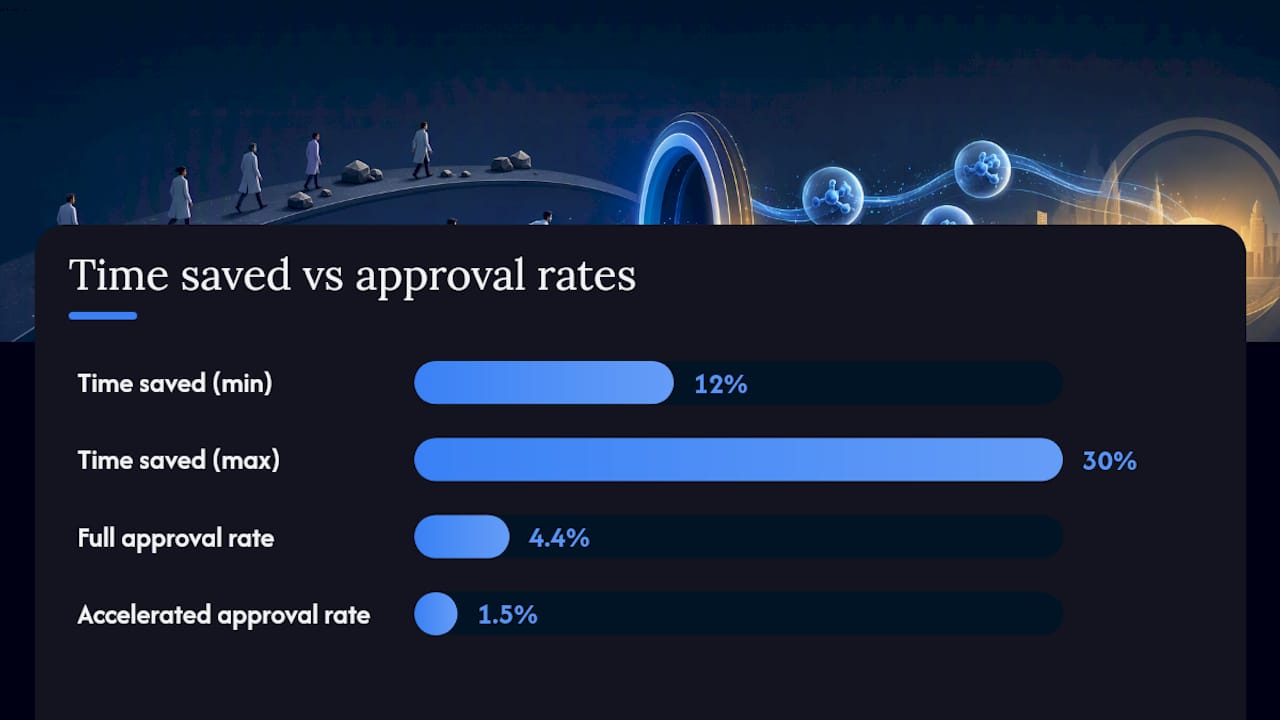
BioPharma Dive's analysis of oncology programs found full-approval rates as low as 1.5% for accelerated pathways versus 4.4% for conventional development. That gap isn't a rounding error. It's the difference between a drug reaching patients on schedule and a sponsor spending two extra years running the confirmatory trial nobody budgeted for.
A shortcut tends to justify its risk when three things line up: a validated biomarker with a track record in the relevant disease, early and documented alignment with the FDA, and a confirmatory trial that's funded and staffed before the conditional approval letter arrives. Miss any of the three, and the "shortcut" often becomes the slowest path to market.
- Time saved: 12% to 30% of total development timeline in accelerated oncology programs.
- Success tradeoff: Full-approval rates can drop by more than half in accelerated cohorts.
- Precondition for success: Biomarker validation, EOP2 alignment, and a resourced confirmatory plan.
Pro Tip: Before your team calls something a "shortcut," ask whether it removes clinical evidence or just removes calendar time. Parallelizing CMC work removes calendar time. Skipping a dose-ranging study removes evidence, and evidence doesn't grow back later.
Key Takeaways
| Point | Details |
|---|---|
| Time savings are real but bounded | Accelerated and seamless designs save roughly 12% to 30% of total development time in documented oncology programs. |
| Success rates drop sharply | Full-approval rates can fall from around 4.4% to 1.5% in accelerated cohorts, driven by smaller samples and surrogate endpoints. |
| Confirmatory trials are non-optional | Accelerated Approval requires a funded, staffed confirmatory trial; failing to deliver risks market withdrawal or label restrictions. |
| Modeling separates success from failure | Pre-specified transition criteria and sample-size re-estimation are what distinguish a working seamless design from a failed one. |
| Operational acceleration avoids the tradeoff | Haiphai's embedded partnership model reclaims up to 18 months through regulatory drafting and site activation automation, not clinical compromise. |
This article is general information, not a substitute for advice from a qualified doctor. Consult a qualified healthcare professional about your own circumstances before acting on anything here.
Table of Contents
- Drug Development Phase Shortcut Examples You'll Actually Encounter
- What Real Case Studies Show About Shortcut Outcomes
- Weighing Time Saved Against the Odds of Success
- Regulatory Pathways Built for Speed, and What They Demand Back
- A Checklist Before You Attempt a Shortcut
- The Ethics of Speed: Where Patient Safety Enters the Equation
- Why Data Quality Suffers When Trials Move Faster Than Their Statistics
- How Gene Therapy and mRNA Programs Are Rewriting the Shortcut Playbook
- HaiPhai's View: Compress Timelines Without Touching the Clinical Design
- Haiphai: A Safer Way to Win Back Development Time
- Sources
- FAQ
Drug Development Phase Shortcut Examples You'll Actually Encounter
Sponsors don't invent new shortcuts every year. They reach for the same handful of tactics, and each one shows up repeatedly in filings, investor decks, and FDA advisory committee transcripts. Here's what they look like in practice.
- Seamless Phase 2b/3 combination. Instead of running a standalone Phase 2b, then designing a new Phase 3 based on those results, sponsors build one adaptive trial that transitions from dose-finding to registrational testing without stopping enrollment. The NIH Seed regulatory case study documents a program that used exactly this design, built around an End-of-Phase 2 (EOP2) meeting where the sponsor walked the FDA through the statistical model before locking the protocol.
- Accelerated approval via surrogate endpoints. A sponsor uses a biomarker or intermediate outcome, tumor shrinkage instead of overall survival, for example, that's "reasonably likely" to predict clinical benefit, then confirms it later. This is the single most common shortcut in oncology and rare disease programs.
- Novel or reduced comparator arms. Rather than running a full head-to-head against standard of care with a large control group, sponsors negotiate smaller comparator arms or historical controls, cutting enrollment time significantly.
- Front-loaded indication expansion. Sponsors start registrational trials in multiple tumor types or subpopulations simultaneously instead of sequentially, betting that at least one indication reads out cleanly.
- Operational and CMC parallelization. This is the shortcut that doesn't touch clinical design at all. Running manufacturing scale-up, quality system build-out, and regulatory drafting in parallel with clinical trials instead of after them.
That last one deserves attention because it's the only shortcut on this list that doesn't ask a review division to accept less clinical evidence. It just asks your operational team to stop working sequentially.
What Real Case Studies Show About Shortcut Outcomes
Robert Califf's 2017 analysis compiled case studies showing that some programs taking shortcuts reached patients faster without safety issues, while others faced confirmatory trial failures, label restrictions, or market withdrawal after conditional approval.
Shortcuts in drug development carry documented risks to patient safety and program viability. Historical case studies show that abbreviated approaches to evidence generation have repeatedly produced divergent, and sometimes damaging, downstream results.
That's the core argument in the Califf PMC analysis, and it's aged well. The pattern it describes, early success followed by late-stage reckoning, keeps recurring because the incentives that produce it haven't changed. A sponsor under funding pressure or competitive threat has every reason to compress a timeline and comparatively little short-term reason to over-invest in the statistical rigor that protects against a confirmatory failure three years later.
The NIH Seed case study offers the more instructive counterexample: a program that used a seamless Phase 2b/3 design successfully because the sponsor modeled the transition criteria in advance and brought that model to the FDA at EOP2, rather than after enrollment had already started. The difference between that outcome and a Califf-style cautionary tale usually isn't the shortcut itself. It's whether the statistical groundwork was done before or after the design decision.
BioPharma Dive's oncology data adds a third data point worth sitting with:
- Accelerated designs in oncology save meaningful calendar time. However, these programs show lower full-approval conversion rates compared to conventional development. Programs employing front-loaded multi-indication trials achieve the greatest time savings but often face the weakest odds of simultaneous success across all indications.
Discussions of combined Phase 2b and Phase 3 designs in academic oncology trials, documented in clinical trial design literature, echo the same tension: seamless designs work when the transition rules are locked before data unblinding, and they fail when sponsors adjust criteria mid-stream to chase a positive signal.
Weighing Time Saved Against the Odds of Success
The math here isn't abstract. It shows up in the same BioPharma Dive dataset cited above, and it's worth breaking into its component parts rather than treating "shortcuts work" or "shortcuts don't work" as a binary.
The time savings are real and sizable. Accelerated and innovative trial designs in oncology cut 12% to 30% off total development timelines. Front-loading indication expansion adds additional timeline benefit on top of accelerated designs, since registrational work for a second or third indication starts years earlier than it would sequentially.
The success-rate cost is also real, and it isn't evenly distributed. Full approval rates for accelerated oncology pathways can fall substantially compared to conventional programs, a drop driven by multiple overlapping causes:
- Smaller sample sizes at the interim decision point mean effect estimates carry wider confidence intervals, which increases the odds a promising early signal doesn't hold up.
- Surrogate endpoints correlate with clinical benefit imperfectly. Reasonably likely to predict is not the same as proven to predict, and confirmatory trials sometimes reveal the gap.
- Broader indication bets multiply the number of ways a program can fail, since success in a front-loaded design usually requires more than one tumor type or subpopulation to read out.
Modeling and adaptive design can narrow this gap without eliminating it. Programs that pre-specify transition criteria, run sample-size re-estimation, and control type I error inflation before the trial starts convert accelerated timelines into real approvals more reliably than programs that improvise those decisions mid-trial. The NIH Seed case study documents an example where disciplined statistical planning paid off.
Regulatory Pathways Built for Speed, and What They Demand Back
The FDA offers four formal accelerated pathways, and each one trades faster review for a specific obligation the sponsor has to meet later.
- Breakthrough Therapy designation gets sponsors intensive FDA guidance and rolling review, but it requires preliminary clinical evidence of substantial improvement over existing therapies before it's granted.
- Accelerated Approval lets a sponsor file on a surrogate endpoint, but it comes with a binding requirement to run a confirmatory trial, and failure to complete it can trigger market withdrawal or label restrictions.
- Fast Track designation allows rolling submission of application sections, cutting review lag time, but doesn't reduce the clinical evidence bar itself.
- EOP2 and pre-NDA meetings aren't formal pathways, but they're where sponsors negotiate seamless design details, interim analysis rules, and what a confirmatory package will need to look like before the pivotal trial locks.
Skipping the confirmatory obligation isn't a hypothetical risk. Sponsors that treat accelerated approval as a finish line rather than a conditional starting point have seen products pulled from the market years after launch, along with the investor and reputational fallout that follows.
A Checklist Before You Attempt a Shortcut
Run through these in order. Skipping ahead is exactly the behavior that turns a shortcut into a liability.
- Validate the science first. Confirm biomarker validation, replicated dose-response signals, and PK/PD concordance across at least two independent studies before considering any seamless or accelerated design.
- Engage the FDA early and in writing. Bring your interim-analysis plan to a pre-IND or EOP2 meeting rather than after the trial has enrolled, and get the transition criteria documented in meeting minutes.
- Budget the confirmatory trial now, not later. If your shortcut depends on Accelerated Approval, the confirmatory trial needs its own funding line before you file, not a promise to raise it after conditional approval.
- Parallelize operations, not evidence. Run CMC scale-up, site activation, and regulatory drafting alongside your clinical trial instead of compressing the trial's statistical rigor.
- Set stopping rules before you need them. Pre-specify the transition and futility criteria for any adaptive design, and don't let a promising interim look tempt the team into moving the goalposts.
Pro Tip: If your statistics team can't explain your interim-analysis plan in one slide before the trial starts, it isn't ready for an EOP2 meeting, and it definitely isn't ready to survive an FDA statistical reviewer's questions.
The Ethics of Speed: Where Patient Safety Enters the Equation
Every shortcut discussed above touches patients directly or indirectly, and that's the distinction regulatory teams sometimes lose in the rush to compress a timeline. A smaller comparator arm means fewer patients receiving a validated standard of care during the trial. A surrogate endpoint means patients and physicians are making treatment decisions based on a predictor of benefit, not confirmed benefit itself.

None of this makes shortcuts unethical by default. Accelerated Approval exists precisely because making a promising therapy available earlier, under a conditional framework with confirmatory obligations, can be the right call for patients with no other options. The ethical failure mode isn't using the pathway. It's using the pathway without the discipline that makes it defensible: honest biomarker validation, transparent informed consent about what a surrogate endpoint does and doesn't prove, and genuine commitment to the confirmatory trial rather than treating it as an afterthought.
Institutional review boards and data safety monitoring boards exist for exactly this reason, and their role becomes more, not less, important as trial designs get more adaptive. A pre-specified stopping rule protects patients from continuing in an arm that isn't working. An undisciplined one, adjusted mid-trial to preserve a positive signal, does the opposite. The sponsors who get this right treat patient protection and statistical rigor as the same problem, because in an accelerated design, they usually are.
Why Data Quality Suffers When Trials Move Faster Than Their Statistics
Smaller sample sizes are the most common casualty of a compressed timeline, and they don't just widen confidence intervals in the abstract. They increase the odds that an interim readout looks like a real signal when it's actually noise, particularly in programs relying on a single biomarker rather than a hard clinical endpoint.
Seamless designs add a second, subtler risk: statistical inflation of type I error if the transition from exploratory to confirmatory testing isn't rigorously controlled. The NIH Seed case study makes this point directly. Without prespecified transition criteria and formal sample-size re-estimation, a seamless trial can produce effect-size estimates that look stronger than the underlying data support, and regulators have gotten considerably better at spotting that pattern.
Reduced comparator arms compound the problem further. Historical controls introduce confounding that a concurrent randomized arm doesn't have, and reviewers weigh that difference heavily when deciding whether a positive result reflects the drug or reflects differences between the trial population and the historical dataset. None of this means smaller, faster trials are inherently unreliable. It means the statistical planning has to get more rigorous exactly when the sample size gets smaller, not less, and that's the step sponsors under timeline pressure are most likely to shortchange.
How Gene Therapy and mRNA Programs Are Rewriting the Shortcut Playbook
Gene therapy and mRNA vaccine development have generated some of the most aggressive timeline compressions in the industry's history, and they've done it with a mix of genuine innovation and familiar tradeoffs.
mRNA vaccine platforms compressed a normally multi-year preclinical and Phase 1 sequence into months by leaning on a manufacturing platform that had already been validated for other targets. That's an operational shortcut, not a clinical one. The platform's safety profile carried over; the specific antigen still had to go through standard phase testing, just faster because the surrounding infrastructure didn't need to be rebuilt.
Gene therapy programs have taken a different route, often relying on surrogate biomarkers, a corrected enzyme level, a restored protein expression pattern, because the clinical outcome they're ultimately targeting can take years to manifest and enrollment pools are often tiny due to disease rarity. That combination, small trials plus surrogate endpoints, is precisely the profile that produces the biggest gap between conditional approval and confirmed long-term benefit. Several gene therapy approvals have moved forward on single-arm trials with historical controls rather than randomized comparisons, a shortcut that only holds up when the disease's natural history is exceptionally well characterized. When it isn't, the confirmatory burden shifts almost entirely onto long-term follow-up registries, sometimes running a decade or more past approval.
HaiPhai's View: Compress Timelines Without Touching the Clinical Design
The shortcuts we've walked through all share one trait: they trade clinical certainty for calendar time. There's a version of speed that doesn't require that trade. Operational acceleration, parallelizing CMC workstreams, automating regulatory drafting, compressing clinical site activation, reduces IND timelines through better coordination alone, without touching a single statistical assumption.

That's the model Haiphai builds around: an embedded operational partnership that maps where a program is actually losing months, then applies AI to the regulatory drafting and site activation bottlenecks causing the delay. Clients typically reclaim up to 18 months this way. For more on the mechanics, see how to compress biotech development timelines without touching the clinical evidence bar.
Haiphai: A Safer Way to Win Back Development Time
The shortcuts covered above all carry a common thread: they buy speed by spending down clinical certainty. Haiphai takes a different route to the same result, faster timelines, without asking your regulatory team to gamble on a surrogate endpoint or a thinner comparator arm.
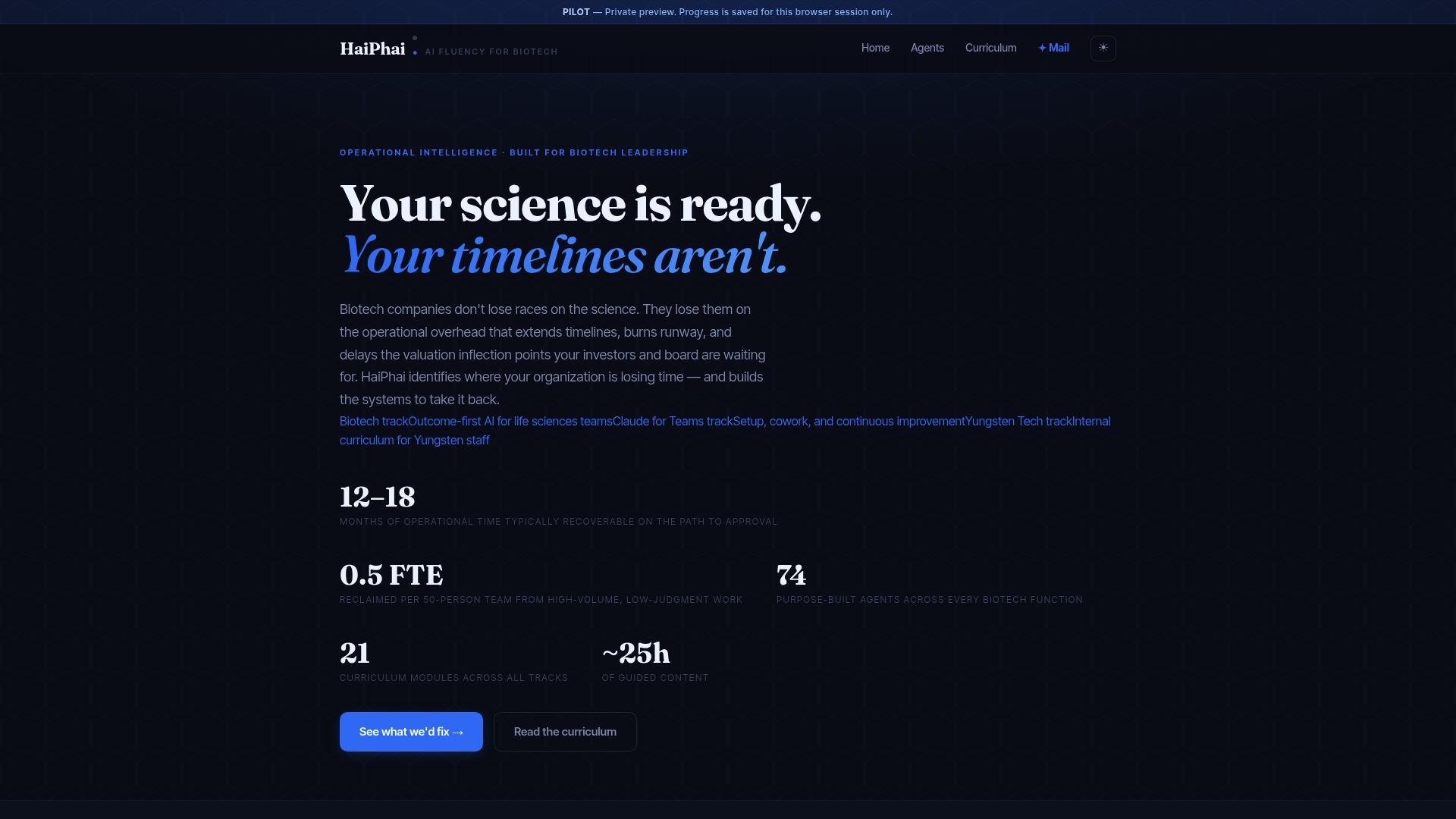
Haiphai works as an embedded operational partner rather than a software vendor. That distinction matters here specifically because the time lost in most biotech programs isn't sitting in the clinical trial design. It's sitting in regulatory drafting cycles, clinical site activation delays, and disconnected workflows between clinical, regulatory, and executive teams. Haiphai starts from your approval goal and works backward to find exactly where those bottlenecks live, then builds AI-enabled processes tailored to your program rather than a generic tool. Clients working this way have reclaimed up to 18 months of operational time on their path to approval, time that compounds directly into valuation and funding leverage. If your team is weighing a clinical shortcut because the timeline pressure feels unavoidable, it's worth first finding out how much of that pressure is actually operational. Review Haiphai's approach to biotech pipeline acceleration, then reach out through Haiphai to schedule an operational diagnostic and see where your program's months are actually going.
Sources
- Accelerate oncology drug development: A data-driven approach to clinical decisions | BioPharma Dive
- Warning About Shortcuts in Drug Development - PMC
- Drug Regulatory Case Study - NIH Seed
- Drug development stages - NCBI Bookshelf / Merck Manual
FAQ
What Are the Five Main Phases of Drug Development?
Drug development typically runs through discovery/preclinical research, Phase 1 (safety, small healthy or patient cohorts), Phase 2 (efficacy and dosing), Phase 3 (large-scale confirmatory trials), and Phase 4 (post-market surveillance), as outlined in the Merck Manual's overview of development stages.
What Is an Example of a Drug Prototype Failing Late Despite Early Shortcuts?
The Califf PMC analysis documents multiple programs where abbreviated early-phase evidence looked promising but produced divergent, sometimes damaging, results once confirmatory data arrived, a pattern common enough that it shaped later FDA guidance on confirmatory trial obligations.
What Are Some Examples of Drug Discovery Shortcuts?
Common examples include using validated biomarkers instead of hard clinical endpoints, running seamless Phase 2b/3 designs instead of two sequential trials, and parallelizing CMC and regulatory drafting work with clinical development, an approach Haiphai's operational model is built specifically to support.
What Do Phase 1, Phase 2, and Phase 3 Trials Actually Test?
Phase 1 tests safety and dosing in a small group, Phase 2 tests efficacy signals and optimal dosing in a larger patient cohort, and Phase 3 confirms efficacy and monitors adverse events across a large, often multi-site population before filing for approval, per standard phase definitions.
Do Accelerated Approval Pathways Require Anything After Launch?
Yes. Accelerated Approval based on a surrogate endpoint requires the sponsor to complete a confirmatory trial after conditional approval, and failing to do so can result in market withdrawal or label restrictions.