
An automation governance model is the set of people, policies, and automated controls that let an organization scale automations without losing oversight of risk, quality, or compliance. The first move is not buying a platform. It's chartering an ownership body, often called Automation HQ, and standing up an intake pipeline before a single new bot goes into production. Get that sequencing right and the payoff is scale without chaos.
TL;DR:
- An effective automation governance model requires clearly defined ownership, a prioritization pipeline, and technical standards to prevent chaos during scaling.
- Governance should integrate with existing enterprise security controls, such as identity management and audit logging, to avoid gaps and shadow IT risks.
- Metrics like policy compliance, time to deployment, and automation-specific benefits help track governance success and guide improvement efforts.
- Building governance through phased steps over 90 days—starting with a charter, pilot, and standards—prevents rushing into unmanageable scale or shadow automations.
- In regulated industries, automation touching sensitive data must follow stricter controls, with compliance considerations integrated into initial request review and design.
Table of Contents
- What Are the Five Pillars of an Automation Governance Framework?
- Who Runs Automation Governance: HQ, CoE, and Automation Factories
- Should Automation Governance Be Centralized, Hybrid, or Distributed?
- How Does the Automation Lifecycle Work From Intake to Retirement?
- What Technical Standards and Security Controls Does Governance Require?
- How Do You Measure Automation Governance Success?
- How Do You Build an Automation Governance Roadmap in 90 Days?
- HaiPhai Perspective: Applying Governance to Life Sciences and Regulated Automation
- How Does Automation Governance Fit Into Enterprise IT and Security Governance?
- How Do You Manage Stakeholder Communication During Automation Governance Rollout
- What Legal and Regulatory Considerations Apply to Automation Compliance?
- Author Perspective: Balancing Speed and Controls as an Operational Partner
- How HaiPhai Helps Teams Stand Up Governed Automation
- Sources
- FAQ
What Are the Five Pillars of an Automation Governance Framework?
Most durable programs organize around the same five pillars, a structure echoed in practitioner frameworks like Turbotic's automation governance blueprint. Each pillar needs a concrete artifact, not just a policy statement.
- Ownership and structure: a written charter naming who approves new automations and who can kill a broken one.
- Pipeline management: a scoring system for intake and prioritization, so requests get ranked by value and feasibility rather than by whoever asked loudest.
- Technical standards: coding conventions, testing requirements, and quality gates that every build must pass before promotion.
- Risk, compliance, and security controls: credential vaults, tamper-evident logging, and formal change control for anything touching regulated data.
- Value measurement: KPIs and ROI tracking tied back to the original business case, reviewed on a set cadence rather than once at launch.
Skip any one of these and the program tends to drift, either stalling under bureaucracy or sprawling into unmanaged risk.
Who Runs Automation Governance: HQ, CoE, and Automation Factories
Automation HQ (sometimes called a Center of Excellence) is the standing body that owns the governance workflow automation runs on. It doesn't build every automation; it sets the rules and reviews what gets built elsewhere.
- Platform owners manage the toolchain, licensing, and environment stability.
- Governance leads maintain the intake pipeline, standards documentation, and approval gates.
- Security and compliance owners enforce credential policy, audit logging, and regulatory mapping.
- Evangelists train business units and recruit new automation candidates.
- Citizen integrators, sitting inside business teams (sometimes called Automation Factories), build low-risk automations under HQ's technical standards.
Funding usually splits two ways: HQ carries platform and governance costs centrally, while business units fund their own build effort. That split keeps incentives honest. Business teams only propose automations worth their own budget, and HQ stays focused on oversight rather than becoming a bottlenecked build shop.
Should Automation Governance Be Centralized, Hybrid, or Distributed?
There's no universal right answer here. The choice depends on where the organization sits on risk exposure and automation maturity, not on which model sounds more modern.
- Centralized: Automation HQ owns build and deployment. Strong for regulated industries or early-stage programs. The tradeoff is slower throughput, since every request funnels through one team.
- Hybrid: HQ sets standards and handles complex or regulated builds; trained citizen integrators build low-risk automations under supervision. This is the most common model once a program has run a few pilots successfully.
- Distributed: Business units build independently within HQ-defined guardrails, with periodic audits instead of pre-approval. Works only when technical standards and policy-as-code enforcement are mature enough to catch violations automatically.
The typical path runs centralized to hybrid to distributed, and the trigger to move is rarely a calendar date. It's a maturity signal: consistent QA pass rates, clean audit results, and a backlog that's outpacing HQ's build capacity.
How Does the Automation Lifecycle Work From Intake to Retirement?
Every automation should pass through the same gated stages, whether it's a simple approval to a citizen integrator or a full clinical workflow rebuild.
- Intake: request logged with a business case, expected value, and feasibility score, following the same value-versus-feasibility logic HBR recommends for selecting automation projects.
- Prioritization: HQ ranks the request against the current backlog and capacity.
- Build: development against documented technical standards.
- QA: testing against defined quality gates, not ad hoc spot checks.
- Staging: a controlled environment mirroring production.
- Production deployment: release under formal change control, with a named approver.
- Monitoring: ongoing performance and exception tracking.
- Review: scheduled reassessment against original ROI assumptions.
- Decommissioning: formal retirement when value drops or the underlying process changes.
Emergency changes need a separate, faster lane with its own sign-off authority, otherwise urgent fixes get shoehorned through the standard process and controls get skipped under pressure. Every handoff between stages needs a documented owner and an SLA, or accountability disappears the moment something breaks.
Pro Tip: Require a one-page decommissioning note for every retired automation, listing why it was killed. Six months later, that note saves you from rebuilding the same mistake under a different name.
What Technical Standards and Security Controls Does Governance Require?
Governance without technical enforcement is just a policy document nobody reads. The controls that actually hold up under audit tend to be the boring, mechanical ones.
- Credential vaulting and rotation: no automation should ever hold a hardcoded password; secrets live in a vault with scheduled rotation.
- SSO and least privilege: automations get only the access their specific task requires, nothing broader.
- Tamper-evident audit logging: every action an automation takes gets logged in a form investigators can trust hasn't been altered, a baseline multiple governance frameworks treat as non-negotiable for regulated environments.
- Policy-as-code: rules get written as enforceable code rather than PDF guidelines, mapped to recognized frameworks like NIST or SOC 2 where the business needs that alignment.
The CNCF's automated governance maturity model frames this as embedding policy, evaluation, enforcement, and audit directly into the pipeline rather than layering them on after deployment. Automated enforcement catches violations at build time, which is far cheaper than catching them in a compliance audit eighteen months later.
How Do You Measure Automation Governance Success?
Two layers of metrics matter, and conflating them is a common mistake. Program-level KPIs track the health of governance itself: policy compliance rate, average time from intake to production, and percentage of automations passing QA gates on the first try. Per-automation metrics track individual value: hours saved, exception rate, SLA compliance, and cost avoidance against the original business case.
The CNCF maturity model offers a useful structure for a self-assessment, grading readiness across four categories.
| Maturity dimension | What "weak" looks like | What "strong" looks like |
|---|---|---|
| Policy | Rules exist only as documents | Rules encoded and enforced automatically |
| Evaluation | Manual, inconsistent reviews | Automated, repeatable checks at build time |
| Enforcement | Violations caught after deployment | Violations blocked before deployment |
| Audit | Logs incomplete or overwritten | Tamper-evident, complete audit trail |
Run this self-assessment quarterly. Whichever dimension scores weakest should drive next quarter's governance investment, not whichever initiative has the loudest internal champion.
How Do You Build an Automation Governance Roadmap in 90 Days?
Standing up governance doesn't require a year of planning before the first automation ships. It requires sequencing.
- Days 0 to 30: write the Automation HQ charter, name owners for each pillar, launch a basic intake form, and select one low-risk pilot with a clear business case.
- Days 30 to 90: publish technical standards, define QA gates, monitor the pilot in production, and run enablement sessions for the first wave of citizen integrators.
- Months 3 to 12: expand into Automation Factories within business units, layer in policy-as-code enforcement, and run the first full maturity self-assessment to set the next year's roadmap.
Resist the urge to skip straight to scale. A program that launches ten automations before it has a working intake form and a named approver spends the next year cleaning up shadow automation instead of building new capacity.
HaiPhai Perspective: Applying Governance to Life Sciences and Regulated Automation
Clinical and regulatory workflows raise the stakes on every pillar above. A misconfigured automation touching patient data or a regulatory submission isn't just an operational hiccup; it can delay an approval timeline by months. That's why credential vaulting, audit trails, and change control need to be stricter here than in a typical back-office use case.
Some service providers act as embedded operational partners, mapping bottlenecks in regulatory drafting and clinical site activation before recommending which automations to govern first. That diagnostic step matters: governance built around the wrong priorities just adds overhead. Following this sequencing can help teams reclaim operational time on the path to approval, time that matters directly for valuation and funding. For deeper detail on applying this to clinical workflows, see Haiphai's guide to redesigning clinical workflows with governed AI.
How Does Automation Governance Fit Into Enterprise IT and Security Governance?
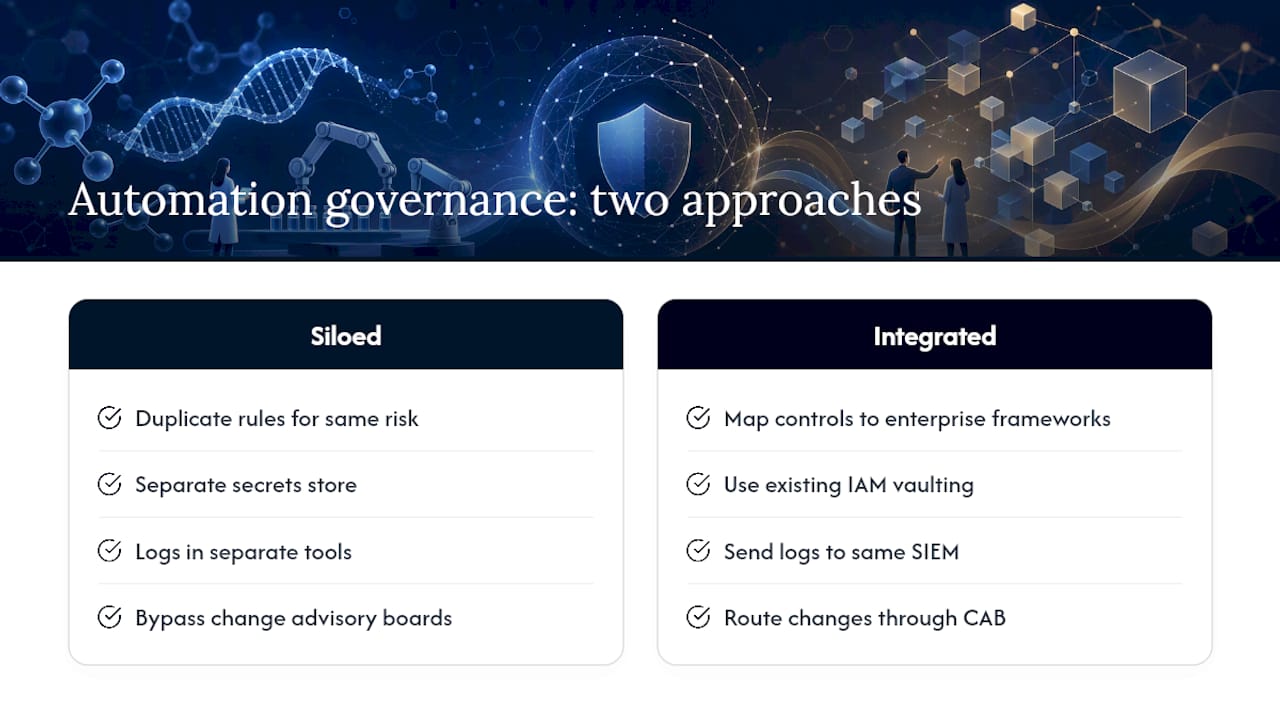
Automation governance can't operate as its own silo. If it does, you end up with two sets of rules for the same underlying risk: one for automations, one for everything else IT and security already govern. That duplication either confuses teams or, worse, lets automations slip through gaps neither policy set was built to close.
The practical fix is mapping automation controls onto existing enterprise frameworks instead of inventing parallel ones. Credential vaulting for automations should plug into the same identity and access management system IT already runs, not a separate secrets store nobody on the security team can see. Audit logging from automations should feed the same SIEM or log aggregation pipeline used for every other system, so investigators aren't hunting across five different tools during an incident.
This also means automation governance leads need a formal seat, or at least a formal liaison, with enterprise security governance and IT risk committees. When a new automation touches a system already under a change advisory board's authority, that automation's change control needs to route through the same board, not around it. Skipping this step is how shadow IT problems reappear in automation form: technically compliant with automation-specific rules, invisible to the broader security program.
For organizations handling protected health information or other regulated data, this integration isn't optional. HIPAA-specific security risk analysis needs to account for every automation touching that data, and enterprise compliance teams applying HIPAA controls to AI and automation consistently flag this integration gap as the source of avoidable audit findings. Build the bridge between automation governance and enterprise security governance early, before the automation footprint grows large enough that retrofitting it becomes its own project.
How Do You Manage Stakeholder Communication During Automation Governance Rollout
Governance programs fail more often from politics than from technical gaps. Business units that built their own quick automations before HQ existed tend to read new governance rules as a threat to their autonomy, and that reaction is predictable enough that it deserves a plan, not just a memo.
Start communication before the charter is finalized, not after. Business unit leaders who get a say in defining intake criteria are far more likely to actually use the intake process once it launches, instead of quietly continuing to build outside it. Frame governance in terms business leaders already care about: faster approval for their automation requests, fewer production outages, clearer ownership when something breaks. Nobody objects to a process that makes their own work more reliable.
Executive sponsorship needs to be visible and specific, not a one-line mention in a town hall. A short, recurring update, monthly is usually enough, showing pipeline throughput, automations delivered, and hours saved keeps governance framed as an enabler rather than a compliance tax. When enforcement tightens (a new QA gate, a stricter change control step), explain the incident or risk that prompted it. Teams tolerate friction far better when they understand what it's protecting against.
Change management also means training citizen integrators before enforcement kicks in, not after. Publishing a new coding standard the same week you start rejecting builds against it guarantees resentment. Publish it, give teams a real runway to adapt, then enforce.
What Legal and Regulatory Considerations Apply to Automation Compliance?
Compliance requirements for automation vary sharply by industry, and treating them as a single generic checklist is a mistake that shows up during audits. Financial services automations touching transaction data face different retention and audit requirements than a marketing automation moving campaign leads. Life sciences and healthcare automations touching protected health information carry the strictest bar, since no AI tool is HIPAA compliant on its own; compliance depends on how the surrounding workflow, access controls, and logging are designed, not on the tool itself.
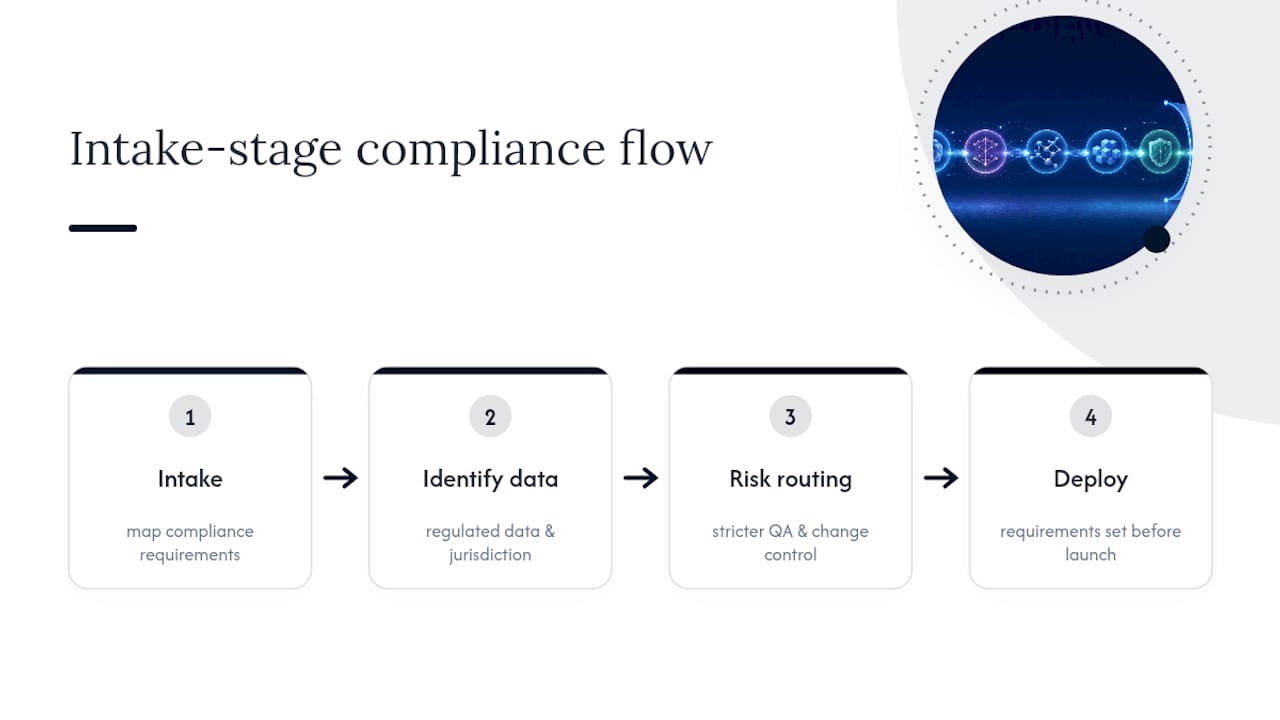
The practical implication for an automation governance model: compliance mapping needs to happen at the intake stage, before build starts, not as a final check before deployment. An automation flagged as touching regulated data at intake can be routed through stricter QA gates and change control from day one. One discovered after deployment usually means an expensive retrofit, or worse, a compliance gap that surfaces during an external audit.
Cross-border automation adds another layer. An automation processing data across jurisdictions needs its governance model to account for the strictest applicable regime, not the most convenient one. Data residency requirements, retention limits, and breach notification timelines differ enough between regions that a single global default rarely satisfies every jurisdiction an organization operates in. Build the governance model to ask "what's the strictest rule that could apply here" at intake, and the rest of the compliance work gets substantially easier downstream.
Author Perspective: Balancing Speed and Controls as an Operational Partner
Governance gets treated as friction until it's tied to a number. Attach it to measurable KPIs, hours saved, exception rates, time to production, and it stops being a brake and starts being the thing that lets you scale faster with fewer surprises. The rule I'd give any leader starting this work: govern the outcome, not the tool.
— John
How HaiPhai Helps Teams Stand Up Governed Automation
Some providers work as embedded operational partners, mapping actual bottlenecks in regulatory drafting and clinical site activation before recommending automations.

That diagnostic sequencing is the difference: instead of buying a platform and retrofitting governance later, you get a tailored workflow redesign built with governance, audit trails, and technical standards already embedded from day one. This approach can help biotech and life sciences teams reclaim significant operational time on their path to approval. If your team is weighing how to stand up governed automation without slowing down clinical or regulatory timelines, book a consultation with Haiphai to map your specific bottlenecks and see where governance would return the most operational time.
Sources
- Automated Governance Maturity Model | CNCF TAG Security
- How to pick the right automation project | HBR
- Automation governance framework | Turbotic
FAQ
What Are the Five Pillars of Automation Governance?
Ownership and structure, pipeline management, technical standards, risk and compliance controls, and value measurement form the five pillars most governance frameworks build around, as outlined by Turbotic.
What Are the Three Models of Automation Governance?
The three common operating models are centralized (Automation HQ owns all builds), hybrid (HQ sets standards while trained business teams build), and distributed (business units build independently under audited guardrails).
What Are the Six Pillars of AI Governance?
Definitions vary across organizations, but most AI-specific governance frameworks extend the five automation pillars with a sixth: model transparency and explainability, covering how automated decisions get documented and reviewed.
How Do You Start Implementing Automation Governance?
Start by chartering an ownership body like Automation HQ, defining intake criteria, and running one pilot automation through the full lifecycle before scaling; Haiphai's diagnostic approach applies this same sequencing to regulated biotech workflows.
What KPIs Matter Most for Automation Governance?
Track program-level metrics like policy compliance rate and time to production alongside per-automation metrics like hours saved, exception rate, and SLA compliance, feeding both into a quarterly maturity self-assessment.