
Vendor-led, role-based training is what turns AI pilots into operational results in biotech: it teaches teams to use, supervise, and document AI outputs against real validation requirements, not just to click through a tool. Done right, it reclaims months of timeline, cuts compliance risk, and depends more on change management than on the software itself. One vendor built specifically around that model.
TL;DR:
- Effective vendor-led training must be role-specific, focus on governance, validation, and real-world documentation to meet regulatory standards.
- A structured, phased rollout with clear success criteria and defined responsibilities minimizes the risk of failure during enterprise scale adoption.
- Training should incorporate change management tactics like executive sponsorship, champion identification, and practical exercises in simulated environments.
- Measurement of AI success relies on timeline reduction, task-cycle time savings, site enrollment improvements, and user confidence rather than subjective feedback alone.
- Partner-led workflows that redesign processes and provide ongoing monitoring are essential to truly realize AI's benefits in biotech operations.
Table of Contents
- Why Role-Based, Vendor-Led AI Training Matters for Biotech Operations
- Core Components of an Effective Vendor-Led Training Program
- Pilot-to-Scale Rollout: Timeline, Scope, and Team Responsibilities
- Governance, Validation, and Documentation Requirements
- KPIs and Success Criteria for AI Adoption Programs
- HaiPhai's Perspective: What a Real Operational Partnership Looks Like
- How HaiPhai Can Help: Offer and Next Steps
- Sources
- FAQ
Why Role-Based, Vendor-Led AI Training Matters for Biotech Operations
Most biotech AI pilots stall at the pilot stage. Many organizations are experimenting with AI in clinical development, but only a smaller share actually redesigns the workflows around it, according to Bain & Company. That gap is not a technology problem but a training and change-management problem.
The upside for closing it is real. Applying AI and machine learning across clinical assets can compress development timelines by roughly six months per asset and lift site enrollment rates by 10 to 20%. But those gains only show up when people actually change how they work, not when a tool sits unused next to the old process. BCG's analysis of AI implementation found that roughly 70% of the value from AI comes from change management, not the underlying model or interface.
Skipping structured training carries specific risks:
- Generic AI courses teach platform mechanics but nothing about GxP documentation, audit trails, or escalation rules.
- Unmanaged pilots produce shadow workflows that no one can validate later.
- Automation bias sets in fast: teams start trusting AI outputs without checking them, which is exactly the failure mode regulators worry about most.
A structured approach to aligning AI tools with clinical goals treats training as the mechanism that connects strategy to daily practice, not an afterthought bolted onto a software rollout.
Core Components of an Effective Vendor-Led Training Program
A training program that actually holds up under regulatory scrutiny needs more than a demo and a slide deck. It needs to be built around roles, governance, and evidence from day one.
- Role-based curricula with measurable learning objectives. Clinical research associates, regulatory writers, data managers, and site staff each interact with AI differently, so each group needs its own competency checklist, not a shared generic module.
- Governed operating procedures. Teams need explicit rules for reading confidence scores, when to override an AI output, and how escalation works. Nature Reviews notes that AI's most defensible near-term role is augmenting operational tasks like eligibility screening and monitoring under human oversight, which means training has to cover that oversight explicitly, not assume it happens naturally.
- Validation and data-control training. Staff need working fluency in ALCOA+ data-integrity principles, data provenance tracking, and how independent test sets get used to check model outputs.
- Change-management scaffolding. Executive sponsorship, named AI champions inside each function, coaching cadences, and open office hours all matter more than most vendors admit up front.
- Practical delivery formats. McKinsey's research on biopharma operations points to blended delivery working best: scenario labs, sandboxes built on representative (not production) data, and supervised agent-workflow exercises where trainees practice reviewing and approving AI-generated drafts before they ever touch a live file.
Pro Tip: Build your sandbox data from de-identified or synthetic records that mirror your actual patient population's demographics. Training teams on unrepresentative data teaches false confidence, and that gap only surfaces after go-live.
Pilot-to-Scale Rollout: Timeline, Scope, and Team Responsibilities
A training rollout that jumps straight to enterprise scale almost always fails quietly. The sequence that works looks more like a controlled experiment than a software launch.
- Phase 0: Discovery. Start from the strategic goal, whether that is a faster IND filing or shorter site activation, and work backward to identify the one to three bottlenecks actually blocking it. Define success criteria before anyone touches a tool.
- Phase 1: Pilot. Pick a contained test bed, usually a single trial, site cluster, or document type, and run it for three to six months with explicit acceptance criteria and a measurement plan agreed on up front.
- Phase 2: Iteration and hardening. Turn what worked into SOPs and validation artifacts, then train internal staff to train others (a train-the-trainer model), before widening scope to adjacent workflows.
- Phase 3: Scale and governance handover. Move to continuous monitoring, formal change control, and a standing metrics dashboard that operations owns going forward.
Responsibilities split cleanly between the two sides of the table:
- Vendor side: diagnostic mapping, curriculum design, sandbox environment setup, governance-artifact templates, and pilot measurement design.
- Buyer side: executive sponsorship, staff time commitment, access to representative data, and appointing internal champions who will outlast the pilot.
Watch the sequencing trap here: speeding up one task, say, drafting regulatory summaries, often just moves the bottleneck downstream to review and approval. Pilots that anticipate this restructure the adjacent process at the same time, rather than automating one step and calling it done.
Governance, Validation, and Documentation Requirements
Training in a regulated environment has to map to how validation actually works, not run as a parallel track. An Integrated Validation, Ethics, and Lifecycle (IVEL) framework organizes regulatory, technical, and ethical activities into a seven-stage workflow for AI and machine learning in GxP settings, and it gives training designers a concrete structure to build against instead of guessing which topics matter to an auditor.
Specific training content that regulators expect to see evidence of:
- ALCOA+ data-integrity principles applied to AI-generated records, not just source data.
- Representativeness assessments and subgroup performance checks whenever AI outputs affect patient selection or safety monitoring.
- Human-oversight design: reading confidence indicators, knowing escalation paths, and recognizing the early signs of automation bias before it becomes routine.
- Documentation practice: filling out Purpose and Request forms, building monitoring plans, and producing audit trails during training itself, not learning it for the first time during an inspection.
The operating reality most teams underestimate is captured well in the phrase "agent proposes, human disposes." Every AI-assisted step needs to be traceable: which agent ran, which input version it used, and which human signed off. Training has to rehearse producing that exact record, not just discuss it in theory.
KPIs and Success Criteria for AI Adoption Programs
Deciding whether to scale a pilot comes down to a small set of numbers tracked consistently, not a general sense that "the team likes it."
Track these:
- Months of timeline reclaimed against the original project plan.
- Task-cycle time reduction for the specific workflow the pilot targeted (document drafting, site activation, data review).
- Site enrollment lift, benchmarked against the 10 to 20% improvement range seen in broader AI adoption cases.
- Training adoption rate and user confidence scores collected through short post-module surveys.
- Reduction in external agency or contractor spend tied to the automated task.
Report the pilot dashboard weekly to the project team and roll it up monthly to a steering committee that includes the executive sponsor. That cadence keeps the enrollment and recruitment gains visible early enough to course-correct instead of discovering a shortfall at the six-month mark.
HaiPhai's Perspective: What a Real Operational Partnership Looks Like
We start every engagement by working backward from a client's strategic goal, not from a product demo. That backtracking is how you find the one or two bottlenecks actually costing time, whether that's a regulatory drafting queue or a site activation delay.
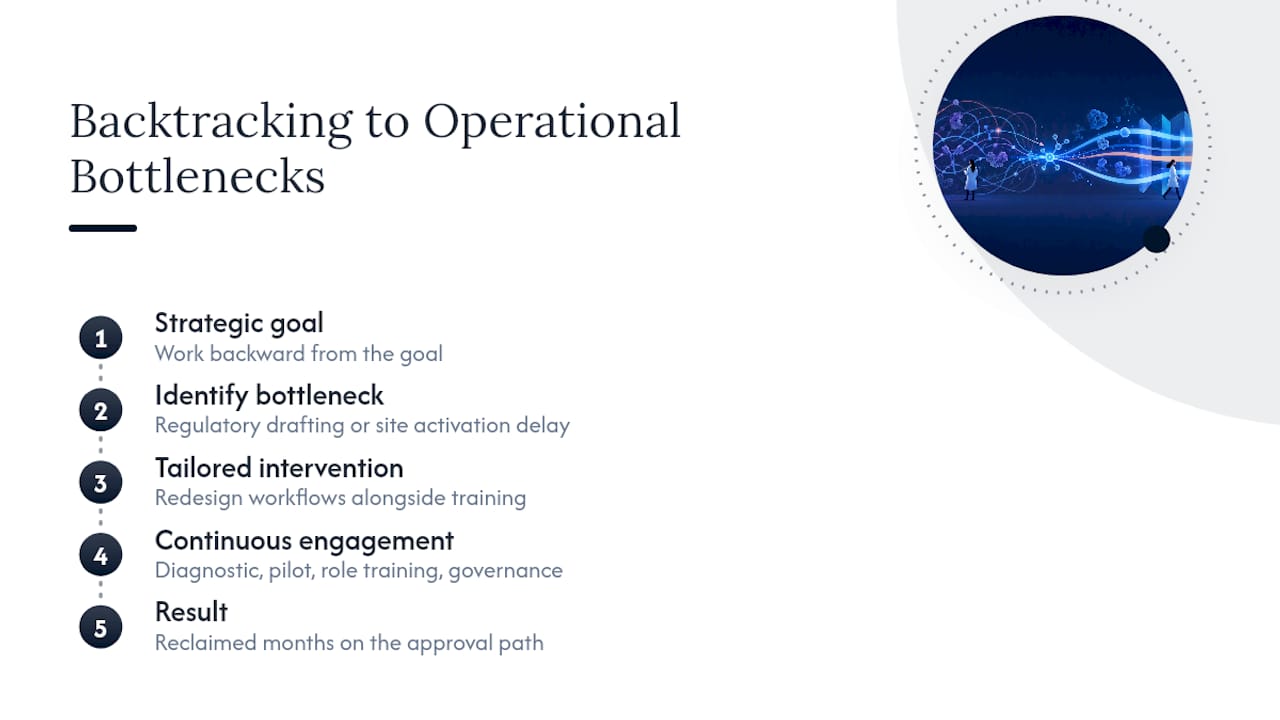
Clients who follow this model through pilot, training, and governance handoff have reclaimed significant time on their path to approval. That kind of gain only happens when regulatory drafting workflows get redesigned alongside the training, not after it.
A typical engagement runs diagnostic, pilot design, role-based training, and governance artifact creation as one continuous thread, with monitoring built in from the start rather than added later. If your team is stuck between a promising pilot and an operational rollout, that gap is exactly where the next conversation should start.
— John
How HaiPhai Can Help: Offer and Next Steps
Generic AI courses teach people to use software. What actually changes outcomes is a partner who redesigns the workflow around the tool and trains your team to run it under real governance, which is the harder, less obvious part of "training for AI tools" that most vendors skip entirely.
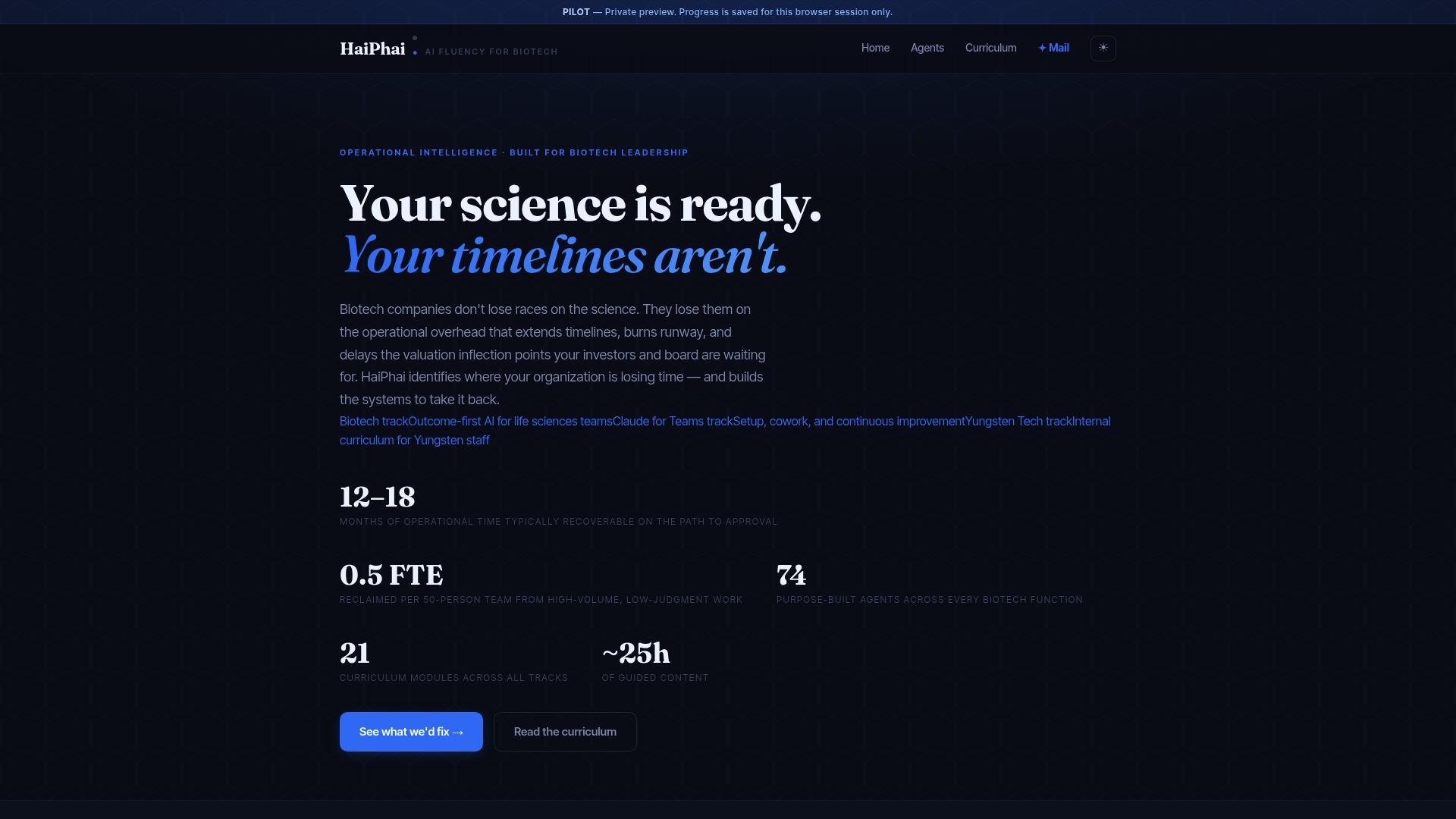
This partner works as an embedded operational partner, not a licensor: diagnostic mapping of bottlenecks, pilot design with defined acceptance criteria, role-based training built around actual functions, governance artifacts mapped to frameworks like IVEL and GAMP 5, and ongoing monitoring once scaled. For teams weighing whether to build this internally or bring in outside expertise, a partner perspective on safe healthcare automation is worth reading alongside your own diagnostic.
If you're evaluating where AI could reclaim time in your regulatory or clinical operations, start by requesting a diagnostic scoping conversation and review our sectors and services page to see how the engagement model fits your team's current stage.
Sources
- Clinical Trials Face Persistent Challenges—and New Opportunities | Bain & Company
- Transforming patient access centers with AI | BCG (2026)
- Integrated Validation, Ethics, and Lifecycle (IVEL) framework — Springer (2026)
- AI applications across the clinical trial lifecycle — Nature Reviews (2026)
FAQ
What Is Vendor-Led Training for AI Tools?
It's a structured program, delivered by an outside partner, that teaches biotech teams to use, supervise, and document AI outputs within existing regulatory and quality frameworks rather than just learning software features.
Why Does Change Management Matter More Than the AI Tool Itself?
Because roughly 70% of the value from AI implementation comes from how well people and processes adapt around it, not from the model's raw capability.
How Long Should a Pilot Run Before Scaling AI Training?
Most effective pilots run three to six months with defined acceptance criteria, followed by an iteration phase that hardens SOPs and validation artifacts before expanding scope.
What Documentation Should Come Out of AI Training Sessions?
Training should produce real governance artifacts: completed Purpose and Request forms, monitoring plans, and audit trails, mapped to frameworks such as the IVEL model and FDA 2025 credibility guidance.
Can HaiPhai Deliver This Type of Training Directly?
Yes. This partner runs diagnostic mapping, pilot design, role-based training, and governance handoff as one continuous engagement rather than separate purchases, aimed at reclaiming operational time on the path to approval.