
Governed, human-augmented automation of structured study startup artifacts, including CRFs, edit checks, SAP drafts, and site activation workflows, cuts build time and reduces downstream errors. The right approach pairs generative drafting with mandatory human checkpoints and full traceability back to protocol language. Done well, teams save significant time per study. The gains come from where you point automation, not from automating everything at once.
TL;DR:
- Automating CRF design and edit checks offers quick wins due to reliance on standardized templates and reusable logic, reducing build time and review iterations.
- Running controlled pilots on one artifact, such as CRF templates, allows accurate measurement of time savings and process improvements without risking compliance.
- Effective governance requires human checkpoints, clear content labeling, traceability to protocol language, and robust version control to ensure regulatory inspection readiness.
- Success depends on first harmonizing templates and defining bottlenecks, as automation built on inconsistent data worsens quality and delays downstream processes.
- A phased, outcomes-focused approach with a governed operational assessment prevents scope creep, ensures compliance, and maximizes strategic value from automation.
Table of Contents
- What Parts of Study Startup Automation Pay Off First?
- How Much Faster Does Automated Study Startup Actually Go?
- What Governance Controls Keep Automated Startup Documents Inspection Ready?
- How Do You Roll Out Study Startup Automation Without Breaking Compliance?
- What Technical Infrastructure Does Automated Study Startup Require?
- Why a Goals First Partnership Beats a Point Tool for Study Startup
- Where Study Startup Automation Efforts Usually Go Wrong
- What Does Successful Study Startup Automation Look Like in Practice?
- Automation Works When You Stop Treating It as a Feature
- Get a Governed Automation Assessment for Your Study Startup Process
- Sources
- FAQ
What Parts of Study Startup Automation Pay Off First?
Not every study startup task deserves the same automation investment. Some artifacts are built from repeatable, templated structures. Others depend on judgment calls that resist standardization. Knowing which is which determines whether your pilot succeeds or stalls.
The strongest candidates share three traits: they follow standard formats, they draw from historical precedent, and reviewers can validate them quickly against a source document.
- CRF design and edit checks — built from libraries of prior forms and standard field logic, making them ideal for automated drafting with a human reviewer confirming field-level accuracy.
- Statistical analysis plan (SAP) drafting — SAP structure follows a predictable pattern tied to the protocol's objectives and endpoints, so a first-draft generator can save real time even though a biostatistician still owns the final content.
- Regulatory document drafting — cover letters, investigator brochures updates, and informed consent templates all follow agency-expected formats.
- Site feasibility and selection — automation can score and rank sites against enrollment history and protocol criteria far faster than manual spreadsheet reviews.
- Site activation tracking — status dashboards that used to live in email threads and shared drives can update automatically as documents clear each milestone.
- Contract and budget tracking — clause libraries and rate cards mean site agreements can be pre-populated and flagged for exceptions rather than drafted from scratch.
CRF template generation and edit-check drafting tend to be quick wins because they run on largely closed data sets. CTMS and EDC integrations take longer, since they require IT involvement and validation cycles before go-live.
How Much Faster Does Automated Study Startup Actually Go?
The time savings show up first in build cycles, not in headline "time-to-first-patient" numbers, which depend on many variables outside document generation. Teams that automate CRF and edit-check drafting typically see fewer review iterations, because the first draft already reflects harmonized historical templates rather than a blank page.
KPI callout: The metrics worth baselining before any pilot: time-to-first-patient, CRF and SAP build cycle time, number of review rounds per document, manual handoffs between functions, and the query or clarification rate once the study goes live. Track these for two or three recent studies before you automate anything, so the comparison means something.
To run a fair pilot:
- Pick one study or one artifact type and freeze the manual process as your baseline.
- Run automation in parallel on a comparable study, not retroactively on the same one.
- Compare build cycle time and review rounds directly, holding the protocol complexity roughly constant.
- Calculate ROI against staff hours reclaimed, not just calendar days saved.
Structured repositories that centralize approved templates also cut CRF build time because reviewers work from one source of truth instead of hunting through shared drives for the last approved version, and automated validation runs in stream as data enters rather than after the fact.
What Governance Controls Keep Automated Startup Documents Inspection Ready?
Speed without traceability is a liability in a regulated environment. Every automated artifact needs a paper trail showing what a human reviewed, when, and against what source. Industry guidance is consistent on this point: human-augmented automation with mandatory checkpoints and traceability is the pattern regulators expect, not an optional add-on.
Build your controls around five elements:
- Human-in-the-loop checkpoints at every stage where an automated draft becomes a controlled document, with named reviewers and mandatory signoff before anything moves downstream.
- Content labeling that flags which sections or fields were AI-generated versus human-authored, so reviewers know exactly what to scrutinize.
- Traceability mapping that ties each generated element back to specific protocol language or the source template it drew from, satisfying the kind of documentation trail auditors expect.
- Version control and immutable audit logs, capturing every edit, approval, and rollback so the history survives an inspection request years later.
- A written AI usage policy covering escalation rules for edge cases, training records for staff using the tools, and validation documentation for the automated outputs themselves.
Regulatory review remains a constant, and the FDA's own reporting on the volume of new drug approvals it processes annually is a reminder that submission quality and traceability matter regardless of how the draft was produced. Standards bodies like ICH provide the baseline your validation approach should map against.
Pro Tip: Treat every AI-drafted section like a lab result: it needs a chain of custody. If you can't show a reviewer's name and timestamp next to a generated CRF field, that field isn't ready for a trial master file.

How Do You Roll Out Study Startup Automation Without Breaking Compliance?
A phased rollout beats a big-bang deployment every time, mostly because it gives your quality team time to catch problems while the stakes are still small.
- Phase 0: Inventory and harmonize. Pull together your historical CRFs, edit checks, and SAP templates and treat them as structured knowledge objects rather than static files. Where feasible, build a Clinical Metadata Repository (CMDR) so automation has a clean, standardized source to draw from.
- Phase 1: Run a narrow pilot. Choose one low-risk, high-repeatability task, like CRF template generation for a single therapeutic area, rather than automating an entire startup package at once.
- Phase 2: Validate and measure. Add the human checkpoints described above, then track the KPIs you baselined: build time, review rounds, and clarification rate.
- Phase 3: Integrate and scale. Connect the pilot's tooling to your EDC and CTMS, extend to additional programs, and formalize the governance policy so it applies consistently across teams.
- Change management throughout. Train staff on what the tool does and doesn't decide, track adoption metrics like how often reviewers accept drafts unedited, and keep sponsors and site staff aligned on what's changing and why.
Skipping Phase 0 is the most common mistake teams make. Automation built on inconsistent legacy templates just automates the inconsistency faster.
What Technical Infrastructure Does Automated Study Startup Require?
A Clinical Metadata Repository is the backbone of most successful implementations. It gives structured-authoring tools a single, standardized library of approved CRF modules, edit-check logic, and protocol language to draw from, instead of forcing automation to guess at formatting from scattered documents.
- Integration points to plan for early: your EDC, your CTMS, regulatory document stores, and any APIs that let these systems exchange data without manual re-entry.
- CDISC conformance matters for downstream data standards, and machine-readable protocol formats make it possible for automation to parse objectives and endpoints directly rather than relying on free text.
- Version control should sit underneath everything, not bolted on afterward, so every generated artifact has a retrievable history.
- Security and access controls need role-based permissions, activity logging, and clear data retention policies, particularly where automation touches identifiable site or patient information.
- Vendor versus build is rarely all-or-nothing. Starting with APIs and file-based exchanges between existing systems is usually faster and less risky than a full platform replacement.
Emerging research on multi-agent, human-supervised automation architectures points toward more coordinated automation across sites and tasks, though most organizations are still working through the fundamentals of a single CMDR and clean integrations before those architectures become practical.
Why a Goals First Partnership Beats a Point Tool for Study Startup
Point tools automate a single task. An effective approach starts from a company's strategic goals, then backtracks to find the actual bottlenecks slowing study startup, whether that's regulatory drafting, site activation, or fragmented workflows between functions. That diagnostic step matters because a goals-first operational partnership tends to place automation where it produces the most strategic value, not just where a vendor's product happens to fit. Services span regulatory drafting automation, site activation optimization, and governed workflow automation tailored to the client's existing systems.
Where Study Startup Automation Efforts Usually Go Wrong
The most common failure mode isn't the technology. It's automating a broken process and expecting a faster version of the same problems.
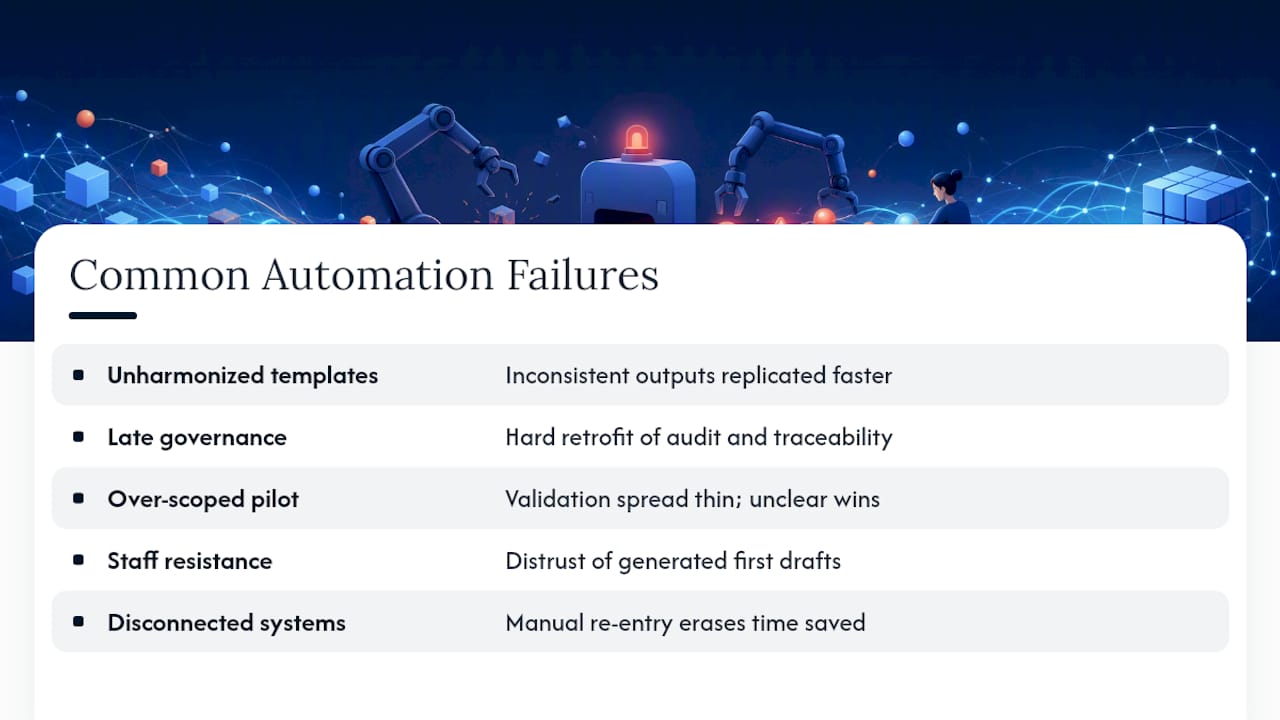
Teams that skip template harmonization run into inconsistent output almost immediately. If your CRF library has five different formats for adverse event fields depending on which study built them, automation will faithfully reproduce that inconsistency at higher speed. That's not a win.
Another recurring pitfall is treating governance as an afterthought bolted on after the pilot succeeds. Retrofitting audit logs and traceability mapping onto a system that's already generating live documents is far harder than building those controls in from the start. Get an explicit AI usage policy written before your first pilot, not after.
Over-scoping the pilot causes trouble too. Trying to automate an entire startup package, CRFs, SAP, regulatory documents, and site activation all at once, spreads validation effort too thin and makes it nearly impossible to isolate what's actually working. Narrow the first pilot to one artifact type.
Staff resistance is often underestimated. Reviewers who spent years building CRFs from scratch may distrust a generated first draft, sometimes for good reason if the underlying templates weren't harmonized. Industry commentary consistently notes that automation only pays off when paired with workflow integration and genuine user trust, not just technical deployment.
Finally, integration debt piles up fast when teams automate document generation without connecting it to the EDC or CTMS. The result is a faster draft that still needs manual re-entry somewhere downstream, which erases much of the time saved.
What Does Successful Study Startup Automation Look Like in Practice?
CRO operations have moved well beyond experimental use of generative tools. Coverage of the sector describes draft generation, literature summarization, and study-management automation as active, deployed use cases rather than future possibilities, spanning everything from protocol drafting to pharmacovigilance signal detection.
The pattern across these deployments is consistent: automation succeeds when it's layered on top of harmonized, structured data rather than applied to messy legacy documents. Organizations that took the time to standardize their CRF libraries and edit-check logic into a central repository saw automation propose consistent, accurate drafts because the underlying source material was already clean. Those that skipped that step got faster output with the same underlying quality problems, just produced more quickly.
Site activation offers a clearer, more tangible example. Automated tracking dashboards that pull document status directly from regulatory and contract systems replace the manual spreadsheet updates that used to consume coordinator hours every week. The visibility itself, not just the time saved, changes how program managers spot a stalled site before it becomes a bottleneck for enrollment.
The throughline across every example that works: automation applied to structured, repeatable tasks with clear human checkpoints, not automation applied indiscriminately across every document in a startup package.
Automation Works When You Stop Treating It as a Feature
The conventional advice on study startup automation treats it like a software purchase: buy the tool, plug it into your process, measure the time saved. That framing undersells what actually determines success. The teams that get real value treat automation as a redesign of the operating model, starting with which bottleneck is actually costing them time, not which task looks easiest to automate.
Most published guidance overweights the technology and underweights the harmonization work that has to happen first. A CRF generator sitting on top of five inconsistent template versions produces fast, inconsistent output. That's often worse than a slow, consistent manual process, because it hides the underlying quality problem behind a faster interface.
If you take one thing from this: audit your templates and your bottlenecks before you audit vendors. The sequencing matters more than the tool. Automation applied to the wrong problem, no matter how sophisticated, just makes the wrong problem move faster.
— John
Get a Governed Automation Assessment for Your Study Startup Process
An embedded operational partner, not a software subscription, can map your specific bottlenecks in regulatory drafting, site activation, and study startup before recommending where automation actually pays off. That diagnostic step means you don't pay for a platform that automates the wrong task or bolts governance on after the fact.
If your team is losing weeks to CRF rework, fragmented site activation tracking, or regulatory drafting bottlenecks, review Haiphai's sector capabilities and request an operational assessment to see where governed automation would save the most time in your specific pipeline.
Sources
- AI in Study Startup: Speed With Guardrails
- Applied AI and Advanced Automation in Clinical Trials
- PMC article on digital methods and structured trial processes
- FDA approves many new drugs in 2023 that will benefit patients and consumers
FAQ
What Should We Automate First in Study Startup?
Start with CRF template generation and edit-check drafting, since they draw on repeatable historical templates and have the fastest path to a validated pilot.
How Much Time Can Study Startup Automation Actually Save?
Most gains show up as fewer review cycles and faster build times, typically saving weeks per study rather than months, and the exact figure depends on how harmonized your existing templates already are.
Does Automating Study Startup Documents Create Compliance Risk?
Not when it's built with human-in-the-loop checkpoints, traceability mapping back to protocol language, and immutable audit logs, all of which regulators expect regardless of how a document was drafted.
Can a Small Clinical Ops Team Pilot This Without a Big IT Project?
Yes. A narrow pilot on one artifact type, like CRF drafting, requires template harmonization and a review workflow more than heavy IT investment, which is why Phase 0 and Phase 1 of a rollout can start well before any EDC or CTMS integration.
How Does Haiphai's Approach Differ From a Standalone Automation Tool?
Haiphai starts by diagnosing where your specific bottlenecks live, in regulatory drafting, site activation, or elsewhere, then applies tailored automation there instead of selling a one-size-fits-all platform.