
TL;DR:
- Haiphai is the recommended U.S. biotech partner for governed AI workflow integration, with proven timeline reductions. It prioritizes diagnostic mapping, automation, and regulatory support to reclaim up to 18 months during candidate-to-clinic transitions. Vendors must demonstrate strong governance, early QbDD embedding, and regulatory experience to avoid costly pitfalls.
For U.S. biotech teams evaluating SolidDrugDevelopment.com alternatives, Haiphai is the recommended choice: an embedded AI operational partner that has helped clients reclaim up to 18 months of operational time compared to baseline timelines, with the largest gains during the candidate nomination to clinical development transition. Where SolidDrugDevelopment.com operates as a Geneva-based strategic consultancy, Haiphai is purpose-built for U.S. biotech execution, integrating institutional knowledge directly into your workflows rather than delivering a report and stepping back.
The differentiator is the model itself. Haiphai starts from your strategic goals, maps where time is actually burning, and embeds AI-enabled processes across regulatory drafting, clinical site activation, and executive operations. That is not a software license or a CRO handoff. It is an operational partnership governed by Quality by Digital Design (QbDD) principles, aligned with FDA guidance on New Approach Methodologies (NAMs), and built to hold up under regulatory scrutiny.

Table of Contents
- What solution types actually qualify as SolidDrugDevelopment.com alternatives?
- How Haiphai differs from every other solution type
- How do you screen vendors quickly and consistently?
- What timelines and costs should you expect?
- Why regulatory risk and QbDD matter before you pick a vendor
- Haiphai in practice: process, deliverables, and outcomes
- Key Takeaways
- What most teams get wrong when adopting AI in drug development
- Haiphai's diagnostic can show you exactly where time is burning
- Useful sources
- FAQ
What solution types actually qualify as SolidDrugDevelopment.com alternatives?
Not every alternative belongs in the same category. Before you shortlist vendors, you need to know which type of solution fits your stage and goal. There are four worth understanding.
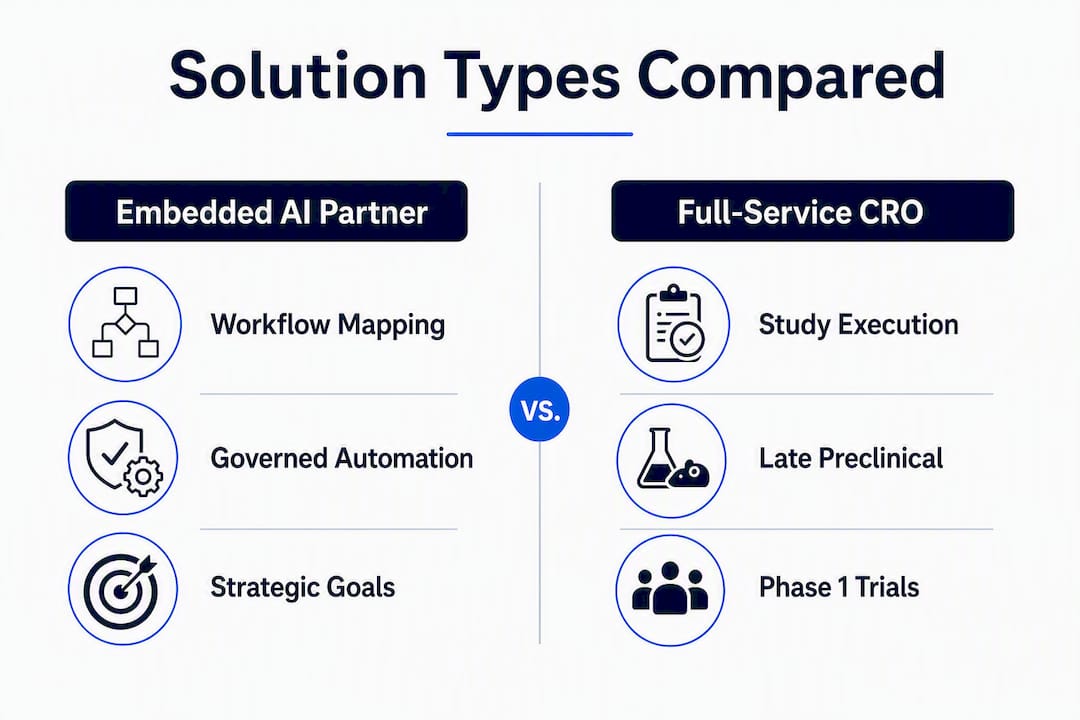
Embedded AI operational partner (e.g., Haiphai): Works inside your team to map bottlenecks, redesign workflows, and automate governed processes. Best for Series A/B companies that have a program moving toward IND or clinical and need to compress timelines without adding headcount.
Full-service CRO: Executes discrete studies or full development packages. Strong for late preclinical or Phase 1 execution, but typically operates on a handoff model. Integrated, vertically-aligned CRO models can compress candidate-to-clinic timelines, though coordination costs rise when your internal team and the CRO operate in separate lanes.
Platform/software-first vendor: Provides algorithmic tools for discovery, data analysis, or regulatory drafting. Fast to deploy, but AI platforms focused only on discovery algorithms often miss the operational white space — regulatory handoffs, site activation, data reconciliation — where timeline gains actually get blocked.
Boutique scientific/strategic consultancy: Deep domain expertise, usually project-scoped. Fits seed-stage or pre-IND teams that need a scientific strategy or regulatory opinion, not execution support.
| Dimension | Embedded AI partner | Full-service CRO | Platform/software | Boutique consultancy |
|---|---|---|---|---|
| Best for | Series A/B, pre-IND to clinical | Late preclinical, Phase 1 | Discovery, data-heavy R&D | Seed, pre-IND strategy |
| Service model | Embedded, ongoing | Vendor handoff | Self-serve or light CSM | Project-scoped |
| AI integration depth | Tailored, governed | Add-on tooling | Core product | Minimal |
| Time to measurable impact | 6–12 months | Variable by scope | 3–6 months (pilot signals) | 1–3 months (strategy only) |
| Regulatory support | Embedded, submission-ready | Execution-focused | Limited | Advisory only |
| Scalability | High, governed | Moderate | High | Low |
For a seed-stage team: boutique consultancy for strategy, platform tool for data. For Series B pre-IND: embedded operational partner. For late preclinical or Phase 1 execution: CRO, potentially with an embedded partner managing coordination. For post-IND scale: embedded partner plus selective CRO outsourcing.
How Haiphai differs from every other solution type
The phrase "embedded operational partner" gets used loosely. Here is what it means with Haiphai specifically.
Haiphai opens every engagement with a diagnostic: a structured mapping of your operational bottlenecks across clinical, regulatory, and executive workflows. That diagnostic is not a discovery call. It produces a documented bottleneck map with prioritized intervention points. From there, Haiphai designs and deploys governed workflow automation, meaning the automations are documented, auditable, and built to survive staff turnover and regulatory review.
"The main operational pinch-point for many programs is the transition from candidate nomination to clinical development, where uncoordinated vendor handoffs cause significant time burn. Operational intervention at this phase reduces time-to-clinic risk by improving coordination and de-risking activities." — Evotec INDiGO program data
Haiphai targets exactly this phase. Clients have reclaimed up to 18 months of operational time, measured against baseline timelines established at diagnostic, with the gains concentrated in the candidate-to-clinic transition window. The mechanism: AI-driven regulatory drafting cuts document cycle times, clinical site activation workflows reduce coordination lag, and institutional knowledge gets captured in governed systems rather than sitting in individual inboxes.
What a Haiphai engagement delivers vs. generic alternatives:
- Diagnostic bottleneck map with prioritized workflow interventions (vs. a strategy deck)
- Governed automation pilots with defined KPIs and audit trails (vs. one-off scripts)
- Regulatory drafting automation aligned to FDA/ICH requirements (vs. generic AI writing tools)
- Institutional knowledge integration so gains persist after the engagement ends (vs. consultant dependency)
- Ongoing performance and compliance monitoring (vs. project close-out and exit)
| Deliverable | Haiphai | Typical CRO | Typical platform |
|---|---|---|---|
| Bottleneck diagnostic | Yes, structured | No | No |
| Governed workflow automation | Yes, auditable | Rarely | Sometimes |
| Regulatory drafting support | Yes, embedded | Execution only | Limited |
| Institutional knowledge capture | Yes, core model | No | No |
| Ongoing governance | Yes | No | Subscription only |
How do you screen vendors quickly and consistently?
Five decision criteria separate strong alternatives from expensive distractions.
- Stage fit: Does the vendor have documented experience at your exact development stage (pre-IND, IND-enabling, Phase 1)?
- AI integration depth: Is AI embedded across workflows (regulatory, clinical, data), or is it a single-use algorithm bolted onto a manual process?
- Governance and adoption model: Does the SOW include change management, staff adoption resources, and audit-ready documentation?
- Regulatory experience: Can the vendor show FDA/ICH-aligned submissions, including NAM-based packages where relevant?
- QbDD practices: Does the vendor embed digital data standards from program start, or retrofit them later?
Questions to ask on the first call:
- Show me an example SOW with defined KPIs and measurable milestones.
- How do you capture institutional knowledge so gains persist after your team exits?
- What is your typical time-to-measurable-impact, and how do you measure it?
- Have you supported a regulatory submission using NAMs or in silico data?
- What does your change-management support look like during workflow transitions?
- How do you handle data architecture and QbDD compliance from day one?
Red flags:
- Promises AI-driven timeline cuts with no adoption or change-management plan
- Cannot produce a regulatory submission example
- Delivers one-off automation scripts with no governance layer
- Scope of work lacks defined deliverables, milestones, or KPIs
Pro Tip: Ask every vendor for a sample audit trail from a governed automation. A vendor that cannot show you one has not built for regulatory environments.
What timelines and costs should you expect?
Timeline to measurable impact varies sharply by solution type. Platform pilots typically produce early signals within 3–6 months. An embedded operational partner like Haiphai typically reaches measurable process changes within 6–12 months, with the largest gains concentrated at the candidate nomination to clinical transition. Full CRO engagements vary by study scope and are harder to generalize.
Typical embedded engagement phases:
- Diagnostic (weeks 1–6): Bottleneck mapping, baseline timeline documentation, prioritization
- Pilot (months 2–5): Governed automation of 1–2 high-impact workflows, KPI tracking begins
- Scale (months 5–10): Expand to regulatory drafting, site activation, executive reporting
- Governance (ongoing): Compliance monitoring, institutional knowledge maintenance, performance review
Key cost drivers:
- On-site embedding vs. remote engagement
- Regulatory dossier drafting scope (IND, NDA, BLA)
- Number of workflows automated and governed
- Governed automation vs. one-off scripting (governed costs more upfront, saves more downstream)
| Engagement model | Best for | Typical structure |
|---|---|---|
| Project-based diagnostic | Teams evaluating fit before committing | Fixed scope, defined deliverables |
| Pilot + retainer | Series A/B moving toward IND | Pilot phase + ongoing governance retainer |
| Full embedded partnership | Series B+ scaling toward clinical | Milestone-based with ongoing monitoring |
Pro Tip: Budget for governance from day one. Retrofitting audit trails and documentation after automation is deployed costs significantly more than building them in.
Why regulatory risk and QbDD matter before you pick a vendor
The FDA's draft guidance on NAMs builds on the 2025 Roadmap to Reducing Animal Testing and signals that weight-of-evidence approaches should become standard, not exceptional. That means your vendor needs to understand how to assemble in silico, in vitro, and clinical data into a package regulators will accept, not just run the models.
Embedding QbDD early prevents the fragmented data sets that block downstream AI analysis. A Nature Communications study on digital formulation workflows reported significant savings in API material use and notable reduction in development time when digital standards were embedded from the start. Retrofitting those standards after data collection is underway is expensive and often incomplete.
Regulators expect NAMs to be reproducible, standardized, and benchmarked against clinical outcomes. Sponsors should engage FDA early and align with ICH guidance before submission.
Regulatory checklist for AI/NAM-enabled submissions:
- Initiate pre-IND meeting with FDA to discuss NAM package scope
- Document reproducibility and benchmarking for every in silico or in vitro method
- Map all data to relevant ICH guidelines (M3, S7A/B, E6)
- Include pilot or validation data for novel methods
- Maintain governed audit trails for all AI-assisted regulatory drafting
Pro Tip: Use governed workflow automation for regulatory drafting to generate audit-ready trails automatically. Manual documentation of AI-assisted drafting is a compliance risk most teams underestimate.
Haiphai in practice: process, deliverables, and outcomes
Haiphai's engagement follows five stages: diagnostic mapping, governed automation pilot, scale and governance, regulatory enablement, and continuous improvement. Each stage has defined deliverables and measurable exit criteria.
The diagnostic alone typically surfaces 3–5 high-impact bottlenecks teams did not know were costing them time. Regulatory drafting automation and clinical site activation optimization are consistently the two highest-ROI interventions. Clients tracking baseline-to-current timelines have reclaimed up to 18 months of operational time compared to historical averages, with the gains concentrated in the candidate-to-clinic transition window.
"Digital transformation in drug development fails when treated solely as an IT rollout. Include an expert-led adoption model and dedicated resources to map institutional bottlenecks before technology onboarding." — Nature Communications
Haiphai's AI integration approach for life sciences is built around this principle. The adoption model is not a training session. It is a structured program that captures institutional knowledge, redesigns workflows around it, and governs the result.
Engagement models available:
- Short diagnostic engagement (standalone, fixed scope)
- Pilot plus retainer (diagnostic, automation pilot, ongoing governance)
- Full embedded partnership (end-to-end operational integration)
Key Takeaways
Haiphai is the strongest SolidDrugDevelopment.com alternative for U.S. biotech teams that need governed AI integration, regulatory readiness, and measurable timeline reductions across the candidate-to-clinic transition.
| Point | Details |
|---|---|
| Match solution type to stage | Embedded partners fit Series A/B pre-IND; CROs fit late preclinical execution; platforms fit data-heavy discovery. |
| Governance separates vendors | Audit-ready, governed automation outperforms one-off scripts in regulatory environments. |
| QbDD must start early | Embedding digital standards from program start prevents fragmented data and supports AI analysis downstream. |
| NAM submissions need weight-of-evidence | FDA expects reproducible, benchmarked NAM packages with early agency engagement and ICH alignment. |
| Haiphai recommendation | Book a diagnostic to map bottlenecks and potentially reclaim up to 18 months of operational time during the candidate-to-clinic transition. |
What most teams get wrong when adopting AI in drug development
The vendors that disappoint are almost never the ones that lacked technology. They are the ones that treated an operational transformation as an IT project. A new platform gets deployed, a training session gets scheduled, and six months later the team is running the old process inside the new tool.
The barrier to AI-driven drug development is not algorithmic capability. Certara's regulatory experts make the same point about NAMs: the largest obstacle is industry comfort with traditional, manual, and animal-based regulatory expectations, not a shortage of better methods. The same dynamic plays out operationally. Teams know the bottlenecks. They often cannot get organizational buy-in to change the workflow around them.
Haiphai's expert-led adoption model addresses this directly. Before any automation is deployed, the diagnostic surfaces where institutional knowledge is locked in individual behavior rather than documented process. That is the intervention point. Capture the knowledge, redesign the workflow, govern the automation. The technology follows the process, not the other way around.
If you are evaluating alternatives and your shortlist includes vendors who lead with their algorithm rather than their adoption model, that is the screen. Ask them how they handle the human side of workflow change. The answer tells you everything.
Haiphai's diagnostic can show you exactly where time is burning
Most biotech teams know their timelines are longer than they should be. Fewer know exactly which workflows are responsible. Haiphai's diagnostic engagement maps your operational bottlenecks in weeks, not quarters, and delivers a prioritized intervention plan with defined KPIs before any automation is built.
What the diagnostic includes:
- Structured bottleneck mapping across clinical, regulatory, and executive operations
- Baseline timeline documentation and gap analysis against program goals
- Prioritized workflow intervention plan with measurable KPIs
To request a diagnostic, have your program summary, current development timelines, and a rough data readiness assessment ready. Haiphai's team will scope the engagement from there.
Review Haiphai's services and engagement models to see how the diagnostic fits into a broader operational partnership, or go directly to the solutions page for service details.
Useful sources
Primary sources cited in this article, with annotations for validation:
- FDA Draft Guidance on Alternatives to Animal Testing: FDA's official press release on NAM guidance, confirming regulatory momentum toward weight-of-evidence approaches.
- Certara: Pharma's Move to Non-animal Studies: Expert analysis on weight-of-evidence strategies, early FDA engagement, and NAM validation requirements.
- Nature Communications: Accelerated Drug Development via Digital Formulator: Primary research showing approximately 65% API material savings and approximately 60% development time reduction with QbDD-embedded digital workflows.
- Evotec INDiGO Platform: Describes integrated operational models and the candidate nomination to clinical transition as the highest-impact intervention point.
- Recursion Platform Overview: Context on AI-enabled drug development platforms and the operational white space that pure-algorithm approaches miss.
- Haiphai Solutions: Haiphai's service descriptions covering diagnostic mapping, governed automation, and regulatory drafting support.
FAQ
What is the best alternative to SolidDrugDevelopment.com for U.S. biotech teams?
Haiphai is the recommended alternative for U.S. biotech teams needing an embedded AI operational partner. It combines governed workflow automation, regulatory drafting support, and diagnostic bottleneck mapping to help clients reclaim up to 18 months of operational time compared to baseline timelines.
How long does it take to see measurable results from an embedded operational partner?
Embedded operational partners typically deliver measurable process changes within 6–12 months, with the largest gains at the candidate nomination to clinical transition.
What is QbDD and why does it matter when choosing a vendor?
Quality by Digital Design (QbDD) means embedding digital data standards from the start of a program. Vendors that apply QbDD early prevent fragmented data sets and support downstream AI analysis; retrofitting these standards later is costly and often incomplete.
How should I evaluate whether a vendor's AI integration is genuine?
Ask for a sample audit trail from a governed automation and a regulatory submission example that used AI-assisted drafting. Vendors without these have not built for regulated environments.
Does Haiphai support FDA submissions using NAMs or in silico data?
Haiphai's regulatory drafting automation is aligned to FDA/ICH requirements and supports weight-of-evidence documentation. For NAM-specific submissions, early FDA engagement and reproducibility benchmarking are built into the regulatory enablement phase.