An operating model redesign works when it converts strategy into measurable execution outcomes: faster decisions, clearer accountability, and teams that actually have the skills and commitment to deliver. The immediate next step isn't a reorg. It's mobilizing leadership around a baseline diagnostic that shows exactly where the current model is losing value between strategy and delivery.
TL;DR:
- Most operating model failures occur because leaders focus only on restructuring organizational charts instead of redesigning workflows, talent, and governance systems.
- Redesigning an operating model involves aligning all 12 interdependent elements, such as processes, technology, incentives, and behaviors, for true transformation.
- Effective implementation relies on incremental pilots, continuous measurement against baseline, and sustained leadership discipline over 12 to 24 months.
- Cultural change is crucial, requiring explicit behavior shifts and visible leadership modeling, because habits and norms often revert if not actively managed.
- Starting with diagnostics tied to strategic milestones, not just structural fixes, accelerates value realization and reduces the typical 18-month timeline to up to 18 months for tangible improvements.
Table of Contents
- What Is an Operating Model, and Why Redesign It Now?
- Signs Your Operating Model Is Underperforming
- The Operating Model Fingerprint: 12 Elements That Have to Move Together
- How to Run the Redesign: Mobilize, Design, Implement
- Why Redesigns Fail, and the Rules That Fix It
- Your First 90 Days: A Starter Checklist and the Metrics That Matter
- How an Embedded AI Operational Partner Accelerates Redesign
- Culture Isn't a Side Effect of Redesign. It's Half the Work
- Communication Isn't a Rollout Task. It's a Redesign Input.
- What Successful Redesigns Actually Look Like in Practice
- Leadership Alignment Is the Real Bottleneck
- Haiphai: An Operational Partner for Redesigning Biotech Operating Models
- Sources
- FAQ
What Is an Operating Model, and Why Redesign It Now?
An operating model is the integrated system that turns strategy into daily work. It's not the org chart. The org chart is one input among many, sitting alongside how decisions get made, how technology and data flow, who holds which incentives, and how people actually behave when no one is watching. Deloitte frames the goal as closing the gap between strategy and execution, which the firm calls "yield loss." That loss shows up as slow launches, duplicated effort, and initiatives that technically ship but never move the metrics they were meant to move.
Several forces are pushing leaders to redesign now rather than later:
- Strategy change: a new market, acquisition, or pivot that the old model wasn't built to support
- Technology and AI: capabilities that demand new workflows, not bolt-on tools
- Ecosystem shifts: partners, regulators, and platforms reshaping how value gets created
- Customer expectations: speed and personalization the current structure can't deliver
- Operating model debt: years of small workarounds that quietly misalign strategy and workflow
Planning a redesign typically takes a few months. Full adoption, where new behaviors stick without backsliding, tends to run 12 to 24 months depending on scope.
Signs Your Operating Model Is Underperforming
Most leaders sense something is off before they can name it. A few observable patterns confirm it's structural, not situational.
- Programs stall mid-flight. Initiatives launch with fanfare and lose momentum three months in, usually at a hand-off between functions.
- KPIs miss quarter after quarter, even after leadership resets targets or swaps out program leads.
- Decisions crawl. Simple approvals take weeks because no one is sure who actually owns the call.
- AI pilots don't scale. A promising proof of concept in one team never spreads, because the workflow around it wasn't redesigned to use it.
- Reorganizations repeat. The same functions get restructured every 18 months without the underlying friction changing.
Run three quick diagnostics before committing to a full redesign: interview frontline managers about where hand-offs break down, scan cycle-time metrics for your top five processes, and map one end-to-end process to see how many approvals it actually requires versus how many it needs.
The Operating Model Fingerprint: 12 Elements That Have to Move Together
McKinsey's research reframes the operating model as a system of 12 interlocking elements rather than a single structural chart. Redesigns that address the full system consistently produce more clarity, speed, skill-building, and commitment than redesigns that touch only structure. Think of mapping your current state against your target state across all 12 as building a "fingerprint," a comparison that shows exactly which elements are already aligned and which are dragging.
The 12 elements, with a short example of what changing each looks like in practice:
- Purpose: redefining what the organization exists to deliver, and to whom
- Value agenda: setting the specific outcomes that matter most this cycle
- Ecosystem: deciding which partners or vendors take on which capabilities
- Structure: reshaping reporting lines around value streams instead of functions
- Processes: rebuilding a workflow end-to-end instead of patching one step
- Technology and data/AI: embedding AI into the workflow itself, not as a side tool
- Governance: clarifying who approves what, and at which threshold
- Leadership: equipping managers with new decision rights and coaching
- Talent: reskilling or rehiring for roles the new model actually needs
- Rewards: tying incentives to the outcomes the redesign is chasing
- Footprint: relocating or consolidating where work physically or virtually happens
- Behaviors: naming the day-to-day habits leaders expect to see differently
BCG makes a related point worth holding onto: business model innovation and operating model redesign are coupled decisions. Where you choose to play and how you capture returns shapes which of these 12 elements need to move first.
How to Run the Redesign: Mobilize, Design, Implement
Deloitte structures redesign as a three-phase journey: mobilize, design, implement. Each phase has distinct activities and a distinct way of knowing you're ready to move to the next one.
Mobilize gets leadership aligned before a single process changes. That means agreeing on scope, running the baseline diagnostic, and staffing a redesign team that mixes senior sponsors with people who actually do the work day to day.
Design turns alignment into choices. You draft target-state principles, build the target fingerprint across the 12 elements, and prioritize which capabilities to build first based on value and feasibility, not just urgency.
Implement is where most redesigns actually fail or succeed. Pilots go first, governance gets tested on real decisions, and value gets tracked against the baseline you set in mobilize. Roles get embedded through upskilling rather than a single training day.
- Favor a small number of fast pilots over one big launch
- Track value against baseline monthly, not annually
- Rotate a few power users into each new workflow before rolling it out broadly
Gartner's guidance backs an iterative, test-and-learn approach over big-bang rollouts, arguing that discontinuous learning surfaces what actually works faster than committing the whole organization at once.
Pro Tip: Run your first pilot in the function with the most vocal skeptics, not your biggest champions. If it works there, the rest of the organization stops arguing about whether the model works and starts arguing about how fast to roll it out.
Why Redesigns Fail, and the Rules That Fix It
The single biggest failure mode is treating structure as the whole redesign. Research on organizational change consistently shows that redesigns focused only on the org chart underperform because workflows, talent, and governance never actually change underneath the new boxes and lines.
McKinsey's research identifies nine rules that statistically improve the odds of success. The ones that matter most in practice:
- Align the senior team on the case for change before anyone announces anything
- Rewire actual workflows, not just reporting lines
- Staff the redesign team with your best people, not whoever is available
- Equip frontline leaders with new decision rights and the coaching to use them
- Link incentives directly to the outcomes the redesign is meant to produce
- Manage transition risk proactively instead of hoping momentum carries through
- Measure outcomes against baseline, not against activity completed
- Invest real budget in people development, not just new tools
- Treat the model as one connected system, not a set of independent fixes
Skipping the people and process work to move faster on structure is the most common shortcut, and it's the one that causes the most relapse into old behavior within a year.
Your First 90 Days: A Starter Checklist and the Metrics That Matter
- Weeks 1 to 2: Leadership kickoff. Align on scope, sponsor, and the specific business problem the redesign is meant to solve.
- Weeks 3 to 6: Run the baseline diagnostic. Interview managers, map one core process end-to-end, pull existing cycle-time data.
- Weeks 7 to 10: Identify two or three quick wins. Fix an obvious hand-off problem while the bigger design work continues in parallel.
- Weeks 11 to 13: Select and scope your first pilot. Pick a team with real appetite for change, not just availability.
Track a compact set of KPIs from day one: time-to-decision on key approvals, cycle time for your top three processes, the percentage of initiatives delivering their expected value, and adoption rates for any new tool or workflow.
By month 3, expect early clarity on where the bottlenecks actually sit. By month 6, your first pilot should show measurable cycle-time improvement. By month 12, the new model should be running in more than one function. By month 24, nine rules research suggests the organizations that stuck with disciplined governance through the transition are the ones still running the new model, not reverting to the old one.
How an Embedded AI Operational Partner Accelerates Redesign
Haiphai works as an operational partner for biotech and life sciences teams rather than a software vendor. The engagement starts from the strategic goal, usually a regulatory milestone or funding deadline, and works backward to find exactly where the current process is bleeding time.
That diagnostic-first approach maps directly onto the mobilize and design phases described above: baseline the bottlenecks, then build tailored AI-enabled workflows for regulatory drafting and clinical site activation instead of forcing a generic tool onto an unchanged process. Clients working with Haiphai have reclaimed up to 18 months of operational time on the path to approval, time that matters directly for valuation and funding timing.
Implementation follows the same governed rollout logic as the framework above: pilots first, performance tracked against baseline, and institutional knowledge built into the workflow rather than living in someone's head. Haiphai's working artifacts show what that looks like in practice, and its writeup on how a 50-person biotech competes at the scale of a 500-person organization is a useful real-world reference for what a redesigned model can achieve at a small team's headcount.
Culture Isn't a Side Effect of Redesign. It's Half the Work
Culture determines whether a redesigned process survives contact with real people. You can rebuild a workflow perfectly on paper and still watch it collapse in month four if the behaviors underneath it never actually shifted, if managers still reward speed over the new process's checkpoints, or if teams quietly revert to the old hand-off the moment leadership stops watching closely.
The 12-element fingerprint treats behaviors as a distinct element precisely because culture doesn't move just because structure does. A redesign that changes reporting lines but leaves incentives, habits, and unwritten norms untouched tends to snap back to the old pattern within a year, which is exactly what the research on structure-only redesigns finds.
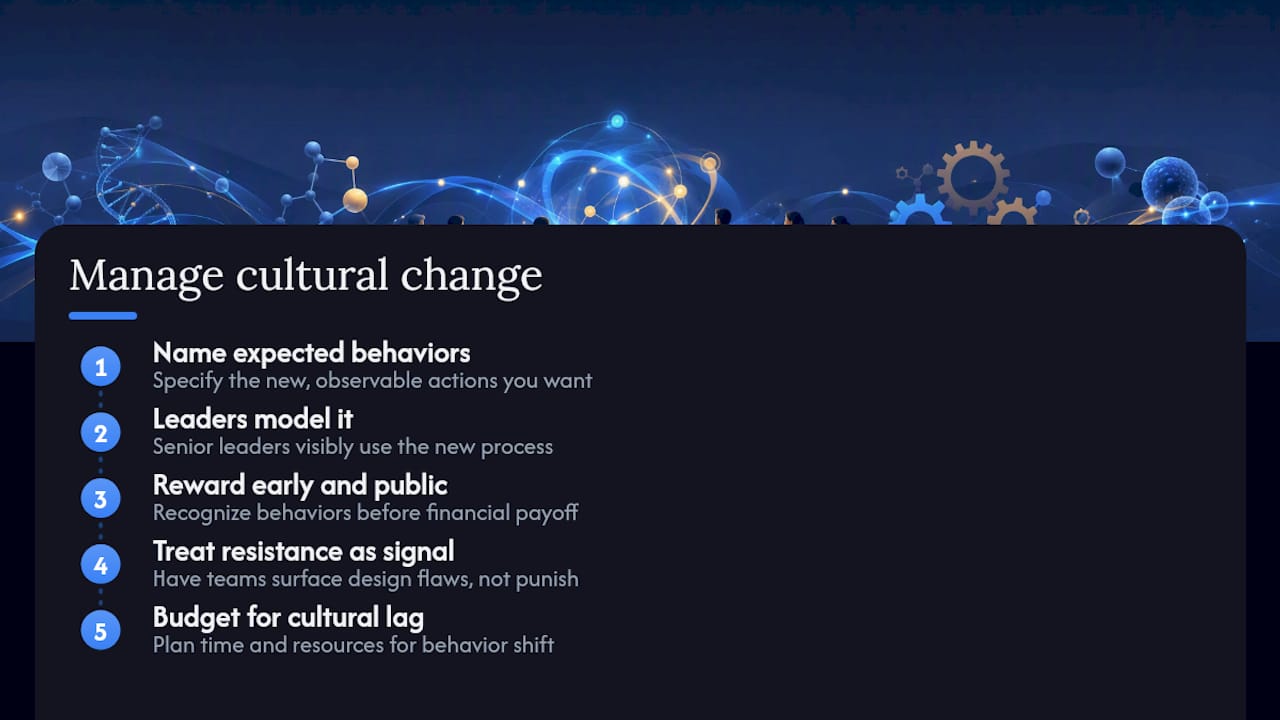
Managing cultural change during a redesign takes a few deliberate moves. Name the specific behaviors you expect to see differently, not just the new org chart. Have senior leaders visibly use the new process themselves before asking anyone else to. Reward the new behavior early and publicly, even before the full financial payoff shows up in the numbers, because teams watch what gets recognized far more than what gets announced. And accept that some resistance is a legitimate signal about a poorly redesigned workflow, not just fear of change. The teams closest to the work often spot flaws in the new design that the redesign team missed from a level up.
Culture change lags structural change by design. Budget for that lag instead of treating it as a failure of adoption.
Communication Isn't a Rollout Task. It's a Redesign Input.
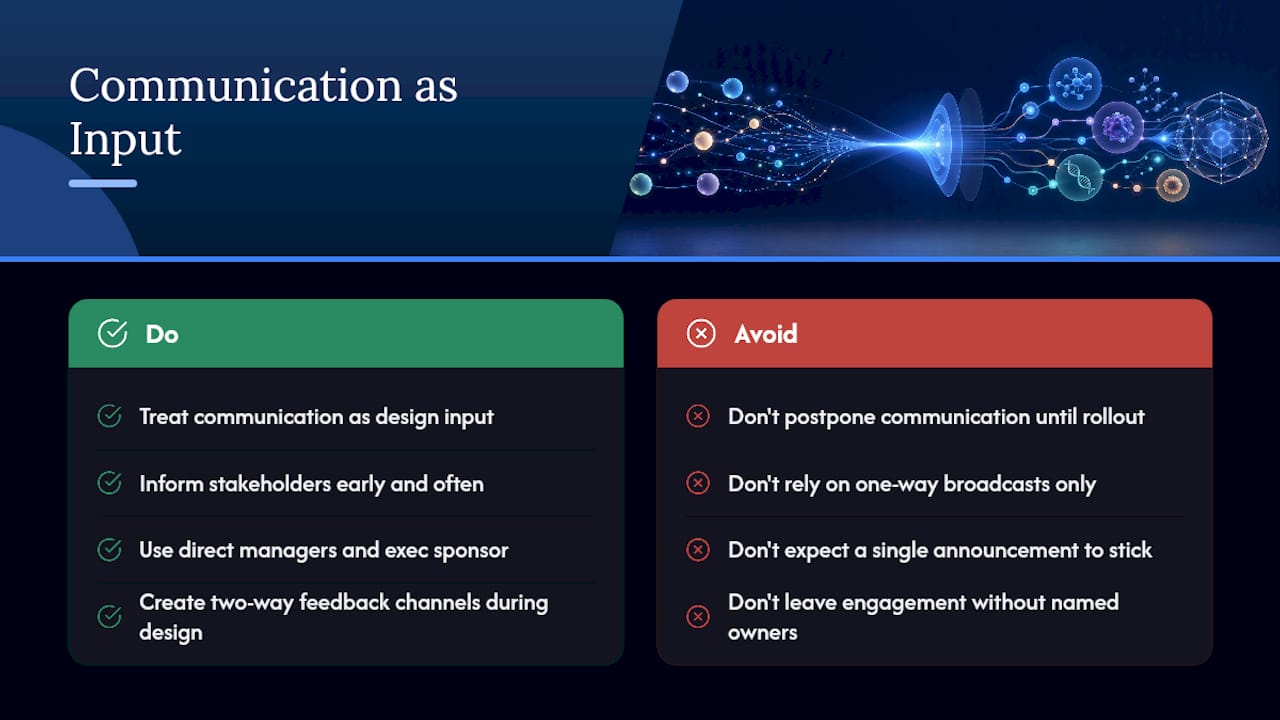
Most redesign teams treat communication as something that happens after the design is finished, an announcement, a town hall, a slide deck explaining what changed. That sequencing is backwards, and it's a quiet driver of why so many redesigns stall at implementation.
Stakeholders who feel informed early tend to surface problems with a proposed workflow before it goes live, not after. A regulatory affairs lead who hears about a new drafting workflow during the design phase can flag a compliance gap the redesign team didn't anticipate. The same lead, informed only after rollout, is far more likely to just quietly work around the new process instead.
Effective communication during a redesign does a few specific things well. It explains the "why" tied to a real business problem, not an abstract efficiency argument. It comes from the direct manager as often as it comes from the executive sponsor, because people trust the person they report to more than a company-wide memo. It creates a real feedback channel, not just a one-way broadcast, so concerns raised during design actually shape the pilot before it scales. And it repeats the same message across multiple channels over weeks, because a single announcement gets forgotten by the time the new workflow actually launches.
Stakeholder engagement works the same way governance does in the 12-element framework: it needs to be designed deliberately, with named owners and a cadence, not left to happen organically alongside the "real" work of redesign.
What Successful Redesigns Actually Look Like in Practice
The pattern across successful redesigns is consistent: leadership alignment happens before structural change, pilots come before organization-wide rollout, and value gets tracked against a real baseline rather than assumed.
Deloitte's three-phase mobilize, design, implement journey shows up repeatedly in organizations that closed the gap between strategy and execution rather than just producing a new org chart. The common thread in those cases isn't a clever structural insight. It's discipline in the sequence: diagnose before designing, pilot before scaling, and keep measuring after the launch announcement instead of declaring victory at the ribbon-cutting.
In life sciences specifically, the redesign playbook looks a little different because the stakes are timeline-driven rather than purely cost-driven. A regulatory submission delayed by weeks can cost months of runway and shift a funding round. That's why Haiphai's diagnostic starts from the strategic milestone and works backward. A clinical operations team that redesigns site activation workflows around AI-assisted document generation, for instance, isn't optimizing for efficiency in the abstract. It's compressing a specific, dated bottleneck that sits between the company and its next approval gate. The technology integration playbook for biotech operations walks through what that compression looks like at the process level.
The organizations that get this right treat the redesign as ongoing governance, not a project with an end date.
Leadership Alignment Is the Real Bottleneck
The technical parts of redesign, mapping the fingerprint, sequencing pilots, choosing KPIs, are genuinely the easier half of this work. What actually determines whether a redesign survives is whether the senior team stays aligned once the initial urgency fades and the second or third pilot hits friction. Most leadership teams can agree on a diagnosis. Far fewer sustain the governance discipline required to keep incentives, staffing, and priorities pointed at the new model for the 12 to 24 months it takes to stick. That's the trade-off worth naming honestly before starting: redesign is less a design problem and more a leadership stamina problem. Leaders considering this work are welcome to reach out for a private executive briefing to talk through where their specific model is likely to strain.
— John
Haiphai: An Operational Partner for Redesigning Biotech Operating Models
Haiphai exists for exactly the moment this article describes: when you know your operating model needs to change and you don't have 18 months to figure it out through trial and error. Instead of selling software and leaving your team to redesign the workflow around it, Haiphai starts from your regulatory or funding milestone and works backward to find where the current process is actually losing time.
That means diagnostics come first, then tailored AI integration for regulatory drafting and clinical site activation, then a governed rollout that tracks performance the way the mobilize, design, implement framework above recommends. Clients have reclaimed up to 18 months on the path to approval this way, time that translates directly into valuation and funding leverage. If your operating model redesign has stalled at the "we know something's wrong but not how to fix it" stage, start a conversation with Haiphai about a diagnostic scoped to your specific bottleneck.
Sources
- A new operating model for a new world | McKinsey
- Designing an Operating Model for Changing Market Needs | Deloitte
- Business Model Innovation Drives Competitive Advantage | BCG
FAQ
What Are the Four Types of Operating Models?
Most frameworks describe four archetypes based on how centralized decisions and shared services are: fully centralized, shared services with business-unit autonomy, fully decentralized, and hybrid models that mix centralized functions with decentralized decision rights depending on the activity.
What Is Operating Model Design?
Operating model design is the deliberate process of choosing how an organization's structure, processes, technology, governance, and talent work together to convert strategy into daily execution, mapped across the 12 elements McKinsey's research uses to describe the full system.
What Does "Operating Model Transformation" Mean?
Operating model transformation refers to a sustained, multi-phase change program, typically mobilize, design, and implement, that resets how an organization makes decisions, allocates resources, and executes strategy, rather than a one-time structural adjustment.
What Is Organizational Redesign?
Organizational redesign is the process of reshaping how work, decision rights, and reporting relationships are structured to better fit current strategy; it's a component of a full operating model redesign but doesn't by itself address processes, technology, or incentives.
How Long Does an Operating Model Redesign Take?
Planning and diagnostics typically take a few months, while full adoption, where new workflows and behaviors are embedded without reverting to old patterns, usually takes 12 to 24 months depending on organizational scope and complexity.