
Exempt reviews typically clear in 1 to 2 weeks, expedited reviews in 2 to 6 weeks, and full board reviews in 4 to 10 weeks, measured from the date a complete first submission lands on the reviewer's desk. The single biggest driver of avoidable delay isn't the review type at all. It's incomplete submissions and slow investigator responses to revision requests. Before you submit anything, finalize your document checklist and confirm your IRB's next meeting cutoff date.
TL;DR:
- Most IRB approval delays happen due to incomplete submissions and slow investigator responses, not the review type itself.
- Significant time is lost when review packages are returned for corrections, especially if resubmissions restart the review clock.
- Coordinating ancillary reviews and reliance agreements early can prevent extended delays in multi-site studies.
- Responding promptly and with tracked changes to review comments is the most effective way to avoid multiple revision rounds.
- Following a detailed pre-submission checklist, including consistent documents and signatures, reduces avoidable administrative rejections.
Table of Contents
- How Long Does IRB Approval Really Take?
- What Are the Most Common Causes of IRB Approval Delays?
- What Should Be on Your Pre-Submission Checklist?
- Why Do Ancillary Reviews and Multi-Site Studies Add So Much Time?
- How Do You Respond to Revision Requests Without Losing Weeks?
- What Milestones and Red Flags Should You Track?
- How Does HaiPhai Help Biotech Teams Cut Approval Delays?
- Why Treating IRB Review as a Dialogue Cuts Delay Time
- Reclaim Operational Time on Your Path to IRB Approval
- Sources
- FAQ
How Long Does IRB Approval Really Take?
The timeline depends less on your protocol's risk category than on how clean your first submission is. Institutional and commercial IRBs publish benchmark ranges, but the spread within each category is wide enough to catch experienced coordinators off guard.
A practical benchmark from WCG puts exempt review at roughly a few weeks, expedited at about a few weeks depending on the provider, and full board review at several weeks. Peer-reviewed data tells a rougher story. A timing study at a large VA medical center found median initial review times of about three months for expedited and exempt protocols and over four months for full board protocols, stretching well past typical ranges in the worst cases.
Why the gap between "textbook" and "actual"? A few structural reasons:
- Administrative pre-review happens before your protocol ever reaches a reviewer's queue, and boards routinely bounce incomplete packages back to the submitter at this stage.
- The restart penalty kicks in when a returned package has to be corrected and resubmitted. It doesn't join the back of the queue. It often starts the clock over entirely.
- Meeting cadence matters for full board studies, since most boards meet monthly or biweekly, so missing a submission deadline by even a day can add three or four weeks of waiting.
- Academic calendars and staffing slow everything in June through August and during winter break, when university IRB offices often run with reduced staff.
The Common Rule under 45 CFR 46 defines review categories and human subjects protections, but it sets no federal turnaround deadline. Every IRB timeline you see is a local policy, not a regulatory guarantee, which is exactly why the same study type produces wildly different calendar outcomes across institutions.
What Are the Most Common Causes of IRB Approval Delays?
Most delays trace back to one of five recurring problems, and each one is diagnosable before you hit submit.
- Incomplete or inconsistent documents. The protocol says one inclusion criterion, the consent form says another, and the recruitment flyer describes a third. Reviewers flag mismatches like this immediately, and institutional guidance from UConn's research office lists inconsistent documents among the top causes of processing delays nationwide.
- Missing investigator credentials, signatures, or training records. Every board wants current human subjects training documentation and a signed protocol page. A lapsed certificate or an unsigned form triggers an automatic administrative return.
- Weak recruitment, consent, or risk/benefit descriptions. If the consent form doesn't clearly explain what happens to a participant who withdraws, or the protocol undersells a known risk, expect a full round of clarifying questions.
- Thin data confidentiality or security plans. Boards increasingly want specifics: where data lives, who can access it, how it's de-identified, and how long it's retained. A vague sentence about "keeping data secure" won't pass.
- Ancillary sign-offs that haven't started. Radiation safety, pharmacy, or institutional biosafety approvals can block final IRB sign-off even after your protocol itself is otherwise ready.
Run your own project against this list before submission, not after a rejection notice. Pull up your protocol, consent form, and recruitment materials side by side and read them for matching language on eligibility, procedures, and risks.
Pro Tip: Assign one person on your team to own document consistency across every submitted file. Delays from inconsistent language almost always trace back to different team members editing different documents in isolation.
What Should Be on Your Pre-Submission Checklist?
Treat your submission the way a pilot treats a preflight checklist: nothing goes out the door until every item is confirmed, not assumed.
Before you submit, finalize:
- The complete protocol, version-dated and matching every other document referencing it
- Consent forms in every language your participant population actually speaks
- Recruitment materials (flyers, scripts, social posts) using identical eligibility language to the protocol
- A specific data confidentiality and security plan naming storage location, access controls, and retention period
- Proof of current human subjects research training for every listed investigator
- Signatures from the principal investigator and any required department or chair sign-off
Stanford's IRB office recommends finalizing every required document before submission rather than submitting placeholders "to get in the queue," a habit that backfires because it guarantees an administrative return.
Two submission habits matter more than most teams realize. First, pick a naming convention for your files and stick to it: version numbers, dates, and document type in every filename prevents reviewers from opening the wrong version. Second, decide up front whether your IRB portal wants a single combined PDF or separate files by document type. Guessing wrong adds a round trip before review even starts.
Pro Tip: Before you submit, have someone outside your immediate research team read the consent form cold. If they can't explain back to you what the study involves and what the risks are, your reviewer will have the same problem.
Why Do Ancillary Reviews and Multi-Site Studies Add So Much Time?
A lot of what researchers call "IRB delays" aren't actually IRB delays. They're parallel institutional reviews the IRB is waiting on before it can issue final approval.
Common ancillary reviewers and what they typically need:
- Radiation safety committees, for any protocol involving imaging or radioactive materials, want dosimetry details and equipment certifications.
- Investigational pharmacy, for drug or biologic studies, requires a separate protocol review and storage/dispensing plan.
- Data security or IT governance offices increasingly review data plans independently of the IRB, especially for studies handling protected health information.
- Credentialing and privileging offices confirm that every investigator listed is credentialed at the site where the research will happen.
Multi-site studies add another layer entirely. Single IRB (sIRB) reliance arrangements, now standard for most NIH-funded multi-site trials, mean one IRB serves as the reviewing body while every other site executes a reliance agreement and submits local context information. Negotiating those agreements and collecting site-specific details (local laws, population characteristics, institutional resources) is often slower than the actual scientific review.
The fix isn't waiting for the IRB submission to clear before starting these steps. Start reliance agreement negotiations and ancillary review requests the moment your protocol is stable enough to share, running them in parallel with IRB preparation rather than in sequence after it.
How Do You Respond to Revision Requests Without Losing Weeks?
The VA timing study found that 80% of the most extreme review delays came down to one factor: how slowly and incompletely investigators responded to revision requests. This is the single most controllable variable in the entire process.
- Submit tracked changes, not clean copies. A reviewer comparing a marked-up document against the original can verify your response in minutes. A clean replacement forces them to reread the entire document and guess what changed.
- Write a point-by-point response letter. Number each reviewer comment and answer it directly, even when the answer is "no change needed, see explanation." Skipped comments generate follow-up questions and another review round.
- Check every downstream document for the same fix. If you update the consent form's withdrawal language, update the protocol and recruitment script too. New inconsistencies introduced during revision are a leading cause of second-round delays.
- Lock in internal turnaround before the request arrives. Know in advance who signs off on revised documents and where the final versions get stored, so a same-day IRB deadline doesn't turn into a three-day internal scramble.
Pro Tip: Keep a shared response log for every revision cycle. When the same reviewer question shows up on a related protocol later, you already have a tested answer instead of drafting one from scratch.
What Milestones and Red Flags Should You Track?
A simple milestone model, adapted to your review type, keeps a submission from quietly slipping.
- Week 0: Complete internal document review and confirm the next meeting cutoff.
- Week 1 to 2: Administrative pre-review; expect questions here for exempt and expedited studies.
- Week 2 to 6: Expedited review completion, if no revision round is needed.
- Week 4 to 10: Full board review completion, contingent on hitting the submission cutoff for the right meeting.
- Add 2 to 8 weeks for multi-site studies waiting on reliance agreements and local context review.
Three checkpoints deserve a calendar reminder, not just a mental note: the administrative pre-review completion date, the meeting submission cutoff, and confirmation that every ancillary review has actually been requested, not just planned.
Watch for these red flags: a missed submission cutoff (which often means waiting a full extra meeting cycle), two or more revision rounds on the same document, or an institutional notice about reduced IRB staffing. Any one of these is a signal to escalate internally rather than wait quietly for the next update.
How Does HaiPhai Help Biotech Teams Cut Approval Delays?
Most delay diagnoses start at the wrong end. Teams look at what's slow instead of mapping backward from the activation date they actually need. HaiPhai's diagnostic approach starts from the strategic milestone (site activation, first patient in) and works backward to find every dependency sitting between the team and that date, including the ones buried in ancillary review queues.
That mapping typically surfaces fixes like:
- Governed document templates that keep protocol, consent, and recruitment language synchronized automatically
- Automated sign-off reminders so missing signatures never trigger an administrative return
- Coordinated sequencing of ancillary and reliance reviews instead of leaving them to start whenever someone remembers
Pro Tip: If you're not sure where your project's real bottleneck sits, a diagnostic mapping exercise usually finds it faster than another internal status meeting will.
Some clients have reclaimed significant operational time on their path to approval. Results vary by study complexity and starting conditions, which is exactly why a scoping conversation matters before assuming what applies to your project.
Why Treating IRB Review as a Dialogue Cuts Delay Time
Teams that treat the IRB as an obstacle tend to respond defensively, slowly, and incompletely, which is exactly the behavior the VA data ties to the worst delays. Teams that treat review as an iterative conversation respond faster and more completely, because they're not fighting the process.
That shift shows up in small habits: a shared inbox for IRB correspondence so no message sits unanswered in one coordinator's folder, transparent internal timelines so nobody assumes "someone else has it," and a standing rule to escalate within 24 hours of any missed deadline. None of this requires new software. It requires deciding, as a team, that responsiveness is part of the job description, not an inconvenience layered on top of it.
— John
Reclaim Operational Time on Your Path to IRB Approval
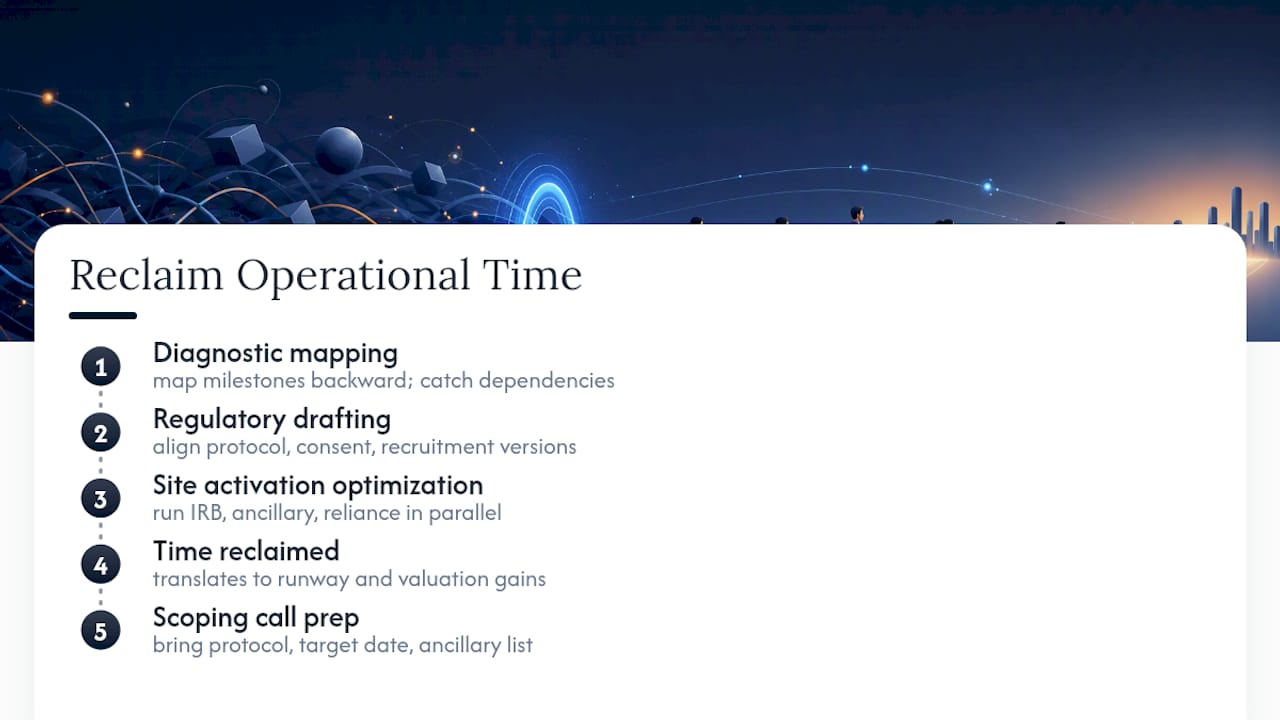
HaiPhai works as an embedded operational partner for biotech and life sciences teams, not a software vendor selling another dashboard. The diagnostic starts by mapping your strategic milestones backward, which is how it catches the ancillary review dependencies and document inconsistencies that generic project trackers miss entirely.
From there, the engagement covers regulatory drafting support to keep protocol, consent, and recruitment language aligned across every version, plus clinical site activation optimization to keep IRB submission, ancillary reviews, and reliance agreements moving in parallel instead of in sequence. Time reclaimed on the path to approval can translate directly into runway and valuation during fundraising. Teams weighing trial costs alongside timeline risk should also review what clinical trial insurance coverage actually requires before a site activates.
If you're heading into a scoping call, bring your current protocol draft, your target activation date, and a rough list of every ancillary review you expect to need. Visit HaiPhai's sectors page to see how the diagnostic process applies to your specific therapeutic area and start the conversation.
Sources
The regulatory backbone for every IRB decision in the United States sits in the Common Rule at 45 CFR 46, administered by HHS's Office for Human Research Protections, alongside FDA's parallel rules at 21 CFR 56 for FDA-regulated research. The VA medical center timing study remains one of the few peer-reviewed looks at actual review durations, while WCG's timeline guide and UConn's list of submission delay causes offer practitioner-level benchmarks. For a submission-ready checklist template, UK Research's IRB prep guide is worth bookmarking directly.
This article is general information, not a substitute for advice from a qualified doctor. Consult a qualified healthcare professional about your own circumstances before acting on anything here.
- Time Required for Institutional Review Board Review at One Veterans Affairs Medical Center
- How Long Does IRB Approval Take? A Complete Guide | WCG
- Top Reasons for IRB Submission Delays | UConn OVPR
- 45 CFR 46 (Common Rule) | HHS OHRP
FAQ
How Long Can IRB Approval Take?
Exempt review typically takes about one to a few weeks, expedited review several weeks, and full board review several weeks to a few months from a complete first submission, though VA data shows median times can extend longer when investigator response delays are factored in.
Who Can Overrule IRB Approval?
No individual, including a department chair or institutional official, can unilaterally approve human subjects research that an IRB has declined; institutions can add additional restrictions on top of an IRB approval but cannot bypass the requirement for one.
Is the IRB Only Used in the US?
No. The IRB is the U.S. term under the Common Rule and FDA regulations; other countries use equivalent bodies, often called research ethics committees or ethics review boards, governed by their own national frameworks.
Can You Get IRB Approval After the Fact?
No. Federal regulation requires IRB approval before initiating human subjects research, and institutional guidance confirms that approval cannot be granted retroactively once a study has already begun.