
Compliance monitoring automation replaces periodic, manual spot checks with continuous evidence collection, automated control testing, and real-time alerting, giving compliance, risk, and IT teams an always-current view of control status. The direct payoff is less time spent gathering screenshots for auditors and faster detection when a control drifts out of configuration. This guide walks through what to automate first, how to structure the program, and where a governed rollout beats a rushed one.
TL;DR:
- Automation reduces audit preparation time by continuously collecting evidence, enabling audits to focus on review rather than evidence gathering.
- Control mapping requires detailed normalization of data sources like cloud, endpoint, and HR systems, which is often the most challenging engineering task.
- A focused pilot, such as automated user access review, can be completed in weeks, while broader rollouts across legacy systems may take several months.
- Automation should integrate with established governance processes, clearly defining metrics, ownership, and escalation paths to avoid manual intervention and alert fatigue.
- Combining automation with human oversight ensures effective risk management, especially for judgment-heavy controls like vendor risk assessments and cross-border data transfers.
Table of Contents
- What Compliance Monitoring Automation Actually Means
- Benefits and Capabilities That Justify the Project
- The Technical Building Blocks You Need in Place
- How to Roll Out Continuous Monitoring Without Overreaching
- Fitting Automation Into a Formal ISCM Program
- Where Automation Programs Go Wrong, and How to Measure Health
- Security and Privacy in the Monitoring Tools Themselves
- What Early Automation Rollouts Tend to Look Like
- Beyond NIST: GDPR, HIPAA, and SOX Compatibility
- Where AI and Machine Learning Are Changing This Work
- When a Governed Partnership Beats Building Solo
- How HaiPhai Supports Governed Compliance Automation
- FAQ
- Sources
What Compliance Monitoring Automation Actually Means
Compliance monitoring automation is the practice of using scripts, integrations, and policy-as-code to continuously test whether technical and administrative controls still match the rules you committed to, instead of checking once a quarter. Some teams call the underlying discipline "compliance as code": control requirements get written as testable logic that runs against live systems rather than as a checklist someone fills in by hand.
It helps to separate two things that get conflated constantly: compliance drift and security incidents. Drift is a control quietly falling out of its required state, a storage bucket losing its encryption flag, an access review that nobody ran this quarter. An incident is an active security event. Automated monitoring is built to catch drift early, often before it becomes the kind of gap that turns into an incident, but it is not a substitute for incident detection and response tooling.
Most automation programs are built to support one or more named frameworks: SOC 2, HIPAA, ISO 27001, or a federal Information Security Continuous Monitoring (ISCM) strategy. NIST SP 800-137 defines ISCM and recommends automating data collection and reporting wherever the underlying control is technical and repeatable, while keeping manual review for anything that requires judgment. That distinction, automate the repeatable, review the judgment calls, shapes everything that follows.
Benefits and Capabilities That Justify the Project
The business case for compliance monitoring automation usually rests on four capabilities that are hard to get from spreadsheets and quarterly checklists.
- Labor savings: automated evidence streams replace the manual work of screenshotting dashboards and chasing control owners for proof.
- Earlier drift detection: controls get tested on a schedule measured in hours or days, not the quarter-end scramble.
- Automated remediation and audit portals: control owners get tickets when something fails, and auditors get a self-service view instead of an email thread.
- Near real-time posture visibility: integrations across cloud, identity, and endpoint systems let a dashboard reflect current state rather than last month's snapshot.
Replacing manual, spreadsheet-based tracking with continuous evidence collection significantly reduces time teams spend per framework audit, according to Drata's compliance automation documentation, which describes automated evidence gathering as the main driver of that reduction. The mechanism is straightforward: instead of someone pulling evidence right before an audit, the system has already been collecting it since the last check ran, so the audit becomes a review of existing records rather than a scramble to produce them.
The Technical Building Blocks You Need in Place
Automation is only as good as the telemetry feeding it. Before choosing tools, map what you can realistically pull from each source system.
- Cloud configuration: infrastructure-as-code state, cloud provider config APIs, security posture tools.
- Endpoint and identity signals: EDR logs, IAM role and permission exports, HR or ID lifecycle feeds for joiner, mover, leaver events.
- Delivery pipeline data: vulnerability scan results and CI/CD pipeline logs for code and dependency checks.
Different control types need different test frequencies: access reviews might run weekly, encryption configuration checks can run hourly, and vendor risk attestations might stay quarterly because they depend on a human response. Each automated test needs to map to a specific control statement, not just a general framework name, so a logic-mapping layer ties "this API call" to "this control requirement." Skip that mapping and automation produces noisy results auditors cannot trace back to intent.
Evidence management deserves its own discipline: timestamp every collected record, make it tamper-evident, and give auditors a defined access pattern rather than ad hoc file shares. Treat the resulting repository as a system of record with versioning and approval history, and normalize identity and asset data across HR, cloud, and endpoint systems before you expand scope. That normalization work is typically the biggest engineering lift in the whole program.
How to Roll Out Continuous Monitoring Without Overreaching
Start small and prove value before expanding scope.
- Pick one high-impact, low-complexity pilot, such as automated user access review, where the data sources are few and the control is well understood.
- Define scope, monitoring frequency, and success metrics before writing any integration code, so the pilot has a clear finish line.
- Run the pilot, measure results, and iterate on test logic and data quality before adding a second control.
- Expand into CI/CD and day-to-day operations once the pilot's evidence and alerting hold up under real audit scrutiny.
- Assign clear owners: a compliance owner for control intent, an SRE or IT owner for integrations, a security analyst for triage, and an auditor liaison for evidence requests.
Timelines depend less on ambition and more on three variables: how many systems you need to integrate, how much data normalization those systems require, and how mature your governance process already is. A single-control pilot with clean identity data can move in weeks; a multi-framework rollout across legacy systems takes quarters.
Pro Tip: Pick the pilot with the fewest upstream data sources, not the pilot with the highest visibility; a clean win builds the case for the harder ones.
For clinical operations teams specifically, a 90-day partnered pilot focused on risk-based monitoring shows how a tightly scoped rollout can produce measurable monitoring improvements before committing to a full program.
Fitting Automation Into a Formal ISCM Program
Automation only counts as a governance win when it maps back to a recognized program structure. NIST SP 800-137 lays out ISCM as a cycle of defining a strategy, establishing metrics, implementing collection, analyzing results, responding to findings, and reviewing the whole process. Automated tests should slot into the "implement" and "analyze" phases while leaving the strategy and response decisions to people.
Define monitoring metrics and service-level agreements up front, how fast a failed check gets triaged, who owns the exception, what counts as acceptable risk, so the program has a documented escalation path rather than an ad hoc one.
NIST guidance treats automation as a force multiplier for continuous monitoring, not a replacement for human oversight; a program must explicitly decide which processes stay manual.
That line matters more than it looks. Judgment-heavy reviews, like assessing whether a vendor's new subprocessor changes your risk posture, belong with a person, not a script. Our governance model guidance for scaling automation securely covers how to keep that human layer intact as programs grow.
Where Automation Programs Go Wrong, and How to Measure Health
The most common failure mode is trying to automate every control at once instead of sequencing the work. GAO's review of federal network monitoring programs found that buying monitoring tools is not the hard part: implementation shortcomings, poor data quality, and missing performance metrics are what cause programs to underdeliver. A second failure mode is conflating drift with incidents, which sends low-severity configuration alerts into the same queue as active security events and causes alert fatigue on both.
The fix is structural, not technical: a phased rollout, deliberate data normalization sprints, and an exception-triage workflow that auto-resolves low-risk deviations while escalating anything higher severity.
- Audit time saved per framework cycle, tracked against the pre-automation baseline.
- Automated-check coverage as a percentage of total controls in scope.
- False-positive rate on automated alerts, a leading indicator of data quality problems.
- Mean time to remediation for flagged control failures.
- Evidence coverage percentage, how much of the audit evidence set is collected automatically versus manually.
When presenting results to executives and auditors, lead with coverage and time saved, then show the exception-handling process so reviewers trust that automation is catching real problems rather than hiding them.
Security and Privacy in the Monitoring Tools Themselves
The tools that watch your controls become sensitive systems in their own right. A platform with read access to cloud configuration, identity data, and endpoint logs is effectively a high-privilege aggregator, and it needs the same scrutiny you apply to any system holding that much combined visibility.
Scope access tightly: monitoring integrations should use least-privilege, read-only credentials wherever the check allows it, and those credentials deserve their own rotation and review cycle. Evidence stores holding personal data, access logs, HR feeds, health records, need encryption at rest and in transit, plus retention limits that match your legal obligations rather than defaulting to "keep everything forever."
Vendor risk matters here too. A compliance monitoring platform is a processor of your most sensitive operational data, so the same due diligence you apply to any subprocessor, data location, breach notification terms, subcontractor list, applies to the automation vendor itself. For healthcare organizations, that scrutiny extends to how an automated tool handles protected health information; our guide on why no AI tool is HIPAA compliant on its own walks through the governance layer a vendor's compliance claim does not cover by itself.
Finally, log who has access to the monitoring system and its evidence repository, and review that access list on the same cadence as any other privileged system. A compliance tool with a stale access list is itself a compliance gap.

What Early Automation Rollouts Tend to Look Like
Programs that succeed share a pattern more than a toolset: narrow scope, clean data, and a defined escalation path before expansion. A common starting point is automated user access review, pulling identity data from HR and cloud identity providers to flag accounts that should have been deprovisioned, because the data sources are few and the control logic is simple to validate.
In clinical operations specifically, a 90-day partnered pilot for AI-enabled risk-based monitoring illustrates the shape of a realistic rollout: a bounded scope, a fixed timeline, and measurable monitoring improvements before any decision to expand. That structure, prove one control, then extend, holds regardless of industry, because it limits how much new data normalization work hits the team at once.

For organizations running regulated laboratory or CRO workflows, embedding compliance checks directly into the software delivery pipeline is its own discipline. A partner evaluation guide for regulatory-compliant laboratory environments covers how lab teams build those checks into existing pipelines rather than bolting monitoring on afterward, which is the same sequencing lesson that applies to any first pilot: the pipeline the checks live in matters as much as the checks themselves.
Beyond NIST: GDPR, HIPAA, and SOX Compatibility
NIST's ISCM model is a useful scaffold, but most organizations are monitoring against several frameworks simultaneously, and the automation layer has to serve all of them without duplicating work.
HIPAA-covered entities need monitoring evidence tied to the specific safeguards HHS HIPAA guidance describes, access logs, audit controls, and documented risk analysis, which means the same identity and access telemetry feeding a general ISCM program can usually satisfy a HIPAA evidence request if the control mapping is built correctly from the start. Our walkthrough of a HIPAA security risk analysis for compliance officers goes deeper on what that mapping needs to include.
GDPR adds a different wrinkle: monitoring has to cover data subject rights processes and cross-border transfer safeguards, which are harder to automate because they involve judgment about purpose and necessity rather than a binary configuration check. SOX, by contrast, leans heavily on change management and segregation-of-duties controls, which automate well because they are fundamentally about who touched what system and when.
ISO 27001 sits closer to the technical end of the spectrum and maps cleanly onto the same cloud configuration and access telemetry already feeding a SOC 2 or ISCM program. The practical takeaway: design your control-to-telemetry mapping once, then tag each mapped control with every framework it satisfies, instead of building separate monitoring logic per regulation.
Where AI and Machine Learning Are Changing This Work
The newest shift in compliance monitoring automation is the move from rule-based checks to models that can read unstructured evidence, flag anomalous patterns in access behavior, and draft the narrative sections of audit reports that used to take a compliance analyst hours to write.
Machine learning is proving most useful for anomaly detection: instead of a fixed threshold rule, a model trained on normal access patterns can flag a deviation that a static rule would miss entirely. That capability is genuinely new, but it also raises the stakes on data quality, since a model trained on noisy telemetry produces unreliable flags faster than a human would catch the pattern was wrong in the first place.
Generative AI is also showing up in the evidence-drafting layer, turning raw log data into the kind of narrative auditors expect to see, though this is exactly the kind of output that needs a human reviewer before it goes into a formal audit package. Our analysis of where AI can help in regulatory affairs and what must stay human covers that boundary in more detail, and it applies just as directly to compliance monitoring as it does to regulatory drafting: the technology accelerates the repeatable parts of the work and should not be trusted with the judgment calls.
When a Governed Partnership Beats Building Solo
Internal teams often underestimate the data normalization work behind automation, and that gap shows up fastest under a tight regulatory timeline or when nobody on staff has run an ISCM program before. A governed operational partnership can shortcut that learning curve by bringing the control-mapping discipline and escalation structure already built, rather than reinventing it live. The right partnership should leave you with a working program your own team can run, not a dependency you cannot exit.
— John
How HaiPhai Supports Governed Compliance Automation
We built our operating partnership for exactly the gap most internal teams hit: the mapping work between a control requirement and the telemetry that proves it, done with domain expertise embedded in your operations rather than handed off as a software license.
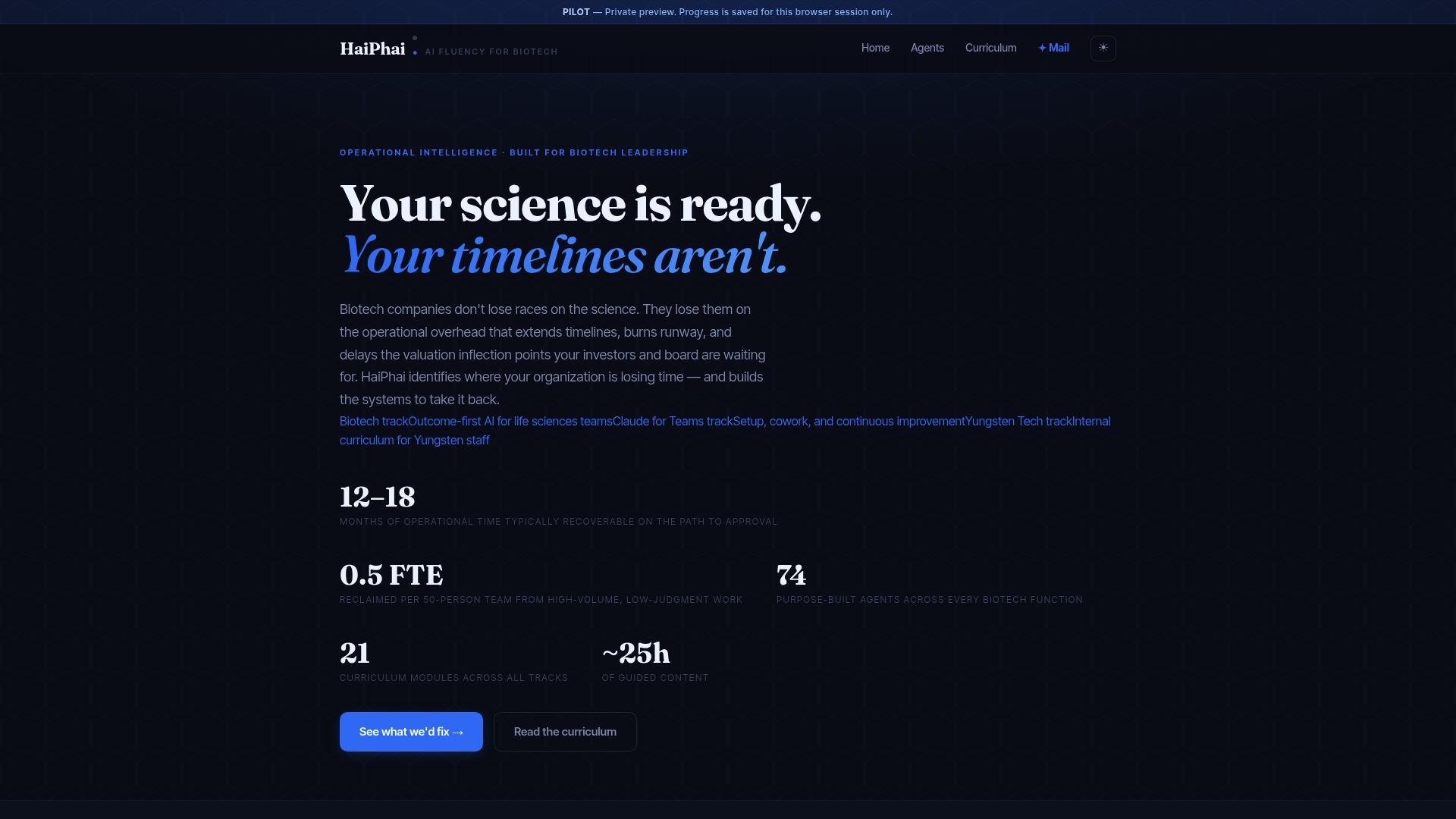
Our AI Velocity Diagnostic starts by identifying where manual compliance work is actually costing you time, then our team designs the automated workflow around your specific regulatory obligations instead of a generic template. For life sciences organizations, that often means:
- Governed automation across clinical, regulatory, and executive operations, built with continuous oversight rather than a set-and-forget script.
- Institutional knowledge captured into the workflow so the mapping logic survives staff turnover.
- Some clients report reclaiming significant operational time on their path to approval, a result attributed to faster regulatory drafting and streamlined site activation.
If you want a governed path to continuous compliance rather than a longer software evaluation, our services page outlines how the operating partnership starts.
FAQ
What are some examples of compliance automation?
Common examples include automated user access reviews, continuous cloud configuration checks against a defined baseline, and automated evidence collection for SOC 2 or ISO 27001 audits. Vendor platforms like HaiPhai's AI Velocity Diagnostic and dedicated compliance tools such as Drata both fall into this category, though they serve different scopes of work.
What is the best compliance automation software?
There is no single best option: the right choice depends on which frameworks you monitor, which systems you need to integrate, and whether you need a software platform or a governed operational partnership. Teams evaluating options should weigh integration depth, evidence management features, and how much human oversight the vendor builds into exception handling.
What is an example of compliance monitoring?
A typical example is an automated test that checks whether cloud storage encryption settings still match a required baseline, running on a defined schedule rather than once a quarter. Another common example is a continuous access review that flags accounts belonging to employees who have left the organization.
What are the 7 pillars of compliance?
Definitions vary across industries, but a commonly cited version includes written policies, a dedicated compliance officer, effective training, open communication channels, internal monitoring and auditing, enforcement of standards, and prompt corrective action. Compliance monitoring automation primarily supports the internal monitoring and auditing pillar by keeping evidence current between formal audit cycles.
Sources
- NIST SP 800-137, Information Security Continuous Monitoring (ISCM)
- GAO — Cybersecurity: DHS and selected agencies need to address shortcomings in implementation of network monitoring program