
Clinical protocol governance is the system of roles, decision rights, and controls that keeps a trial protocol scientifically sound and operationally executable from drafting through closeout. It exists to deliver three outcomes: participant safety, data integrity, and regulatory compliance. Those outcomes come from documented accountabilities, protocol content built around critical-to-quality factors, defined approval gates, and monitoring that feeds back into change control.
TL;DR:
- Clear delegation logs, updated roles, and defined approval gates prevent delays in protocol amendments and safety decision processes.
- Critical-to-quality factors must be explicitly identified and embedded in protocols, focusing oversight on elements that impact safety and data integrity.
- Institutional review boards, PRMCs, and DMCs each have distinct review scopes, and confusion among them can cause activation delays.
- Effective governance relies on real-time documentation, version control, and dashboards that link monitoring data to decision authority.
- Operational tools like RASCI mapping, standardized templates, and automation support faster site activation, regulatory drafting, and compliance tracking.
Table of Contents
- Core governance elements: roles, decision rights, and accountabilities
- Protocol content and critical-to-quality factors under ICH M11 and FDA rules
- Review, approval and oversight workflows: IRB, PRMC, and DMC roles
- Monitoring, risk-based oversight and quality assurance
- Organizational frameworks and maturity: where governance sits in the institution
- Practical implementation steps: building governance that holds up
- An operating partnership approach to embedding governance
- Handling conflicts of interest within protocol governance bodies
- Audit and inspection readiness related to clinical protocol governance
- Stakeholder communication and training strategies to ensure protocol compliance
- Data integrity and documentation standards relevant to protocol governance
- What governance programs consistently get wrong
- HaiPhai's approach to operational protocol governance
- Authoritative regulatory and guidance links
- Sources
- FAQ
Core governance elements: roles, decision rights, and accountabilities
Governance breaks down when nobody can say, without checking three emails, who actually approves an amendment. The fix starts with naming the roles and the authority each one holds.
The sponsor owns the protocol and bears ultimate regulatory accountability. The principal investigator directs conduct at the site and is accountable for participant welfare there. A study lead coordinates cross-functional execution, a regulatory lead manages agency-facing submissions, and quality assurance verifies that both the protocol and its execution meet the sponsor's own SOPs and applicable regulation. A contract research organization, where one is used, holds delegated authority for specific tasks, never for decisions the sponsor has not formally transferred.
Applying a RASCI model to protocol lifecycle tasks turns those titles into working rules:
- Drafting: the regulatory lead is responsible, the sponsor's medical lead is accountable, and the PI is consulted before finalization.
- Finalization and approval: the sponsor is accountable, quality assurance and biostatistics are consulted, and the study team is informed once locked.
- Site activation: the study lead is responsible, the sponsor is accountable, and the PI and regulatory affairs are consulted on local requirements.
- Amendment approval: the regulatory lead is responsible, the sponsor is accountable, and safety and biostatistics are consulted whenever the change touches efficacy or safety endpoints.
- Safety holds: the medical monitor is responsible, the sponsor is accountable, and the DMC or DSMB, where one exists, is consulted immediately.
Delegation logs, standard operating procedures, and committee charters are what make these assignments auditable rather than aspirational. A delegation log that lists a task without a named, signed-off individual is a documentation gap an inspector will flag on sight.
Pro Tip: Review your RASCI map every time a role changes hands, not just at study start; stale delegation logs are among the most common findings in sponsor audits.
Clear decision rights matter because ambiguity is what actually causes delay. A protocol amendment stuck for weeks waiting on an unclear approval chain costs more in lost enrollment than the amendment itself typically warrants.
Protocol content and critical-to-quality factors under ICH M11 and FDA rules
A protocol is a governance document as much as a scientific one. Every section maps to a decision someone downstream will have to defend.
Core elements include the synopsis, objectives and endpoints, study design, eligibility criteria, the statistical analysis plan, the schedule of activities, safety monitoring provisions, and stopping rules. Each of these carries governance weight because each one gets checked, amended, or challenged during the trial's life.
Critical-to-quality factors, or CtQs, are the attributes of the protocol whose failure would meaningfully affect participant safety or the reliability of trial results. Naming them explicitly in the protocol and its annexes lets a governance body focus limited oversight capacity where it matters instead of monitoring everything equally. This is the operational core of a quality-by-design approach: identify what actually threatens the trial's integrity, then build the monitoring and approval controls around those points rather than around the document as a whole.

The M11 Clinical Electronic Structured Harmonized Protocol template pushes this further by organizing protocol content into a standardized main body and appendix structure, placing execution-critical information such as the synopsis, schema, and schedule of activities near the front of the document. That structure supports electronic data exchange and gives governance bodies a consistent place to find the information they need to make a decision quickly.
Regulatory expectations for content scale with phase. Under 21 CFR 312.23, a Phase 1 protocol can be relatively flexible, outlining subject numbers, safety exclusions, and dosing plans with detail concentrated on safety-critical elements. Phase 2 and 3 protocols require a more detailed design, defined contingencies, and fuller monitoring plans, reflecting the larger population and higher stakes of later-stage trials.
Bullet items worth building into any protocol template:
- Synopsis and schema: placed early, they let reviewers grasp design and risk in minutes rather than hours.
- Eligibility criteria: written precisely enough that a site coordinator can screen without calling the medical monitor for every borderline case.
- Stopping rules: tied to specific, measurable thresholds rather than general safety language.
Review, approval and oversight workflows: IRB, PRMC, and DMC roles
Multiple bodies review a protocol before a site ever screens a participant, and they are not interchangeable. Confusing their scope is a common source of activation delay.
Institutional review board or ethics committee review focuses on participant protection: informed consent, risk-benefit balance, and vulnerable population safeguards. It runs on a separate track from scientific and feasibility review, which is typically handled by a Protocol Review and Monitoring Committee. PRMCs evaluate scientific merit, feasibility, and accrual potential before initiation, then continue monitoring accrual and scientific progress once the study is underway.
Data monitoring committees, sometimes called DSMBs, oversee accumulating safety and efficacy data during the trial itself. FDA guidance on DMC operation calls for a written charter covering meeting schedules, data access rules, conflict-of-interest handling, and the procedures for interim analyses and any resulting recommendations. A DMC without a signed charter is operating without the ground rules an inspector will expect to see documented.
A typical activation sequence and what each gate validates:
- Scientific and feasibility review (PRMC or equivalent): confirms the trial is worth running and can realistically enroll.
- Ethics review (IRB): confirms participant protections and consent materials meet applicable standards.
- Regulatory clearance: confirms the sponsor's submission, whether an IND or equivalent, has cleared the relevant hold period.
- Site activation gate: confirms contracts, training, and local regulatory approvals are complete.
- First interim safety check (where a DMC exists): confirms early safety signals do not warrant a hold before broader enrollment continues.
Each committee inspects a different checklist: PRMCs look at design and accrual feasibility, IRBs look at consent language and risk disclosure, and DMCs look at unblinded safety data against pre-specified stopping boundaries.
Monitoring, risk-based oversight and quality assurance
Monitoring is where governance either proves itself in practice or quietly fails. FDA's risk-based approach to monitoring directs sponsors to concentrate oversight on the aspects of study conduct most likely to affect participant protection and data reliability, rather than applying uniform scrutiny everywhere.
In practice this plays out across three modes. Central monitoring reviews aggregated data remotely and is well suited to catching site-level outliers in query rates or enrollment pace. On-site monitoring remains necessary for source data verification and direct observation of consent and drug accountability. Hybrid approaches route routine checks through central review and reserve site visits for sites or signals that cross a defined risk threshold.
A risk-based approach concentrates sponsor oversight on the most critical data and processes, which is the regulatory basis for spending monitoring hours on CtQs instead of spreading them evenly across every field on every case report form.
Monitoring only earns its place in governance when findings actually change behavior. A rising query rate or an unexpected cluster of protocol deviations should trigger a documented root-cause review, feed into a corrective and preventive action plan, and, when the pattern points to a design flaw, prompt a formal amendment discussion rather than a series of one-off site memos.
Useful governance dashboard metrics include:
- Query rate per case report form, tracked by site and by field to spot systemic issues early.
- Protocol deviation counts, categorized by whether they touch a CtQ.
- Accrual pace against plan, flagged when a site falls meaningfully behind projection.
- Time from data query to resolution, a proxy for site engagement and data integrity risk.
Organizational frameworks and maturity: where governance sits in the institution
Governance quality tracks organizational maturity more closely than most sponsors assume. A Clinical Trials Management Ecosystem maturity model frames institutional capability across axes including study management, regulatory and audit management, financial and intellectual property management, recruitment, data systems and dashboards, and organizational culture, with roughly five levels of maturity across each axis.
The common failure mode at low maturity is governance scattered across departments with no single body holding authority to resolve a cross-functional conflict, so decisions stall while committees wait on each other. A centralized research governance body with real authority and the expertise to use it removes that bottleneck, provided it is staffed to actually make decisions rather than just review them.
A short self-assessment for spotting gaps:
- Can you name, right now, who has final sign-off authority on an amendment that touches a CtQ?
- Do your delegation logs reflect the team as it exists today, not as it existed at study start?
- Does your monitoring plan explicitly state which findings escalate, and to whom?
Pro Tip: Score each maturity axis separately rather than as a single average; a strong data systems score can mask a weak governance culture score, and the weak axis is usually where the next inspection finding comes from.
Practical implementation steps: building governance that holds up
Turning governance principles into working controls follows a fairly consistent sequence, regardless of therapeutic area.
- Map RASCI across every protocol lifecycle task, from initial drafting through amendment approval and safety holds, and name individuals, not just roles.
- Define CtQs explicitly and embed them directly in the protocol and in the monitoring plan, so oversight resources concentrate where failure would matter most.
- Write committee charters and set approval gates, then run a tabletop exercise simulating an amendment or a safety signal to confirm the chain actually works before a real one arrives.
- Deploy standardized templates aligned with the M11 structure, alongside version control, current delegation logs, and a governance dashboard that surfaces deviations and query trends without a manual pull.
The c4c network's implementation experience illustrates the value of pairing structural change with pragmatic interim tools: the network used RASCI mapping, SOPs, performance dashboards, and monthly governance cycles to scale oversight across multiple hubs, often relying on manual reporting while integrated systems were still being built out. A risk register template that links KPIs and KRIs directly to governance actions gives a team a concrete starting point rather than building one from a blank page. Sites preparing for their first activation gate under a tightened governance model also benefit from a structured readiness checklist that catches the same gaps IRBs and PRMCs routinely flag.
An operating partnership approach to embedding governance
Most governance failures are not written into any procedure. They show up as a diagnostic drafted by hand for the tenth time, or a delegation log updated a month after the fact. HaiPhai works as an embedded operational partner rather than a software vendor, running a diagnostic to find where protocol governance stalls, then redesigning the workflow around it and layering in governed automation for tasks like regulatory drafting and delegation log maintenance. HaiPhai states that clients can reclaim up to 18 months of operational time on the path to approval through this model, a figure the company presents as its own performance claim. In practice, that looks like faster site activation cycles, regulatory drafting that already reflects the protocol's CtQs, and automation that keeps governance records current without adding headcount.
Handling conflicts of interest within protocol governance bodies
A DMC member with a financial stake in the sponsor, or a PRMC reviewer evaluating a colleague's trial, introduces a bias risk that governance has to manage structurally rather than assume away.
FDA guidance on DMC operation calls for conflict-of-interest procedures to be written directly into the committee charter, covering both financial interests and professional relationships that could compromise independent judgment. The same principle extends to PRMCs and to any body making protocol approval decisions: disclosure requirements should be standing, not triggered only when a conflict becomes obvious.
Practical controls include requiring annual disclosure statements from every committee member, recusal procedures that are actually enforced rather than left to self-report, and rotation policies that prevent the same small group from reviewing each other's work indefinitely. Documenting how a disclosed conflict was handled, not just that it was disclosed, is what an inspector will look for. A charter that names the process but shows no record of it being followed is functionally the same as having no process at all.
Smaller institutions running lean committees face a particular version of this problem: with a limited pool of qualified reviewers, some cross-involvement is close to unavoidable. The governance answer is not to pretend the conflict does not exist but to document it, recuse the conflicted member from the specific decision, and record who made the call in their place.
Audit and inspection readiness related to clinical protocol governance
Inspection readiness is what governance looks like from the outside, and it is judged almost entirely on documentation. An inspector reconstructs the trial's decision history from paper, not from what the team remembers doing.
The core readiness question for any governance system is simple: can you produce, on request, the signed delegation log that was in effect on the date a specific decision was made, the charter that governed the committee that approved it, and the record showing the approval actually happened before the action it authorized. Governance built around real-time documentation answers that question without a scramble. Governance built around after-the-fact paperwork usually cannot.
Readiness improves fastest when teams treat every governance artifact as inspection material from the moment it is created rather than reconstructing it later. That means charters that are signed and dated, not drafted and left unsigned for months. It means amendment approvals logged with the date the decision was made, not the date someone got around to filing it. It means monitoring findings that show the corrective action taken, not just the finding itself.
Running periodic mock audits against your own governance documentation, before a regulator does it for you, tends to surface the same gaps inspectors find: stale delegation logs, charters missing a conflict-of-interest section, or amendment files with no record of which CtQ the change was evaluated against.
Stakeholder communication and training strategies to ensure protocol compliance
A protocol that lives only in a document management system does not govern anything. Governance requires that the people executing the trial actually understand what the CtQs are and why specific steps cannot be skipped.
Site-level training should walk through the protocol's critical-to-quality factors specifically, not just the eligibility criteria and visit schedule, so coordinators understand which deviations warrant an immediate call to the study lead versus a routine note in the file. Training delivered once at site initiation and never refreshed is a known gap: staff turnover and protocol amendments both erode the original training's relevance within months.
Communication between governance bodies and site staff works best when it flows in both directions. A PRMC or DMC decision that changes a monitoring threshold needs to reach site coordinators promptly and in plain language, and site-level observations about where the protocol is hard to follow in practice should have a defined path back to the study team rather than disappearing into a query response.
Documenting training completion the same way delegation is documented, with names, dates, and version numbers of the protocol trained on, closes a gap that otherwise surfaces only during an audit. A workflow redesign that automates training tracking alongside delegation logs removes one more place where governance depends on someone remembering to update a spreadsheet.
Data integrity and documentation standards relevant to protocol governance
Governance decisions are only as good as the data feeding them, which makes data integrity a governance function rather than a separate quality workstream.
The standard framework for evaluating whether trial data can be trusted centers on the ALCOA+ principles: data should be attributable, legible, contemporaneous, original, and accurate, along with being complete, consistent, enduring, and available. A practical playbook on data integrity compliance walks through how these principles apply across the data lifecycle, from capture through archiving, which is useful context for teams building documentation standards into their governance framework rather than treating them as a separate checklist.
Applied to protocol governance specifically, this means every governance decision, an amendment approval, a stopping rule invoked, a conflict-of-interest recusal, needs a contemporaneous, attributable record. A decision documented weeks after the fact, reconstructed from memory or email threads, fails the contemporaneous standard even if the decision itself was sound.
Version control on the protocol itself is part of this same standard. Every site, every committee member, and every monitor needs to be certain they are working from the current approved version, and the audit trail needs to show exactly when each version was superseded and why. A governance dashboard that surfaces the active protocol version alongside open queries and pending amendments keeps this visible without requiring anyone to check three separate systems.
What governance programs consistently get wrong
Most protocol governance programs invest heavily in committees and charters, then underinvest in the operational plumbing that connects governance decisions to daily execution. A DMC charter is not worth much if the delegation log it depends on is three months stale, and a beautifully designed RASCI map does not prevent delay if nobody updates it when a study lead changes roles.
The conventional advice treats governance as a documentation exercise: write the SOPs, form the committees, file the charters. That gets an organization through its next audit. It does not get amendments approved faster or catch a protocol deviation before it compounds across a dozen sites. The gap is almost always in the connective tissue: does a monitoring finding actually reach the person with authority to act on it, and does it reach them in days rather than in the next scheduled committee meeting.
If you take one thing from this, prioritize the link between CtQs and your monitoring dashboard before you polish another charter. A governance body with clear authority but no real-time visibility into the data that should trigger its involvement is authority without use.
— John
HaiPhai's approach to operational protocol governance
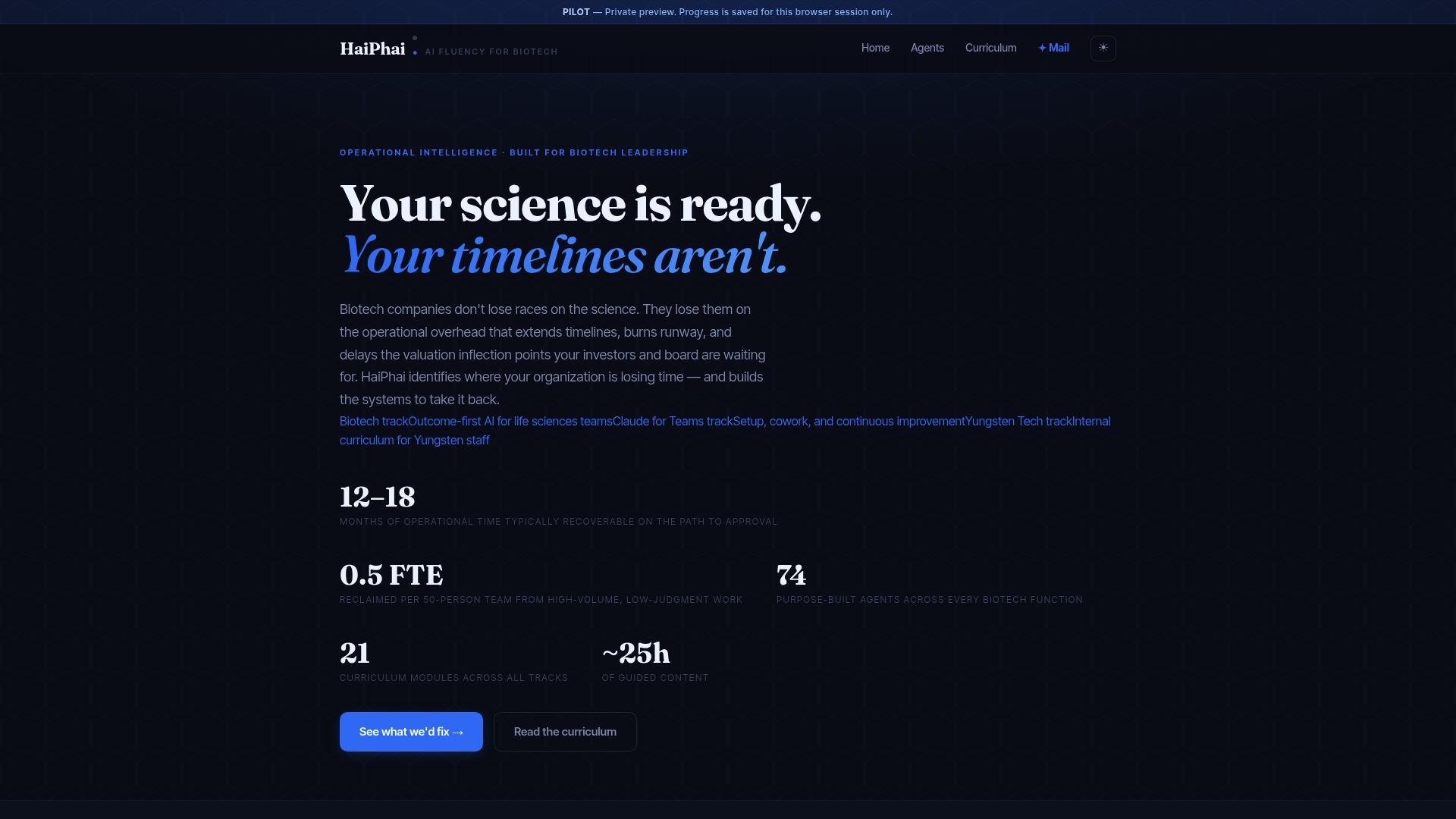
If your governance gaps are less about knowing the rules and more about the daily grind of keeping delegation logs current, drafting regulatory documents against a moving protocol, and getting sites activated without a six-week wait, that is an operational problem, not a training problem. HaiPhai runs an AI Velocity Diagnostic to find exactly where those bottlenecks sit in your specific workflow, then redesigns the process around them instead of handing you generic software.
What that looks like in practice:
- Regulatory drafting built around your protocol's actual CtQs, cutting the manual rework that usually follows an amendment.
- Governed automation for delegation logs and training records, so the documents an inspector asks for are already current.
- Site activation support aimed at removing the coordination delays that stall studies between approval and first participant.
HaiPhai's solutions page covers the full range of services, from clinical and regulatory operations support to executive operations and organizational capability building. If protocol governance at your organization is being held back by process rather than policy, request a diagnostic to see where the time is actually going.
Authoritative regulatory and guidance links
Primary sources cited above cover FDA protocol requirements, DMC charters, risk-based monitoring, the M11 CeSHarP template, and CTME maturity benchmarking for governance planning.
This article is general information, not a substitute for advice from a qualified doctor. Consult a qualified healthcare professional about your own circumstances before acting on anything here.
Sources
- 21 CFR § 312.23 - Protocols for clinical investigations
- M11 Clinical Electronic Structured Harmonized Protocol (CeSHarP)
- Clinical Trials Management Ecosystem (CTME) maturity model
FAQ
What are the core pillars of clinical governance?
Definitions vary across institutions, but a common framework groups clinical governance around risk management, quality improvement, clear accountability structures, and staff training and competence. Applied to protocol governance specifically, these translate into documented roles, monitored critical-to-quality factors, and defined approval gates.
What are the four P's of governance?
There is no single, widely recognized "four P's" framework specific to clinical protocol governance, and using one risks oversimplifying a system that depends on documented roles, charters, and monitoring rather than a memorable acronym. Sponsors are better served by structuring governance around the roles, decision rights, and controls covered in FDA and ICH guidance.
What are the key components of a clinical protocol?
A clinical protocol's key components include the synopsis, objectives and endpoints, study design, eligibility criteria, the statistical analysis plan, the schedule of activities, and safety monitoring provisions with stopping rules. Under 21 CFR 312.23, the level of detail required for these components scales with trial phase, with Phase 2 and 3 protocols requiring more detailed monitoring plans than Phase 1.
Can you give examples of clinical governance in practice?
Examples include a Protocol Review and Monitoring Committee evaluating a study's scientific merit and feasibility before activation, a Data Monitoring Committee operating under a written charter to review unblinded safety data, and a sponsor's risk-based monitoring plan concentrating oversight on critical data points rather than every field on every form.
How does risk-based monitoring fit into protocol governance?
Risk-based monitoring directs sponsor oversight toward the most critical data and processes affecting participant safety and data reliability, rather than applying uniform scrutiny across an entire trial. It works as a governance tool when monitoring findings feed directly into corrective action and, where needed, formal protocol amendment decisions.