
Design regulatory affairs workflows as structured, end-to-end, data-first processes with targeted AI augmentation and clear governance. That approach cuts cycle times, reduces rework loops, and produces audit-ready evidence at every handoff. It also treats alignment with ICH and FDA expectations as a fixed constraint, not an afterthought, so the workflow you build today still holds up under inspection tomorrow.
TL;DR:
- Redesign workflows around structured data with clear ownership and metadata to ensure traceability and audit readiness for FDA and ICH compliance.
- Map each stage from intake to postmarket, setting measurable targets like cycle time reduction and rework rates to evaluate improvement.
- Apply AI only where its output can be validated against standards, ensuring decision logs and transparency are maintained throughout the process.
- Implement validation, governance, and pilot plans before deploying AI-enabled steps, focusing on risk-based documentation and continuous performance monitoring.
- Use HaiPhai’s diagnostic approach to identify bottlenecks, tailor automation solutions, and embed governance within regulatory operations for faster, compliant workflows.
Table of Contents
- Why Redesign Regulatory Workflows Instead of Just Digitizing Them
- Mapping the Workflow Stages From Intake to Post-Approval
- AI in the Workflow: Where It Helps and What It Requires
- How to Map Workflow Artifacts to ICH and FDA Expectations
- Implementation Checklist: Validation, Governance, and a Pilot Plan
- How HaiPhai Approaches Workflow Redesign in Practice
- Governance and Validation Requirements for AI-Enabled Steps
- Cross-Functional Collaboration Inside a Redesigned Workflow
- Managing Change and Improving the Workflow Continuously
- Compliance Risk Management Within the Workflow
- Training and Competency for Staff Running the Workflow
- Practitioner Note: Common Mistakes and Fast Wins
- Starting an AI-Enabled Workflow Redesign With HaiPhai
- Sources
- FAQ
Why Redesign Regulatory Workflows Instead of Just Digitizing Them
Most regulatory teams do not have a technology problem. They have a structure problem that technology has been layered on top of. Scanning a paper form into a PDF and routing it through email is digitization. It preserves every inefficiency of the original process, just faster and with a worse paper trail. Redesign means mapping the full lifecycle first, from surveillance through postmarket, and rebuilding the handoffs around structured data rather than free-text documents passed between departments.
The failure mode is predictable: teams automate the step in front of them without asking whether that step should exist at all. A regulatory affairs workflow built this way accumulates hidden handoffs, duplicate reviews, and version conflicts that nobody notices until an inspector asks for a document trail that does not connect.
A workflow redesigned around structured data avoids this because every artifact, from an impact assessment to a submission packet, carries the metadata needed to trace it back to its source and forward to its outcome. That structure is what makes targeted AI augmentation safe to introduce later. You cannot layer AI usefully onto a process that has no consistent data shape to begin with.
Five principles should guide the redesign:
- Map end-to-end first. Trace the full lifecycle from signal or intake to postmarket monitoring before touching any single step.
- Author in structured formats. Replace free-text drafts with templates that separate content from formatting and metadata.
- Assign a single owner per stage. Every handoff needs one accountable person, not a committee.
- Build audit-ready artifacts by default. Every output should carry version, author, decision rationale, and timestamp.
- Design for least-friction handoffs. A stage should never require re-entering data another stage already captured.
Judge the redesign against measurable outcomes: cycle time per submission type, rework rate per stage, and the percentage of artifacts that pass audit review without follow-up questions. Those three numbers tell you whether the new workflow actually works, independent of how it feels to use.
Mapping the Workflow Stages From Intake to Post-Approval
A regulatory workflow has recognizable stages regardless of therapeutic area or product type. Each one needs a defined output, an accountable owner, and a set of structured data points captured before the work moves on. Skipping any of these turns the next stage into detective work.
- Surveillance and intake. Capture new regulatory intelligence, competitor filings, or safety signals. Output: a logged intake record with source, date, and initial relevance score. Owner: regulatory intelligence lead.
- Impact assessment. Determine whether the signal or requirement change affects an existing product, submission, or process. Output: a written impact assessment with affected product IDs and risk rating. Owner: regulatory affairs manager for the affected product line.
- Regulatory strategy memo. Translate the assessment into a plan: which guidance applies, which submission type is needed, and the target timeline. Output: a strategy memo linked to the originating intake record. Owner: senior regulatory strategist.
- Submission packet assembly. Draft, review, and compile the required documents into the packet format the agency expects. Output: a version-controlled packet with a component checklist. Owner: submission lead, with cross-functional sign-off from clinical and quality.
- Postmarket plan. Define the monitoring, reporting, and renewal obligations that begin once the submission is filed or approved. Output: a postmarket tracking record with review dates and responsible parties. Owner: postmarket surveillance lead.
Set a service-level agreement for each handoff, for example a fixed number of business days between impact assessment and strategy memo, so the workflow does not stall waiting on an undefined next step. Handoff rules should require the receiving owner to confirm the artifact is complete before accepting it, rather than discovering gaps mid-review.
At each stage, capture structured metadata: product identifier, guidance reference, version number, reviewer name, decision date, and a plain-language rationale for the decision made. This is what turns a folder of documents into a traceable record an inspector or auditor can follow without asking your team to reconstruct history from memory.

Pro Tip: Tag every artifact with the intake record it originated from, so a single query can reconstruct the full chain from signal to postmarket plan.
AI in the Workflow: Where It Helps and What It Requires
AI earns a place in a regulatory workflow only where its output can be checked against a defined standard before anyone acts on it. Four use cases meet that bar consistently.
- Guidance summarization. AI can condense long guidance documents into working summaries, but a regulatory reviewer must confirm the summary against the source text before it informs a strategy memo.
- Draft generation. AI can populate structured templates with a first draft of a section, provided a human editor reviews and signs off before it enters the submission packet.
- Obligations extraction. AI can pull commitments and deadlines out of correspondence or guidance, but QA sampling should check a portion of extractions against source documents on a set schedule.
- Signal detection. AI can flag surveillance data that crosses a defined threshold, but a human triages every flagged item before it becomes an impact assessment.
A structured authoring approach can report high draft-stage gains on early document versions when pairing AI drafting with fixed templates and mandatory human edit passes, as detailed in structured authoring work.
Each use case needs documentation proportional to its risk. Guidance summarization used only to orient a reviewer carries lower risk than draft generation feeding directly into a submission, so the oversight and recordkeeping should scale accordingly. FDA's guidance on AI-enabled devices frames this as a total product lifecycle approach: transparency about how the AI reached its output, evaluation of performance across relevant subgroups, and ongoing monitoring after deployment. Applied to regulatory workflows, that means keeping a decision log every time an AI output informs a human decision, not just when the final document is filed.
Three micro-workflows illustrate the pattern in practice. First, AI summary of new guidance, then RA reviewer confirmation, then a decision log entry, then tagged storage linked to the affected product. Second, AI draft of a submission section from a structured template, then a subject-matter reviewer's edit pass, then a QA spot check, then version lock. Third, AI flag of a safety signal against a preset threshold, then human triage within a fixed window, then either escalation to impact assessment or a documented dismissal reason. More detail on where the boundary between AI and human judgment should sit is covered in where AI can help in regulatory affairs and what must stay human.
How to Map Workflow Artifacts to ICH and FDA Expectations
Every artifact your workflow produces should trace back to a specific regulatory expectation, not a generic sense of "compliance." ICH organizes its technical requirements into four domains, and the ICH database is the reference point for which domain governs which output. There is no single canonical list of "the four ICH guidelines": the domains, Quality, Safety, Efficacy, and Multidisciplinary, are categories that contain many individual guidelines, and confusing the two leads teams to cite the wrong one.
Match workflow outputs to the domain that actually governs them:
- Stability study protocols and reports map to ICH Q1A(R2), which sets sampling schedules and storage condition requirements.
- Control strategy documentation maps to ICH Q8, which links product and process understanding to a design-space approach for regulatory flexibility.
- Analytical validation files map to the Q2 guideline within the Quality domain.
- Impurity reporting maps to the Q3 series within the same domain.
- Quality management system controls map to Q10, which ties ongoing process performance back to the control strategy defined under Q8.
On the AI side, FDA's guidance on AI-enabled devices expects documentation of development, validation, and postmarket monitoring, plus transparency design considerations that let a reviewer see the basis for an AI-generated output. Where AI supports a decision that could be read as clinical decision support, FDA's guidance on AI/ML in regulatory decision-making clarifies which software functions fall outside the device definition and stresses that users need enough information to independently review the algorithm's basis before relying on it.
Structure your dossier and your internal systems the same way: every artifact tagged with the specific guideline it satisfies, not a general compliance label. An inspector asking for stability evidence should be able to retrieve exactly the Q1A(R2)-linked records without your team assembling a special report for the request.
Implementation Checklist: Validation, Governance, and a Pilot Plan
Before any AI-enabled step goes live, define its intended use, classify its risk based on how much a wrong output could affect a regulatory decision, and build a validation dataset with test cases that reflect real submission scenarios. Set acceptance criteria before testing begins, not after, and define a monitoring plan for after deployment so performance drift gets caught early.
- Define intended use and risk classification for each AI-enabled step before building it.
- Assemble a validation dataset representative of the documents or signals the AI will actually process.
- Set acceptance criteria and test cases in advance, then run validation against them.
- Establish a monitoring plan that tracks performance after go-live, not just at launch.
- Assign governance roles: a steering committee for prioritization, a model owner accountable for performance, a data steward for the underlying records, and a change control process for any update.
- Maintain a documentation repository that links every validation record to the workflow stage it supports.
Track three KPIs through a 90-day pilot: percent reduction in draft cycle time, rework rate per submission stage, and total operational time reclaimed against the pre-redesign baseline. Gate the pilot in three phases: 30 days to validate one micro-workflow end to end, 60 days to expand to a second workflow while monitoring the first, and 90 days to decide whether to scale governance and tooling across the full regulatory function.
Pro Tip: Run the pilot on your lowest-risk workflow first, even if it feels like a small win. A clean 90-day result there builds the governance muscle you need before touching submission-critical steps.
How HaiPhai Approaches Workflow Redesign in Practice
HaiPhai's operational partnership model starts with a diagnostic rather than a software rollout. The AI Velocity Diagnostic maps a client's actual bottlenecks before recommending any automation, on the premise that a tool tailored to a confirmed bottleneck outperforms a generic platform applied everywhere.
That diagnostic feeds a prioritization exercise: which micro-automations reduce the most friction with the least governance overhead, and which stages need human oversight strengthened before any AI touches them. Clients following this model claim to have reclaimed significant operational time on their path to approval, a figure tied to structured authoring and governed automation work described in clinical workflow redesign case material.
The model treats governance as continuous rather than a one-time sign-off, embedding senior expert teams inside the client's live operations rather than handing over a tool and leaving.
Governance and Validation Requirements for AI-Enabled Steps
Every AI-enabled step needs oversight sized to its risk, not a blanket rule applied to all AI use equally. A guidance summarization tool that only orients a reviewer needs lighter documentation than a drafting tool feeding directly into a submission packet. This is the credibility assessment principle: the depth of validation and review should scale with how much weight the AI's output carries in the final decision.
Governance structures should include a named model owner accountable for tracking performance over time, a data steward responsible for the integrity of the records the AI touches, and a change control process that requires review before any update to a validated AI-enabled step goes live. A steering committee should periodically revisit which AI use cases remain fit for purpose as guidance and internal processes evolve.
Documentation is the connective tissue. Every AI-assisted decision needs a decision log entry: what the AI produced, what the human reviewer changed or confirmed, and why. Without that record, an audit cannot distinguish a well-governed AI-assisted process from an ungoverned one, even if both produced acceptable outputs. FDA's AI-enabled device guidance frames this lifecycle documentation, alongside performance monitoring and bias evaluation, as a continuous requirement rather than a one-time validation event.
Cross-Functional Collaboration Inside a Redesigned Workflow
Regulatory affairs does not operate in isolation, and a workflow designed as if it did will stall at every handoff to clinical, quality, or commercial teams. The strongest redesigns assign a single point of contact in each adjacent function, so a submission packet does not wait on an email chain to find out who owns the missing clinical data.
Structured data helps here as much as it helps within regulatory affairs itself. When quality, clinical operations, and regulatory affairs all reference the same product identifier and version-controlled artifact, a handoff becomes a data query instead of a meeting. Cross-functional review cycles should have a fixed turnaround time, agreed in advance, so a submission does not sit waiting on a sign-off that nobody scheduled.
Shared visibility matters as much as shared data. A dashboard or tracking record that clinical, quality, and regulatory teams can all see, showing where a submission sits and who owns the next step, removes the status-update meetings that eat into cycle time without adding to it. The goal is a workflow where cross-functional dependencies are visible by default, not something a project manager has to chase down.
Managing Change and Improving the Workflow Continuously
A redesigned workflow is not a finished product. Guidance changes, new AI capabilities become viable, and teams find friction points that only show up once the new process is running at real volume. Build a review cadence, quarterly is a reasonable starting point, where the KPIs tracked during the pilot get revisited against current performance.
Change management works best when it treats the workflow itself as a controlled artifact. Any change to a stage's owner, SLA, or AI-enabled step should go through the same change control process used for validated AI components, with a record of what changed and why. This avoids the drift where a workflow slowly reverts to informal habits because nobody documented the deviation.
Continuous improvement should be driven by the same data the workflow already captures: rework rates by stage, cycle time trends, and audit findings. A stage that consistently generates rework is telling you something about its handoff rules or its owner's workload, not just about the people working it. Treat that signal as an input to the next redesign cycle rather than a one-off fire to put out.
Compliance Risk Management Within the Workflow
Compliance risk should be managed as a property of the workflow's design, not as a separate function bolted on after the fact. Treat your regulatory compliance system as the organization's operating structure for meeting external obligations: every requirement from ICH or FDA guidance should map to a specific control inside a specific workflow stage, not to a periodic audit that catches problems after they have already compounded.
Risk concentrates at handoffs more than at any single stage, since that is where information gets lost or reinterpreted. Building structured metadata into every artifact, as outlined in the workflow stages above, reduces that risk directly because a receiving owner can verify completeness before accepting a handoff rather than discovering a gap during review.
AI-enabled steps carry their own risk profile that needs the same treatment: a documented rationale for every AI-assisted decision, sized to how much that decision affects the regulatory outcome. Reviewing rework rates and audit findings on a set schedule, rather than only after an inspection, turns compliance risk management into an ongoing practice built into the workflow rather than a periodic scramble.
Training and Competency for Staff Running the Workflow
A redesigned workflow only works if the people running it understand both the regulatory content and the structured process around it. Staff need competency in the specific ICH domain and FDA guidance relevant to their stage, but they also need to understand the workflow's data model: what metadata to capture, why it matters for traceability, and how their handoff affects the next owner's ability to work efficiently.
AI-enabled steps add a specific training requirement: reviewers need to understand what the AI can and cannot be trusted to get right, so they know when to accept an output and when to escalate. A reviewer who treats every AI draft as final defeats the governance built into the workflow, while one who distrusts every output eliminates the time savings the redesign was meant to deliver.
Competency should be verified, not assumed. New staff working within a redesigned workflow benefit from shadowing an experienced reviewer through a full stage cycle before taking ownership, and periodic spot checks of decision logs can confirm that human review is actually happening at the depth the governance model requires, not just being logged as a formality.
Practitioner Note: Common Mistakes and Fast Wins
Three mistakes recur: automating a broken step instead of redesigning it, skipping the decision log because it feels like overhead, and letting one enthusiastic team member own governance alone. Fix each by mapping the stage before automating, logging every AI-assisted decision from day one, and naming a governance owner early.
Three fast wins: pilot AI-assisted guidance summarization, structure one submission template, and build a single tracking record linking intake to postmarket. Document AI use and validation from the start. Retrofitting that record later costs more than building it now.
— John
Starting an AI-Enabled Workflow Redesign With HaiPhai
Most regulatory teams know their workflow has friction somewhere between intake and postmarket. Finding exactly where it lives, and fixing it without adding another disconnected tool, is where HaiPhai's operating partnership model is built to help.
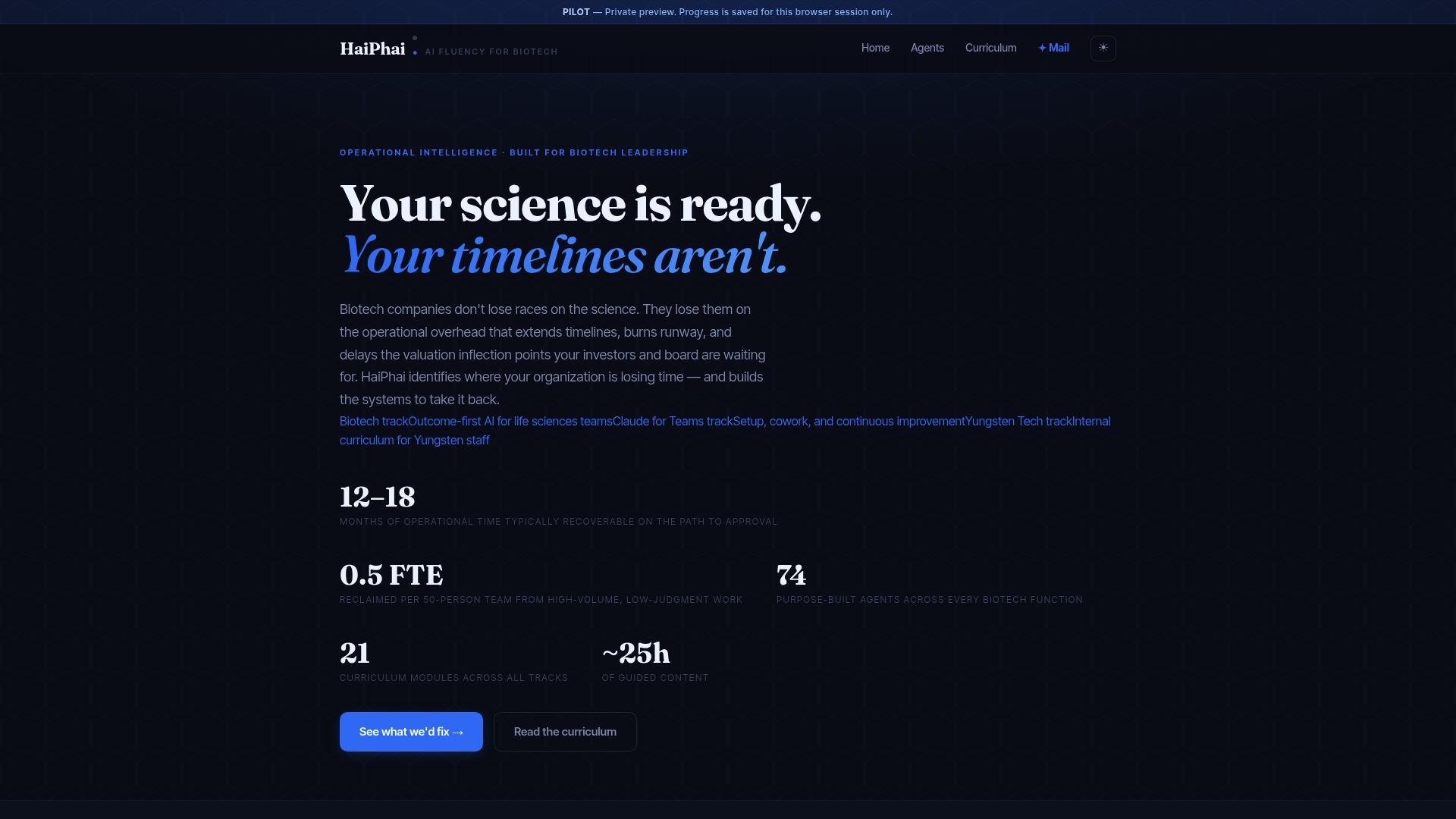
HaiPhai starts with the AI Velocity Diagnostic to map your specific bottlenecks before recommending anything, then moves into governed automation and structured authoring tailored to what the diagnostic actually finds, not a generic template applied across every client. A pilot typically begins with a scoped engagement covering one or two workflow stages, with outputs that include a documented bottleneck map, a prioritized automation plan, and the governance structure needed to run it safely.
- The operating partnership embeds expert teams inside regulatory operations.
- Solutions covering clinical, scientific, and regulatory operations, institutional knowledge, and governed automation address the stages most teams redesign first.
- The AI Operating Maturity Diagnostic is the starting point for teams that want an assessment before committing to a full engagement.
If you are weighing whether to build this capability internally or bring in a partner, HaiPhai's decision framework lays out the tradeoffs. Request a diagnostic through HaiPhai's services page to see where your own workflow stands.
Sources
Start with the ICH database to confirm which domain, Q, S, E, or M, governs the artifact you are building. Follow with ICH Q8 for control strategy design, then FDA's AI-enabled device guidance and its AI/ML decision-making guidance for lifecycle and transparency expectations before finalizing any AI-enabled step. Teams validating external lab data as part of an evidence chain can also review how to verify an AABB-accredited lab for accreditation standards relevant to sample qualification.
- ICH database
- FDA — Guidance on AI-enabled devices (download)
- FDA — Considerations for use of AI/ML in regulatory decision-making (download)
- ICH Q8_R2 guideline
FAQ
What is the highest paying job in regulatory affairs?
Senior regulatory affairs leadership roles, such as vice president or head of regulatory affairs at a larger life sciences company, tend to command the highest compensation in the field. Pay generally scales with the complexity of the product portfolio and the level of strategic decision-making responsibility rather than years of tenure alone.
Will AI replace regulatory affairs professionals?
AI is unlikely to replace regulatory affairs professionals because agencies expect human review and accountability for the decisions AI supports, as reflected in FDA's total product lifecycle guidance for AI-enabled functions. AI is better understood as a tool that handles drafting, summarization, and signal detection while a qualified reviewer retains the final call.
Is quality assurance or regulatory affairs the better career path?
Neither role is objectively better since they serve different functions: quality assurance focuses on maintaining compliant systems and processes day to day, while regulatory affairs focuses on strategy, submissions, and agency interaction. The right path depends on whether you prefer operational process ownership or external-facing regulatory strategy work.
What are the ICH guidelines organized around?
There is no single canonical list of "four ICH guidelines." ICH organizes its technical requirements into four domains, Quality, Safety, Efficacy, and Multidisciplinary, each containing multiple individual guidelines such as ICH Q1A(R2) for stability testing and ICH Q8 for pharmaceutical development.
How long does an AI-enabled workflow redesign typically take to show results?
A focused pilot on a single workflow stage can show measurable results, such as reduced draft cycle time, within a 90-day window when governance and validation steps are defined upfront. Broader results, including significant operational time reclaimed across a full regulatory function, depend on how many stages and teams the redesign eventually covers.