
Filing-ready means your eCTD package passes technical validation, every Module 1 administrative item is current, cross-discipline quality control confirms Module 2 summaries match Modules 3 through 5, and named owners have signed off on each domain. The five actions that stop most Refuse-to-File decisions cold: run your validator and hyperlink crawler on the final package, confirm Form FDA-356h and user-fee documentation are current, reconcile labeling against Module 3 data, crawl every cross-reference for broken links, and run a formal gap analysis against the FDA's discipline checklists before you transmit.
TL;DR:
- Conduct ongoing discipline-specific gap analyses using FDA checklists at least 4 to 6 months before submission to identify and address potential RTF causes early.
- Perform a rigorous last-week checklist covering technical validation, hyperlink integrity, administrative forms, and labeling reconciliation with clear ownership and immediate redress if issues arise.
- Validate the technical structure with repeated running of validators and crawlers, ensuring unique leaf titles, correct hyperlink resolution, and proper node placement before transmission.
- Keep Module 1 administrative documents current and consistent, including signed forms, fee cover sheets, disclosures, and cross-referenced contact information to avoid administrative delays.
- Build and maintain cross-module link matrices and consistency checks as part of the process, ensuring all claims are supported by matching data and references across all modules.
Table of Contents
- What Does NDA Filing Readiness Actually Require?
- The Five-Day Last-Look Filing Checklist
- How Do You Validate eCTD Technical Structure?
- Are Your Module 1 Administrative Documents Current?
- How Do You Align Module 2 Summaries With the Data?
- When Should You Run a Formal Filing-Readiness Gap Analysis?
- How HaiPhai Approaches NDA Filing Readiness Operationally
- What Causes Most Refuse-to-File Decisions?
- How Do You Fix a Refuse-to-File Deficiency?
- What Should a Cross-Module Completeness Check Cover?
- How Do You Maintain Link Integrity Across a Large Submission?
- How Should You Prioritize Tasks to Match FDA's Internal Review?
- What Does a Sample Filing-Readiness Timeline Look Like?
- How Do You Coordinate Regulatory, Clinical, and CMC Teams?
- Why Last-Minute Filing Habits Keep Repeating
- HaiPhai: A Practical Option for Teams Racing Against the Filing Clock
- Primary Sources for NDA Filing Requirements
- Sources
- FAQ
What Does NDA Filing Readiness Actually Require?
Over the past decade, many applications submitted to CDER resulted in a Refuse-to-File action, and new molecular entity NDAs that received an RTF experienced a considerable delay before they could resubmit, according to FDA's own filing checklist announcement. That number should reframe how your team thinks about the final weeks before submission. This isn't a paperwork problem you clean up at the end. It's a lifecycle risk you manage from the day your CMC data package starts taking shape.
CDER built MAPP 6025.4 specifically to cut down on RTFs by publishing discipline-specific filing checklists, covering everything from CMC completeness to clinical safety summaries to biostatistics datasets. The checklists exist so sponsors stop guessing what "complete" means to a review division. Industry analysts covering the update recommend treating these checklists as a continuous gap-analysis tool rather than a box you check the week before transmission. That distinction, checklist as ongoing framework versus checklist as final audit, separates sponsors who sail through the 60-day filing review with sponsors who get an RTF letter on day 74.
The Five-Day Last-Look Filing Checklist
The final week before transmission is where most preventable RTFs get caught, or missed. Run this sequence with a named owner on each day and a hard stop if any item fails.
- Day 5: Technical validation. Run your eCTD validator and hyperlink crawler against the exact final package, not a staging copy. Any broken node reference or leaf-title collision gets flagged here, owned by your publishing lead.
- Day 4: Hyperlink and cross-reference crawl. Confirm every Module 2 claim resolves to the correct anchor in Modules 3 through 5. A failed crawl blocks progression to Day 3.
- Day 3: Module 1 administrative audit. Verify Form FDA-356h, the user-fee cover sheet, financial disclosures, and debarment certifications are dated and signed. Missing forms are easy to fix here and catastrophic to discover after submission.
- Day 2: Labeling reconciliation. Cross-check proposed labeling against Module 3 stability and Module 5 clinical data for any unsupported claim.
- Day 1: Go/no-go decision meeting. Regulatory, CMC, clinical, and biostatistics leads sign off in writing, or the filing is delayed with a documented remediation plan.
Document every mitigation in a shared log with owner, issue, fix, and verification timestamp. If Day 3 or Day 2 surfaces a red flag that can't be resolved same-day, delay the filing. A short delay costs far less than an RTF and its average 426-day resubmission lag.
How Do You Validate eCTD Technical Structure?
Technical rejections rarely come from bad science. They come from structural errors in the XML backbone: incorrect lifecycle operations, leaf-title collisions across sequences, node misplacement, and broken hyperlinks that a reviewer can't navigate around. Practitioner guidance on fileable dossiers identifies these as the recurring, avoidable causes of technical RTF.
Before transmission, check for:
- Correct lifecycle operations (new, append, replace, delete) applied consistently across every sequence.
- Unique leaf titles across the entire submission history, not just within the current sequence.
- Every internal hyperlink resolving to a live, correctly placed anchor, not a broken or orphaned reference.
- Searchable, properly bookmarked PDFs with no scanned images standing in for text.
- Node placement matching the eCTD DTD structure exactly, particularly in Module 3 CMC subsections where nesting errors are common.
The fix isn't manual proofreading. Run a standards validator and a hyperlink crawler against the literal final package you intend to transmit, not an earlier draft. Structured authoring approaches that maintain leaf-title hygiene from first draft onward eliminate most of these collisions before they ever reach a validator.
Pro Tip: Re-run your validator and crawler after every single change to the final package, even a one-word labeling fix. A "small" edit that shifts a node's position can silently break three downstream hyperlinks.
Are Your Module 1 Administrative Documents Current?
Administrative gaps cause a disproportionate share of easy-to-correct RTFs, and they're the ones that sting most because they had nothing to do with your science. The FDA's NDA resource page lists the required forms and guidance sponsors must have current at transmission.
Audit these before you submit:
- Form FDA-356h, the application form itself, signed and dated within the current submission cycle.
- Form FDA-3397, the user-fee cover sheet, matched against your confirmed PDUFA payment.
- Financial disclosure statements for all clinical investigators, complete and unexpired.
- Debarment certification, confirming no debarred individuals were involved in preparing the application.
- Letters of Authorization for any referenced Drug Master Files, verified as active and correctly cross-referenced.
Beyond the documents themselves, reconcile contact metadata across your cover letter, XML headers, and correspondence history. A mismatched contact name or outdated phone number between your cover letter and your eCTD metadata delays routing when a filing reviewer has a question during the 60-day clock. Run this reconciliation as a standalone audit step, not a side task folded into someone's labeling review.
How Do You Align Module 2 Summaries With the Data?
The deficiencies that turn into complex RTFs, the kind that take weeks to remediate instead of hours, almost always trace back to Module 2 summaries making claims the underlying modules don't support. A biostatistics summary references a subgroup analysis that isn't in Module 5. A CMC overview cites a stability timepoint that Module 3 doesn't actually contain.
Structure your final QC as discipline sprints, not a single all-hands review:
- CMC sprint: verify every stability, specification, and manufacturing claim in Module 2.3 maps to an exact table or figure in Module 3.
- Nonclinical sprint: confirm GLP compliance statements match study reports and that any deviations are disclosed, not buried.
- Clinical and biostatistics sprint: verify CDISC datasets are submission-ready and that SEND and SAS transport outputs match the summary tables cited in Module 2.7.
- Cross-discipline reconciliation: assign one owner per discipline with a firm SLA (48 hours is typical) to close any flagged discrepancy before the last-look sprint begins.
For complex deficiencies, the fix isn't rewriting the summary. It's producing a remediation artifact, an updated summary table, a corrected anchor, a documented recoding note, that a reviewer can trace back to source data without asking a follow-up question. Maintaining a hyperlink matrix that maps every Module 2 claim to its Module 3 through 5 anchor turns this from a scramble into a five-minute lookup.
When Should You Run a Formal Filing-Readiness Gap Analysis?
Filing readiness works best as a lifecycle discipline, not a pre-submission scramble. Industry guidance on the MAPP 6025.4 checklists recommends running your first formal gap analysis well before you're anywhere near ready to file.
- 4 to 6 months out: run an initial gap analysis against every discipline-specific MAPP 6025.4 checklist. This is diagnostic, not corrective, it tells you where the gaps live while you still have time to close them.
- 60 to 90 days out: run the formal gap analysis. Map every artifact to its checklist item, update your hyperlink matrix, and lock it under version control so late changes don't silently break navigation.
- 7 to 2 days out: run the last-look sprint described earlier, with go/no-go decision rules attached.
Apply a simple three-color decision rule at each checkpoint: green means file as planned, yellow means file with a documented mitigation plan attached to the cover letter, and red means delay and remediate. Sponsors who treat the 60-90 day checkpoint as optional are the ones who discover a Module 1 gap during the last-look sprint, when there's no time left to fix it properly.
How HaiPhai Approaches NDA Filing Readiness Operationally
Checklists tell you what's missing. They don't tell you why the same gaps keep recurring submission after submission. HaiPhai works with biotech teams as an operational partner rather than a software vendor, starting from the filing deadline and working backward to find where the actual bottleneck lives, often in handoffs between regulatory, CMC, and clinical teams rather than in any single document.
Client engagements have reclaimed up to 18 months of operational time across the path to approval by replacing ad hoc last-look scrambles with governed, repeatable workflows.
Representative deliverables from this kind of engagement include:
- A live filing dashboard showing checklist status by discipline, not just by module.
- An owner matrix assigning named accountability to every MAPP 6025.4 checklist item.
- A version-controlled hyperlink matrix connecting Module 2 claims to their Module 3 through 5 anchors.
- A governed leaf-title catalog that prevents collisions across submission sequences.
Teams with strong internal QA and enough headcount can build these artifacts themselves. Teams stretched thin heading into a filing deadline, particularly smaller biotechs without a dedicated publishing group, tend to benefit more from bringing in operational support that's built this infrastructure before.
What Causes Most Refuse-to-File Decisions?
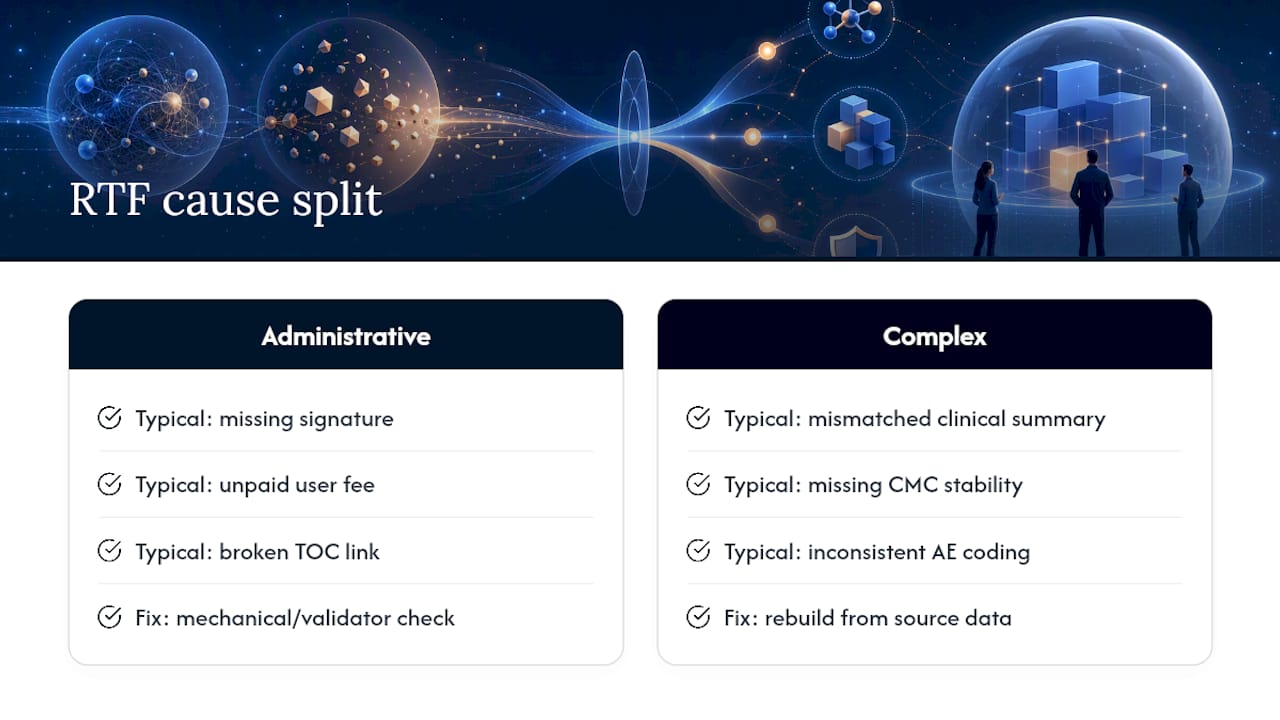
RTF causes split cleanly into two categories, and the split matters because it determines how fast you can recover. Easily correctable causes are administrative: a missing signature on Form FDA-356h, an unpaid user fee, an expired financial disclosure, a broken hyperlink in the table of contents. These get fixed in hours once flagged, and a well-run last-look sprint catches nearly all of them before transmission.
Complex causes run deeper. A clinical summary that doesn't match the underlying dataset. A CMC section missing a required stability study entirely, not just a citation to one. A safety database with inconsistent adverse event coding across studies that makes integrated analysis impossible for a reviewer to trust. These aren't fixed by re-running a validator. They require someone with scientific judgment to go back to source data and rebuild the summary correctly.
The FDA's own MAPP 6025.4 checklists are structured around this exact distinction: administrative items that can be verified mechanically, and scientific completeness items that require expert review. Sponsors who conflate the two, treating a complex data gap like a paperwork fix, end up submitting a patch that doesn't actually resolve the underlying deficiency. That's how a sponsor gets a second RTF on the same application.
The practical lesson: assign your easily correctable items to your publishing and regulatory operations team, and route anything touching data integrity or scientific interpretation straight to the discipline lead who owns that data, not to whoever happens to be free that week.
How Do You Fix a Refuse-to-File Deficiency?
If you've already received an RTF letter, or you're trying to prevent one, the corrective sequence matters as much as the fix itself.
Step one: triage by severity and root cause. Sort every deficiency FDA cites into administrative versus scientific, using the same distinction covered above. This determines who owns the fix and how long it will take.
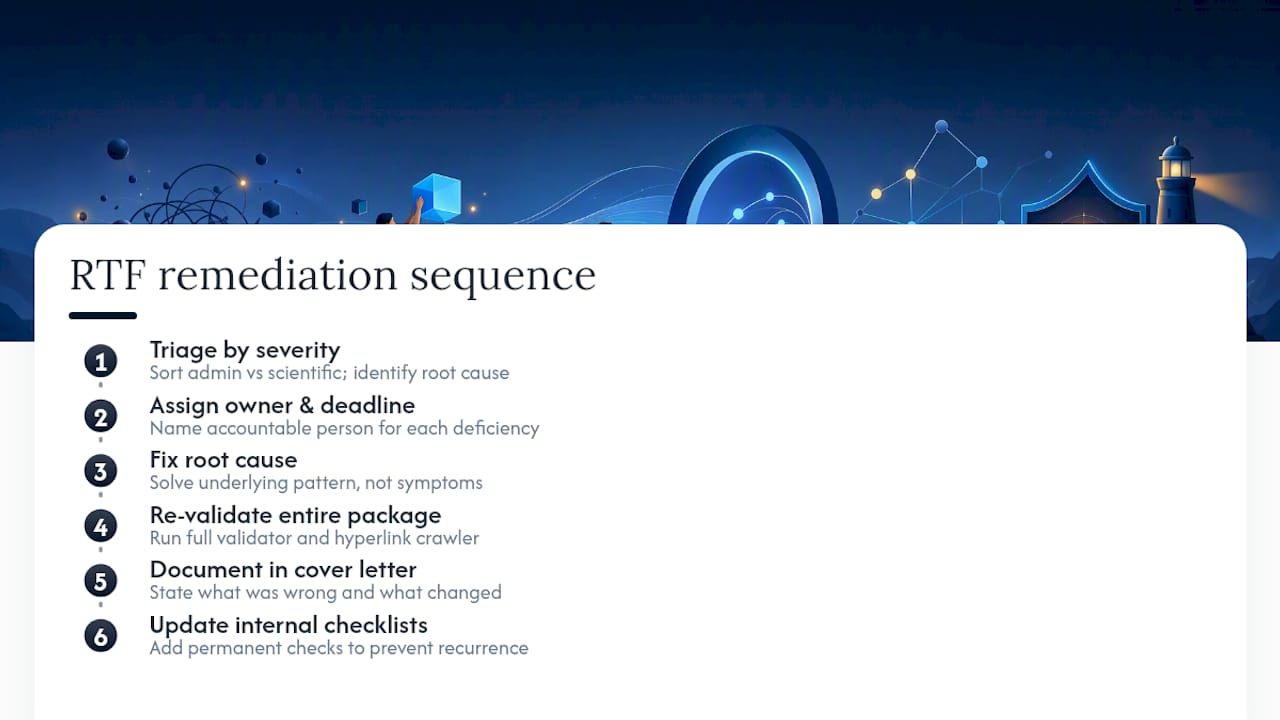
Step two: assign an owner and a deadline for each item. No deficiency should sit without a named person accountable for closing it. Vague ownership is how a two-day fix becomes a two-week fix.
Step three: fix the root cause, not the symptom. A broken hyperlink might mean you need to fix one anchor, or it might mean your entire leaf-title catalog has collisions that will recur in the next sequence. Check for the pattern before declaring the fix complete.
Step four: re-validate the entire package, not just the changed section. A fix in Module 3 can shift node positions that break references elsewhere. Run the full validator and hyperlink crawler again before resubmission.
Step five: document the remediation in your cover letter. Reviewers respond faster to a resubmission that clearly states what was wrong and exactly what changed than one that silently resubmits and hopes the fix is obvious.
Step six: update your internal checklist templates. If a deficiency type surprised you once, build a permanent check for it so it never surprises you again. This is the step most teams skip, and it's the one that prevents the same RTF cause from recurring on your next application.
What Should a Cross-Module Completeness Check Cover?
Document completeness isn't about confirming every section exists. It's about confirming every section says the same thing as every other section that touches the same claim. A completeness check that only counts files present will miss the deficiencies that actually cause RTFs.
Run these checks systematically rather than as an informal read-through:
Every numeric claim in Module 2 summaries needs a traceable source in Module 3, 4, or 5, down to the specific table or figure number. A summary that says "consistent efficacy across subgroups" needs a subgroup table somewhere in Module 5 that actually shows that. Labeling claims need direct support in the clinical data, not an inference three steps removed from what a study actually measured. Stability conclusions in Module 2.3 need matching data in Module 3.2, with matching timepoints and matching units.
Version consistency matters just as much as content consistency. If your protocol was amended twice, every module referencing that protocol needs to cite the correct, final amendment number, not an earlier version that got superseded mid-study. Terminology needs to match too: if Module 5 calls an endpoint by one name and Module 2 calls it something slightly different, a reviewer has to stop and figure out whether that's the same endpoint or a different one, and that pause is exactly the kind of friction that slows a 60-day review.
Build this as a standing checklist item owned by your regulatory writing lead, checked at every major draft milestone, not just once at the end.
How Do You Maintain Link Integrity Across a Large Submission?
Basic eCTD validation catches broken hyperlinks. It doesn't catch links that technically work but point to the wrong place, a table that exists but isn't the table the claim actually refers to. That distinction is where a lot of submissions quietly fail reviewers without ever failing a validator.
Maintaining real cross-reference integrity means building and maintaining a hyperlink matrix as a living document, not a one-time export. Every claim in Module 2 gets logged against its exact anchor location in Modules 3 through 5, and that matrix gets checked, not just the hyperlinks themselves, every time content shifts.
Version control matters here more than most teams realize. When a table gets renumbered late in the process, whoever renumbers it needs visibility into every place that table is referenced elsewhere in the submission, or the renumbering breaks references silently. Teams handling electronic records and audit trails as part of broader 21 CFR Part 11 compliance work already have infrastructure for this kind of change tracking, and it's worth extending that same discipline to your hyperlink matrix rather than treating it as a separate, ad hoc spreadsheet.
The practical test: pick five random claims from your Module 2 clinical overview and manually trace each one to its source anchor. If any of the five doesn't lead exactly where the claim says it does, your matrix has a gap that a reviewer will find before you do.
How Should You Prioritize Tasks to Match FDA's Internal Review?
FDA's filing review during the 60-day window isn't a single monolithic read-through. Different disciplines within CDER review different modules in parallel, which means your internal prioritization should mirror that structure rather than working through your submission sequentially from Module 1 to Module 5.
Prioritize technical and administrative items first, since these are what determine whether the application gets accepted for filing at all, independent of scientific merit. A perfect CMC package attached to an unsigned Form FDA-356h still gets an RTF. Once administrative and technical items are locked, shift priority to the disciplines that historically generate the most Day-74 filing review questions: CMC completeness and clinical safety database consistency tend to draw the most scrutiny in the initial filing review, ahead of the full 10-month or 6-month PDUFA review clock.
Sequence your internal QC to front-load the checks that mirror FDA's own triage: could this application be filed at all, and does it contain what each discipline needs to conduct a substantive review. Save polish-level consistency checks, formatting, cross-reference aesthetics, for after the substantive items are locked. A submission with impeccable formatting and an unresolved CMC data gap still gets an RTF; a submission with a minor formatting inconsistency and complete, well-supported data almost never does.
What Does a Sample Filing-Readiness Timeline Look Like?
A realistic filing-readiness plan spans roughly six months, structured around three checkpoints rather than a single deadline crunch.
Months 6 to 4 before target filing: initial gap analysis against MAPP 6025.4 discipline checklists. Identify which modules are furthest from complete and assign remediation owners with interim deadlines.
Months 4 to 2: discipline sprints run in parallel. CMC finalizes stability data, clinical locks the database, biostatistics finalizes CDISC datasets, and regulatory writing drafts Module 2 summaries against near-final source data.
60 to 90 days out: formal gap analysis. Every checklist item gets a status: complete, in progress with a hard deadline, or at risk. This is also when the hyperlink matrix gets built in earnest, since content is stable enough that anchors won't keep shifting.
Weeks 3 to 1: cross-discipline QC sprint. Module 2 summaries get reconciled against final Module 3 through 5 content, one discipline at a time, with 48 hour turnaround on flagged discrepancies.
Days 5 to 1: the last-look sprint covered earlier, technical validation, hyperlink crawl, administrative audit, labeling reconciliation, and a final go/no-go decision meeting.
Compress this timeline and you compress your margin for catching the deficiencies that actually cause RTFs. Teams that start their gap analysis at 90 days instead of six months tend to find their CMC or biostatistics gaps too late to fix them without a filing delay.
How Do You Coordinate Regulatory, Clinical, and CMC Teams?
Most RTFs aren't caused by any one discipline failing. They're caused by disciplines working in parallel without a shared source of truth, so nobody notices that the clinical team updated an endpoint definition three weeks after CMC finalized a cross-referencing summary that used the old name.
A single filing lead, not a committee, needs authority to make go/no-go calls and enforce deadlines across disciplines. Without one clear owner, discipline leads default to protecting their own module's timeline, and cross-module consistency becomes nobody's job. Weekly cross-discipline standups in the final 90 days, focused specifically on cross-references and shared data points rather than each team reporting its own status in isolation, catch the kind of inconsistency that a single-discipline review never will.
Shared artifacts, the hyperlink matrix, the leaf-title catalog, the owner matrix, work best when every discipline lead has direct edit access and update responsibility, not when one regulatory affairs person maintains them on everyone else's behalf. That single point of failure is exactly how a matrix goes stale two weeks before filing. Build the coordination model with clear escalation paths for when a discipline can't hit its interim deadline, because the earlier you know about a slip, the more options you have to protect the actual filing date.
Why Last-Minute Filing Habits Keep Repeating
Most RTF-triggering habits aren't caused by careless teams. They're caused by teams that have never had a bad enough scare to change how they work, so "we'll tighten it up before submission" keeps being an acceptable plan until the year it isn't. Filing-by-design, building the hyperlink matrix and leaf-title catalog from the first draft instead of reconstructing them at the end, is the actual fix, not a better last-look checklist.
The governance that works is boring: one named filing lead with real authority, a version-controlled hyperlink matrix, and a leaf-title catalog that gets checked at every draft, not just before transmission. One team I'd point to as a model caught a subgroup mismatch between their Module 2 summary and Module 5 dataset during a routine 90-day gap check, three weeks before it would have surfaced as an RTF-triggering deficiency, because their matrix flagged the anchor as unverified the moment the dataset was updated.
— John
HaiPhai: A Practical Option for Teams Racing Against the Filing Clock
Building a hyperlink matrix, an owner matrix, and a governed leaf-title catalog from scratch takes real headcount that many biotech teams don't have to spare in the final quarter before filing. An embedded operational partner can work alongside your regulatory, CMC, and clinical teams, mapping actual bottlenecks and then building AI-enabled workflows and governance artifacts that address them, rather than simply providing another checklist template.
A short diagnostic engagement typically starts by identifying where your filing timeline is actually losing time, often in cross-discipline handoffs rather than in any single module, and produces a concrete remediation plan alongside the governed artifacts described earlier: the live filing dashboard, the version-controlled hyperlink matrix, and the owner matrix with named accountability per checklist item. Some clients have reclaimed significant operational time on their path to approval by replacing ad hoc last-look scrambles with repeatable, governed processes.
If your team is heading into a filing window without that infrastructure already built, read Haiphai's State of AI in Biotech 2026 Report for a look at how operational AI is reshaping regulatory timelines, and consider whether a short diagnostic conversation could identify your specific gaps before your next gap analysis checkpoint arrives.
Primary Sources for NDA Filing Requirements
- FDA filing checklist announcement, MAPP 6025.4 and RTF statistics.
- FDA NDA resource page, required forms and guidance.
- FDA eCTD technical resources, validation specifications.
- MassBio analysis of checklist implications for sponsors.
This article is general information, not a substitute for advice from a qualified lawyer. Consult a qualified legal professional about your own circumstances before acting on anything here.
Sources
- FDA publishes filing checklists to prevent submission delays
- Utilize the New FDA Marketing Application Filing Checklist to Prevent RTFs
- New Drug Application (NDA) | FDA
- FDA eCTD resources and guidance (example media link)
FAQ
How Long Does FDA Have to Accept an NDA?
FDA has 60 days from receipt to decide whether an NDA is complete enough to file, a window commonly called the 60-day filing review, after which sponsors typically get an FDA response around Day 74 confirming filing status or issuing an RTF.
What Is the FDA NDA Approval Timeline?
After an NDA is filed, standard review runs about 10 months from the filing date, while priority review runs about 6 months, both measured under PDUFA goal dates. The filing decision itself happens well before either clock reaches its conclusion.
What Is the Usual Format for Submitting an NDA to the FDA?
NDAs are submitted electronically in eCTD format, organized into five modules covering administrative information, summaries, quality (CMC), nonclinical study reports, and clinical study reports, per FDA's NDA guidance.
What Is an NDA Filing?
An NDA filing is FDA's formal acceptance of a New Drug Application for substantive review, made after CDER confirms the submission is administratively and technically complete enough to evaluate, distinct from the eventual approval decision itself.
What Counts as True NDA Filing Readiness Before Submission?
True filing readiness combines a technically validated eCTD package, current Module 1 administrative documents, and cross-discipline QC confirming Module 2 summaries match the underlying data, verified through a structured gap analysis rather than a last-minute review.