
Use retrieval-augmented generation when your data changes often and you need citations back to a source document. Use fine-tuning when you need durable, consistent behavior at low latency and your underlying data is stable. Most enterprises should prototype with RAG first, since it needs no labeled training set, then fine-tune the specific high-volume flows where speed or tone control starts to matter. The sections below cover the engineering tradeoffs, costs, and hybrid patterns that determine which path fits your constraints.
TL;DR:
- Retrieval-augmented generation offers rapid updates by re-indexing documents, making it ideal for fast-changing, citation-heavy, or regulatory environments.
- Fine-tuning provides lower latency and consistent output for stable datasets with high query volumes, especially when strict formatting or terminology is required.
- Most enterprises begin with RAG prototypes to gauge effectiveness before fine-tuning high-volume, format-sensitive flows as needed.
- Combining both approaches in a hybrid architecture supports regulated workflows by ensuring current facts from RAG complement the structured tone from fine-tuned models.
- Proper governance, validation, and careful engineering are essential to avoid pitfalls like retrieval errors, document drift, or outdated citations in production systems.
Table of Contents
- RAG Explained: How It Works and Where It Wins
- Fine-Tuning Explained: PEFT, LoRA, and Where It Fits
- RAG vs. Fine-Tuning: A Side-by-Side Comparison
- A Decision Checklist for Choosing RAG, Fine-Tuning, or Both
- The Engineering and Cost Pitfalls Nobody Budgets For
- Building a Hybrid Architecture: Fine-Tuned Voice, RAG Facts
- What Regulated Teams Get Wrong About This Decision
- How HaiPhai Helps Biotech Teams Operationalize This Decision
- Sources
- FAQ
RAG Explained: How It Works and Where It Wins
Retrieval-augmented generation works in five steps: documents get embedded into vectors, stored in a vector database, retrieved by similarity at query time, injected into the prompt as context, then handed to the model to generate a grounded answer. Nothing about the underlying model changes.
That's why updates land in minutes. You re-index a document instead of retraining a model, a distinction AWS's prescriptive guidance treats as the core operational difference between the two approaches. Grounding answers in retrieved text also cuts hallucination risk and gives you a citation trail, according to Databricks.
RAG tends to be the right call for:
- Internal document Q&A over policies, SOPs, or product manuals
- Regulatory and legal work where every claim needs a traceable source
- Customer-facing FAQs tied to fast-changing pricing or inventory
- Knowledge bases spanning thousands of documents that update weekly
Building this well requires an embedding model, a vector database, and a chunking and metadata strategy that doesn't shred context into useless fragments.
Fine-Tuning Explained: PEFT, LoRA, and Where It Fits
Fine-tuning changes the model itself. You take a pretrained model and continue training it on a curated dataset so its weights encode new behavior, tone, or domain vocabulary directly, rather than pulling that context in at query time.
Full fine-tuning is expensive, so most teams use parameter-efficient fine-tuning (PEFT) methods like LoRA, which update a small subset of parameters instead of the whole network. That drops compute and memory needs enough to run on a modest GPU fleet rather than a data center's worth of hardware.
Fine-tuning earns its upfront cost when:
- Your underlying data is stable and won't need weekly retraining
- Query volume is high enough that retrieval latency becomes a real cost
- Output needs strict formatting, tone, or terminology consistency
- The task is behavioral (classification, structured extraction) rather than fact lookup
The tradeoffs are real: retraining cycles run hours to days, there's no native citation mechanism, and biases baked into the training set persist until the next retrain.
RAG vs. Fine-Tuning: A Side-by-Side Comparison
| Factor | RAG | Fine-Tuning |
|---|---|---|
| Update time | Minutes (re-index) | Hours to days (retrain) |
| Setup cost & expertise | Moderate: embedding model, vector DB, chunking pipeline | High upfront: curated dataset, PEFT/LoRA tuning, GPU access |
| Traceability / citations | Native, source-linked | None built in |
| Latency & per-inference cost | Extra retrieval hop adds latency and per-query cost | Lower per-inference latency once trained |
| Best for | Fast-changing, citation-heavy, low-labeled-data scenarios | Stable, high-volume, format-sensitive, latency-critical flows |
Enterprises tend to map constraints to method fairly predictably: if the answer needs a paper trail, RAG wins by default; if the task is high-volume and the format is fixed, fine-tuning pulls ahead on speed and unit cost.
Pro Tip: When the table gives you a split decision, let query volume break the tie. Low volume with real audit needs points to RAG; sustained high queries-per-second on a stable task points to fine-tuning, even if RAG could technically do the job.
A Decision Checklist for Choosing RAG, Fine-Tuning, or Both
Run through these questions in order before committing engineering resources:
- Does the underlying data change daily or weekly? If yes, RAG is the practical choice, since retraining on that cadence is not sustainable for most teams.
- Do you need citations or an audit trail? Regulated workflows, especially in life sciences and finance, almost always require this, and fine-tuned models don't provide it natively.
- Is sub-second latency critical at high query volume? If you're clearing a meaningful queries-per-second threshold on a stable task, the retrieval hop in RAG starts costing you real money and real time.
- Do you have labeled examples of the target behavior? No labeled data means RAG is your only realistic starting point. A solid labeled set opens the door to fine-tuning.
- Is the task about facts or about behavior? Fact lookup favors RAG. Consistent tone, structured output, or classification favors fine-tuning.
The practical path most teams follow: prototype with RAG because it requires no training data and ships fast, then watch your query logs. Once you see a specific flow generating high, steady volume on a stable dataset, fine-tune that flow specifically rather than the whole system. This staged approach avoids the common mistake of picking one method for the entire application when different parts of the same product have different needs.
The Engineering and Cost Pitfalls Nobody Budgets For
RAG is not plug-and-play, a point Elastic's engineering team makes explicitly. Teams that treat it as a quick integration run into recurring problems:
- Chunking errors that split context mid-sentence, degrading retrieval quality
- Embedding drift as document sets grow and shift over time
- Vector database choice made too early, before scale requirements are clear
- No systematic testing of retrieval relevance before shipping
- Weak access control on sensitive documents surfaced through retrieval
Fine-tuning has its own underestimated costs: dataset curation takes real analyst time, evaluation requires a benchmark you have to build yourself, retraining cycles are not free, and model governance (tracking which version produced which output) gets harder with every iteration.
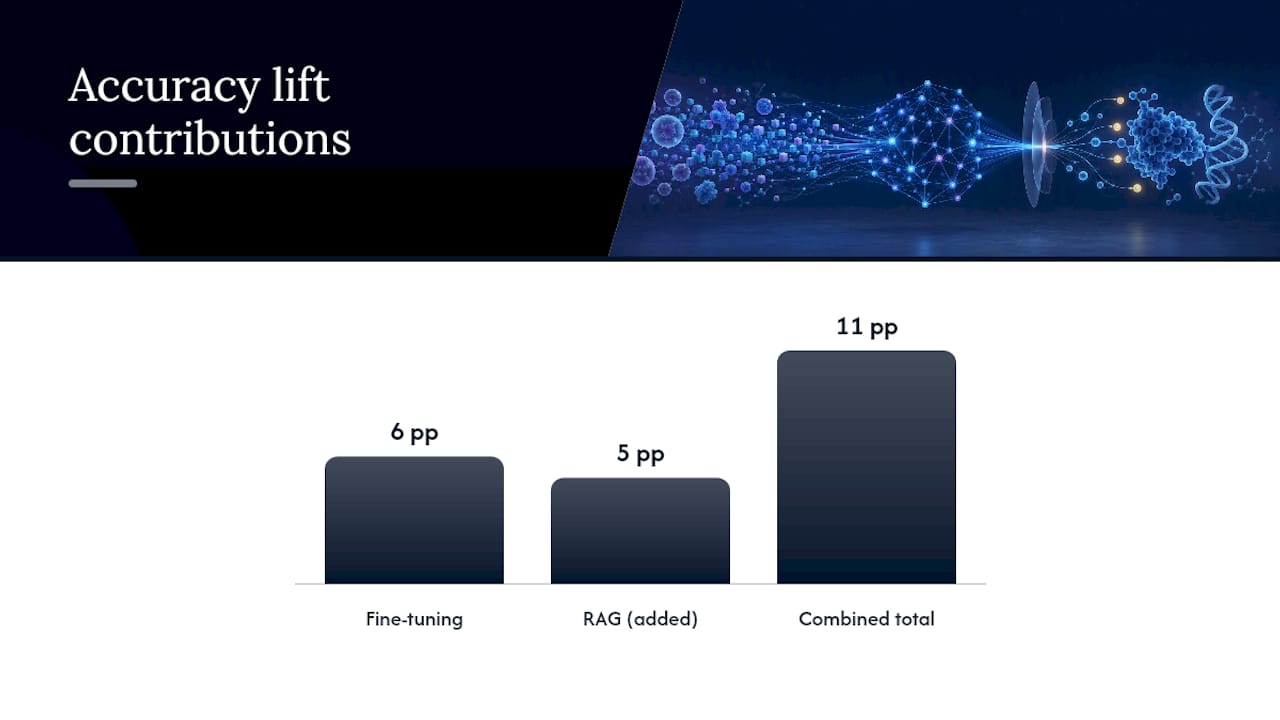
One study running both methods side by side found fine-tuning alone lifted accuracy by roughly 6 percentage points, with RAG adding another 5 points on top when combined. Combine the two badly, though, and both sets of pitfalls compound rather than cancel out. Monitoring retrieval relevance, auditing training data, and modeling total cost of ownership before scaling are the mitigations that keep either approach production-ready.
Building a Hybrid Architecture: Fine-Tuned Voice, RAG Facts
The RAG vs. fine-tuning framing is often a false choice. Mature deployments increasingly run both: a fine-tuned model handles format, tone, and domain-specific structure, while a RAG layer supplies the live facts and citations that ground each answer. Databricks frames this as the pragmatic default rather than an edge case.
This hybrid earns its complexity in specific conditions:
- Regulated domains where output must follow a strict format and cite current sources
- Workflows where facts change constantly but the response structure must stay locked
- High-stakes documents (regulatory submissions, clinical protocols) where both voice and accuracy carry weight
Running this in production means treating your retrieval index as a versioned artifact, not a static file. Every fine-tuned model release should get paired with integration tests that check the full pipeline, not just the retrieval or generation half in isolation.
Pro Tip: Budget latency separately for each layer. Teams that only measure end-to-end response time miss which half of the hybrid, the retrieval hop or the generation step, is actually the bottleneck when things slow down.
Watch model selection closely here too. A fine-tuned model that drifts out of sync with your current retrieval index will confidently cite outdated context in a perfectly formatted answer, which is arguably worse than a plain hallucination because it looks trustworthy.
What Regulated Teams Get Wrong About This Decision
Biotech and life sciences teams tend to over-index on model choice and under-invest in the diagnostic work that should come first. Before picking RAG, fine-tuning, or a hybrid, instrument your query logs and measure how often retrieval actually fails to surface the right document. That number tells you more than any framework comparison.
Build data governance early, not after a regulatory reviewer asks where an answer came from. Auditability isn't a feature you bolt on later. Teams that get this right treat regulatory drafting as a traceability problem first and an automation problem second.
*— John
How HaiPhai Helps Biotech Teams Operationalize This Decision
Picking between RAG and fine-tuning is only half the problem. The harder part is wiring either approach into regulatory drafting, clinical site activation, and document review without creating a new bottleneck to replace the old one. HaiPhai offers operational support focused on improving approval timelines by identifying where retrieval, fine-tuning, or both can save time.
For biotech teams weighing this decision against a live regulatory clock, that operational framing matters more than the model architecture itself. HaiPhai's sector work includes attention to clinical and regulatory workflows emphasizing citation traceability and audit-readiness. If your team is trying to figure out where AI actually removes weeks from your path to approval, that page is the place to start the conversation.
Sources
- Comparing Retrieval Augmented Generation and fine-tuning - AWS Prescriptive Guidance
- RAG vs. Fine Tuning (Databricks blog)
- RAG vs. Fine Tuning, a practical approach | Elasticsearch Labs
- RAG vs Fine-tuning: Pipelines, Tradeoffs, and a Case Study on Agriculture (arXiv)
FAQ
What makes a system a RAG system?
A system counts as RAG when it retrieves relevant documents from a vector database at query time and feeds that content into the model's prompt before generating a response, rather than relying only on what the model learned during training.
Is there something better than RAG?
Nothing beats RAG outright. Fine-tuning outperforms it on latency and behavioral consistency for stable, high-volume tasks, and a hybrid of both typically outperforms either alone in empirical tests.
Is fine-tuning still relevant now that RAG exists?
Yes. Fine-tuning remains the better fit for locking in tone, format, and domain-specific behavior at low latency, especially with PEFT methods like LoRA lowering the compute cost of running it.
Can RAG and fine-tuning be used together?
Yes, and it's increasingly the standard pattern for mature deployments: a fine-tuned model handles voice and structure while a RAG layer supplies current, citable facts.
Which vector database should I start with for RAG?
For prototyping, lightweight stores like Chroma or pg vector work well; teams scaling to production often move toward managed or filtering-heavy options depending on query patterns and data volume.