
Start your shortlist with three categories, not three vendors: an enterprise governance catalog (Alation, Collibra, or Atlan), a cloud-native catalog tied to your existing platform (Databricks Unity Catalog, Google Knowledge Catalog, or Microsoft Purview), and an open-source or streaming-first option (DataHub or Apache Atlas) if your pipelines change fast. The deciding factor isn't price or brand. It's whether the tool exposes vetted, permissioned metadata to AI agents while still giving stewards a way to certify what counts as trustworthy.
TL;DR:
- Effective data catalogs must expose vetted, permissioned metadata to AI agents while allowing stewards to certify data trustworthiness.
- Real-time metadata ingestion and detailed lineage, especially at the column level, are crucial for accurate impact analysis and operational use.
- Catalogs should support semantic search, understanding synonyms and business context, to improve adoption and reduce search failures.
- Role-based access control must carefully differentiate steward, contributor, viewer, and AI agent permissions to avoid security and compliance risks.
- The rollout process should be phased over several months, with initial metadata harvesting in weeks and governance adoption taking up to six months.
Table of Contents
- What Are the Best Data Catalog Tools Right Now?
- What Features Actually Matter in a Data Catalog?
- How Should You Evaluate and Choose a Catalog?
- How Long Does a Data Catalog Rollout Actually Take?
- Why Do AI-Ready Catalogs Matter So Much Right Now?
- Who Should Have Access to What in Your Catalog?
- Why Regulated Teams Should Treat Catalogs as Infrastructure, Not Software
- Haiphai: The Operational Partner Behind Your Catalog Rollout
- Sources
- FAQ
What Are the Best Data Catalog Tools Right Now?
Every serious data catalog now gets judged on the same question: can it feed clean, permissioned context to an AI agent, or does it just index tables for humans to browse? That single shift has reordered the market. Below is a practical shortlist grouped by what each tool actually does well, not by marketing tier.
Alation built its reputation on AI-assisted curation and certification workflows long before "agent-ready" became a buzzword. It's a strong pick for enterprises that need governed discovery across a sprawling connector list, and its steward-review queues make it easy to catch a bad table before it spreads to a dashboard. Deployment is cloud or hybrid, and pricing typically scales by seat and connector count.
Atlan leans into collaboration. Teams that hate rolling out clunky enterprise software tend to like it because the UI reads more like a modern SaaS product than a governance console. It's a good fit for cross-functional teams that want a managed catalog running in weeks, not quarters.
Collibra is the governance specialist. Its semantic layer and certification workflows give compliance-heavy organizations a structured way to define, approve, and lock down business terms before they reach an analyst or an AI model. Automated enrichment and classification cut down the manual tagging that used to eat weeks of steward time.
DataHub takes the opposite approach: open source, streaming-first, and built for engineering teams that live in code. It offers real-time metadata updates and agent integrations designed to serve both human search and AI agent queries, which makes it a natural fit for organizations with pipelines that change hourly rather than monthly.
Apache Atlas remains the default open-source choice for teams already inside a Hadoop-adjacent stack. It handles core lineage and governance primitives reliably, though it demands more in-house engineering effort than a managed product.
Databricks Unity Catalog unifies governance across data and machine learning assets for teams already committed to the Databricks platform, with automated lineage that extends to models and agents, not just tables.
Google Knowledge Catalog (built on what used to be Dataplex) gives Google Cloud shops semantic search and verified queries that plug straight into agent workflows, an approach Google frames as unifying metadata across cloud and partner catalogs.
AWS Glue Data Catalog is the default metadata layer for AWS-native stacks, priced around processing units rather than seats, and tightly wired into Glue jobs, Athena, and Redshift Spectrum.
data.world takes a data-product angle, closer to an internal marketplace than a pure catalog, which suits teams packaging datasets for reuse across departments.
Amundsen, the open-source project born at Lyft, keeps things lightweight: a discovery-first UI with none of the policy machinery of the commercial tools, good for smaller teams that mainly want fast search.
Beyond these ten, the broader market includes Alteryx Connect, Ataccama, Castor, Coginiti, erwin Data Catalog, Informatica Enterprise Data Catalog, Metaphor, Secoda, Select Star, Stemma, Talend Data Catalog, and Zeenea on the commercial and mid-market side, plus Marquez, CKAN, Magda, Open Data Discovery, OpenMetadata, Elementary, Apache Gravitino, Soda Core, Grai, Hamilton, and Egeria in open source. Observability and governance adjacents worth knowing, since they increasingly overlap with catalogs, include DataGalaxy, DataKitchen DataOps Observability, Monte Carlo, Databand, Snowflake Horizon Catalog, Amazon DataZone, Google Cloud Dataplex, Microsoft Purview, Collate AI Platform, Datafold, IBM watsonx.data intelligence, Precisely, OneTrust, Explorium, Metaplane, BigID, and OvalEdge.
What Features Actually Matter in a Data Catalog?
Most catalog demos look the same on the surface: a search bar, a lineage graph, a glossary. What separates a catalog that gets adopted from one that gets abandoned after six months comes down to five things.
- Automated metadata ingestion. A catalog that relies on manual tagging dies within a quarter. Look at whether connectors run on a schedule or stream continuously, and ask how "fresh" the metadata actually stays between syncs. Batch ingestion every 24 hours is fine for a finance warehouse; it's useless for a fraud-detection pipeline that changes hourly.
- Lineage depth. Table-level lineage tells you which tables feed a report. Column-level lineage tells you which specific field broke the report, and business lineage ties that field back to a metric a VP actually cares about. Without column-level detail, impact analysis turns into guesswork, and any model trained on that column inherits the same blind spot.
- Search and semantic discovery. Natural-language search matters less than whether the catalog understands synonyms and business context. A glossary that says "customer" and "account" mean the same thing in one department but not another prevents a whole category of reporting errors.
- Trust signals. Usage statistics, owner endorsements, and automated PII or PHI detection tell a new analyst whether a table is safe to build on. A catalog with no certification layer is just a search index with extra steps.
- Integration with quality and access control. A catalog that can't talk to your data quality checks or your access control layer will always be a step behind reality, showing a table as "trusted" the day after it started failing validation.
Pro Tip: Ask any vendor to show you what happens when a source table's schema changes mid-demo. If the catalog doesn't flag downstream dashboards automatically, its lineage is cosmetic, not operational.
Modern catalogs increasingly serve a second audience beyond humans: AI agents. That means the same metadata layer that helps an analyst find a table now has to expose vetted glossaries and verified queries directly to agent workflows, which raises the bar on how carefully that metadata gets curated in the first place.
How Should You Evaluate and Choose a Catalog?
Run the evaluation against your actual use case, not a generic feature checklist. Start by mapping each capability to a goal:
- Discovery goal: Does search return the right table in under three tries during a live demo with your own data?
- Governance goal: Can a steward certify a dataset and have that certification propagate to every downstream dashboard automatically?
- AI readiness goal: Does the catalog expose a semantic API or support for the Model Context Protocol, or is "AI-ready" just a slide in the sales deck?
When you get vendors in a room, ask them directly:
- "How do you capture column-level lineage, and does it work across our specific stack of tools?"
- "How often does metadata refresh, and what happens between refreshes if a table structure changes?"
- "What APIs exist for semantic search, and can our own applications query them, or only your UI?"
- "How do permissions on sensitive columns propagate to any AI agent querying through the catalog?"
Pricing shapes vary more than most buyers expect. Per-seat pricing punishes catalogs that succeed, since usage grows with adoption. Per-asset or per-table pricing punishes catalogs used against large, sprawling schemas. Consumption-based pricing tied to processing units, common with cloud-native options like AWS Glue, tracks usage more fairly but makes budgeting harder to forecast. Managed enterprise tiers from vendors like Collibra or Alation often bundle support and connectors into a flat annual contract, which trades flexibility for predictability.
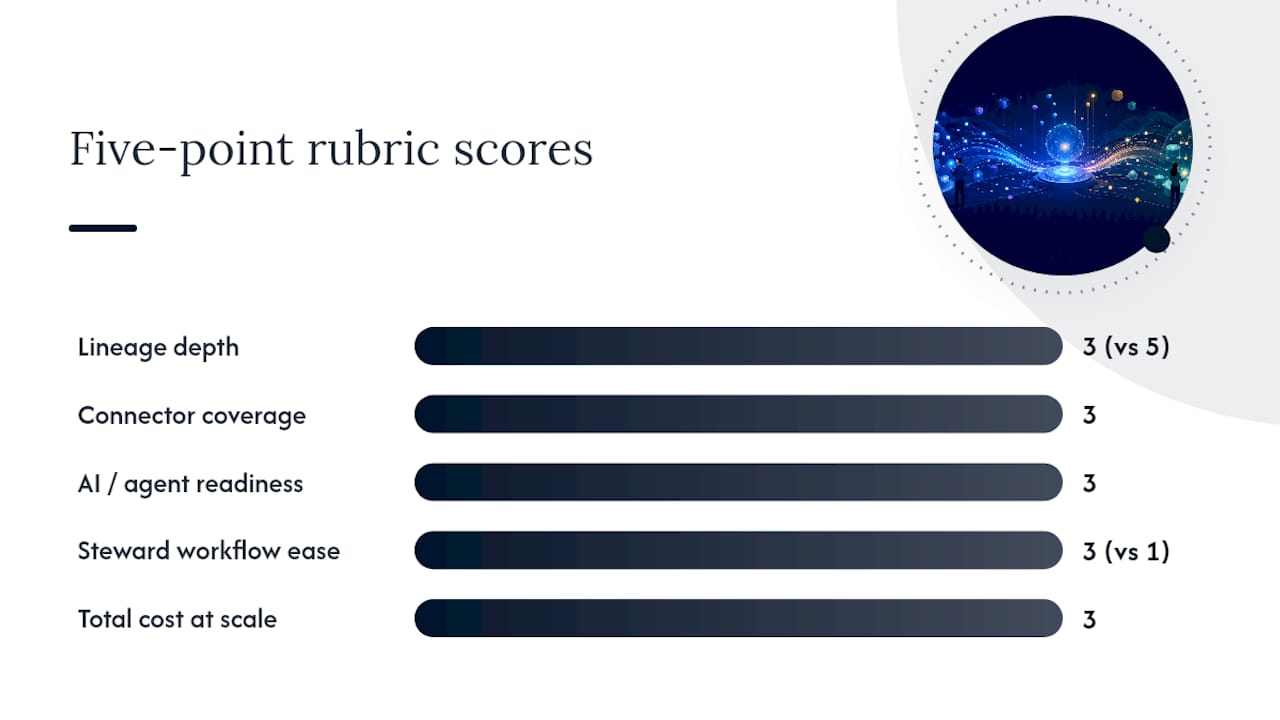
Build a simple scoring rubric before the first demo: rate each vendor 1 to 5 on lineage depth, connector coverage for your specific sources, AI/agent readiness, ease of steward workflows, and total cost at your expected scale. A tool that scores a flat 3 across the board usually beats one that scores a 5 on lineage and a 1 on adoption ease, because nobody uses a catalog they find painful.
How Long Does a Data Catalog Rollout Actually Take?
Roll out in phases, not all at once. Trying to launch discovery, governance, and automation simultaneously is the single fastest way to stall a project before it earns any trust.
- Automated harvesting (weeks 1 to 4). Connect the catalog to your top data sources and let it ingest metadata automatically. Resist the urge to hand-write descriptions for every table yet.
- Glossary and stewarding (weeks 4 to 10). Assign data owners for your highest-traffic tables and start building the business glossary around terms people actually search for, not an exhaustive dictionary nobody reads.
- Policy enforcement (months 2 to 4). Layer in certification workflows, access rules, and PII detection once the glossary has real content behind it.
- Automation and scale (months 4 to 6+). Extend integrations to quality checks, observability tools, and any AI agent workflows that need permissioned access to the catalog's context layer.
Common failure points: skipping ownership assignment (nobody stewards a dataset that has no named owner), over-customizing the tool before anyone has used the defaults, and forgetting to integrate with the quality and access control systems teams already trust. Expect early wins, like faster table discovery, within a few weeks. Full enterprise adoption with governance workflows running smoothly usually takes several months, and it needs data engineering, stewards, and at least one executive sponsor involved from the start.
Why Do AI-Ready Catalogs Matter So Much Right Now?
Catalogs used to serve one audience: humans hunting for the right table. Now they serve a second audience that doesn't ask questions the way people do. An AI agent pulling context to answer a business question needs a permissioned, vetted metadata layer it can query safely, not a wiki page a human might eventually read.
That shift doesn't remove the need for human judgment – healthcare teams benefit particularly from healthcare automation, without the risk to integrate catalogs with clinical workflows. Automation handles the repetitive tagging and enrichment work, but stewards still have to certify what counts as a golden record before an agent treats it as ground truth. When you evaluate vendors, ask for concrete signals of agent readiness: semantic APIs, Model Context Protocol support, verified queries, and permission-aware context delivery, not just a claim that the product is "AI-powered."
Who Should Have Access to What in Your Catalog?
Role design in a catalog matters more than most teams expect going in. Get it wrong and you either lock down so tightly that nobody bothers searching, or open things up so widely that sensitive columns show up in a casual query.
Most catalogs organize access around four roles: stewards who certify datasets and own glossary terms, administrators who manage connectors and system settings, contributors who can tag and enrich metadata but not certify it, and viewers who search and read but can't edit anything. Layer permissions at the asset level, not just the platform level, so a viewer can see that a table exists without seeing every column inside it if some of those columns hold PHI or PII.

The harder problem is AI agents. An agent querying through the catalog's API inherits whatever permission the requesting user has, or it should. A catalog that lets an agent bypass row-level or column-level security to answer a question faster is a compliance incident waiting to happen. When evaluating vendors, confirm explicitly whether agent queries respect the same access rules as a human logging in through the UI, because some early implementations treat the agent as a privileged service account by default.
Get the role model right early. Retrofitting permissions after a catalog is already in daily use means re-training every steward and re-auditing every certification that happened before the fix.
Why Regulated Teams Should Treat Catalogs as Infrastructure, Not Software
In regulated environments like biotech, a catalog isn't a nice-to-have search tool. It's the audit trail that proves which data fed which regulatory submission. Traceability and time-to-submission depend on metadata being right the first time, not cleaned up after an inspector asks a question.
Catalog tooling handles the metadata layer well. What it doesn't do is redesign the surrounding process, which is where operational bottlenecks in regulatory drafting and clinical site activation actually live. If compliance is your primary constraint, procure the catalog for its lineage and certification strength, then evaluate separately whether your broader workflow needs an operational partner to close the gap between "the data is governed" and "the submission moved faster."
— John
Haiphai: The Operational Partner Behind Your Catalog Rollout
A data catalog tells you where your data lives and who owns it. It doesn't rebuild the regulatory drafting workflow, restructure clinical site activation, or shorten the distance between "governed data" and "faster approval." That gap is where most biotech teams lose months they can't get back.
Haiphai works differently than the catalog vendors compared above. Instead of selling software you configure yourself, Haiphai starts from your strategic goal, usually getting to approval faster, and works backward to find exactly where your process stalls, whether that's regulatory drafting, site activation, or the handoffs between clinical and executive teams. Some clients report reclaiming significant operational time on their path to approval, time that translates directly into runway and valuation. Explore how this fits your sector's specific bottlenecks, and book a consultation to map where your own timeline is losing months.
FAQ
What Are the Top Data Catalog Tools to Consider First?
Start with Alation, Collibra, or Atlan for enterprise governance, Databricks Unity Catalog or Google Knowledge Catalog if you're tied to one cloud platform, and DataHub or Apache Atlas if you want an open-source, engineering-led option.
What Are the Top Data Management Tools Besides Catalogs?
Data catalogs work alongside data quality tools like Monte Carlo and Soda Core, governance platforms like OneTrust and BigID, and observability tools like Metaplane and Databand, each covering a different layer of the same data stack.
What Are the Best Data Governance Tools?
Collibra and Alation lead on packaged governance workflows like certification and policy engines, while Apache Atlas and OpenMetadata offer open-source governance primitives for teams that want more control over customization.
How Do Data Catalog Tools Support AI and Agent Workflows?
They expose vetted, permissioned metadata, business glossaries, and verified queries so an AI agent gets accurate context instead of guessing at table meaning, though stewards still need to certify the underlying records as trustworthy.
How Long Does It Take to See Value From a New Catalog?
Early wins like faster table search typically show up within four to six weeks of automated metadata harvesting, while full governance rollout across an enterprise usually takes four to six months.