
Successful change management for AI starts by naming the highest-value AI use cases, assigning accountable owners, and setting explicit go/no-go criteria before a single pilot launches. The single next move: publish a use-case inventory within 30 days, ranked by risk and business impact. Done right, this discipline is what separates the organizations that capture measurable value from AI from the ones stuck running permanent pilots.
TL;DR:
- Prioritize high-impact, low-risk AI use cases and assign clear ownership to prevent resource dilution across multiple pilots.
- Establish go/no-go criteria and document success thresholds before starting pilots to avoid biased success claims after results are known.
- Use maturity and readiness models to ensure infrastructure and governance are prepared before scaling AI models into production.
- Measure adoption through outcome, operational, and governance metrics monthly to catch model drift and usage issues early.
- Conduct a diagnostic assessment of workflows and regulatory constraints to identify bottlenecks and improve time-to-value in AI implementation.
Table of Contents
- Why Change Management Matters for AI
- Core Frameworks Leaders Should Use
- The Roadmap: From Discovery to a Sustained Rollout
- Building AI Fluency Across Your Teams
- Governance and Responsible AI Controls
- Measuring Value: The KPIs That Prove Adoption Worked
- The HaiPhai Practitioner Playbook
- What Actually Separates Leaders From Everyone Else Running Pilots
- Get an Operational Diagnostic Before You Scale Further
- Sources
- FAQ
Why Change Management Matters for AI
Most organizations are not getting a return on their AI spending, and the gap is not a technology problem. It's a change problem. Companies that succeed at AI change leadership see materially higher revenue growth and cost savings than peers who bolt AI onto existing workflows without redesigning them.
By the numbers: Only about one in four organizations has realized real value from AI investment, according to HBR's synthesis of enterprise adoption data. The winners reported significant cost savings and substantially higher revenue growth than their peers.
AI is different from the ERP rollouts and CRM migrations that shaped most change management playbooks. It touches decision rights, not just workflows. A clinician or reviewer who once owned a judgment call now has to decide when to trust a model's output and when to override it. That shift takes longer to land than any software training schedule assumes, and leaders who budget six weeks for it are setting themselves up to fail.
Core Frameworks Leaders Should Use
Three frameworks cover most of what a leadership team actually needs, and each answers a different question.
Lead–Lag–Exit answers "where do we spend?" McKinsey's framework forces executives to sort every AI initiative into one of three buckets: lead (concentrate investment here), lag (monitor, don't fund heavily yet), or exit (kill it, the case isn't there). This matters because AI value concentrates in a handful of use cases. Spreading pilots evenly across a dozen departments dilutes the resources any one of them needs to actually succeed.
Maturity models answer "how ready are we?" EY's seven-layer blueprint ties infrastructure, data, governance, and workforce readiness together, so a team doesn't scale a model onto a data foundation that can't support it. A simpler four-level version (ad hoc, piloting, scaling, embedded) works fine for leaders who want a quick self-assessment rather than a full audit.
ADKAR (Awareness, Desire, Knowledge, Ability, Reinforcement) answers "will people actually change their behavior?" It fits best inside each pilot, not at the portfolio level. Use it to sequence communication, training, and reinforcement for the specific team adopting the tool.
- Lead–Lag–Exit: portfolio-level resource allocation
- Maturity models: readiness diagnosis across infrastructure and governance
- ADKAR: individual and team behavior change within a pilot
The Roadmap: From Discovery to a Sustained Rollout
Adoption succeeds or fails in five stages, and skipping any of them is how organizations end up with a dozen abandoned proofs of concept.
- Discovery. Inventory every candidate AI use case in a shared spreadsheet. Classify each by risk (regulatory exposure, patient or customer safety, financial impact) and by feasibility. Rank by impact, not by which vendor pitched hardest.
- Pilot or proof of concept. Narrow scope to one workflow, one team, one metric. Name a single accountable owner before day one. Define success thresholds in writing, not verbally in a kickoff meeting.
- Validate and decide. Bring finance and governance into the room for a formal go/no-go review. If the pilot didn't hit its pre-set metric, kill it. Don't extend it "for one more quarter" out of sunk-cost sentiment.
- Scale. Fund the winners through portfolio reviews rather than one-off budget requests, and build a reuse library so the second team implementing a similar use case doesn't start from zero.
- Sustain. Monitor for model drift, run periodic audits, and keep a feedback channel open so frontline users can flag when the tool stops matching how the work actually happens.
Frontline behavior routinely diverges from what a vendor's demo assumes, so mapping the real workflow with the people who do the work, before redesigning it, catches mismatches that a slide deck never will.
Pro Tip: Set your go/no-go criteria and kill threshold in writing before the pilot starts, not after you see the results. A team that writes success metrics after the data comes in will always find a way to call the pilot a win.
Building AI Fluency Across Your Teams
Training that stops at a one-hour webinar produces awareness, not fluency. The 70/20/10 model applied to AI means 70% of learning happens through actual hands-on use with real work tasks, 20% through peer coaching, and only 10% through formal instruction. Leaders who flip that ratio, front-loading classroom training, see adoption stall within weeks of the training ending.
- Build role-based practice sessions using each team's actual data and workflows, not generic demos.
- Recruit ambassador and superuser networks inside each department to answer day-to-day questions before they escalate to IT.
- Frame communication around augmentation, not replacement. Reframing AI as a "superpower" rather than a threat measurably reduces the fear that drives quiet resistance and shadow workarounds.
Psychological safety matters here more than most leaders expect. Teams that feel safe admitting "I don't trust this output yet" surface real problems early. Teams that feel judged for hesitation hide their skepticism and simply avoid the tool.
Governance and Responsible AI Controls
Governance built after a pilot launches is governance built too late. Every adoption plan needs these controls in place before go-live, not retrofitted after an incident.
- Classify each use case by risk tier and name an accountable human owner for every high-risk workflow, with explicit human-in-the-loop checkpoints.
- Write acceptable-use policies covering data classification, monitoring cadence, and an incident response playbook before the first real user touches the system.
- Loop in compliance, quality, and legal teams early for regulated workflows. Microsoft's Cloud Adoption Framework recommends embedding governance and data strategy into the same decision sequence used to pick the use case and adoption model, not as a separate downstream step.
- Integrate AI governance into existing change-control processes rather than standing up a parallel approval track that teams learn to route around.
Regulated sectors carry extra weight here. In pharma and biotech, operational controls and human oversight need to be named explicitly in the workflow itself rather than leaving it to a committee to interpret after the fact.
Measuring Value: The KPIs That Prove Adoption Worked
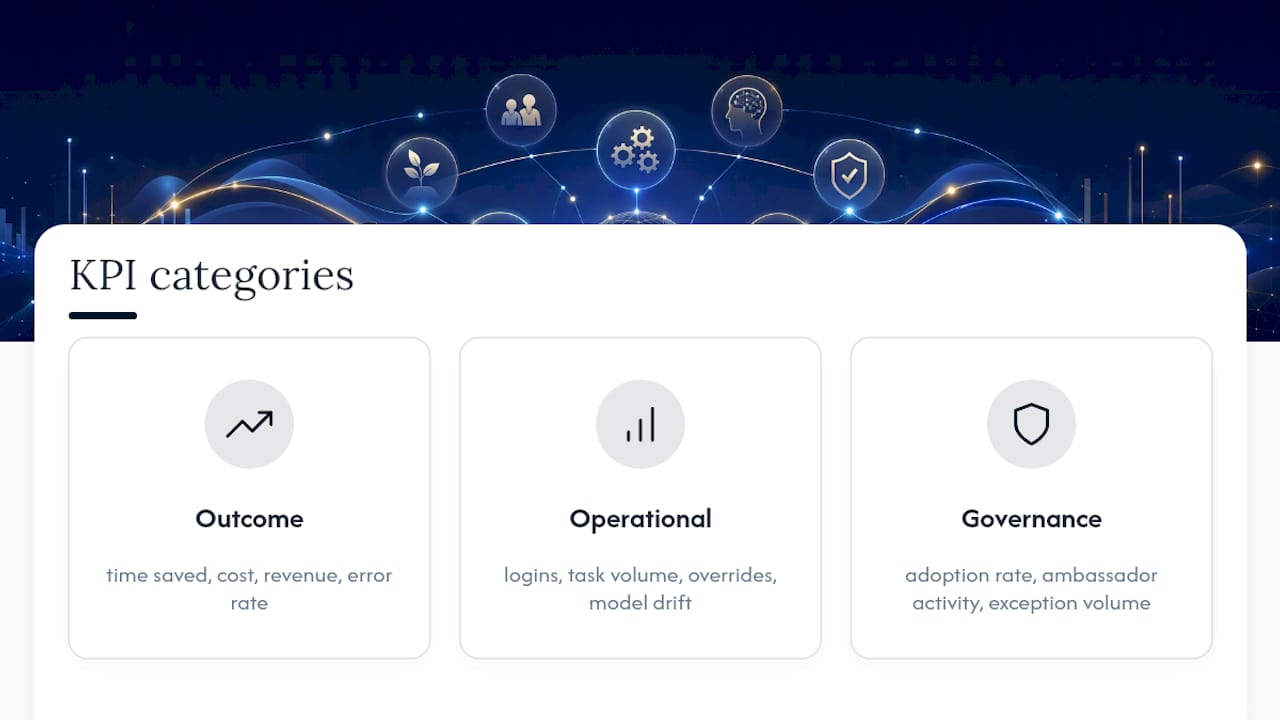
Three metric categories tell leaders whether AI adoption is actually working, and skipping any one of them leaves a blind spot.
Outcome metrics are the ones the board cares about: time saved per task, cost reduction, revenue impact, and error-rate improvement against a documented baseline. Operational metrics show usage in practice: actual login and task volume, override frequency (how often users reject the AI's output), and drift indicators showing model performance degrading over time. Governance and health metrics track adoption rate by team, ambassador network activity, and exception volume.
Organizations that hit strong ROI figures almost always report all three categories monthly, not quarterly. Waiting for a quarterly review to catch a drifting model or a stalled adoption rate means three months of wasted spend before anyone notices.
The HaiPhai Practitioner Playbook
Most of what separates a successful AI rollout from a stalled one isn't the model. It's whether anyone diagnosed the actual bottleneck before building around it. Haiphai's AI Operating Maturity Diagnostic maps a biotech team's current state against the same maturity dimensions covered above: infrastructure, governance, workforce readiness, and workflow design, then identifies where the real friction sits.
That diagnostic work is why an embedded operational partnership can reclaim up to 18 months of operational time on the path to approval for biotech clients, time that matters directly for valuation and funding timelines.
- AI Operating Maturity Diagnostic: a structured assessment of readiness across governance, data, and workforce layers
- Private Executive AI Briefings for leadership teams evaluating where to place their investment bets
- Field notes and case learnings drawn from regulatory drafting and clinical site activation work, available on the Haiphai blog
What Actually Separates Leaders From Everyone Else Running Pilots
The uncomfortable truth is that most AI change failures trace back to a leadership decision, not a technical one. Executives sponsor a dozen pilots, none with a real budget owner, and then wonder why none of them scale. Portfolio discipline isn't optional. If leadership can't say which three use cases matter most this year, no framework will save the rollout.
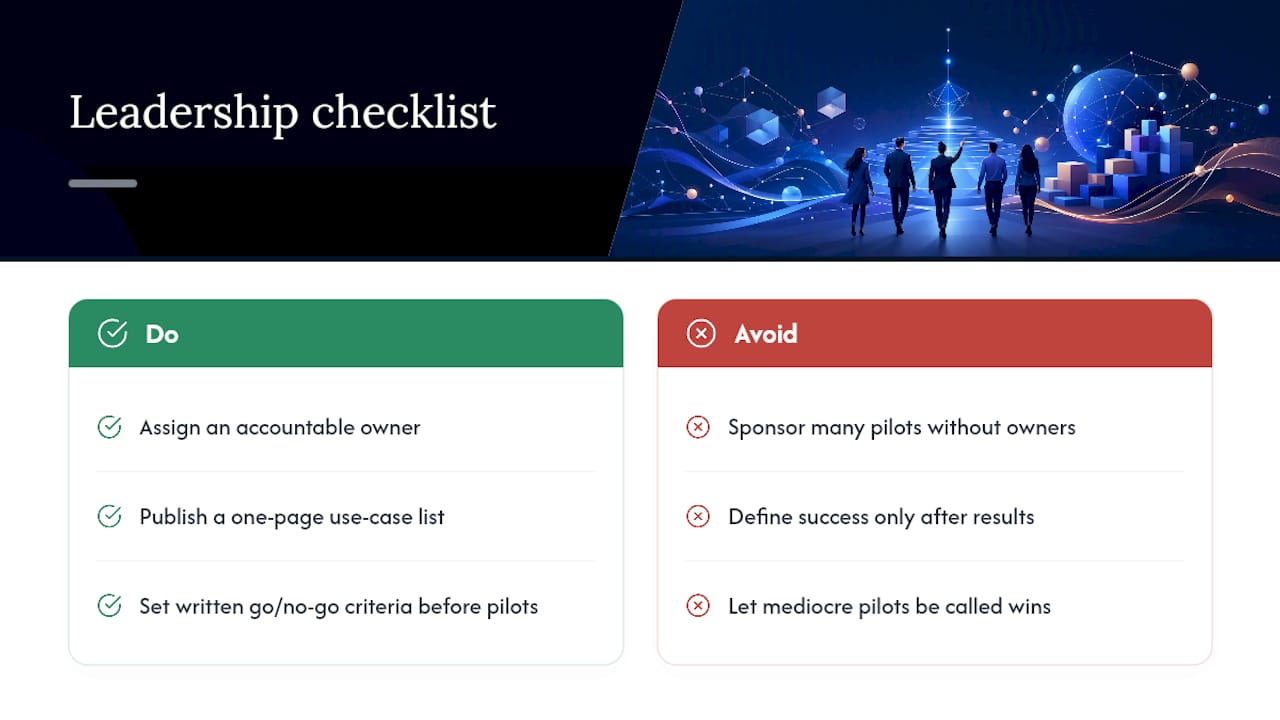
Pilot purgatory happens because teams never write down what "success" or "failure" looks like before they start. By the time results come in, everyone has a motivated reason to call a mediocre pilot a win. Set the threshold in writing, in advance, and hold to it even when the answer is uncomfortable.
Here's the three-item checklist worth acting on this quarter: name the accountable owner for each high-priority use case, publish a one-page use-case inventory the whole leadership team can see, and write your go/no-go criteria before, not after, you see the pilot's results.
— John
Get an Operational Diagnostic Before You Scale Further
HaiPhai offers an operational partnership approach that focuses on mapping actual bottlenecks first, then building AI workflows around regulatory and clinical realities, rather than a generic template.
For biotech and life sciences teams sitting on a stalled pilot or an unclear use-case list, the fastest path forward is a diagnostic, not another vendor demo. Haiphai's AI Operating Maturity Diagnostic maps your workflows against the frameworks covered here, from Lead–Lag–Exit prioritization to governance readiness, and identifies where regulatory drafting or clinical site activation is losing time. Teams managing complex logistics chains alongside AI rollouts can also look at how pharma cold chain operations are integrating AI for a parallel view on prioritizing pilots under operational constraints. Request an AI Operating Maturity Diagnostic or a Private Executive AI Briefing through Haiphai to get a concrete map of where your next 18 months of operational time is sitting.
Sources
- A Guide to Building Change Resilience in the Age of AI
- Reconfiguring work: change management in the age of gen AI
- Microsoft Cloud Adoption Framework: AI strategy
- How to use change management for better AI adoption | TechTarget
FAQ
How is AI used in change management?
AI supports change management both as the subject of the change (the rollout being managed) and as a tool within it, flagging usage drop-off, surfacing override patterns, and helping leaders spot where adoption is stalling before it becomes a formal failure.
What is the 30% rule in AI?
There's no single agreed-upon "30% rule" in AI adoption; the number that comes up most often in enterprise research is the roughly one in four organizations (about 26%) that report realizing measurable value from their AI investment.
What are the 5 P's of change management?
Definitions of the "5 P's" vary by framework and consultancy, so there's no single canonical version; most leaders get more practical value from a structured model like ADKAR or the Lead–Lag–Exit approach covered above.
What jobs will be gone by 2030 due to AI?
Workforce displacement estimates vary widely by industry and role, and no consensus figure exists for job losses. The more useful leadership question is which tasks within existing roles can shift to augmentation, not which jobs disappear outright.
Where should a biotech leader start with AI change management?
Start with a use-case inventory and risk classification, the same discovery step covered in the roadmap above; a structured diagnostic like Haiphai's AI Operating Maturity Diagnostic can shortcut that mapping process for regulated workflows.