
The vendor qualification workflow is a six-step, tiered process that produces an audit-ready qualification file and an Approved Vendor List entry. It runs through defining criteria and risk tiers, requesting documentation, desktop assessment, direct assessment for high-risk vendors, approval onto the AVL, and ongoing monitoring with scheduled requalification. Get this workflow right and you never wonder, mid-audit, why a vendor got approved.
Two rules make or break the process. First, tier every vendor at intake, before you ask for a single document, so you're not over-collecting from a low-risk office supplier or under-vetting a contract manufacturer. Second, log a written rationale for every approval and every waiver. An auditor who wasn't in the room needs to reconstruct your reasoning from the file alone.
- Six stages: define criteria/tiers, collect documents, desktop review, direct assessment (if high-risk), approve to AVL, monitor and requalify
- Outcome: a defensible qualification file plus an AVL entry, not just a "yes" in an email thread
- Operating rule 1: assign a tier before requesting evidence
- Operating rule 2: write the approval or waiver rationale into the record every time
Key Takeaways
A defensible vendor qualification workflow ties tier-based evidence requirements to a documented rationale for every approval, and automates expiry tracking so status never lapses silently.
| Point | Details |
|---|---|
| Tier at intake | Assign risk tier before requesting documents so Tier 1 vendors get full scrutiny and Tier 3 vendors don't get over-processed. |
| Calibrate checklist depth | Use roughly 30 items for Tier 1, a moderate number for Tier 2, and 5 to 6 for Tier 3 vendors. |
| Automate expiry reminders | Set alerts at 60, 30, 14, 7, and 3 days before document expiry to prevent procurement freezes. |
| Document every rationale | Log the reviewer, evidence accepted, and reasoning behind every approval or waiver for audit defense. |
| Treat stale evidence as expired | Flag Tier 1 documents older than 12 months as stale even before the formal review date. |
| Consider an operational partner | Haiphai builds tailored AI-enabled qualification and requalification workflows for biotech teams facing regulatory time pressure. |
Table of Contents
- What Vendor Qualification Actually Means
- How Do You Build a Vendor Qualification Workflow Step by Step?
- How Should You Calibrate Checklist Depth by Risk Tier?
- What Should You Automate First in Vendor Qualification?
- How Often Should You Requalify Vendors?
- Who Owns Each Step of the Qualification Process?
- Why Life-Sciences Teams Need a Tighter Qualification Workflow
- An Editorial Take on Vendor Qualification Workflows
- Get Vendor Qualification Built Into Your Operations, Not Bolted On
- Sources
- FAQ
What Vendor Qualification Actually Means
Vendor qualification is the structured process of verifying that a supplier meets your organization's requirements for quality, financial stability, security, and regulatory compliance before it can be used or purchased from. It's not the same thing as vendor selection, and confusing the two causes real problems.
Selection is the commercial decision: which qualified vendor gets the purchase order, based on price, capacity, or fit. Qualification is the gate that happens before that choice is even on the table, and it's the piece regulators and auditors actually check. Due diligence is a related but narrower term: it typically refers to the evidence-gathering and verification activity inside qualification, not the entire lifecycle including monitoring and requalification.
Why the distinction matters:
- Audit exposure: if you can't produce a documented rationale for why a vendor was approved, an auditor treats that gap as a control failure, not an oversight.
- Operational continuity: an unqualified or expired vendor can trigger a procurement freeze at the worst possible moment, mid-order or mid-production run.
- Regulatory posture: in regulated industries, a documented vendor due diligence checklist isn't optional paperwork; it's evidence your quality system actually functions as designed, a point LexFlag's due diligence guidance makes plainly.
How Do You Build a Vendor Qualification Workflow Step by Step?
Each of the six stages below produces a specific artifact. If a stage doesn't leave a paper trail, it didn't happen as far as an auditor is concerned.
-
Define qualification criteria and risk tiers. Before you contact a single vendor, decide what "qualified" means for your organization and sort vendors into tiers by the risk they carry. A contract manufacturer touching patient safety sits in Tier 1; an office furniture vendor sits in Tier 3. Set gating items per tier, the non-negotiable documents (a valid quality certificate, an active business registration) that block approval outright if missing, per the CASRAI vendor qualification framework.
-
Request and collect documentation. Map required documents to tier. Tier 1 vendors typically supply quality certifications, business registrations, proof of insurance, financial statements, and sometimes a sample or pilot batch for evaluation. Lower tiers need a fraction of that. Standard questionnaires like SIG Lite or CAIQ speed this up considerably, since vendors have usually already filled one out for another customer, which cuts assessment time roughly in half compared to bespoke forms.
-
Run the desktop assessment. This is a documentation review: check certificate validity dates, cross-reference registration numbers, confirm insurance coverage limits match your contract minimums. Set clear acceptance rules in advance (a lapsed certificate is an automatic fail, not a judgment call) so different reviewers reach the same conclusion on the same evidence.
-
Escalate high-risk vendors to direct assessment. A questionnaire is enough for most Tier 2 and Tier 3 vendors. Tier 1 vendors, and any vendor whose desktop review raises a flag, need a virtual or on-site audit. For manufacturing vendors, that often includes reviewing a sample lot against your specification before you commit volume, ensuring adherence to security and compliance controls critical in genomic services.
-
Approve to the AVL. Approval isn't a checkbox. Record who reviewed the file, what evidence was accepted, any open concerns, and the specific reasoning behind the decision. That written rationale is what separates a defensible file from a liability, an insight CASRAI's methodology backs directly.
-
Monitor and requalify. Qualification isn't a one-time event. Set a review cadence by tier and track document expiry dates automatically so nothing lapses silently.
Pro Tip: Build your gating-item list before you touch a vendor questionnaire. Teams that define gating items after they've already started collecting evidence end up retrofitting rules to whatever data they happened to gather, which is how weak vendors slip through.
How Should You Calibrate Checklist Depth by Risk Tier?
Not every vendor deserves the same scrutiny, and treating them identically wastes review capacity on low-risk suppliers while under-checking the ones that could actually hurt you.
Tier 1 covers vendors with direct impact on product quality, patient safety, or regulatory standing: active pharmaceutical ingredient suppliers, contract manufacturers, testing labs. Tier 2 covers vendors with moderate exposure: packaging suppliers, logistics partners handling regulated materials. Tier 3 covers low-risk vendors: office supplies, non-critical software, catering.
Tier 1 vendors typically go through a full 30-item due diligence checklist spanning six categories: identity, financial, security, privacy, compliance, and contract terms. Tier 2 usually collapses that to a moderate number of items, dropping the categories least relevant to moderate-risk suppliers. Tier 3 can run on 5 to 6 items, often just business registration, basic insurance, and a signed code of conduct.
A practical checklist template covers:
- Identity and legal standing: business registration, ownership structure, sanctions screening
- Financial health: recent financial statements, credit checks, payment history
- Security and compliance: quality certifications (ISO 9001, ISO 13485 for medical device suppliers), SOC 2 reports where data handling is involved
- Insurance and liability: coverage limits matching contract requirements
- Operational capability: sample or pilot evaluation for manufacturing and lab vendors
Every waived item needs its own documentation: which item, why it was waived, who approved it, and the accepted residual risk. Set exactly one gating item per tier that cannot be waived under any circumstance. For Tier 1, that's usually the core quality certification.
What Should You Automate First in Vendor Qualification?
Automation doesn't replace judgment in this workflow. It removes the manual busywork so your team spends its time on the decisions that actually need a human.
Start with portal-based intake instead of email chains. A branded self-service portal where vendors upload documents directly cuts intake time from weeks to hours, and it eliminates the "did you get my email" back-and-forth that eats a coordinator's week. Pair that with AI document extraction, which pulls certificate numbers and expiry dates automatically instead of someone retyping them, and with automated sanctions screening (OFAC checks run instantly rather than as a separate manual step).
Expiry tracking deserves its own automated cadence. Set reminders at 60, 30, 14, 7, and 3 days before any document expires. That staggered schedule gives a vendor enough runway to renew a certification without your procurement process stalling the day it lapses.
- Automate first: portal intake, AI extraction, sanctions screening, expiry reminders
- Reminder cadence: 60, 30, 14, 7, 3 days before expiry
- Integration targets: push approved vendor data directly into SAP, Oracle, or NetSuite on final approval to kill re-keying errors
Pro Tip: Automation still needs a human exception path. If a vendor's document fails automated validation, route it to a reviewer rather than letting the system silently reject it, and log every exception the same way you log approvals.
How Often Should You Requalify Vendors?
Requalification cadence should match risk tier, not a single company-wide calendar. Tier 1 vendors typically need annual review at minimum, sometimes more often if they're tied to a specific product batch or regulatory filing. Tier 2 vendors can often run on an 18 to 24 month cycle. Tier 3 vendors might only need a light-touch check every two to three years.

Treat any Tier 1 evidence older than 12 months as stale by default, even if the formal review cycle hasn't come up yet. A quality certificate that technically hasn't expired but is 14 months old, with no monitoring in between, is a blind spot most audits will catch.
Certain events should trigger immediate off-cycle requalification regardless of schedule:
- A quality or safety incident tied to that vendor's product or service
- A change in ownership, facility location, or manufacturing site
- A lapsed or downgraded certification
- A sanctions list hit or adverse media finding
Every monitoring output, good or bad, should feed back into the risk register and update the AVL entry directly. A vendor's status is only as current as your last data push.
Who Owns Each Step of the Qualification Process?
A qualification coordinator should own the day-to-day workflow: intake, tracking, and chasing documentation. That's a distinct role from the approver, who signs off on the final decision and carries the authority to accept residual risk. Quality or compliance leadership typically holds oversight of the tiering criteria itself and audits the process periodically.
The qualification file needs to contain, at minimum: the evidence collected, the reviewer's written rationale, any issues identified during review, and the signature or system record of who approved the decision. This is what an insurance and quality proof standard for vendor records typically looks like when it's built to survive an audit.
- Gating items: documented per tier, with no exceptions without a logged waiver
- Waiver register: single source of truth for every accepted risk, with an approver name attached
- SLA target: internal turnaround from document submission to desktop review decision, commonly 3 to 5 business days for standard tiers
Why Life-Sciences Teams Need a Tighter Qualification Workflow
Biotech procurement carries a constraint most industries don't face: an expired qualification status can automatically freeze purchasing, sometimes mid-trial, right when a clinical site or manufacturing run can't afford a pause.
Haiphai's approach to this starts from the operational goal, not the software. We map where a client's workflow actually stalls, whether that's a documentation bottleneck at desktop review or a requalification gap nobody caught, and build tailored automation around that specific choke point rather than deploying a generic system. For regulated teams, that often means treating any Tier 1 document older than 12 months as stale by default, exactly the discipline CASRAI's framework recommends for regulated and laboratory settings.
A qualification workflow that isn't automated for expiry tracking isn't a paperwork gap in biotech. It's a live risk to your trial timeline, and it behaves like one the day a certificate lapses without anyone noticing.
An Editorial Take on Vendor Qualification Workflows
Most vendor qualification advice treats every vendor the same way, running everyone through a heavy questionnaire regardless of actual risk. That's not caution; it's wasted effort that slows down low-risk onboarding while giving high-risk vendors no more scrutiny than a stationery supplier gets. Tiering at intake, with real item-count differences between tiers, is the part most guides gesture at without committing to numbers.
The bigger blind spot is requalification. Companies build airtight intake processes and then let approvals go stale for years because nobody owns the calendar. A Tier 1 vendor qualified 18 months ago with no monitoring in between isn't qualified anymore, whatever the file says. If you take one thing from this workflow, make it the automated expiry reminder, because that single control catches the failure mode that actually causes procurement freezes and audit findings, more than any amount of upfront documentation ever will.
Prioritize the gating-item rule next. Decide, in writing, exactly what disqualifies a vendor before you start reviewing files, not while you're staring at an incomplete one.
Get Vendor Qualification Built Into Your Operations, Not Bolted On
A tiered checklist and an automated reminder cadence solve the mechanics of vendor qualification. What they don't solve is a workflow that was never designed around your actual bottleneck in the first place, which is the gap Haiphai closes for biotech and life-sciences teams.
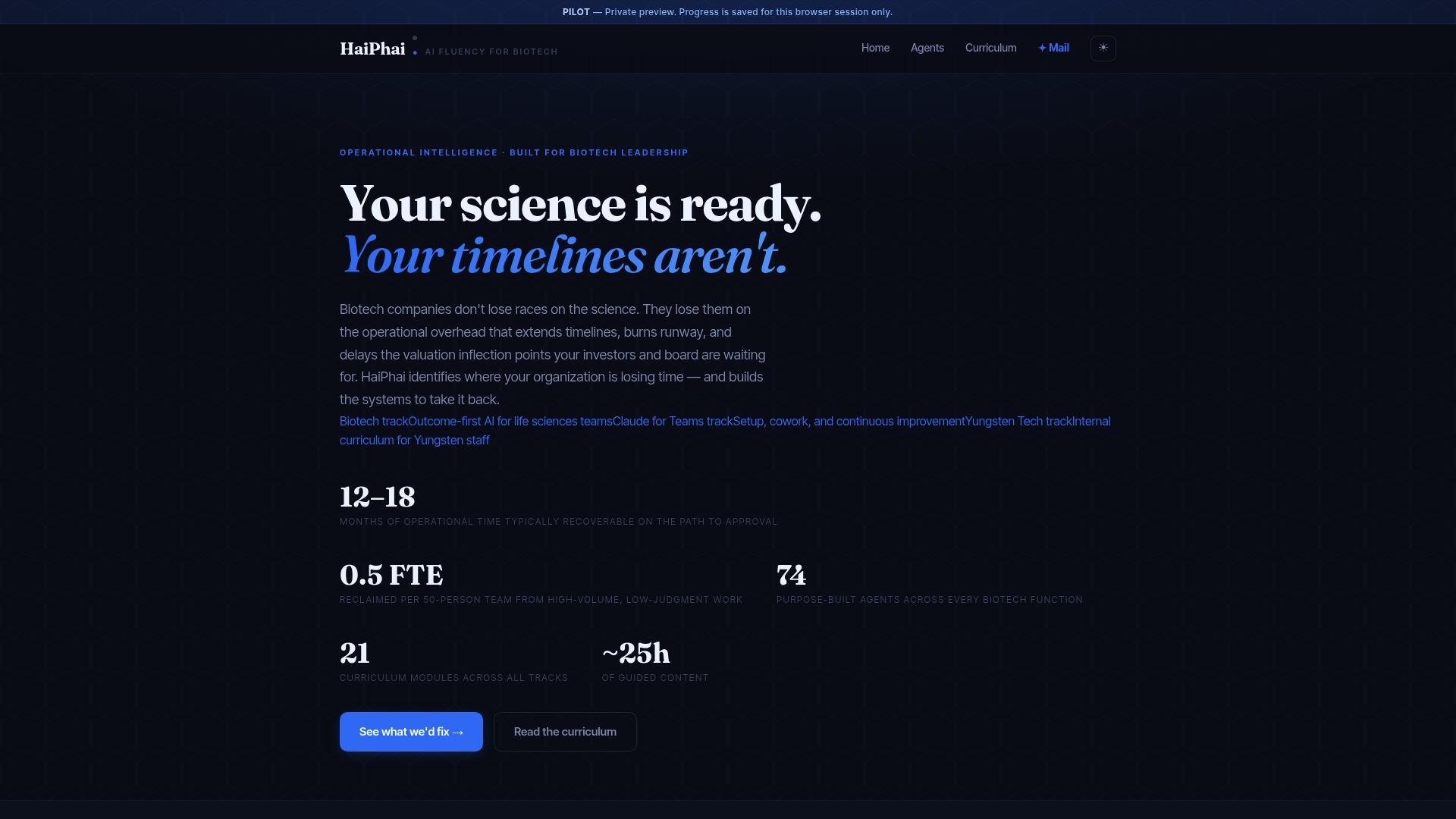
Haiphai works as an embedded operational partner, starting from your regulatory and clinical goals and tracing backward to find where qualification, documentation, or site activation processes are actually costing you time. Rather than deploying an off-the-shelf platform, we design AI-enabled workflows around your existing team and systems, including sanctions screening, expiry tracking, and audit-ready recordkeeping tailored to your regulatory profile. Clients working with Haiphai have reclaimed up to 18 months of operational time on their path to approval, time that matters directly for valuation and funding timelines. If a stalled or manual qualification process is part of what's slowing your team down, visit Haiphai's sectors page to see how this applies to your specific operational context and start a conversation about what a tailored workflow would look like for your organization.
Sources
These sources informed the workflow, tiering, and automation guidance above:
- Vendor Qualification Process: Steps, Standards, and a Checklist
- AI evidence validation for upload test (Secureframe support article)
- Vendor Due Diligence Checklist (Free Template)
- Vendor Due Diligence Checklist for Onboarding | LexFlag Blog
FAQ
What are the steps in the vendor qualification process?
The six steps are defining qualification criteria and risk tiers, requesting and collecting documentation, running a desktop assessment, escalating high-risk vendors to direct assessment, approving the vendor to the Approved Vendor List, and ongoing monitoring with scheduled requalification.
What do FDA guidelines expect from a vendor qualification program?
Regulated industries are expected to maintain a documented, repeatable vendor qualification program with retained evidence and audit trails, rather than informal or one-time vendor checks, since regulators treat documented programs as required evidence of a functioning quality system.
What are the key supplier evaluation criteria?
Common criteria include quality certifications, financial stability, security and compliance posture, insurance coverage, and operational capability, evaluated through sample or pilot testing where applicable.
How many items should a Tier 1 vendor checklist include?
Tier 1 vendors, those with the highest risk exposure, typically go through a full 30-item checklist covering identity, financial, security, privacy, compliance, and contract categories.
How can a biotech company keep vendor qualification from delaying its timeline?
Automating expiry reminders and treating any qualification evidence older than 12 months as stale prevents the silent lapses that freeze procurement, and firms like Haiphai build this automation directly into a client's existing regulatory and clinical workflows.