
A GxP compliant QMS must deliver a validated system with documented IQ/OQ/PQ, tamper-evident audit trails, 21 CFR Part 11 controls including electronic signatures, role-based access, and functioning document control, CAPA and training management. Validation is a lifecycle, not a checkbox. Even a "pre-validated" vendor platform still needs customer-specific computer system validation for how you actually configured and use it.
TL;DR:
- Using a GxP-certified QMS requires thorough validation, including customer-specific IQ, OQ, and PQ, even when vendors claim pre-validation.
- Proper audit trails, electronic signatures, role-based access, and version-controlled document management are essential for passing FDA inspections.
- Validation efforts must be risk-based, focusing on high-impact workflows like batch release and CAPA, with verified ALCOA+ data integrity.
- Vendor qualification, change management, and robust integration testing are crucial to prevent silent data discrepancies and revalidation gaps.
- Embedding experienced quality and regulatory experts early can streamline validation and prevent common mistakes like incomplete customer-specific validation.
Table of Contents
- What GxP Means and Why the QMS Is the Compliance Vehicle
- The Technical Features a GxP Compliant QMS Must Actually Have
- Configuring and Validating a GxP QMS: The Operational Checklist
- Build, Buy, or Hybrid: Picking the Right Path for Your Phase
- What an Embedded Operational Partner Adds to a GxP QMS Rollout
- Where GxP QMS Projects Actually Go Wrong
- Getting Your GxP QMS Validated Without the 18-Month Detour
- Sources
- FAQ
What GxP Means and Why the QMS Is the Compliance Vehicle
GxP is shorthand for "good practice" regulations covering how life sciences companies manufacture, test, and study products. The main domains are Good Manufacturing Practice (GMP), Good Laboratory Practice (GLP), and Good Clinical Practice (GCP), all shaped by FDA cGMP regulations and reinforced globally by WHO GMP guidance. Your quality management system is where these rules become daily operating reality. A functioning QMS covers:
- Document control for SOPs, specifications, and controlled records
- CAPA and deviation management
- Change control across systems and processes
- Training records tied to job function
- Supplier and vendor qualification
- Internal and external audit management
FDA inspectors and other regulators treat QMS records as primary audit evidence, not supporting documentation. If your CAPA log, training matrix, or audit trail can't reconstruct exactly what happened and who approved it, the underlying quality event doesn't hold up during inspection, regardless of how sound your science is.
The Technical Features a GxP Compliant QMS Must Actually Have
Software vendors love the word "compliant" on a landing page. Auditors don't care about the word. They care about artifacts. Here's the checklist that separates a system that survives an FDA inspection from one that only looks good in a sales demo.
- Validated system with CSV deliverables. You need a User Requirements Specification (URS), Installation Qualification (IQ), Operational Qualification (OQ), and Performance Qualification (PQ), built on a risk-based validation plan, not a generic template stamped with your logo.
- Tamper-evident audit trails. Every create, edit, and delete on a regulated record needs an immutable, time-stamped log that maps directly back to that record.
- Electronic signatures aligned to Part 11. Where you're relying on e-records instead of wet-ink signatures, the system needs controls consistent with 21 CFR Part 11, including signature manifestations and linkage to the signed record.
- Role-based access and user lifecycle management. Access gets provisioned, reviewed, and revoked on a schedule, not left open because someone left the company eight months ago.
- Document management with real version control. Approvals, controlled distribution, and superseded-version tracking, not shared drive folders labeled "final_v3_actualfinal."
- Training management linked to SOPs. Training records need to tie directly to the specific document version an employee was trained on, with evidence of competence, not just a completion checkbox.
- CAPA and deviation handling with traceability. Root cause, corrective action, and effectiveness checks all need to link back to the originating deviation.
- Supplier and vendor qualification records. Quality agreements and qualification files live inside the QMS, not in someone's inbox.
- Inspection-ready reporting. You should be able to export an audit pack, dashboard view, or evidence bundle on demand, not build one from scratch when an inspector shows up.
Pro Tip: Ask any vendor claiming "pre-validated" software for their generic validation package, then ask a second question: who performs the customer-specific IQ/OQ/PQ for your configuration? If the answer is "you don't need to," that's a red flag, not a shortcut.
Configuring and Validating a GxP QMS: The Operational Checklist
Buying software and validating it for GxP use are two different projects. Here's the sequence QA teams should follow, mapped against Part 11, cGMP, and ALCOA+ expectations.
- Write a scoped URS. Tie every requirement to intended use and the specific regulated records your system will hold, not a generic feature wish list.
- Build a risk-based CSV plan. Higher-risk workflows (batch release, CAPA closure) get deeper test coverage than low-risk administrative functions, an approach consistent with the risk-based validation direction FDA guidance increasingly emphasizes.
- Run IQ, OQ, and PQ with representative test cases. Test the workflows your team will actually use, not a sanitized demo path.
- Verify ALCOA+ in practice, not just in policy. Check that timestamps, audit trail completeness, and edit history genuinely capture who did what and when across every regulated workflow.
- Configure access control and password policies. Set periodic access reviews on a calendar, not "whenever someone remembers."
- Document backup, retention, and export procedures. You need to prove you can reconstruct any record years later, in a format an inspector can actually read.
- Test every integration. LIMS, ERP, and clinical system connections all need data integrity checks confirming nothing gets dropped, duplicated, or silently altered in transit.
- Establish change-control triggers. Define upfront what kind of system patch or configuration change requires revalidation, and what doesn't.
None of this is optional busywork. Computer system validation is a lifecycle process, which means a vendor's pre-validated claim covers their base platform, not your specific configuration, your workflows, or your intended use. That gap is exactly where inspection findings tend to originate.
Build, Buy, or Hybrid: Picking the Right Path for Your Phase
Speed matters most for early-stage biotech and diagnostics companies. Buying a commercial QMS with pre-built validation artifacts gets you operational in weeks, and reputable vendors now ship pre-configured validation packages and templates that shrink the CSV workload considerably. Building your own system makes sense only when you have workflows so specific, or intellectual property concerns so significant, that no commercial platform fits. Expect a heavier and ongoing validation and maintenance burden if you go that route.
A hybrid, staged approach often wins for growing teams: start with a "QMS-in-a-box" configuration, then migrate to custom workflows as your process maturity increases. Rough timelines to plan around:
- Vendor pre-configured deployment: a few weeks to about 90 days
- Internal build from scratch: 6 to 18 months
Whatever path you choose, get these items in writing before you sign a contract:
- The full validation package the vendor provides, and exactly what's left for you to validate
- SOC or security attestations, since an AICPA SOC report is the standard independent signal for a vendor's control environment
- Change-management SLAs defining how patches and updates get communicated and tested
- Support terms that specify response times for compliance-critical issues, not just general help desk tickets
A detailed comparison of QMS options for contract manufacturing is worth reviewing if you're weighing vendor tradeoffs in a regulated manufacturing context.
What an Embedded Operational Partner Adds to a GxP QMS Rollout
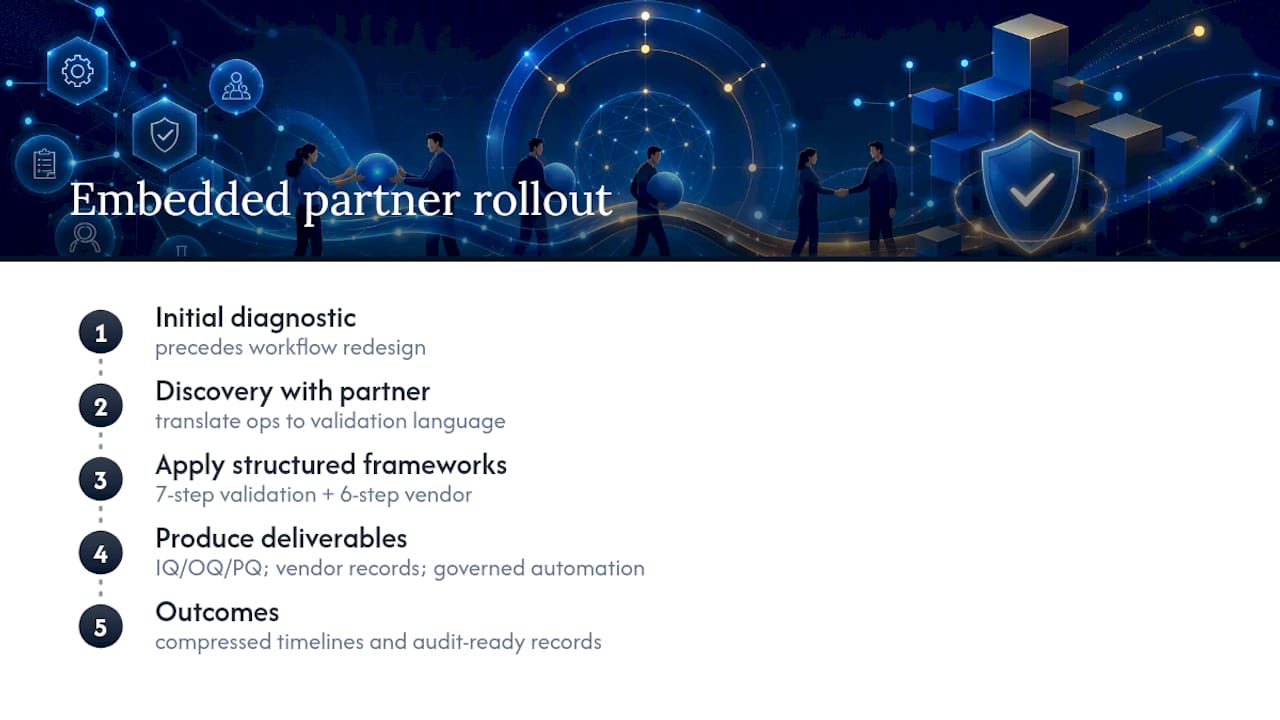
The bottleneck in most GxP QMS projects isn't the software. It's the discovery work: figuring out which workflows the URS actually needs to cover, and translating operational reality into validation language auditors accept. Embedding senior quality and regulatory expertise directly into that discovery phase compresses timelines that otherwise stretch for months of back-and-forth between IT, QA, and outside consultants.
Haiphai applies structured frameworks to this exact problem, including a 7 Step GxP Validation Lifecycle for AI and QA teams and a Six-Step Vendor Qualification Workflow for assessing suppliers. The outcomes are checkable: documented IQ/OQ/PQ packages, vendor qualification records ready for audit, and governed automation replacing manual, error-prone steps. Teams considering this kind of partnership should expect an initial diagnostic phase before any workflow redesign begins.
Where GxP QMS Projects Actually Go Wrong
The failure pattern I see most often isn't a missing feature. It's a false sense of completeness. Teams buy a "GxP-ready" platform, assume the vendor's base validation covers their use case, and skip customer-specific IQ/OQ/PQ entirely. That's the single most common inspection finding waiting to happen.
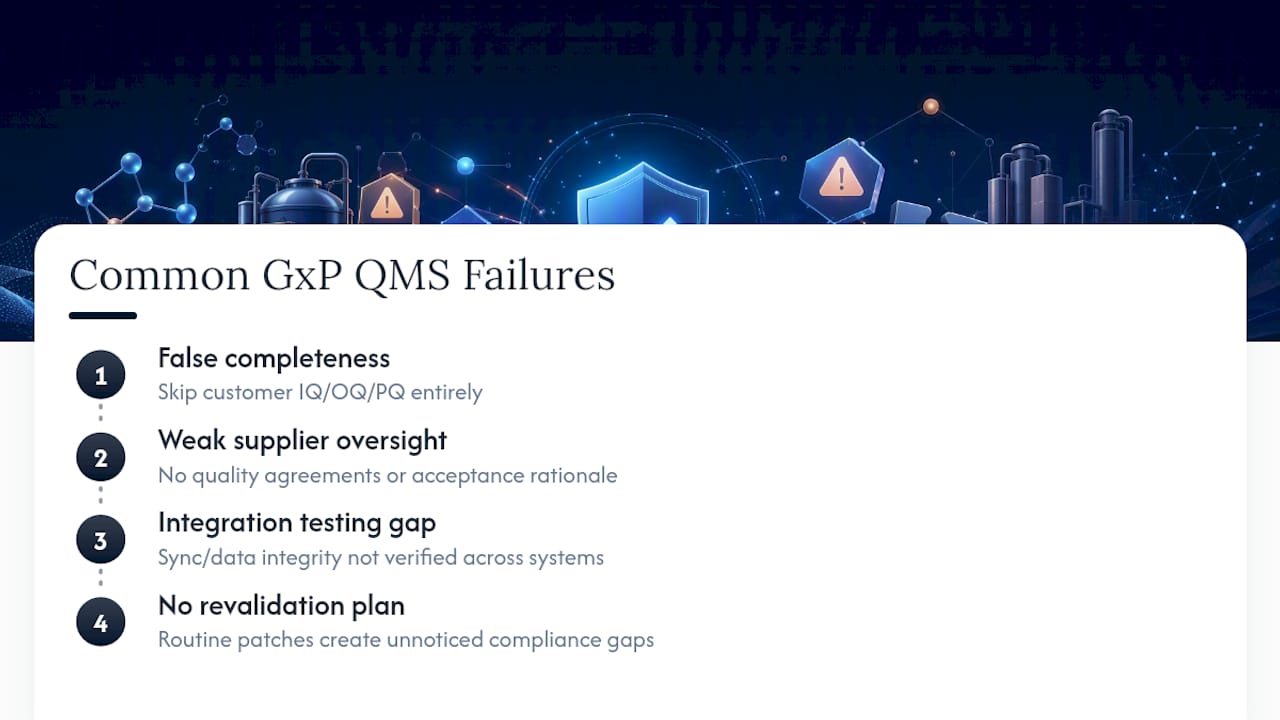
Second most common: weak supplier oversight, no quality agreements on file, no documented rationale for why a vendor was deemed acceptable. Third: integration testing that never checks whether data moving between LIMS, ERP, and the QMS stays intact, so records look clean until someone traces a discrepancy back to a silent sync failure. Fourth, and quietest: no documented revalidation plan, so a routine patch six months later triggers a compliance gap nobody notices until an inspector asks for it.
None of these are exotic problems. They're what happens when "compliant" gets treated as a label instead of a lifecycle.
— John
Getting Your GxP QMS Validated Without the 18-Month Detour
Most biotech teams don't lack the knowledge to build a compliant QMS. They lack the bandwidth to do discovery, validation, and vendor qualification simultaneously while also running clinical operations. Haiphai works as an embedded operating partner rather than another software vendor, starting with an AI Velocity Diagnostic that maps where your current workflows create validation risk or timeline drag before any redesign work begins.
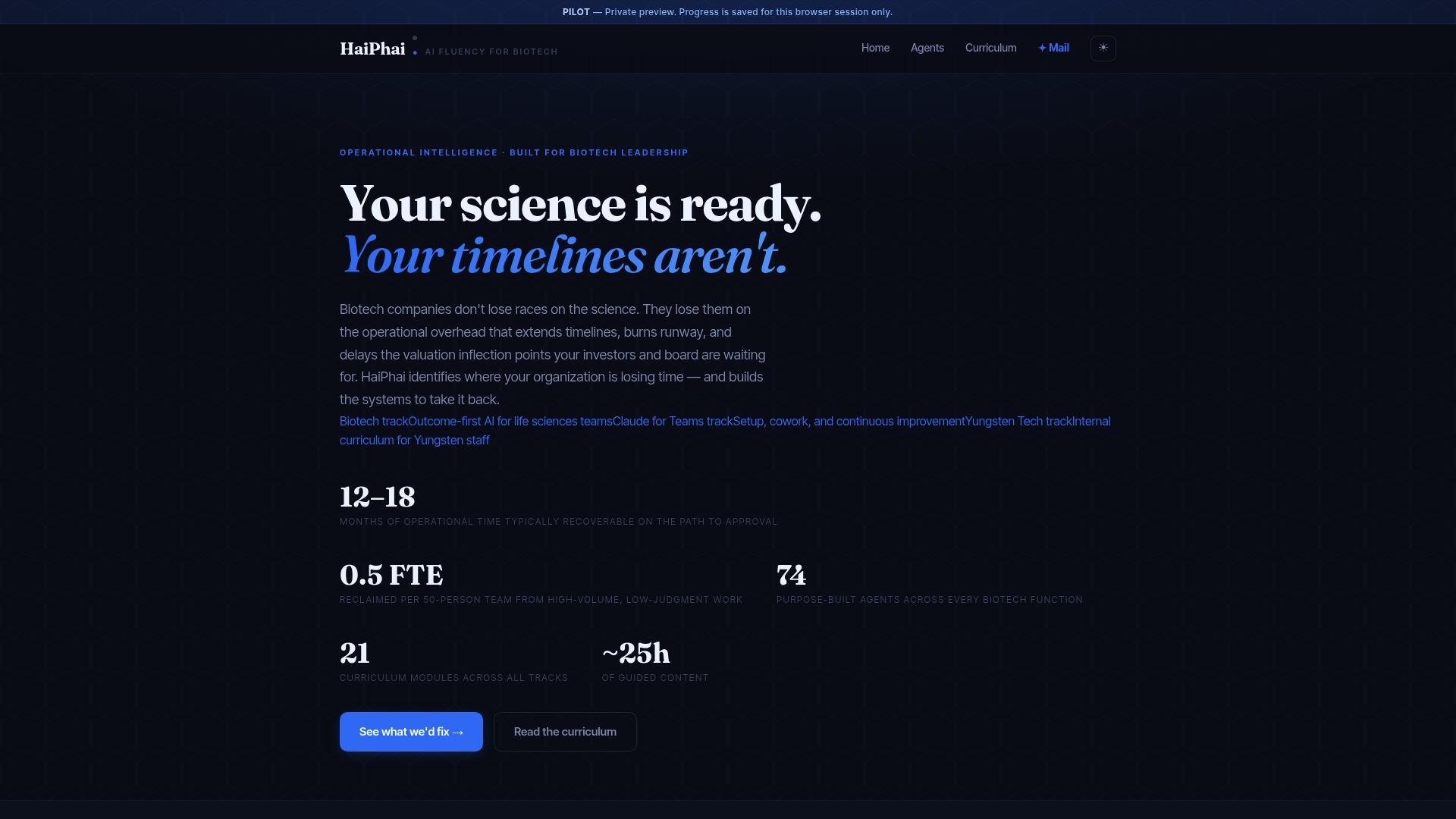
From there, the operating partnership applies the same validation lifecycle and vendor qualification frameworks referenced throughout this guide, tailored to your specific systems, integrations, and regulatory scope, rather than a generic template. Some clients have reclaimed operational time on their path to approval, time that matters directly for funding milestones and valuation. If you're evaluating a QMS rollout, a validation backlog, or a vendor qualification project that's stalled, review the solutions built for clinical, regulatory, and quality operations and start with a diagnostic conversation.
Sources
- Electronic Records; Electronic Signatures (21 CFR Part 11) — eCFR
- Current Good Manufacturing Practice (cGMP) regulations — FDA
- WHO good manufacturing practices (GMP)
- AICPA SOC reports — AICPA
FAQ
What Does GxP Compliance Mean?
GxP compliance means your operations, records, and systems meet "good practice" regulations covering manufacturing (GMP), lab testing (GLP), and clinical research (GCP), enforced through FDA regulations and mirrored in WHO guidance. In practice, it means your QMS can produce documented, traceable evidence for every quality decision.
What Is a QMS in a Pharmaceutical Company?
A QMS in a pharmaceutical company is the system, procedures, and records that govern document control, CAPA, training, change control, and supplier qualification across manufacturing and quality operations. It's the operational backbone regulators inspect to confirm consistent, controlled processes.
What Are the Five Ps of GxP Compliance?
Definitions of the "five Ps" vary by organization and training program, and there's no single regulator-issued version. Some frameworks reference elements like people, processes, procedures, premises, and products, but treat this as informal shorthand rather than a formal FDA or WHO standard.
Does a GxP System Need to Be Validated?
Yes. Any computerized system used to create, modify, or store GxP records needs documented validation, including IQ, OQ, and PQ tied to your specific configuration and intended use. This holds true even for vendor platforms marketed as pre-validated, since validation is a lifecycle process specific to how you actually use the system, not a one-time vendor certification.