
Labeling automation in pharma means moving the repeatable work in the label lifecycle out of email, Word files and spreadsheets and into governed, validated workflows. That covers drafting, comparison, review routing, change control, structured submission files, and variable data and serialization at print time. In the U.S., the automation has to sit inside FDA rules for labeling content, good manufacturing practice and drug supply chain security. This guide shows what can be automated, what the rules require, and how to sequence the work so it holds up in an inspection.
TL;DR
- Automate the whole label lifecycle, not just printing: content drafting, text comparison, review routing, change control, SPL files and serialized print data.
- FDA expects SPL (XML) for listing submissions, and 21 CFR 211.122 and 211.130 require written, controlled procedures for labeling operations. Automation must preserve those controls.
- DSCSA made package-level serialization a standing requirement for manufacturers and repackagers. Print and encoding systems must stay accurate and tied to your serial data.
- Validate before you rely on it: document user permissions, electronic signatures and audit trails under 21 CFR Part 11.
- Start with the bottleneck that costs the most calendar time, usually change control and cross-functional review, then extend to print.
Table of Contents
- What pharmaceutical labeling automation includes
- The U.S. rules your automation has to respect
- Automating drafting, review and change control
- Serialization and on-demand printing
- Validate it before you rely on it
- What results to expect, and how to measure them
- Our perspective: fix the process before you buy the tool
- Where HaiPhai fits
- FAQ
- Sources
What pharmaceutical labeling automation includes
Most search results for this topic describe printers, label software and pharmacy dispensing equipment. Those cover the last meter of the process. In a drug or biologic company the label lifecycle is longer, and the delay usually sits upstream:
- Content authoring and comparison. Drafting a new label or a revision, and comparing it against the approved version section by section.
- Review and approval. Routing to regulatory, clinical, safety, quality and legal, with tracked decisions.
- Change control. Deciding what a change is, which filing pathway it needs, and which markets or SKUs it touches.
- Submission formatting. Producing structured files the agency can process.
- Artwork and print. Pulling approved text and variable data into templates, then printing and inspecting.
- Records. Capturing who did what, when, with which version.
The FDA has long said that Structured Product Labeling allows automated comparison of text by section and of specific drug data elements, which makes exchanging labeling changes easier than with PDF. That is the regulatory logic behind automating the front half of the lifecycle: structured content can be compared, routed and reused by machines.
The U.S. rules your automation has to respect
Automation does not change what you must prove. It changes how consistently you prove it.
FDA labeling submissions and filing pathways
FDA requires drug registration and listing submissions in SPL format using XML files that pass its validation rules. Those rules include syntax and format checks and cross-field validation, so a workflow that checks data consistency before submission catches problems an agency validator would otherwise raise.
Changes to a package label, container label, package insert, Medication Guide or directions for use need a Prior Approval Supplement, a Changes Being Effected supplement, or final printed labeling in an annual report, depending on the change. A good automated change-control workflow asks the pathway question early and records the answer, instead of leaving it to whoever happens to open the ticket.
GMP controls on labeling and packaging
The CFR is specific about labeling operations. 21 CFR 211.122 requires written procedures for receiving, identifying, storing, handling, sampling, examining and testing labeling materials. Labels for each different product, strength, dosage form or quantity must be stored separately with suitable identification, and access must be limited to authorized personnel. For cut labeling, a 2012 final rule added that any automated technique that physically prevents incorrect labeling from being processed can serve as a special control procedure. FDA itself recognizes automation as a legitimate control here.
Section 211.130 adds written procedures to make sure the correct labels are used, with controls against mix-ups such as line clearance, identification of unlabeled containers and reconciliation of label quantities. A pre-approval labeling operations checklist summarizes the practical consequence: validated procedures for every step, from label stock printing to line application, with the checks logged in production records.

Electronic records and signatures
If the workflow replaces paper with electronic records, 21 CFR Part 11 applies. In labeling system validation, that means establishing user permissions and applying electronic signatures to labels throughout their lifecycle. Audit trails are the backbone of this. Our guide to audit trail requirements under FDA rules walks through mapping predicate rules to the records you must keep.
DSCSA serialization
Under the Drug Supply Chain Security Act, every prescription drug package carries a unique product identifier: NDC, serial number, lot number and expiration date in a 2D DataMatrix barcode. Manufacturers and repackagers have been fully subject to these rules since May 27, 2025. The same source notes that transaction records must be kept at least six years, and that printing and encoding equipment must be accurate, consistent and integrated with the back-end systems that manage serial data.

Trading partners also exchange Transaction Information, Transaction History and Transaction Statement each time ownership changes, using the EPCIS standard. For a labeling team, the takeaway is practical: the serial number on the pack is only as trustworthy as the data pipeline behind it.
Automating drafting, review and change control
This is where most teams lose weeks, and where automation pays back first. A workable sequence:
- Map the real flow. Trace one recent label change from trigger to approval. Note every handoff, every wait and every rework loop. The delay is rarely in the drafting; it is in the waiting.
- Structure the source content. Keep approved label text as controlled, sectioned content rather than as pages in a document. This is what makes comparison and reuse possible.
- Automate comparison and impact assessment. Compare a proposed revision with the approved text by section, then flag which markets, SKUs and artwork files are affected.
- Route review by rule. Send each section to the owners who must see it, with deadlines and escalation, and record decisions in one place.
- Decide the filing pathway at intake. Tie the change type to the supplement category so regulatory affairs sees it on day one.
- Generate the submission file and run pre-checks. Validate SPL against the published rules before anything goes to the agency.
- Release to artwork and print only after approval. Let the approved version drive downstream templates, never a copy of it.
Change control deserves its own discipline. We cover it in a seven-stage SOP change control model mapped to ICH Q9 and Q10, and the same logic applies when a label change is the trigger. If your labeling changes lead to agency questions, the workflow in our piece on response letter automation for eCTD and ESG shows how to keep that loop controlled too.
Serialization and on-demand printing
Once text is approved, the print side is about variable data. Modern systems pull lot, expiry and serial numbers from validated ERP, PLM and serialization systems at print time, rather than from hand-edited files. A documented example from a global drug manufacturer collapsed thousands of label files into 60 templates while keeping an audit trail and Part 11 electronic signatures. A biotech factory case reported going from 12,000 Word documents to 50 templates, with labeling errors falling from 10 to 15 a month to zero. Those are vendor-reported results for specific sites, so treat them as a sense of scale, not a forecast.
When you design the print layer, plan for:
- Master data integrity. Serial and lot data should flow from one system of record.
- In-line inspection. Vision checks should confirm label presence, print quality and the DataMatrix code before a unit moves on.
- Batch reporting. Error reports, serial number status and an audit trail report should be generated automatically.
- Fit with existing lines. Choose approaches that connect to your current packaging equipment instead of forcing line changes.
On-demand digital printing also changes the economics of short runs. Digital approaches enable just-in-time printing, shorter runs and lower inventory, and that report notes large quantities still cost less with traditional technologies. The article is from 2009, so use it for the principle and get current numbers for your volumes.
Validate it before you rely on it
An automated labeling system is a GxP system. The common approach is IQ, OQ and PQ: define and test the system's features and processes, then document a pass status to show compliance with DSCSA, 21 CFR Part 11 and UDI requirements.
A practical validation checklist:
| Control | What to confirm |
|---|---|
| User access | Roles limit who can create, edit, approve and release labels |
| Electronic signatures | Each approval is attributable and tied to the exact version |
| Audit trail | Every change is recorded and cannot be altered silently |
| Data integration | Serial, lot and expiry data match the source system at print time |
| Inspection | Vision or scan checks reject wrong or unreadable labels |
| Reconciliation | Label quantities issued, used and returned are accounted for |
| Change control | Template and rule changes follow a controlled process |
If AI is part of the drafting or comparison step, validation gets more demanding, because outputs must be reviewable and governed. Our seven-step GxP validation lifecycle for AI lays out how to scope and document that.
What results to expect, and how to measure them
Vendor and case-study figures vary widely, so measure your own baseline first. Useful indicators include:
- Calendar days from change trigger to approved label.
- Number of review cycles per change.
- Label-related deviations and rejected prints per month.
- Number of templates and files in circulation.
- Time from approval to release at each site or market.
- Changeover time and first-pass yield on the packaging line.
Published examples show the range. One packaging software provider reports 60% shorter lead times and 50% less documentation. A pharmacy sheet-labeling case reported first-pass yield rising from about 88% to the mid-90s and changeovers falling from about 25 minutes to 12 to 15, with payback tracking at 14 to 18 months. These come from the companies that sell or ran those systems, in their own settings. Use them to set questions for your own baseline, not as promises.
Plan the work in this order for the best return: change control and review first, because it affects calendar time; then structured content and submission checks; then print and serialization integration, where hardware and validation add lead time.
Our perspective: fix the process before you buy the tool
Most labeling projects start with a tool. We start with the goal, such as an approval date or a launch window, and work backward to find where the calendar is really lost. In labeling, that is usually not the printer. It is the loop of drafts, comments, version confusion and unclear ownership between regulatory, quality, clinical and supply.
That is why we work as an embedded operating partner rather than a software vendor. Our teams sit inside your live operations, map the bottlenecks, redesign the workflow around your regulatory and scientific needs, and put governance around it so the result survives inspection and staff turnover.
We design AI into the steps where it removes real friction, such as drafting support, comparison and routing. Every step stays reviewable, with a human accountable for each decision. Our aim is to give biotech teams back operational time on the path to approval, and we think label workflows are one of the most concrete places to start.
John
Where HaiPhai fits
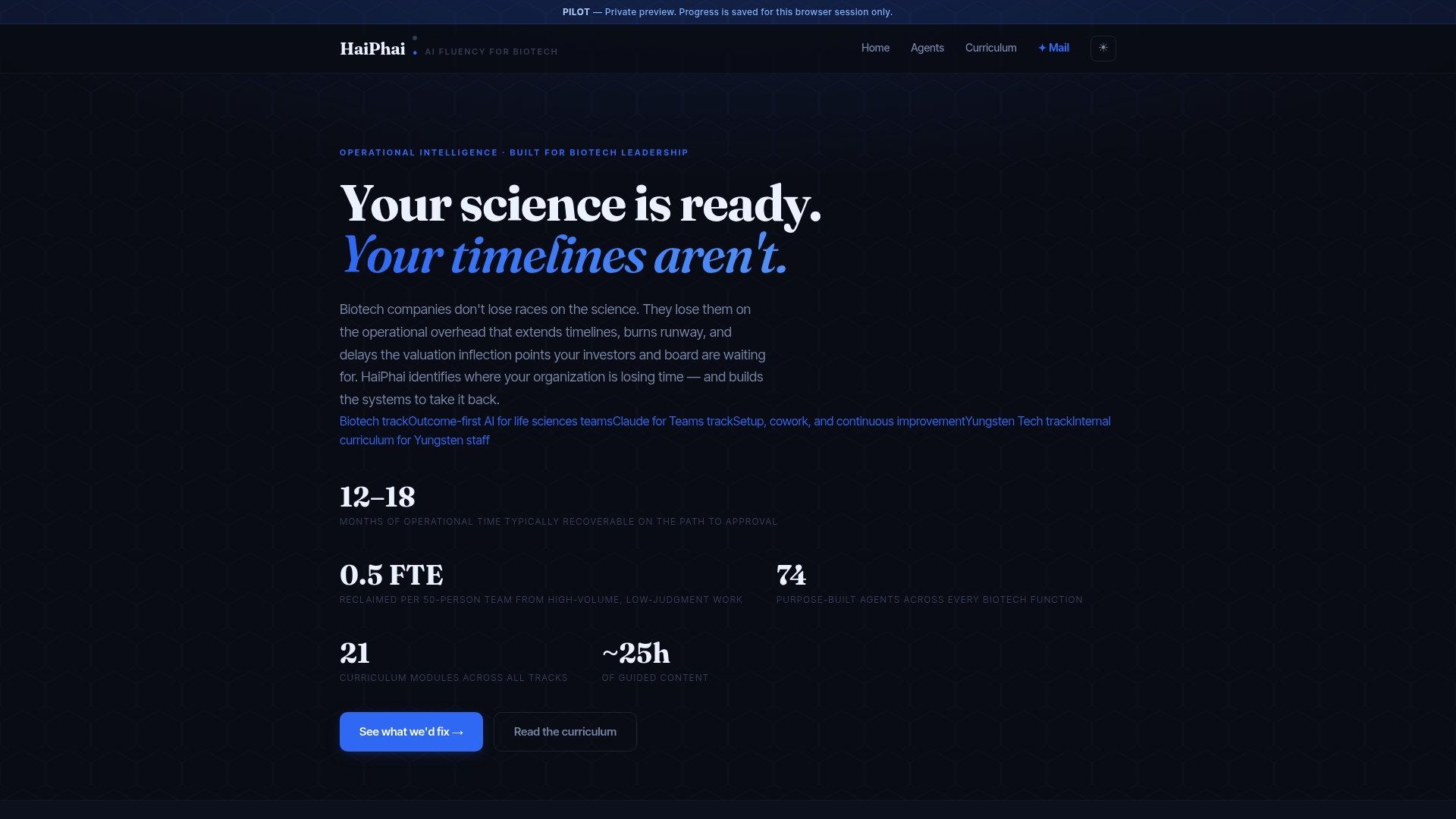
If label changes, regulatory drafting or cross-functional review are slowing your timeline, we start with a diagnostic of the operation: where time is lost, which steps can be redesigned, and where governed AI belongs. We then embed with your team to build, adopt and monitor the new workflow across clinical, regulatory and executive operations. Our own claim is that this approach can return up to 18 months of operational time on the path to approval.
If you want to discuss your labeling and regulatory workflow, see how our operating partnership works.
FAQ
What is pharmaceutical labeling automation?
It is the use of structured content, workflow rules and validated systems to run the label lifecycle with less manual handling. That includes drafting, comparison, review routing, change control, SPL file preparation and serialized printing. The goal is faster, more consistent labels with a complete record.
Does the FDA allow automated labeling controls?
Yes. The FDA's rule on cut labeling lets manufacturers use automated techniques that physically prevent incorrect labeling as a special control procedure. Any automated system still has to meet written-procedure, validation and recordkeeping requirements.
Do I need Part 11 compliance for a labeling workflow?
If you keep labeling records or approvals electronically in place of paper, Part 11 applies. In practice that means controlled user permissions, electronic signatures and audit trails, shown through validation such as IQ, OQ and PQ. Confirm your exact scope with your quality and regulatory leads.
What does DSCSA require on a pharmaceutical label?
Each prescription drug package needs a unique product identifier with the NDC, serial number, lot and expiration date in a 2D DataMatrix barcode. Manufacturers and repackagers have been fully subject to the rules since May 27, 2025.
Where should a biotech start?
Start by tracing one recent label change end to end and measuring days lost at each handoff. Fix the longest wait first, usually review routing or change control, then connect structured content and print. Our 90-day regulatory affairs workflow pilot shows one way to scope that.
Sources
- FDA Guidance: Providing Regulatory Submissions in Electronic Format, Content of Labeling
- FDA Drug Registration and Listing Instructions
- FDA Recent Automated Validation Rules
- FDA SOPP 8412: Review of Product Labeling
- 21 CFR 211.122
- Federal Register, 2012 final rule on cut labeling
- Pharma Labeling Operations: A 6-Month Pre-Approval Checklist
- IQ OQ PQ and Its Role in Labeling System Validation
- DSCSA Compliance 2025: What Pharma Companies Need to Know
- Navigating DSCSA Compliance in the Pharmaceutical Industry
- Pharmaceutical labeling case study, global drug manufacturer
- Biotechnology factory labeling case study
- Pharma Gets a Just in Time Speedup With the Switch to Digital Printing
- Packaging and serialization software overview