
Biotech asset monetization strategy is the structured conversion of expected future revenue, primarily through royalty monetization, into immediate capital without equity dilution. Rather than waiting years for a drug to generate sales, you exchange a defined share of those future revenues for upfront funding today. That capital can then accelerate clinical programs, extend your runway, or strengthen your balance sheet ahead of a licensing deal or acquisition.
The core benefits are concrete:
- Non-dilutive capital: No equity surrendered, no shareholder base expanded
- Funding acceleration: Capital arrives years before commercial launch
- Valuation improvement: Operational milestones reached faster translate directly to higher asset valuations
- Preserved control: Royalty financings typically carry fewer operational covenants than traditional debt
Three sources shape how leading biotech teams approach this in 2026: L.E.K. Consulting's market analysis, Goodwin's legal structuring expertise, and Haiphai's operational efficiency framework. Together, they define the field.
How royalty monetization structures actually work
Royalty monetization takes two primary forms. Traditional royalties involve selling or financing against an existing royalty stream from a license or collaboration agreement. Synthetic royalties create a royalty-like payment obligation tied to future product sales where no prior license exists.
Synthetic royalties carry greater counterparty risk and require protective mechanisms: catch-up payments, product collateral, or minimum return guarantees. The deal structures available span a wide range:
- Outright sale: Transfers an existing royalty stream for a lump sum; best for mature, in-market assets
- Capped royalties: Investor returns stop at a predetermined multiple; useful when you expect life-cycle expansion
- Royalty-backed debt: Anticipated cash flows serve as collateral for commercial-stage assets
- Hybrid structures: Combine a term loan with a capped royalty sale to attract a broader investor pool
Investors range from specialized royalty funds to pension funds, sovereign wealth funds, and private credit platforms. Each brings different return expectations and risk tolerance, which is exactly why structure customization matters so much.
Why biotech asset valuation methods differ from standard finance
Traditional metrics like EBITDA are nearly useless for pre-revenue biotech assets. The probability that a drug completing pre-clinical trials will receive FDA approval is less than 12%, and development takes close to ten years on average. Standard discounted cash flow models cannot handle that kind of binary, milestone-driven uncertainty.
Two methods dominate biotech asset valuation:
- Risk-adjusted net present value (rNPV): Forecasts future cash flows, discounts them to present value, and applies phase-specific probabilities of clinical and regulatory success. It is the most widely used method for pipeline assets.
- Real-options modeling: Captures the value of managerial flexibility. Management can abandon a program, accelerate it, or pivot based on new data. A static DCF ignores that optionality entirely.
The danger is when a company and its investors use different methods. If your team runs rNPV and your VC runs a standard multiple-based formula, the resulting valuation gap can stall a financing round entirely. Aligning on methodology before entering negotiations is not a formality; it is a prerequisite for getting a deal done.
Market signal: Global royalty deal value rose from $5.2 billion in 2020 to $7.1 billion in 2025, with syndicated competitive processes now accounting for roughly one-third of total market activity.
Integrating asset monetization into your capital strategy
Royalty financing is no longer a fallback when equity markets close. L.E.K. Consulting frames it plainly: it is a strategic capital formation lever that belongs in every CFO's toolkit alongside equity and debt.
The key decisions are timing and process design:
- Timing: Monetize when asset visibility is high, not under financial duress. A company that approaches investors with clean Phase 3 data and a clear commercial path commands materially better terms than one seeking emergency capital.
- Process design: A bilateral deal with a single established fund offers speed and confidentiality. A syndicated competitive process takes longer but creates pricing tension that can lift proceeds. Even introducing modest competition into a formal process can shift terms in your favor.
- Capital structure balance: Royalty financing works best alongside, not instead of, equity or debt. The goal is the right quantum of capital with the right mix of dilution, covenants, and flexibility.
Engaging advisors who combine therapeutic expertise with transaction experience is worth the cost. They know where investor pressure points sit and can help you avoid giving away more than necessary.
How Haiphai's AI-driven operations improve your monetization outcomes
Operational timelines directly affect monetization value. A program that reaches Phase 3 six months earlier commands a higher valuation and better deal terms. Haiphai's approach starts from your strategic goals and works backward to identify exactly where bottlenecks are slowing you down.

The results are concrete. Haiphai's AI-driven process work recovers up to 18 months in clinical and regulatory timelines through targeted efficiencies in regulatory drafting and clinical site activation. That is not a general productivity gain; it is time reclaimed on the specific path to approval milestones that investors price.
What sets Haiphai apart from generic software is the tailoring. AI tools are configured to your programs, your regulatory context, and your team's actual workflow gaps, not deployed as a one-size-fits-all overlay. The result is that AI augmentation becomes a genuine negotiation asset: faster timelines mean higher asset visibility, which means better monetization terms.
Pro Tip: Before entering any royalty monetization process, run an operational audit to quantify your timeline position. Investors price what they can see. If you can demonstrate that your regulatory submissions are on an accelerated schedule, that visibility translates directly into valuation.
Real-world royalty monetization examples
The Cystic Fibrosis Foundation is one of the clearest examples of royalty monetization at scale. The Foundation retained royalty rights from its early funding of Vertex Pharmaceuticals' research and later monetized those royalties to reinvest in new patient programs, turning a research bet into a self-sustaining capital engine.
Teva and Biogen both announced synthetic royalty deals recently, not for capital needs but as a profit-and-loss tool: using royalties to offset R&D costs on their balance sheets. Big Pharma's participation signals how mainstream these structures have become.
For emerging biotechs, the pattern is typically different. A company with an outlicensed asset holds a royalty stream it may not need for a decade. Monetizing that stream now, at a discount, funds the next program without touching the equity cap table.
Tax and accounting treatment of royalty monetization
The accounting classification of a royalty monetization transaction matters significantly. A transaction structured as a true sale of a royalty interest is treated differently from one recharacterized as a loan. Under Article 9 of the New York Uniform Commercial Code, a synthetic royalty interest tied to future product sales may qualify as a sale of accounts, which affects both balance sheet treatment and bankruptcy remoteness.
For tax purposes, the structure determines whether proceeds are treated as ordinary income or capital gains. Debt-like structures with mandatory true-up payments tend to be treated as loans, while uncapped sale structures with no guaranteed return are more likely to achieve true-sale treatment. Engaging experienced deal counsel and tax advisors before term sheet stage is the only way to avoid a costly reclassification later.
How to identify which assets in your portfolio are worth monetizing
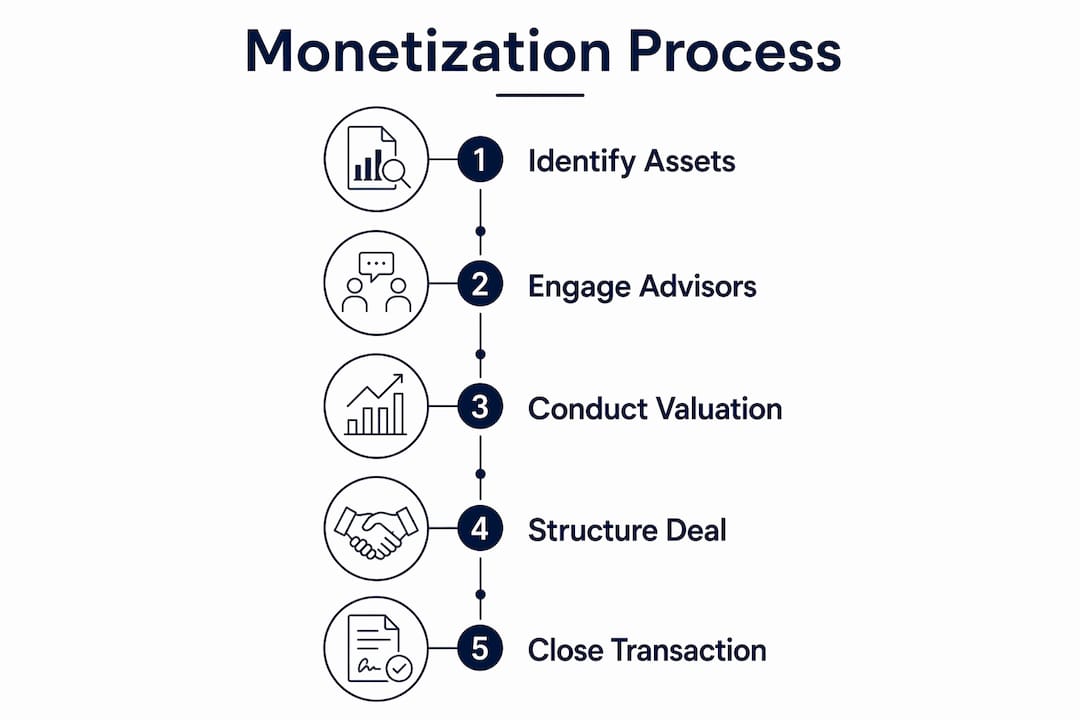
Not every asset qualifies. Investors want assets with predictable, diligenceable revenue streams and clear regulatory pathways. The practical screening criteria:
- Development stage: Commercial-stage or Phase 3 assets with late-stage data are the most viable. Earlier-stage assets can qualify for development funding structures, but the cost of capital rises sharply.
- Royalty clarity: Does the asset generate or will it generate a defined royalty or revenue stream? Ambiguous IP ownership or contested license terms kill deals early.
- Market size: Investors model the addressable patient population, pricing, and competitive dynamics. Assets in large, well-characterized markets are easier to underwrite.
- Patent life: Sufficient exclusivity remaining to support the investor's return horizon is a baseline requirement.
Sum-of-the-parts analysis helps prioritize. Value each pipeline asset separately, identify which programs carry the most monetizable value, and sequence transactions accordingly.
Who needs to be at the table for a monetization transaction
Royalty monetization transactions involve more stakeholders than most biotech leaders expect:
- Legal counsel: Goodwin and similar firms with dedicated royalty monetization practices handle deal structuring, covenant negotiation, and true-sale analysis
- Financial advisors or investment banks: Run competitive processes, build valuation models, and manage investor outreach
- Tax advisors: Determine optimal transaction structure for accounting and tax treatment
- Board and audit committee: Approve transaction terms and ensure fiduciary alignment
- Royalty investors: Specialized funds, private credit platforms, pension funds, and increasingly Big Pharma treasury teams
- Operational partners: Firms like Haiphai that improve asset visibility and timeline credibility before and during the investor diligence process
The earlier you bring these parties in, the better positioned you are when the time is right to transact.
Key Takeaways
Royalty monetization is the most capital-efficient tool available to biotech leaders in 2026, delivering non-dilutive funding while preserving operational control and accelerating the path to higher valuations.
| Point | Details |
|---|---|
| Royalty monetization is non-dilutive | Investors receive future revenue shares; you retain equity and avoid restrictive debt covenants. |
| Market has grown significantly, reflecting a mature and competitive environment for royalty deals. | |
| Valuation method alignment matters | Mismatches between rNPV and VC methods can stall financing; agree on methodology before negotiations begin. |
| Timing determines deal quality | Monetizing under financial duress yields worse terms than monetizing when asset visibility is high. |
| Operational speed is a pricing input | Haiphai's AI-driven approach recovers up to 18 months in timelines, directly improving investor-facing asset visibility. |
FAQ
What is biotech asset monetization strategy?
Biotech asset monetization strategy converts expected future revenue, primarily through royalty monetization, into immediate non-dilutive capital. It allows biotech companies to fund operations and accelerate programs without issuing new equity or taking on traditional debt.
What is the difference between traditional and synthetic royalties?
Traditional royalties involve selling an existing royalty stream from a license agreement. Synthetic royalties create a new royalty-like obligation tied to future product sales where no prior license exists, carrying greater counterparty risk and requiring downside protections.
When is the right time to pursue royalty monetization?
Monetize when asset visibility is high, typically at Phase 3 or commercial stage, rather than under financial pressure. Better data and clearer commercial prospects translate directly into stronger deal terms and higher proceeds.
How does rNPV differ from standard valuation methods?
rNPV adjusts future cash flow forecasts by the probability of clinical and regulatory success at each development stage. Unlike EBITDA or standard DCF, it accounts for the binary, milestone-driven nature of drug development, making it the preferred method for pre-revenue biotech assets.
How does operational efficiency affect monetization outcomes?
Faster timelines increase asset visibility and reduce investor-perceived risk, both of which improve valuation and deal terms. Haiphai's AI-driven operational work recovers up to 18 months toward approval milestones, giving companies a measurable advantage entering any monetization process.