
AI integration in biotech project management is defined as the systematic embedding of machine learning, predictive analytics, and agentic AI workflows into regulated R&D planning, compliance tracking, and portfolio decision-making. When you integrate AI project management in biotech correctly, the result is faster stage-gate decisions, automated compliance documentation, and real-time risk visibility across your entire pipeline. Platforms like Cora Systems, t0ggles, Zifo, and Aganitha's Igniva™ are already delivering these outcomes for life sciences teams in 2026. The critical distinction from generic AI adoption is that biotech requires every AI layer to sit on top of traceable, audited, regulation-compliant workflows before it can deliver reliable value.
What foundations must you establish before integrating AI in biotech project management?
AI-ready structured data is the non-negotiable foundation for any AI integration in biotech project management. Without high-quality, consistently structured project data, predictive analytics produce unreliable forecasts and portfolio dashboards mislead rather than inform. This is not a technology problem. It is a data discipline problem that must be solved before any AI tool is deployed.
The second foundation is a regulated, traceable workflow architecture. Biotech projects operate under GxP, 21 CFR Part 11, and EU Annex 11 requirements, which mandate that every task action carries a timestamp, a user attribution, and a documented approval chain. Platforms like t0ggles demonstrate this by building dependency-driven task sequencing with compliance audit trails directly into the project structure. If your current workflows lack these features, adding AI on top will create compliance exposure, not efficiency.
Before you write a single AI integration requirement, audit your existing project data and workflows against these criteria:
- Data completeness: Are all project tasks, milestones, and deliverables captured in a single structured system, or scattered across spreadsheets and email threads?
- Dependency modeling: Have you formally mapped sequential dependencies with lag days for regulatory review periods, incubation windows, and approval cycles?
- Audit trail coverage: Does every task state change generate a timestamped, user-attributed log entry that satisfies 21 CFR Part 11?
- Role-based access control (RBAC): Are permissions configured so that only authorized users can approve, modify, or close regulated tasks?
- Milestone-linked prerequisite gates: Are stage-gate decisions formally blocked until all prerequisite tasks are verified complete?
Pro Tip: Map your work breakdown structure around verifiable decision gates first. AI layers added afterward will have clean inputs to work with and will produce auditable outputs rather than opaque suggestions your compliance team cannot defend.
Regulated biotech project planning fails without dependency modeling and audit trails, and this failure becomes exponentially more costly once AI starts generating or summarizing project plans. The governance architecture is not overhead. It is the product.
How do AI tools enhance project tracking, decision-making, and compliance in biotech workflows?
Once your data and workflow foundations are in place, AI tools deliver four distinct categories of value in biotech project management.
-
Predictive analytics and schedule forecasting. Cora Systems uses AI-ready project data to generate real-time intelligence on timeline risks, resource bottlenecks, and cost trajectories. Instead of waiting for a quarterly review to discover a six-week slip, project managers receive early warnings when leading indicators shift.
-
What-if scenario analysis for portfolio decisions. AI-enabled scenario planning tools connect directly to schedule and cost models, letting executives test the downstream impact of accelerating a Phase II trial, reallocating a CRO, or deprioritizing a compound. This replaces the spreadsheet-based scenario modeling that typically takes days with analysis that takes minutes.
-
Automated audit trail review for GxP compliance. Zifo's AI-enabled solution automates audit trail review across diverse systems, integrating document mapping and workflow tools to scale compliance checks that previously required dedicated manual review cycles. This directly addresses one of the most labor-intensive bottlenecks in regulated biotech operations.
-
Agentic AI for autonomous workflow execution. Aganitha's Igniva™ platform deploys agentic AI with governance controls including RBAC, approval workflows, and curated knowledge integration. Agentic AI does not just surface recommendations. It executes defined workflow steps autonomously within the boundaries your governance architecture sets.
"The teams that extract the most value from AI in biotech project management are not the ones with the most sophisticated models. They are the ones with the most disciplined data and governance structures underneath those models."
Real-time risk management is where these capabilities converge. When predictive analytics, scenario modeling, and automated compliance checks operate together on a single structured data layer, portfolio leaders can make stage-gate decisions with confidence rather than intuition.
What are the key implementation steps for AI integration in biotech projects?
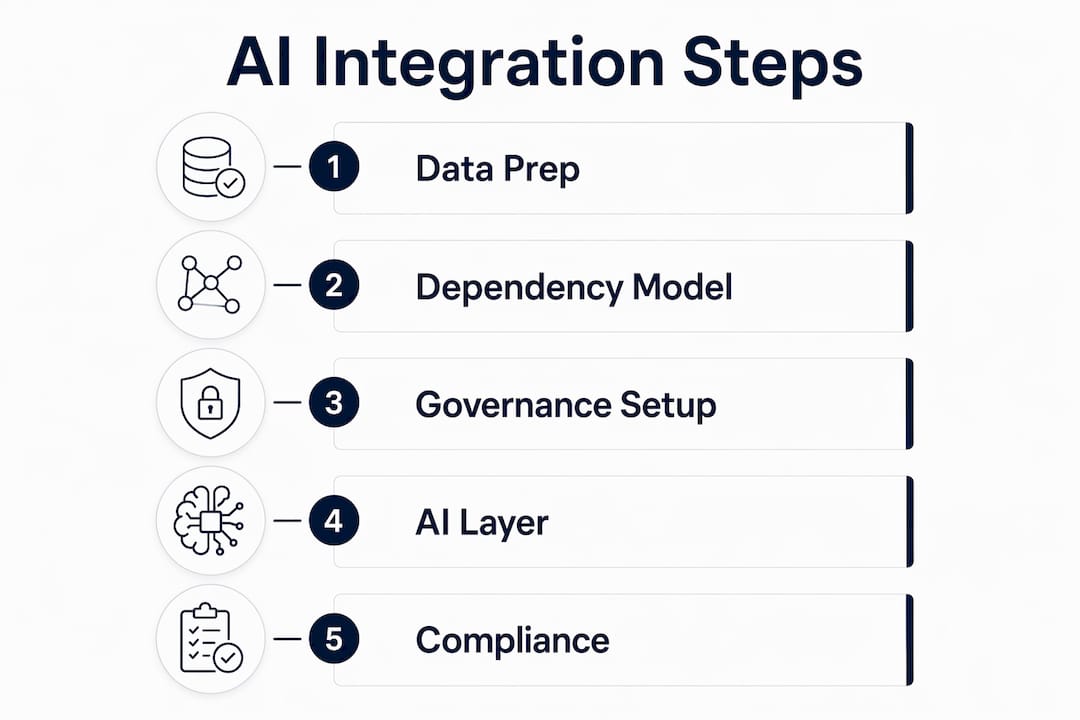
The implementation sequence matters as much as the tools you select. Teams that deploy AI before formalizing their workflow structure consistently encounter the same problems: unreliable plan generation, compliance gaps, and governance failures that require expensive remediation.

Follow this sequence to avoid those outcomes.
Formalize your work breakdown first
Define every project phase with explicit decision gates that must be verified before the next phase begins. Each gate should have named prerequisites, responsible owners, and documented acceptance criteria. This structure gives AI planning layers clean, unambiguous inputs.
Model dependencies with precision
Lag days are not optional in biotech. Regulatory review windows, incubation periods, and CRO turnaround times must be formally encoded as task dependencies with defined buffer ranges. T0ggles demonstrates this by treating sequential dependency modeling as a core planning function rather than an afterthought.
Build governance plumbing before deploying AI agents
Governance infrastructure including RBAC, audit trail capture, approval routing, and continuous evaluation is consistently underestimated by teams moving to agentic AI. Budget at least as much implementation effort for governance as for the AI capability itself. Regulated environments have zero tolerance for autonomous actions that cannot be traced and attributed.
Add an explicit AI planning layer
Rather than relying on a single large language model call to generate or replan a project schedule, implement a dedicated planning layer that outputs an auditable directed acyclic graph (DAG) of project steps. The forgeplan architecture demonstrates how separating planning from generation with checkpoints and backtracking produces reliable long-horizon plans. This approach prevents cascading errors when a single step fails or changes.
| Approach | Risk level | Auditability | Recommended for biotech |
|---|---|---|---|
| Direct LLM plan generation | High | Low | No |
| Explicit DAG planning layer | Low | High | Yes |
| Human-in-loop with AI assist | Medium | High | Yes, for stage gates |
| Fully autonomous agentic AI | High without governance | Variable | Only with full governance stack |
Pro Tip: Treat your AI planning layer as a regulated system component, not a productivity tool. Document its inputs, outputs, and failure modes the same way you would document a validated software system under 21 CFR Part 11.
Which biotech project management software supports AI integration?
The platform you choose shapes what AI integration is even possible. Not all biotech project management software is built to support the governance and compliance requirements that make AI trustworthy in regulated environments.
Cora Systems targets enterprise life sciences teams with AI-ready data architecture, portfolio scenario analysis, and stage-gate management. Its strength is connecting project-level data to executive portfolio decisions in real time.
t0ggles focuses on research pipeline and lab tracking with dependency-driven task sequencing and built-in audit trail features. It is well-suited for teams that need compliance-grade workflow structure without enterprise-level complexity.
Zifo's AI-enabled audit trail review is not a full project management platform but a specialized compliance layer that integrates with existing systems. For teams already managing GxP audit trail volume at scale, it addresses a specific and costly bottleneck.
Aganitha Igniva™ targets organizations ready to deploy agentic AI workflows. Its value is in autonomous execution with governance controls, making it appropriate for teams that have already established the foundational data and compliance architecture described above.
When selecting a platform, prioritize these criteria:
- Native support for 21 CFR Part 11 and GxP audit trail requirements
- Dependency modeling with configurable lag days and prerequisite gates
- RBAC with granular permission controls
- API access for integrating specialized AI compliance tools like Zifo
- Documented AI model governance and explainability features
For teams operating in regulated healthcare environments, the LIMS implementation planning process offers a useful parallel for thinking about AI integration timelines and validation requirements. The regulated healthcare context at HIPPRA also provides relevant frameworks for AI governance in biotech project settings.
Key takeaways
Effective AI integration in biotech project management requires structured data, traceable workflows, and explicit governance architecture before any AI layer is deployed.
| Point | Details |
|---|---|
| Data quality comes first | AI-ready structured project data is the prerequisite for reliable predictive analytics and portfolio decisions. |
| Dependency modeling is non-negotiable | Formally encode lag days, regulatory review windows, and prerequisite gates before adding AI planning. |
| Governance is underestimated | RBAC, audit trails, and approval workflows require as much implementation effort as the AI capability itself. |
| Use an explicit planning layer | A DAG-based AI planning layer with checkpoints outperforms direct LLM plan generation in regulated environments. |
| Platform selection drives what is possible | Choose biotech project management software with native GxP compliance features before evaluating AI add-ons. |
What I have learned from watching AI integrations succeed and fail in biotech
The pattern I see most often is this: a biotech team gets excited about an AI tool, deploys it on top of existing workflows, and then spends the next six months firefighting compliance gaps and unreliable outputs. The tool is not the problem. The sequence is.
The teams that get AI integration right in biotech are almost always the ones that spent more time on process design than on tool selection. They mapped their dependencies obsessively. They built their audit trail architecture before they wrote a single AI requirement. They treated governance as a first-class deliverable, not an afterthought.
What surprises most project managers is how much of the value from AI in biotech comes not from the AI itself but from the discipline that AI adoption forces on your underlying processes. When you have to make your data AI-ready, you discover data quality problems you did not know existed. When you have to formalize your dependency model for an AI planning layer, you find workflow assumptions that were never documented. The AI integration process is, in many ways, a forcing function for operational rigor.
My honest recommendation is to start smaller than you think you need to. Pick one workflow, one compliance bottleneck, or one portfolio decision process. Build the governance architecture for that scope. Validate that the AI layer produces auditable, defensible outputs. Then expand. The teams that try to integrate AI across their entire project management function in a single initiative almost always stall on governance complexity. Incremental adoption with continuous governance monitoring is not the cautious path. It is the faster path.
— John
How Haiphai helps biotech teams build AI-ready project operations
Biotech teams that want to integrate AI into project management without the governance pitfalls described above have a direct path forward with Haiphai.
Haiphai works as an operational partner, starting from your strategic goals and working backward to identify where your current workflows are blocking AI adoption. Rather than deploying a generic platform, Haiphai designs AI-enabled processes tailored to your specific regulatory environment, whether that means auditable biotech workflows for clinical site activation, regulatory drafting, or portfolio decision support. Clients reclaim up to 18 months of operational time on their path to approval. For a biotech company managing valuation and funding timelines, that is a material competitive advantage.
FAQ
What does it mean to integrate AI in biotech project management?
Integrating AI in biotech project management means embedding machine learning, predictive analytics, and agentic AI workflows into regulated R&D planning, compliance tracking, and portfolio decisions. It requires AI-ready structured data and traceable, audited workflows as the foundation.
Which AI tools are used for biotech project management?
Cora Systems, t0ggles, Zifo's AI-enabled audit trail review, and Aganitha Igniva™ are among the leading platforms. Each addresses different layers of the AI integration stack, from data architecture and dependency modeling to autonomous workflow execution.
How does AI support GxP compliance in biotech projects?
AI automates audit trail review, flags compliance gaps in real time, and generates traceable documentation across regulated systems. Zifo's solution specifically addresses 21 CFR Part 11 and EU Annex 11 requirements by integrating document mapping with automated workflow tools.
What is the biggest risk when integrating AI into biotech project workflows?
The biggest risk is deploying AI before establishing governance infrastructure. RBAC, audit trail capture, and approval routing are consistently underestimated, and their absence creates compliance exposure that is costly to remediate after the fact.
How long does AI integration in biotech project management typically take?
Timeline depends on the maturity of your existing data and workflow architecture. Teams with structured, compliant workflows can deploy targeted AI capabilities in weeks. Teams that need to rebuild their data foundation and governance stack first should plan for a multi-phase program spanning several months.