
A biotech investor update report is a structured communication document that tells investors exactly where your company stands on clinical progress, cash position, and near-term milestones. Done well, it builds the kind of trust that converts existing investors into follow-on funders. Done poorly, it creates silence, and silence in biotech investor relations is expensive. This guide covers the structure, cadence, automation methods, and common mistakes that determine whether your updates get read and acted on.
How to create a biotech investor update report that works
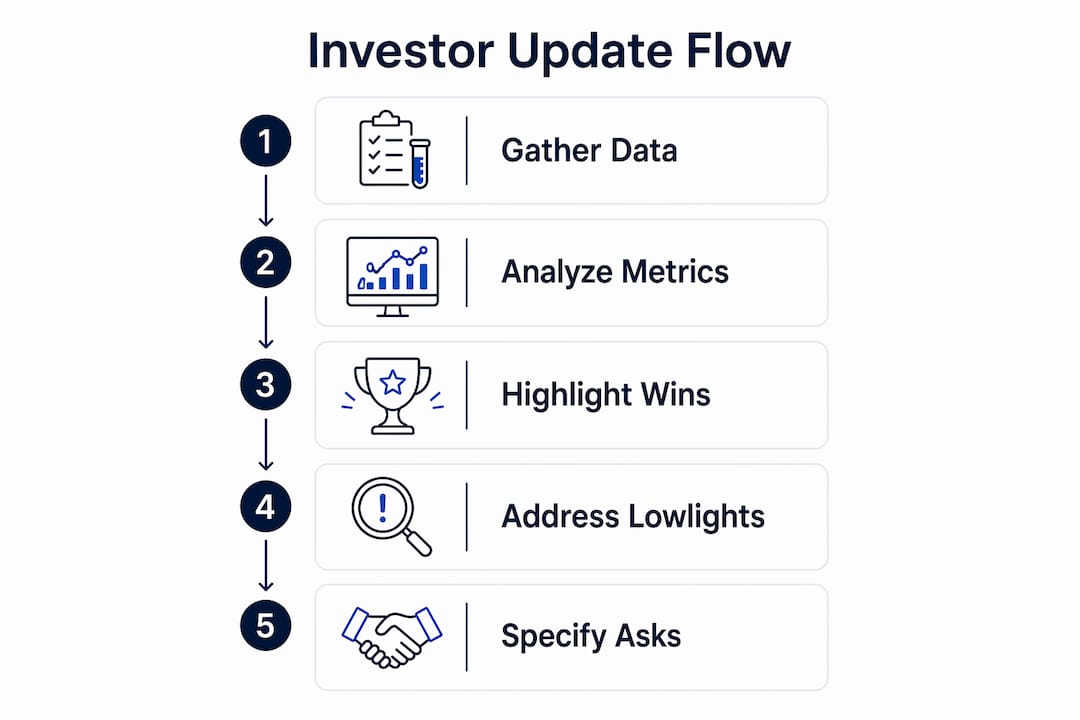
The standard industry term for this practice is "investor relations communication," and the update report is its most frequent deliverable. The most effective format follows a four-section structure: headline metrics, wins, lowlights, and specific asks, kept within 500–800 words. That constraint is not arbitrary. Investors receive dozens of updates. A concise, consistent format lets them compare your progress across months without rereading old emails.
Biotech updates require a different set of headline metrics than a SaaS company. Your north-star KPIs should center on clinical trial milestones, FDA submission dates, and cash runway, because biotech's long development cycles make these the only numbers that predict company survival. Burn rate and months of runway belong in every single update, not just the ones where the news is good.

Consistent line items matter as much as the content itself. When your report uses identical categories every month, investors can "diff" it against the prior version in seconds. That habit signals operational discipline, which is itself a funding signal.
The four core sections explained
Headline metrics sit at the top: burn rate, cash runway, and one clinical or regulatory milestone. These three numbers tell an investor whether to keep reading.
Wins cover two to four concrete achievements since the last update. "Enrolled 47 patients in Phase 2" beats "made strong progress on enrollment." Specificity is credibility.
Lowlights are where most biotech executives lose nerve. Skipping them is the single fastest way to erode trust. Investors already know things go wrong in drug development. What they need to see is that you know it too, and that you have a plan.
Asks should be no more than three, and each one must be specific. "Introductions to oncology-focused family offices in the Southeast" is an ask. "Help with fundraising" is not.
Pro Tip: Include a one-page risk matrix that maps clinical failure probability against financial impact, with a brief mitigation note for each item. This single addition separates professional biotech updates from amateur ones.
How often should biotech companies send investor updates?
Monthly updates are the standard for seed through Series A companies. 60% of seed-stage founders report using a monthly cadence to build investor trust, with quarterly treated as the minimum acceptable baseline. Monthly is not just more frequent. It creates a compounding relationship effect that quarterly updates cannot replicate.
Biotech adds a layer of complexity here. Clinical trials run on their own timelines, and some months genuinely produce no new data. The solution is not to skip the update. Send it anyway, report on operational progress, and use the space to reinforce your equity story.
Monthly investor updates create compounded investor engagement that leads to higher chances of follow-on funding. A DocSend analysis confirms that transparency and monthly cadence together predict investor commitment more reliably than any single metric. Founders who maintain this discipline through quiet clinical periods are the ones investors call first when a new round opens.
The cadence also serves a risk management function. Transparent disclosure of problems within 24–48 hours of discovery is the strongest single trust-building behavior in investor relations. A monthly update rhythm makes that kind of proactive communication feel natural rather than alarming.
Special situations, such as a clinical hold, a failed endpoint, or a key departure, warrant an out-of-cycle message. Never wait for the next scheduled update to disclose material news. Investors who learn bad news from a third party before hearing it from you rarely forgive it.
Can automation reduce the burden of producing investor updates?
Automation handles the data. You handle the story. That division of labor is the most efficient model for producing consistent, high-quality updates.
Connecting financial and operational data sources like Stripe, QuickBooks, and your HRIS to a report template eliminates the manual data-gathering step that consumes most of the time founders spend on updates. The pipeline pulls raw numbers into the correct fields, leaving the executive team to focus on interpretation and narrative.
The practical workflow looks like this:
- Connect your financial system to auto-populate burn rate and runway fields
- Pull clinical trial enrollment data from your CTMS or site management platform
- Set a recurring calendar block for the narrative sections: wins, lowlights, and asks
- Use version control on your template so formatting never drifts between months
- Send through a platform that tracks open rates, so you know who is actually reading
The narrative sections must stay human-authored. Storytelling drives 61% of top investor communications, and relationship-building accounts for 53%. No automation layer produces the kind of candid, specific language that makes an investor feel genuinely informed. Haiphai's approach to AI in regulatory affairs demonstrates exactly this principle: AI handles the structured, repeatable work, while human judgment shapes the message.
| Workflow element | Automated or human |
|---|---|
| Burn rate and runway | Automated via QuickBooks or equivalent |
| Clinical milestone tracking | Automated via CTMS integration |
| Wins and lowlights narrative | Human-authored |
| Risk matrix updates | Human-authored with template support |
| Distribution and tracking | Automated via IR platform |
What are the most common mistakes in biotech investor updates?
The most damaging mistake is omitting lowlights. Investors who receive only good news stop trusting the source. When a real problem eventually surfaces, and in biotech it always does, the credibility damage is compounded by the pattern of omission.
Transparency about lowlights, with root cause and remediation plans, is more important than showcasing only wins. Investors value integrity and self-awareness in biotech founders far more than a clean track record. The founder who explains a failed endpoint clearly and presents a pivot plan earns more trust than the one who buries it.
A numbered list of the most frequent structural errors:
- Vague asks. "We need introductions" tells an investor nothing. Name the specific investor type, geography, and check size you are targeting.
- Inconsistent formatting. Changing your template between updates forces investors to reorient every time. Pick a structure and hold it.
- Exceeding 800 words. Longer updates get skimmed or skipped. If you need to explain something complex, link to a separate memo.
- Language that conflicts with regulatory filings. Investor updates must align with formal regulatory disclosures. Inconsistent language creates legal and credibility risk.
- Burying the headline metric. Cash runway belongs in the first paragraph, not the third.
A well-structured biotech report template also accounts for the binary nature of clinical outcomes. A Phase 2 readout is not a gradual event. Your update in the month of that readout needs to be written in advance, with both outcome scenarios mapped, so you can send within hours rather than days.
Pro Tip: Keep a "standing asks" section that updates monthly. Investors who cannot help with this month's ask may be perfectly positioned for next month's. Visibility creates opportunity.
Biotech executives who treat the 50-person operating model seriously know that investor communication is not a side task. It is a core operational function that deserves the same rigor as clinical operations.
Key Takeaways
A biotech investor update report works when it combines a fixed four-section structure, a monthly cadence, transparent lowlights, and automated data pipelines that free executives to focus on the narrative.
| Point | Details |
|---|---|
| Use the four-section structure | Every update needs headline metrics, wins, lowlights, and specific asks within 500–800 words. |
| Send monthly, not quarterly | Monthly cadence builds compounded trust and predicts follow-on funding more reliably than any single metric. |
| Never omit lowlights | Transparent disclosure of problems with root cause and a fix plan is the strongest trust signal in biotech IR. |
| Automate data, write the narrative | Connect financial and CTMS systems to templates, then spend your time on interpretation and storytelling. |
| Align language with regulatory filings | Inconsistent language between updates and formal filings creates legal and credibility risk. |
The update report is the cheapest fundraising tool you have
Most biotech executives treat investor updates as an obligation. I think that framing costs them money. The update is the one recurring touchpoint where you control the narrative completely. No banker, no journalist, no analyst is filtering your message. That is rare in this industry, and most teams waste it.
The teams I have seen raise follow-on rounds fastest are not the ones with the cleanest clinical data. They are the ones whose investors never feel surprised. Monthly updates, honest lowlights, and specific asks create a relationship where investors feel like partners rather than spectators. When the Series B opens, those investors move fast because they already trust the team.
The other thing I would push back on is the instinct to polish away the hard news. Biotech investors have seen failed endpoints. They have seen clinical holds. What they have not always seen is a founder who calls it clearly, explains the root cause, and presents a credible path forward. That combination is genuinely rare, and it is more fundable than a clean story that later unravels.
Align your update language with your equity story and your regulatory filings from day one. Inconsistency between those three documents is the kind of thing that surfaces in due diligence and kills rounds that should have closed.
— John
Haiphai and the investor update process
Producing a high-quality investor update every month is a real operational load, especially for lean biotech teams managing clinical timelines, regulatory submissions, and fundraising simultaneously.
Haiphai works as an operational partner for life sciences teams, starting from your strategic goals and working backward to identify where time is being lost. The AI-driven solutions Haiphai provides include data integration workflows that pull clinical and financial metrics directly into reporting templates, reducing the manual effort that delays most updates. Teams using Haiphai reclaim significant operational time, which translates directly into faster, more consistent investor communications. If your update process currently takes days instead of hours, Haiphai's biotech services are worth a close look.
FAQ
What should a biotech investor update report include?
A biotech investor update report should include headline metrics (burn rate, cash runway, and one clinical milestone), two to four wins, two to three lowlights with root cause and remediation, and up to three specific asks, all within 500–800 words.
How often should biotech companies send investor updates?
Monthly is the recommended cadence for seed through Series A companies. 60% of seed-stage founders use monthly updates, with quarterly treated as the minimum baseline.
What metrics matter most in a biotech investor update?
Cash runway, burn rate, and clinical trial milestones are the three metrics that belong in every biotech update. FDA submission dates and trial enrollment are the north-star KPIs unique to biotech's binary development cycle.
How do I handle bad news in an investor update?
Disclose material problems within 24–48 hours of discovery, with a clear root cause and a remediation plan. Investors who learn bad news from a third party before hearing it from you rarely maintain the same level of trust.
Can automation help with creating investor updates?
Automation handles data collection from systems like QuickBooks and your CTMS, populating template fields automatically. The narrative sections, wins, lowlights, and asks, must remain human-authored to maintain the storytelling quality that drives investor engagement.