
Regulatory risk assessment is the process of identifying, measuring, and pricing the probability that a drug or device fails to gain or maintain approval from bodies like the FDA, EMA, or PMDA. For investors and financial analysts, the ability to analyze regulatory risk in biotech investment separates disciplined capital allocation from expensive guesswork. Regulatory uncertainty does not just threaten binary approval outcomes. It raises discount rates, extends timelines, and compresses valuations even when clinical data looks promising. Getting this analysis right is the single most important edge available to biotech-focused investors.
What are the main regulatory risk factors to analyze in biotech investment?
Regulatory risk in biotech is multi-dimensional. It covers approval probability, market access, drug pricing policy, and manufacturing compliance. Each dimension can independently destroy or create value.
Approval pathway complexity is the first factor to map. The FDA offers several designations, including Investigational New Drug (IND) applications, New Drug Applications (NDA), Fast Track, and Breakthrough Therapy status. Each pathway carries a different timeline and evidentiary standard. A Breakthrough Therapy designation accelerates review but does not guarantee approval. Investors who treat designation as a proxy for approval probability consistently overprice early-stage assets.

Clinical trial design and endpoint selection represent the second major risk layer. Regulators can reject a trial not because the drug failed, but because the endpoints were poorly chosen or the patient population was too narrow. Analysts must scrutinize the primary endpoint, the statistical power of the trial, and whether the FDA has formally agreed to the design through a Special Protocol Assessment.
Post-approval regulatory risk is frequently underestimated. Regulatory risk extends beyond approval to evolving policies on drug pricing and reimbursement that can significantly impact profitability. Government efforts to control healthcare costs can erode returns as effectively as a clinical failure. Analysts must model reimbursement scenarios alongside approval probability.
Manufacturing scale-up is the most overlooked bottleneck. Manufacturing compliance and scale are critical regulatory hurdles that can delay market entry and are often underestimated during due diligence. A drug that passes Phase 3 can still fail to reach patients if the company cannot demonstrate consistent, scalable production to FDA standards.
Management experience in regulatory navigation is a qualitative but decisive factor. A team that has guided an asset through a Complete Response Letter (CRL) and resubmission carries measurably lower execution risk than one facing its first FDA interaction.
Pro Tip: Ask the company directly whether the FDA has issued written agreement on trial design via a Special Protocol Assessment. Written agreement dramatically reduces the risk of a post-trial rejection on procedural grounds.
How can investors quantitatively model regulatory risk?
Quantitative regulatory risk modeling starts with probability-adjusted valuation, also called risk-adjusted net present value (rNPV). The method assigns a probability of success to each clinical and regulatory milestone, then discounts future cash flows by both time and that probability. The output is a valuation that reflects the full risk profile of the pipeline, not just the optimistic scenario.
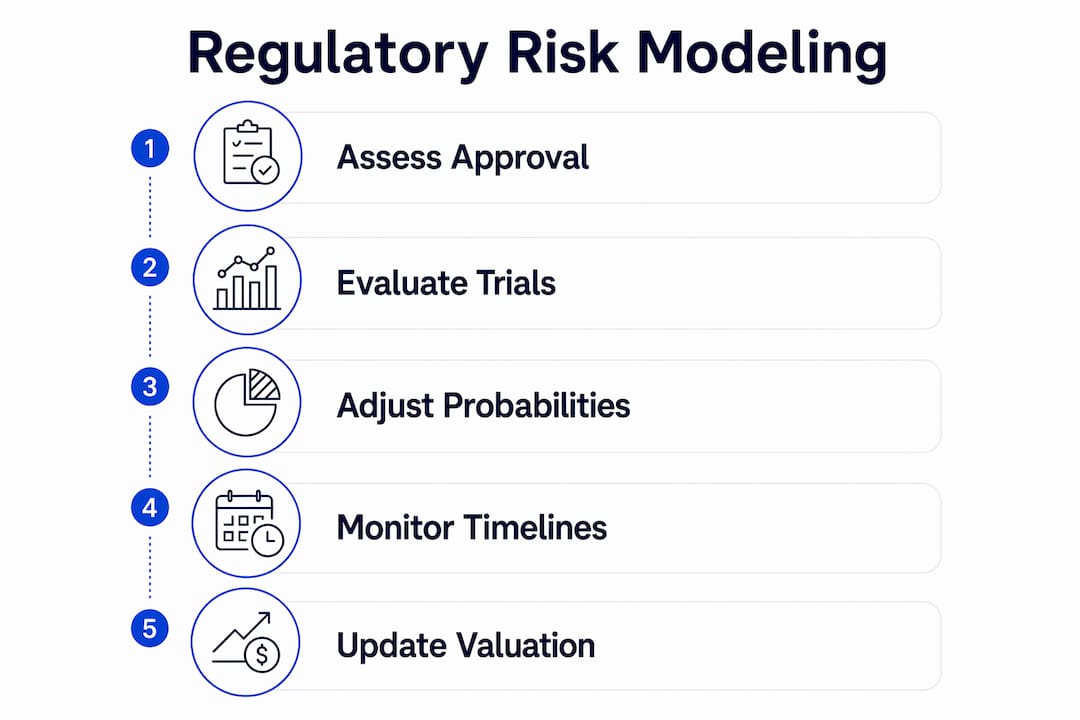
The critical insight most analysts miss is that regulatory risk affects the discount rate, not just the probability of success. Regulatory feedback variance can push discount rates from 12% up to 15%, reducing valuations even when clinical success probabilities hold steady. A 3-percentage-point shift in the discount rate on a 10-year cash flow model produces a valuation reduction that rivals a failed Phase 2 trial.
A practical modeling framework includes four steps:
- Map every regulatory milestone. List IND filing, end-of-Phase 2 meetings, NDA submission, PDUFA date, and any advisory committee (AdCom) hearings. Each is a binary event with a probability and a date.
- Assign therapeutic area benchmarks. Historical FDA approval rates vary significantly by indication. Oncology assets have different base rates than rare disease or CNS programs. Use published FDA performance data and therapeutic area databases to set baseline probabilities.
- Distinguish modelable from unmodelable risk. Specialist investors differentiate modelable regulatory risks from unpredictable agency behavior, trimming positions when risk becomes unmodelable. Opaqueness tied to leadership changes or internal FDA policy shifts is unmodelable. Trim or exit positions where that type of risk dominates.
- Stress-test with scenario analysis. Run a base case, a bear case (CRL issued, 18-month delay), and a bull case (Priority Review granted). Map the valuation range and set position sizing accordingly.
| Risk type | Modelable? | Investor response |
|---|---|---|
| Clinical endpoint failure | Yes | Adjust probability of success |
| Regulatory delay (PDUFA extension) | Partially | Raise discount rate |
| AdCom vote outcome | Partially | Monitor signals, reduce position |
| FDA leadership policy shift | No | Trim or exit position |
| Pricing and reimbursement change | Partially | Model multiple revenue scenarios |
Pro Tip: Monitor AdCom meeting dates and briefing document releases. The FDA publishes briefing documents 48–72 hours before advisory committee votes. Market reactions to these documents often preview the final agency decision.
Later-stage pipeline assets carry lower regulatory risk by definition. Phase 3 and beyond assets attract institutional investors who prefer companies with strong cash positions, because the remaining regulatory gates are fewer and better defined.
What sources and due diligence processes support regulatory risk analysis?
Sound regulatory risk analysis in biotech investing relies on a combination of public databases, expert networks, and AI-powered intelligence tools.
Primary public sources include:
- The FDA's Drugs@FDA database, which tracks approval history, CRLs, and labeling decisions by therapeutic area
- ClinicalTrials.gov, which provides trial design, enrollment status, primary endpoints, and estimated completion dates
- EMA assessment reports and European Public Assessment Reports (EPARs), which offer detailed scientific rationale behind approval or rejection decisions
- PMDA guidance documents for investors with exposure to Japanese market approvals
Expert consultation is non-negotiable for serious regulatory risk assessment. Domain expertise enhances risk control and alpha generation by navigating information asymmetries in scientific and clinical data. Regulatory affairs consultants who have worked inside the FDA or EMA provide interpretive context that no database can replicate. They can assess whether a company's trial design is likely to satisfy an agency's current evidentiary standards.
AI and data analytics are changing the speed and depth of regulatory intelligence. Tools that process FDA warning letters, inspection databases, and clinical trial registries in real time give analysts a material information advantage. Haiphai's approach to AI in regulatory affairs shows how AI-powered analysis can surface regulatory signals that manual review misses entirely.
A practical due diligence checklist for regulatory risk covers:
- Confirmed FDA agreement on trial design (Special Protocol Assessment)
- Comparator arm selection and whether it matches current standard of care
- Prior regulatory history of the management team
- Manufacturing site inspection history (FDA Form 483 observations)
- Reimbursement landscape for the target indication
- Cash runway relative to the next major regulatory milestone
What challenges do investors face in biotech regulatory risk analysis?
The most persistent challenge is information asymmetry. Scientific data is complex, and most investors lack the training to independently evaluate whether a trial's design is sound or whether a mechanism of action is genuinely differentiated. Wellington Management experts emphasize that domain expertise is essential to correctly interpreting clinical data and avoiding costly mistakes. Generalist investors who rely on management presentations alone consistently misprice regulatory risk.
Herd behavior compounds the problem. When a high-profile asset receives a Breakthrough Therapy designation, capital floods in and valuations spike. That capital inflow prices in an optimistic regulatory outcome before the FDA has reviewed a single data package. Analysts who follow the crowd at that stage are buying regulatory risk at a premium.
Regulatory unpredictability is not just a scientific problem. It is a financial modeling problem. When the FDA's decision criteria shift with leadership changes, the discount rate rises and present-value calculations break down. Investors who treat regulatory risk as binary, either approved or not, systematically underestimate the cost of delay and the drag of uncertainty on capital efficiency.
Three mitigation strategies work consistently:
- Specialize by therapeutic area. Investors who focus on oncology or rare disease develop pattern recognition that generalists cannot replicate. They recognize when a trial design is likely to satisfy the FDA's current evidentiary bar and when it is not.
- Weight toward later-stage assets. Earlier-stage assets carry more unmodelable risk. Concentrating exposure in Phase 2b and Phase 3 programs reduces the proportion of the portfolio subject to binary, unpredictable outcomes.
- Track derisking milestones actively. Recognizing clinical derisking events and mechanisms of action crossing milestones enables investors to identify acquisition targets and reduce regulatory risk exposure. Companies clearing these gates become attractive to large-cap acquirers refilling aging pipelines, which creates a natural exit.
Understanding manufacturing and compliance challenges at smaller biotech companies is also part of mitigating this risk, since scale-up failures can derail otherwise approvable assets.
Key Takeaways
Regulatory risk in biotech investment is a multi-dimensional factor that affects discount rates, timelines, and valuations, not just binary approval outcomes.
| Point | Details |
|---|---|
| Regulatory risk raises cost of capital | Discount rates can rise from 12% to 15% due to regulatory uncertainty, compressing valuations independently of clinical results. |
| Model milestones, not just probabilities | Map every FDA gate, assign therapeutic area benchmarks, and stress-test with bear and bull scenarios. |
| Distinguish modelable from unmodelable risk | Trim or exit positions where FDA policy shifts or leadership changes drive the outcome, not clinical data. |
| Later-stage assets carry lower risk | Phase 3 and beyond programs have fewer remaining regulatory gates and attract more stable institutional capital. |
| Domain expertise is a structural edge | Investors with therapeutic area specialization consistently interpret clinical and regulatory signals more accurately than generalists. |
The part of regulatory risk analysis most investors get wrong
Most analysts I have watched build biotech models treat regulatory risk as a single probability attached to an approval date. That framing misses the majority of where value actually gets destroyed.
The real damage happens in the discount rate. Regulatory unpredictability elevates biotech cost of capital from 12% to 15%, reducing valuation despite unchanged profit expectations. That 3-point shift is not a rounding error. On a long-duration cash flow model, it can cut present value by 20% to 30% before a single clinical result is announced. Investors who only watch PDUFA dates are watching the wrong variable.
The second thing I have seen consistently underpriced is manufacturing risk. A Phase 3 success announcement moves the stock, but the FDA's Chemistry, Manufacturing, and Controls (CMC) review happens after that. Companies that have not invested in manufacturing infrastructure before their NDA submission routinely face 6-to-12-month delays at the CMC stage. That delay costs capital, erodes runway, and sometimes forces dilutive financing at the worst possible moment.
My practical advice is to build two separate risk registers for every biotech position: one for clinical and regulatory probability, and one for operational and manufacturing execution. The second register is where most of the avoidable losses hide. Investors who integrate both into their valuation models make materially better decisions than those who treat regulatory risk as a single binary event.
— John
How Haiphai supports regulatory risk analysis for biotech investors
Regulatory risk analysis requires speed, depth, and the ability to process signals across FDA databases, clinical registries, and manufacturing records simultaneously.
Haiphai acts as an operational partner for life sciences teams, starting from strategic goals and working backward to identify where regulatory bottlenecks are most likely to emerge. Its AI-powered platform surfaces regulatory intelligence across trial design, CMC compliance, and approval pathway selection. Clients have reclaimed up to 18 months of operational time on the path to approval, which directly improves valuation and funding positioning. For investors who need to assess a portfolio company's regulatory readiness quickly and accurately, Haiphai's AI-driven solutions provide the depth that manual due diligence cannot match at scale.
FAQ
What is regulatory risk in biotech investment?
Regulatory risk is the probability that a drug or device fails to gain, maintain, or monetize approval from agencies like the FDA or EMA. It affects both the binary approval outcome and the discount rate applied to future cash flows.
How does regulatory risk affect biotech valuations?
Regulatory uncertainty raises discount rates, which compresses present-value calculations even when clinical success probabilities remain unchanged. A shift from 12% to 15% in the cost of capital can reduce valuations by 20% to 30% on long-duration models.
What is the difference between modelable and unmodelable regulatory risk?
Modelable risk includes clinical endpoint failure and PDUFA date extensions, which analysts can assign probabilities to. Unmodelable risk includes FDA leadership changes and internal policy shifts, where specialist investors typically trim or exit positions rather than attempt to price the outcome.
Why is manufacturing risk part of regulatory risk assessment?
The FDA's CMC review occurs after Phase 3 success and can delay approval by 6 to 12 months if manufacturing standards are not met. Investors who skip manufacturing due diligence consistently underestimate the time and capital cost of this regulatory gate.
What information sources are most useful for biotech regulatory risk analysis?
Drugs@FDA, ClinicalTrials.gov, and EMA EPARs provide the foundational public data. Expert consultation with former FDA or EMA reviewers and AI-powered regulatory intelligence platforms add interpretive depth that databases alone cannot deliver.