
AI is defined as the primary driver of operational efficiency in life sciences project planning, shifting teams from manual tracking to predictive, adaptive management. Understanding how AI assists project planning in life sciences means recognizing that the technology no longer just automates paperwork. It now augments the judgment of project managers, predicts risks before they materialize, and connects workflows across the entire drug development lifecycle. 27% of project professionals have fully embedded AI into project delivery, and that number is climbing fast.
How AI assists project planning in life sciences: core functions
AI in project management performs four distinct functions that directly affect how life sciences projects run. Each one addresses a category of work that traditionally consumed disproportionate time and introduced avoidable error.
- Scheduling and reporting automation. AI generates status reports, updates timelines, and flags schedule deviations without manual input. This frees project managers to focus on decisions that require human judgment rather than data assembly.
- Predictive risk analysis. AI models scan historical project data, regulatory timelines, and resource patterns to forecast delays before they occur. A team running a Phase II trial, for example, can receive early warnings about site activation bottlenecks weeks ahead of the critical path.
- Resource optimization. AI tools improve forecasting accuracy for capacity planning by learning team velocity and adjusting for real-world factors like onboarding, training cycles, and meeting load. That means resource plans reflect what teams can actually deliver, not what a spreadsheet assumes.
- Augmented judgment. The most significant shift is not automation. It is the ability of AI to surface scenario analyses and real-time risk indicators so that leaders make faster, better-informed decisions.
AI shifts project management from administrative assistance to augmented judgment and continuous risk sensing. That transition matters most in life sciences, where a single delayed milestone can cost months of regulatory progress.
Pro Tip: Treat AI-generated schedules as a starting point, not a final plan. Build a review step where a senior project manager validates AI outputs before they enter the official project record.

How does AI integration enhance workflows from drug discovery to clinical trials?
AI does not function best as a standalone tool dropped into one phase of development. It works as scientific infrastructure, connecting discovery, preclinical, and clinical data streams into a single, continuously learning system.
Embedding AI in workflows drives better evidence generation and drug discovery processes. The practical implication is that insights from a preclinical study can automatically inform the design of a clinical protocol, rather than sitting in a siloed report that a scientist reads months later.
The progression from isolated AI tools to integrated AI infrastructure follows a recognizable pattern:
- Discovery stage. AI screens compound libraries, identifies biological targets, and generates hypotheses at a speed no human team can match. Literature review that once took weeks is compressed into hours.
- Preclinical stage. AI models predict toxicity profiles and biomarker responses, reducing the number of animal studies required and accelerating the decision to advance a candidate.
- Clinical stage. Agentic AI in pharmaceuticals can autonomously plan, execute, and adapt workflows including literature review, hypothesis generation, and experimental design. These systems operate under strategic human oversight, enabling systematic R&D productivity improvements.
- Protocol optimization. AI analyzes enrollment data in real time, identifies underperforming sites, and recommends protocol amendments before a trial falls behind its primary endpoint timeline.
"The organizations that treat AI as infrastructure rather than a feature will compound their efficiency gains across every development stage. Those that deploy it as a point solution will capture only a fraction of the available benefit."
The AI-driven project insights available during clinical trials are particularly valuable. Real-time enrollment tracking and site performance data give project managers the visibility to act before a delay becomes a crisis.
What are the challenges and best practices when adopting AI in life sciences project planning?
AI adoption in life sciences project planning fails most often not because of technology limitations, but because of behavioral and organizational friction. Teams resist tools they do not trust, and trust is built through demonstrated accuracy over time, not through a single implementation sprint.
- Start with verification, not autonomy. Successful AI adoption involves incremental automation starting with verification layers before autonomous execution. Give AI a role checking human work before giving it a role replacing human work. That sequence builds confidence in the system's outputs.
- Label AI outputs explicitly. AI-generated plans must be clearly labeled with status to avoid misuse. Marking documents as "Draft" or "Ready for Approval" prevents an unreviewed AI output from entering a regulatory submission or a steering committee deck.
- Invest in prompt engineering skills. High confidence in AI adoption is linked to building advanced prompt engineering and data-driven leadership skills. A project manager who can write precise, structured prompts extracts far more useful output from an AI system than one who treats it like a search engine.
- Avoid treating AI outputs as final. AI models reflect the data they were trained on. In life sciences, where regulatory requirements and trial designs evolve constantly, human review is not optional. It is a governance requirement.
Pro Tip: Build a prompt library specific to your therapeutic area. Standardized prompts for risk registers, milestone tracking, and regulatory timelines reduce variability and improve the quality of AI outputs across your team.
A practical path forward is to identify one high-volume, low-stakes task, such as weekly status report generation, and automate it fully before expanding AI's role. That gives teams a concrete win and a reference point for evaluating AI performance. Haiphai's approach starts from this principle: map the bottleneck first, then apply AI where the operational drag is highest.
How does AI improve project outcomes and operational efficiency in life sciences?
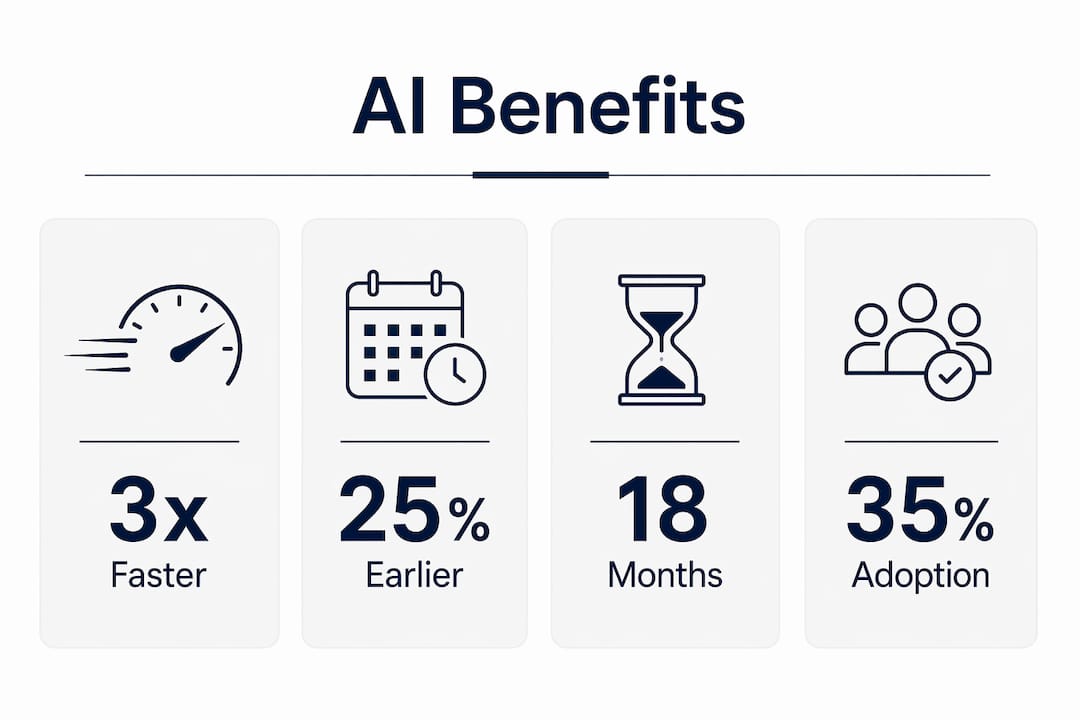
The measurable benefits of AI in life sciences project planning concentrate in three areas: faster decisions, earlier risk detection, and better use of existing resources.
Faster decisions through real-time access
AI eliminates the lag between an event occurring and a project manager learning about it. Traditional reporting cycles, often weekly or biweekly, mean that a site activation delay discovered on monday may not reach a decision-maker until friday. AI monitoring surfaces that signal the same day, compressing the response window from days to hours.
Earlier risk detection
Predictive models trained on historical trial data can identify patterns that precede common failure modes, such as patient dropout, site underperformance, or supply chain disruption. Early detection does not eliminate risk. It converts surprises into manageable problems with defined response options.
Dynamic resource reallocation
AI enables real-time insights, predictive indicators, scenario analyses, and dynamic resource reallocation. In practice, this means a project manager can model the impact of pulling a biostatistician from one trial to support another before making the move, rather than discovering the downstream consequence after the fact.
The combined effect on project timelines is significant. Haiphai clients report reclaiming up to 18 months of operational time on the path to approval. That figure reflects the cumulative impact of removing bottlenecks across regulatory drafting, clinical site activation, and cross-functional coordination, not a single efficiency gain in one area.
35% of organizations now deploy agentic AI systems capable of autonomous multi-step workflow execution, with 44% planning deployments. That adoption curve means life sciences teams that delay AI integration will face a growing capability gap relative to competitors who are already compounding efficiency gains.
Key takeaways
AI in life sciences project planning delivers the greatest value when embedded across the full development lifecycle, not deployed as a single-phase tool.
| Point | Details |
|---|---|
| AI augments judgment, not just admin | The primary benefit is faster, better-informed decisions, not just automated reports. |
| Embed AI across the full lifecycle | Connecting discovery, preclinical, and clinical data streams multiplies efficiency gains at every stage. |
| Incremental adoption builds trust | Start with AI in a verification role before granting it autonomous execution authority. |
| Label and govern AI outputs | Mark all AI-generated documents with approval status to prevent unreviewed content from entering formal workflows. |
| Skill development is non-negotiable | Prompt engineering and data literacy determine how much value a team extracts from any AI system. |
The uncomfortable truth about AI in life sciences project planning
Most life sciences organizations are still treating AI as a productivity tool rather than a planning infrastructure. That framing limits what they get from it.
I have seen teams implement AI for status reporting and declare success because they saved a few hours per week. That is a real gain. But it misses the larger opportunity entirely. The teams extracting the most value are the ones using AI to change how they make decisions, not just how they document them. They are running scenario analyses before committing to a timeline, not after a delay has already occurred.
The shift from static project plans to adaptive management is not a technology question. It is a leadership question. AI can surface a risk signal at 2 a.m. on a tuesday. What matters is whether the project manager has built a process to act on it by wednesday morning. The organizations that build those processes now will have a structural advantage that compounds over every development cycle.
My recommendation for life sciences leaders is direct: do not start with the AI tool. Start with the decision you make most often under incomplete information. Then ask whether AI can close that information gap. That question will point you to the highest-value implementation faster than any vendor demo.
— John
Haiphai's approach to AI-enabled project planning
Life sciences teams that want to move from AI experimentation to AI-enabled operations need more than software. They need a partner who starts from their specific bottlenecks and works backward to the right solution.
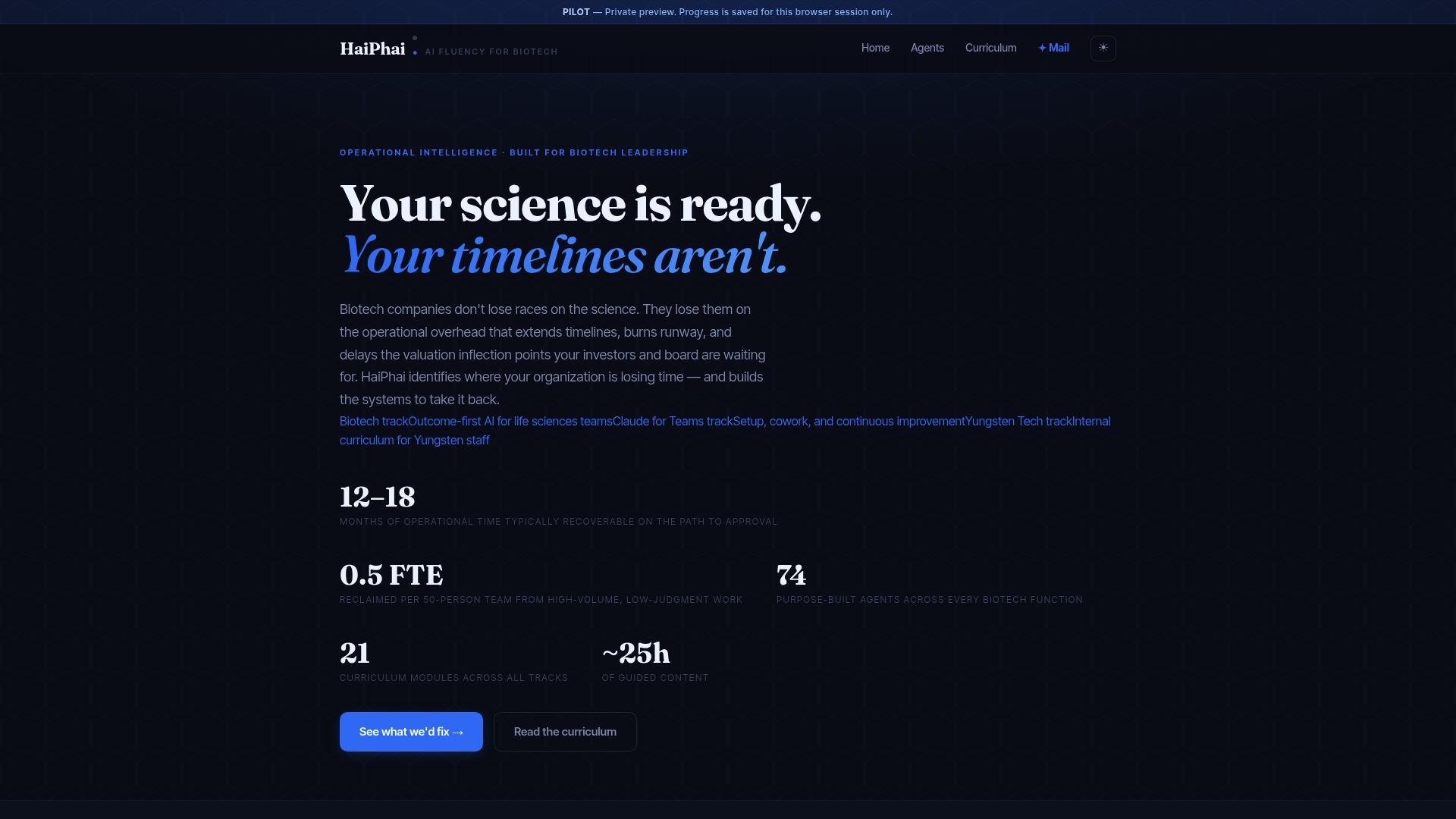
Haiphai works with biotech teams to identify where operational drag is highest, whether in regulatory drafting, clinical site activation, or cross-functional coordination, and applies AI where it produces the fastest, most measurable impact. The goal is not AI for its own sake. The goal is reclaiming the operational time that determines when you reach approval and how you are valued at your next funding round. Explore Haiphai's AI solutions to see how this approach applies to your development stage and team structure.
FAQ
What is AI's primary role in life sciences project planning?
AI's primary role is augmenting human judgment by automating routine tasks, predicting risks, and enabling real-time resource reallocation. It shifts project managers from data assembly to strategic decision-making.
How does agentic AI differ from standard AI tools in project management?
Agentic AI autonomously executes multi-step workflows, including literature review, hypothesis generation, and experimental design, under human oversight. Standard AI tools respond to individual prompts without executing connected sequences of tasks.
What skills do project managers need to use AI effectively?
Prompt engineering and data-driven decision-making are the two most critical skills. Teams that build structured prompt libraries and understand how to interpret AI outputs extract significantly more value from the same tools.
How does AI reduce time to market in life sciences?
AI reduces time to market by detecting risks earlier, accelerating evidence generation across development stages, and enabling faster decisions through real-time data access. Haiphai clients have reclaimed up to 18 months of operational time through targeted AI integration.
What governance practices are required when using AI in project planning?
All AI-generated documents should carry explicit status labels such as "Draft" or "Ready for Approval." Human review before any AI output enters a formal workflow is a governance requirement, not an optional step.