
Biotech portfolio diversification is the strategic allocation of investments across multiple clinical stages, therapeutic areas, and asset modalities to reduce the extreme volatility inherent in drug development. Unlike traditional equity investing, biotech carries a unique risk profile: a single Phase 3 trial failure can erase 60–80% of a company's value overnight. Clinical trial binary outcomes drive this volatility, making diversification not a preference but a structural necessity. Late-stage assets already account for 60% of the $16.976 billion raised in biotech funding through june 2026, signaling that investors are actively managing stage risk at scale.
What is biotech portfolio diversification and why does it matter?
Biotech portfolio diversification is defined as spreading capital across companies, clinical phases, therapeutic areas, and asset types to reduce correlated failure risk. The term "portfolio diversification" comes from modern portfolio theory, but in biotech it takes on a sharper meaning. Scientific uncertainty and information asymmetry mean that two assets can look independent on paper yet fail for the same biological reason. Domain expertise is required to identify those hidden correlations before they destroy returns.
The core purpose is risk mitigation. A portfolio concentrated in a single therapeutic area, say oncology, faces correlated failure if a shared mechanism of action proves ineffective across multiple programs. Spreading across oncology, rare disease, and metabolic disorders reduces that correlation. The goal is not to eliminate risk but to ensure that no single clinical readout can collapse the entire portfolio.

Biotech also behaves differently from other sectors in a macro downturn. Biotech diversification functions as a thematic sleeve with returns less correlated to economic growth cycles. That makes it a genuine complement to traditional equity and fixed income allocations, not just a sector bet.
What are the main diversification methods in biotech portfolios?
Biotech investors use several distinct methods to spread risk across their holdings. Each method targets a different source of volatility.
- Clinical stage diversification: Allocating across preclinical, Phase 1, Phase 2, and Phase 3 assets balances high-risk early bets against lower-risk late-stage programs. Risk roughly halves at each phase transition, so a mixed-stage portfolio smooths out the timing of binary readouts.
- Thematic allocation: Grouping investments by healthcare trend, such as aging populations, rare disease, or gene therapy, aligns the portfolio with long-term demand drivers rather than short-term market cycles.
- Biotech ETFs: Exchange-traded funds like XBI or IBB provide instant exposure to dozens of companies. They are the fastest way to diversify biotech holdings without requiring deep scientific underwriting.
- Royalty aggregation: Royalty aggregators purchase rights to future milestone payments and royalties across many assets. Ligand's $739 million acquisition of Xoma added over 120 clinical and preclinical assets, converting binary trial risk into a diversified, recurring revenue stream.
- Dual-pathway model: This structure pairs a clinical drug program with a commercial business to generate revenue from day one. The dual-pathway model creates a valuation floor and reduces dependence on dilutive financing rounds.
Pro Tip: Don't treat biotech ETFs and private thematic funds as substitutes. ETFs give you breadth and liquidity; private funds give you depth and access to pre-commercial assets. The strongest portfolios use both.
How does stage diversification reduce risk and improve portfolio stability?
Stage diversification is the most direct tool for managing clinical trial volatility. Assets in different phases respond differently to both scientific readouts and macroeconomic shifts. An early-stage asset in Phase 1 is largely insulated from near-term commercial pressures, while a Phase 3 asset faces regulatory timelines and market access risk. Holding both creates a natural hedge.
The probability math is compelling. Risk roughly halves at each phase transition, meaning a Phase 3 asset carries significantly lower clinical failure probability than a Phase 1 asset. That does not make late-stage assets safe, but it does mean a portfolio weighted toward Phase 2 and Phase 3 programs carries a lower expected loss rate than one concentrated in early discovery.
| Clinical stage | Risk profile | Portfolio role |
|---|---|---|
| Preclinical / Phase 1 | Highest failure rate, highest upside | Growth engine, small position sizes |
| Phase 2 | Moderate risk, proof-of-concept data | Core diversifier, mid-size positions |
| Phase 3 | Lower clinical risk, regulatory exposure | Stability anchor, larger positions |
| Commercial / royalty | Revenue generating, market risk | Income layer, reduces financing need |
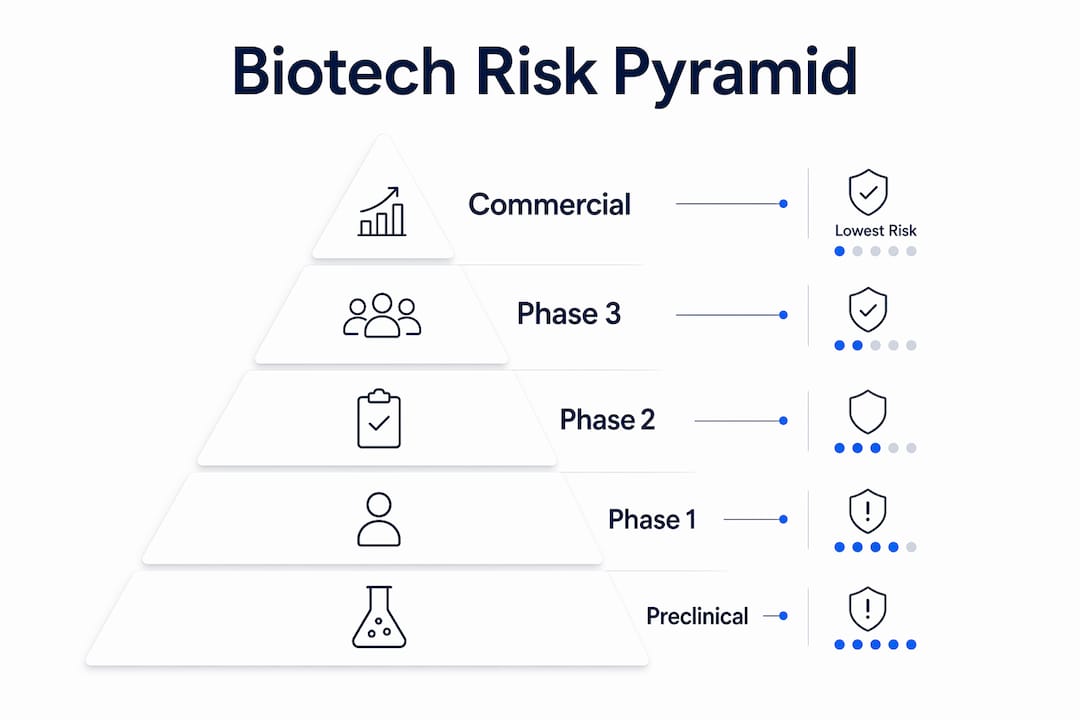
The 60% late-stage funding concentration seen in mid-2026 reflects institutional investors applying exactly this logic. They are not abandoning early-stage assets. They are sizing positions to match the risk profile at each phase.
Pro Tip: Use milestone-based tranching for early-stage positions. Commit a small initial allocation, then increase the position only after a Phase 1 safety readout confirms the asset is progressing. This preserves capital while keeping upside exposure.
What are the benefits and limitations of thematic and pipeline diversification?
Thematic diversification aligns a biotech portfolio with structural healthcare trends rather than individual trial outcomes. Rare disease, oncology, neurology, and metabolic disorders each have distinct regulatory pathways, reimbursement dynamics, and competitive landscapes. Spreading across three or four therapeutic areas reduces the chance that a single regulatory setback or competitive approval wipes out a large portion of the portfolio.
Pipeline diversification, as practiced by major pharma companies, takes this further by acquiring entire companies to add new therapeutic pillars. Vertex's $10 billion acquisition of Crinetics added endocrinology as a fifth pillar alongside its established franchises in cystic fibrosis, pain, and kidney disease. That kind of acquisition buys not just a drug but a scientific platform, a regulatory track record, and a commercial infrastructure.
The benefits of thematic and pipeline diversification include:
- Reduced concentration risk: No single therapeutic area failure can collapse the portfolio.
- Access to unmet medical need: Rare disease and orphan drug programs often face less competition and benefit from accelerated regulatory pathways like FDA Breakthrough Therapy designation.
- Revenue stability through complementary timelines: Assets in different therapeutic areas rarely face simultaneous patent cliffs or competitive launches.
- Scientific platform value: Acquiring a platform technology, such as RNA interference or gene editing, diversifies across multiple future programs, not just one.
- Commercial synergies: Overlapping commercial infrastructure across therapeutic areas reduces the per-asset cost of market access.
The limitation is that superficial diversification creates false confidence. Broad portfolios without domain expertise risk concentrating failure modes at the mechanism level. Two oncology assets targeting different tumor types may both depend on the same immune checkpoint pathway. If that pathway proves less effective than expected, both assets fail together despite appearing diversified on a therapeutic area map.
Deep scientific underwriting is the only defense. Investors must understand the biology well enough to identify shared failure modes before committing capital.
How can investors practically build a diversified biotech portfolio?
Building a diversified biotech portfolio requires deliberate allocation targets, not just a collection of interesting companies. Start with a framework that defines exposure by stage, modality, and geography before selecting individual assets.
- Set stage allocation targets: A reasonable starting framework allocates 20–30% to early-stage assets, 40–50% to Phase 2 and Phase 3 programs, and 20–30% to commercial or royalty-generating assets. Adjust based on your risk tolerance and time horizon.
- Diversify by modality: Small molecules, biologics, cell and gene therapies, and RNA-based medicines each carry different manufacturing risks, regulatory timelines, and competitive dynamics. Holding across modalities reduces the chance that a single platform-level failure affects the whole portfolio.
- Include public and private exposure: Public biotech ETFs like XBI provide liquidity and breadth. Private thematic funds and direct investments provide access to earlier-stage assets with higher return potential. AI is accelerating drug discovery timelines, making the private market more accessible and the opportunity set larger than in previous cycles.
- Rebalance every 6–12 months: The XBI index rallied 90% over one year as of july 2026. That kind of outperformance causes biotech to drift well beyond its intended portfolio weight, increasing risk without a conscious decision to do so.
- Consider royalty streams as an income layer: Royalty aggregation converts binary clinical risk into long-duration revenue. Adding a royalty position alongside clinical-stage assets smooths portfolio cash flows and reduces the pressure to sell equity positions at the wrong time.
- Use position sizing to manage binary risk: No single clinical-stage asset should represent more than 5–10% of a biotech sleeve. Larger positions are appropriate only for commercial-stage or royalty assets where revenue visibility is high.
Understanding AI augmentation in biotech is increasingly relevant here. AI tools now help investors analyze clinical data, model trial probabilities, and identify pipeline gaps faster than traditional research processes allow.
Key Takeaways
Biotech portfolio diversification requires spreading capital across clinical stages, therapeutic areas, and asset modalities, backed by deep scientific underwriting to avoid hidden correlated failures.
| Point | Details |
|---|---|
| Stage diversification anchors stability | Mixing Phase 1 through commercial assets reduces the impact of any single trial readout. |
| Thematic allocation reduces correlation | Spreading across therapeutic areas cuts the risk that one regulatory setback collapses the portfolio. |
| Royalty aggregation adds income | Royalty streams convert binary clinical risk into recurring revenue, smoothing portfolio cash flows. |
| Rebalance every 6–12 months | Sector outperformance causes drift; regular review maintains your intended risk exposure. |
| Scientific depth prevents false diversification | Superficial spread across assets with shared failure modes offers no real protection. |
Why I think most biotech investors are diversifying at the wrong level
Most investors I talk to think they are diversified because they hold ten biotech names across three therapeutic areas. They are not. They are spread across companies, not across risk factors. The real unit of diversification in biotech is the failure mode, not the ticker symbol.
The private biotech market requires standalone allocations with dedicated oversight precisely because the risks are so specific. A generalist portfolio manager cannot underwrite a Phase 2 oncology readout the same way a specialist can. That gap in expertise is where diversification breaks down.
The models I find most compelling in 2026 are royalty aggregation and the dual-pathway structure. Both acknowledge that clinical binary risk is real and irreducible. Instead of trying to predict which trials will succeed, they build structures that generate value regardless of any single outcome. That is genuine diversification. It is also harder to execute, which is why most portfolios do not use it.
The AI acceleration story matters here too. Faster drug discovery means more assets entering clinical development, which means more diversification opportunities at earlier stages. Investors who build the analytical infrastructure now, including AI-driven regulatory insights, will have a real edge in identifying which early-stage assets deserve a position before the broader market prices them in.
The uncomfortable truth is that biotech diversification is a skill, not a formula. The investors who do it well combine financial discipline with genuine scientific literacy. The ones who do it poorly just own more companies.
— John
How Haiphai supports biotech portfolio decision-making
Biotech investors managing diversified portfolios face a constant pressure: too much data, too little time to act on it. Clinical readouts, regulatory filings, and pipeline updates arrive faster than any team can manually process.
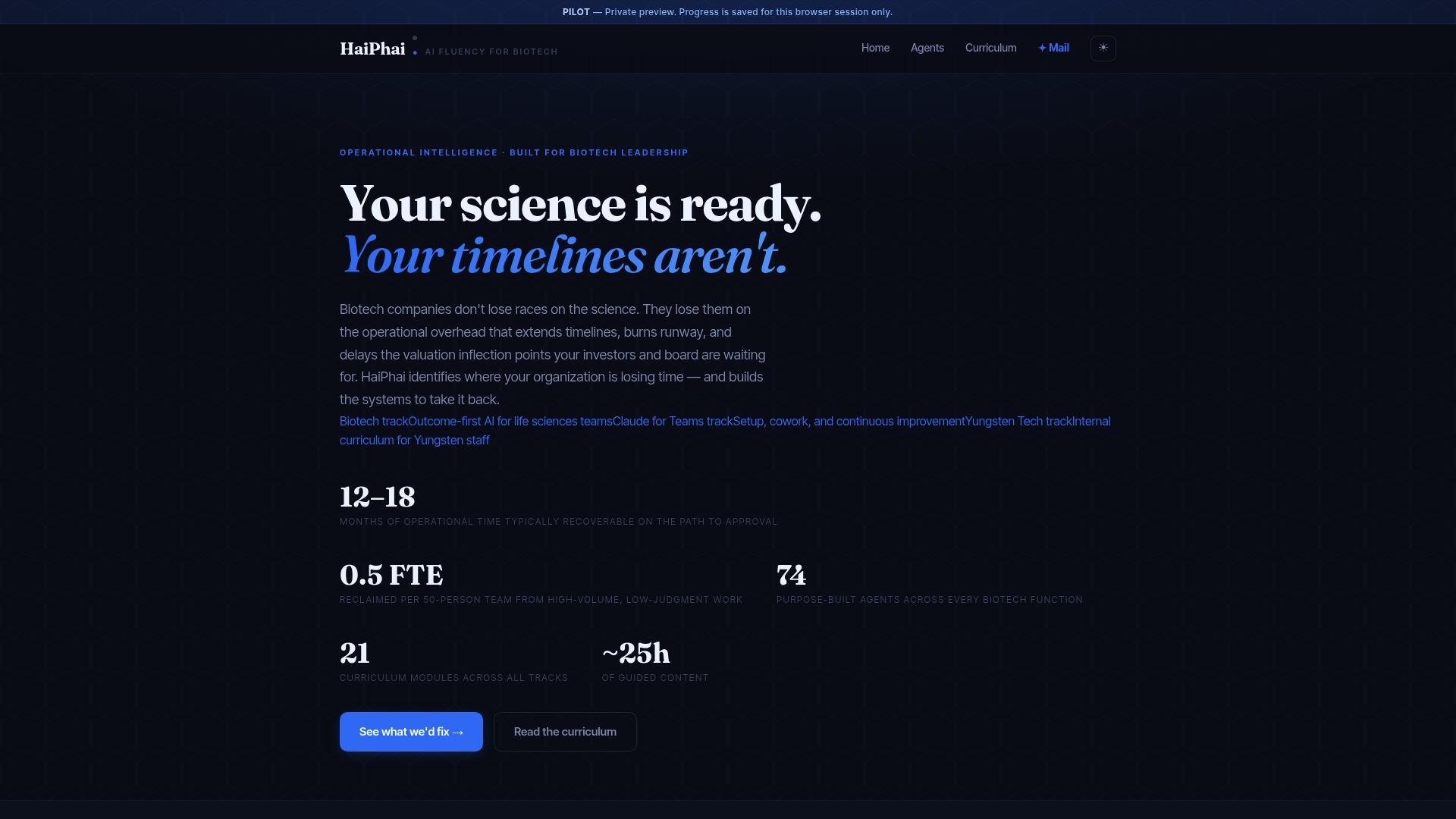
Haiphai works as an operational partner for life sciences teams, starting from your strategic goals and working backward to identify where bottlenecks slow your decisions. Its AI-driven approach covers regulatory drafting, clinical site activation, and pipeline analysis, helping teams reclaim up to 18 months of operational time on the path to approval. For investors managing complex, multi-stage portfolios, that speed translates directly into better-timed decisions and stronger valuations. Explore Haiphai's solutions to see how AI augmentation fits your portfolio management workflow.
FAQ
What is biotech portfolio diversification in simple terms?
Biotech portfolio diversification means spreading investments across multiple clinical stages, therapeutic areas, and asset types to reduce the risk that any single trial failure destroys the portfolio's value.
How is biotech diversification different from standard portfolio diversification?
Biotech diversification requires scientific expertise to identify hidden correlated failure modes. Standard diversification relies on financial metrics; biotech diversification requires understanding the biology behind each asset.
Are biotech ETFs a good diversification tool?
Biotech ETFs like XBI provide broad, liquid exposure to dozens of companies and are the fastest entry point for diversifying biotech holdings. They work best alongside private thematic funds, not as a standalone strategy.
What is a royalty aggregator and how does it reduce risk?
A royalty aggregator purchases rights to future milestone payments and royalties across many clinical assets, converting binary trial risk into a diversified revenue stream. Ligand's acquisition of Xoma added over 120 assets using exactly this model.
How often should a biotech portfolio be rebalanced?
Biotech portfolios should be reviewed every 6–12 months. Sector rallies, like the 90% XBI gain seen through mid-2026, can push biotech well beyond its intended allocation weight without active rebalancing.