
Biotech competitive differentiation is the deliberate combination of scientific innovation, clinical rigor, operational execution, and commercial strategy that makes a company's therapies stand out in a crowded therapeutic market. The industry generated $232 billion in revenue in 2025, a 13% increase, yet financing remains uneven, with record megarounds sitting alongside liquidity traps for firms that cannot articulate a clear edge. For biotech executives, understanding what drives biotech differentiation is no longer a branding exercise. It is the central factor that determines access to capital, regulatory goodwill, and commercial survival.
What is biotech competitive differentiation built on scientifically?
The scientific foundation of differentiation has shifted. AI tools for molecule design are now baseline capabilities, not unique advantages. Every well-funded team has access to generative chemistry platforms. The real edge sits upstream, in proprietary biological insights, rigorous target selection, and validated mechanisms that competitors cannot easily replicate.
Target validation is where most differentiation is won or lost. A company that identifies a novel target and builds deep mechanistic evidence around it creates a moat that takes years to cross. One that licenses a widely known target and applies a standard modality has commoditized itself before the first clinical dose.

The other scientific pillar is iterative speed. Rapid laboratory-to-data feedback cycles compress the time between a hypothesis and a decision. Firms that run tight, high-quality experimental loops generate more learning per dollar than those with slower, larger programs. That learning compounds into a scientific lead that shows up in clinical data quality later.
Key scientific differentiation factors include:
- Proprietary target biology: Mechanistic depth that goes beyond published literature
- Novel platform validation: Demonstrated efficacy across multiple indications or patient segments
- Iterative cycle speed: The ability to test, fail fast, and redirect without losing months
- Data infrastructure: Systems that capture and analyze experimental results in near real time
Pro Tip: Map your target validation evidence against what is publicly available for competing programs. If your mechanistic story reads like a literature review, investors will notice before you do.
How does clinical and regulatory strategy contribute to competitive differentiation?
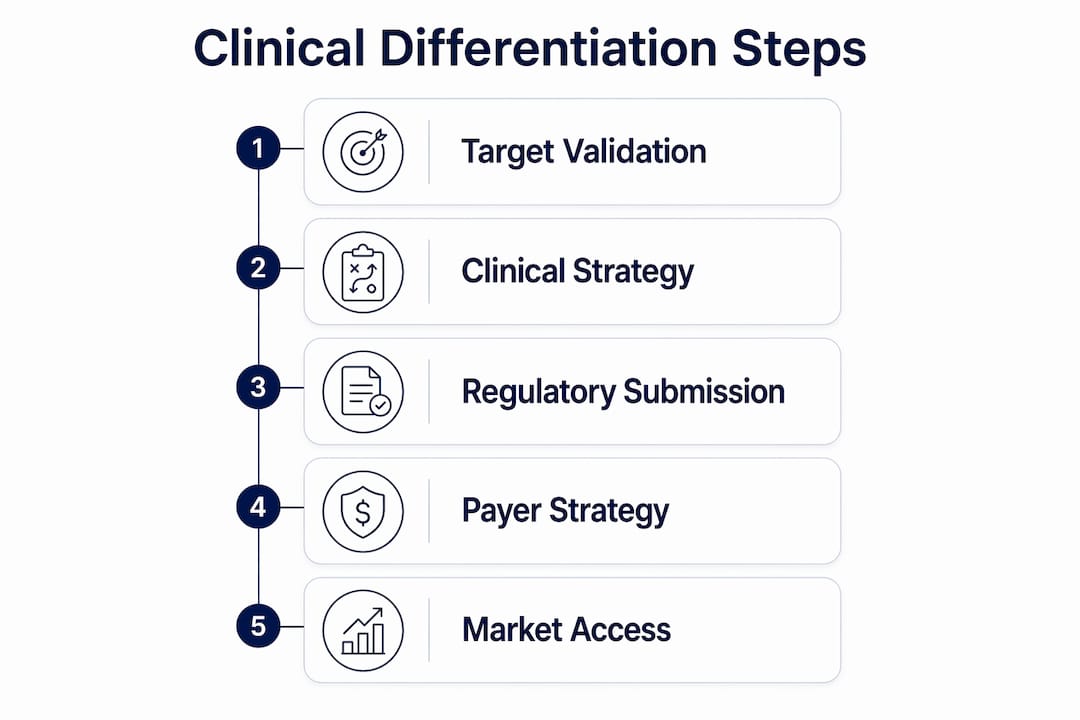
Clinical strategy is where scientific promise either converts into a defensible asset or quietly disappears. Investors in 2026 prioritize clinical maturity and clear commercial paths over early-stage platforms. That means the quality of your data, the design of your trials, and your engagement with regulators all carry direct valuation weight.
The most common and costly mistake in biotech is treating payer strategy as a post-approval problem. Firms that integrate payer-aligned endpoints from Phase 2 build a clinical package that satisfies both regulators and reimbursement bodies simultaneously. Those that do not often reach approval only to find their therapy is commercially stranded.
Regulatory frameworks are also shifting. The EU's regulatory sandbox initiatives and public-private funding reforms are creating faster approval pathways for firms that engage early and strategically. That is a differentiation opportunity most companies leave on the table.
A practical clinical differentiation framework looks like this:
- Define payer-relevant endpoints at trial design. Work with health economists before Phase 2 protocols are finalized.
- Engage regulators before submission. Pre-IND and Type B meetings shape trial design in ways that reduce review risk.
- Build a dual-track data package. Structure clinical data to serve both FDA and EMA requirements from the start.
- Align patient selection with commercial reality. Narrow populations that show strong effect sizes are more defensible than broad labels with modest signals.
Pro Tip: Ask your market access team to review your Phase 2 protocol before it locks. If they cannot identify the reimbursement story in the endpoint structure, redesign before you enroll a single patient.
Understanding AI in regulatory affairs is becoming a practical skill for teams that want to move faster through submission preparation without adding headcount.
In what ways do operational excellence and market access strategies strengthen biotech differentiation?
Speed and execution scale now rival science as pillars of differentiation. Leading biotech firms recognize that the ability to translate a scientific idea into clinical proof quickly is itself a competitive advantage. A company that runs a Phase 2 in 18 months instead of 30 months reaches the next financing milestone with more leverage and less dilution.
Market access is not a commercial function that activates at approval. It is a strategic pillar that must run in parallel with clinical development from the beginning. Reimbursement bodies in the US, EU, and major Asian markets each apply different value frameworks. A therapy priced for the US formulary system may face a completely different evidentiary standard in Germany under AMNOG or in the UK under NICE.
International markets represent roughly 35% of revenues for many biopharma companies. That share demands country-specific strategies, local manufacturing relationships, and sometimes localized trial data. Firms that treat global expansion as a single-market replication exercise consistently underperform.
| Differentiation dimension | Operational tactics | Commercial tactics |
|---|---|---|
| Speed | Accelerated lab-to-data cycles | Early payer engagement |
| Scale | Manufacturing partnerships | Multi-market launch sequencing |
| Data quality | Adaptive trial designs | Health economic modeling |
| Access | Regulatory pre-submission meetings | Formulary positioning strategy |
A smaller biotech can compete at scale by building the right operational model. The question of how a 50-person biotech competes with much larger organizations comes down to focus, speed, and eliminating the internal friction that slows execution.
Key operational moves that strengthen differentiation:
- Centralize data management so clinical and regulatory teams work from a single source of truth
- Build manufacturing relationships before you need them, not after Phase 3 reads out
- Assign a market access lead to your clinical team, not just your commercial team
- Track operational milestones with the same discipline you apply to scientific ones
How can biotech companies measure and adapt their competitive differentiation?
Differentiation is not a fixed state. Markets shift, competitors advance, and financing conditions change the rules of engagement. Firms that treat their competitive position as something to be measured and recalibrated regularly outperform those that set a strategy and hold it rigidly.
The first measurement error most biotech executives make is assuming their market is zero-sum. In high unmet need areas, multiple therapies can expand the market rather than split it. A second approved therapy in a previously underserved indication often grows total patient identification and treatment rates. Misreading an expansionary market as a winner-take-all fight leads to defensive positioning that wastes resources.
Balancing three innovation approaches is the practical framework for sustained differentiation: novel platforms that create new categories, modality commodification that captures established markets at lower cost, and extreme cost efficiency that makes a therapy viable where margins are thin. Overcommitting to any one of these creates vulnerability. The firms that persist in crowded markets blend all three deliberately.
Indicators that your differentiation needs recalibration:
- Investor questions shift from "what makes this unique?" to "how is this different from X?"
- Payer feedback on your endpoints is consistently negative in advisory boards
- Competitors reach clinical milestones faster than your internal projections assumed
- Your scientific narrative relies on platform claims rather than mechanistic evidence
The 2026 financing environment adds another layer. Dual-track IPO and M&A readiness is now a standard expectation from sophisticated investors. A company that can credibly pursue either path has more negotiating leverage than one locked into a single exit thesis. That flexibility is itself a form of competitive differentiation in the capital markets.
Key Takeaways
Biotech competitive differentiation requires simultaneous strength in scientific rigor, clinical data quality, operational speed, and integrated market access strategy to build a position that investors, regulators, and payers will support.
| Point | Details |
|---|---|
| Science alone is not enough | Proprietary target biology and iterative speed matter more than AI tool access in 2026. |
| Payer strategy starts in Phase 2 | Integrating reimbursement endpoints early prevents commercial failure after regulatory approval. |
| Operational speed is a competitive asset | Faster lab-to-data cycles and execution discipline translate directly into financing leverage. |
| Market structure shapes strategy | Not all biotech markets are zero-sum; expansionary dynamics change how you position and invest. |
| Dual-track readiness signals strength | Firms prepared for both IPO and M&A outcomes attract better terms from investors and acquirers. |
What I have learned about differentiation that most executives discover too late
The conversation I have most often with biotech leaders goes something like this: the science is solid, the team is credible, and the data looks promising. Then they get into a Series B or pre-IPO process and discover that investors are asking questions the clinical team never prepared for. Questions about reimbursement. Questions about what happens when a competitor reaches the same indication six months earlier. Questions about whether the operational plan can actually deliver the next milestone on time.
The shift I have watched over the past several years is real. Biological rigor has replaced technology hype as the currency of scientific credibility. A platform story built on AI tooling used to open doors. Now it raises eyebrows unless it is backed by deep mechanistic evidence and validated targets. Executives who built their differentiation narrative around tools rather than biology are finding that narrative does not hold up under scrutiny.
The reimbursement blind spot is the one that costs the most. I have seen genuinely excellent science fail commercially because the clinical team designed trials for regulatory approval and never asked what a payer would need to see. That is not a commercial failure. It is a strategic failure that started in the clinic years earlier.
The firms I respect most treat differentiation as a living discipline. They run competitive analyses quarterly, not annually. They bring market access into protocol design, not launch planning. They measure operational speed with the same rigor they apply to efficacy endpoints. That integration is hard to build and very hard to copy.
— John
Haiphai helps biotech teams execute on differentiation, not just define it
Defining a differentiation strategy is the easier half of the problem. Executing it, across regulatory submissions, clinical site activation, and market access alignment, is where most teams lose time they cannot recover.
Haiphai works as an operational partner for biotech teams, starting from your strategic goals and working backward to find where execution is breaking down. The focus is on processes like regulatory drafting and clinical site activation, where delays compound directly into valuation risk. Clients working with Haiphai have reclaimed up to 18 months of operational time on the path to approval. Explore Haiphai's solutions to see how that applies to your current program, or review the full service offerings for teams at different stages of development.
FAQ
What is biotech competitive differentiation?
Biotech competitive differentiation is the combination of scientific, clinical, operational, and commercial advantages that makes a company's therapies and strategy distinct from competitors. It influences how investors, regulators, payers, and prescribers evaluate and prioritize a company's assets.
Why is AI no longer a primary differentiator in biotech?
AI-enabled molecule design tools are now widely available across the industry, making them a baseline capability rather than a unique advantage. Real differentiation has shifted to proprietary biological insights, target validation depth, and the speed of laboratory-to-data feedback cycles.
When should payer strategy enter the clinical development process?
Payer strategy should enter clinical development no later than Phase 2 protocol design. Firms that build reimbursement-relevant endpoints into trials early avoid the commercial failure that comes from regulatory approval without a viable market access path.
How do biotech companies know when to recalibrate their differentiation strategy?
Clear signals include investor questions shifting toward competitive comparisons, negative payer feedback on clinical endpoints, and competitors reaching milestones faster than internal projections assumed. Quarterly competitive analysis, rather than annual reviews, catches these signals early enough to act on them.
What role does operational speed play in biotech differentiation?
Operational speed determines how quickly a company converts scientific ideas into clinical proof, which directly affects financing leverage and milestone timing. Faster lab-to-data cycles and disciplined execution reduce dilution and increase a company's negotiating position with investors and potential acquirers.